


Christopher Doyle & Wong Kar Wai


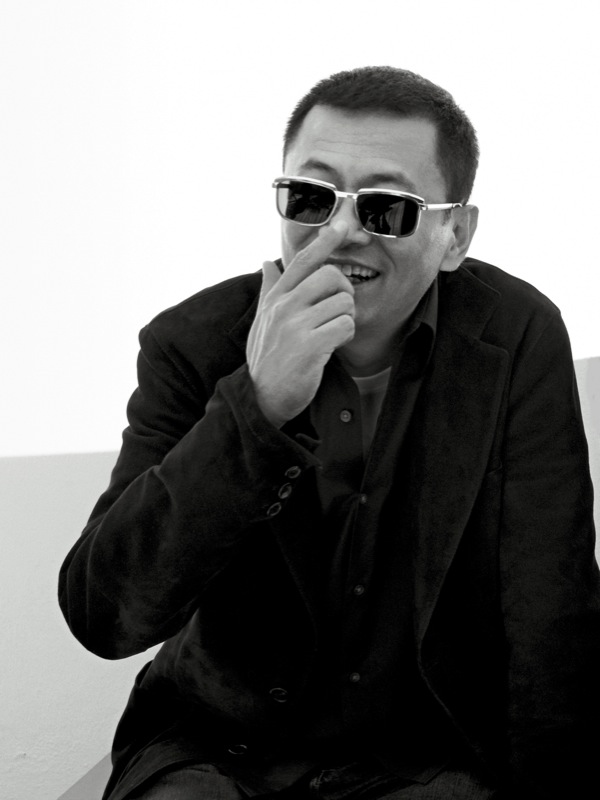
Chinese director Wong Kar Wai and Australian-born cinematographer Christopher Doyle collaborated for the first time nearly two decades ago on the Hong Kong cinema classic Days of Being Wild (1990). Since then, they have made six more features together: Ashes of Time (1992), Chungking Express (1994), Fallen Angels (1995), Happy Together (1997), In the Mood for Love (2000), and 2046 (2004)-all distinctive in form and feel.
Ashes of Time, Wong’s only martial arts movie, was shot in 1992 and first released in 1994. But Wong recently completed a reworked version of the film, titled Ashes of Time Redux, featuring new scenes and a rearranged score by Yo-Yo Ma, among other alterations. Inspired by Louis Cha’s historical-fantasy novel, The Eagle-Shooting Heroes, and set in ancient China, the film stars the late Leslie Cheung (who also played the protagonist in Days of Being Wild; Cheung committed suicide in 2003) as a broken-hearted hit man who sets out for the desert in search of swordsmen to do his bidding.
This interview was conducted over e-mail as Doyle (Du Ke Feng in Chinese) was shooting a film in Ireland with Neil Jordan, while Wong was traveling from Hong Kong to Toronto and Los Angeles to promote Ashes of Time Redux.
It’s 5 a.m. in southern Ireland, and I am shifting between this imaginary conversation and Internet porn. -DKF
DU KE FENG: What does redux literally mean? And where does the word come from?
WONG KAR WAI: The first time the word redux appeared in a film title was when Francis Ford Coppola used it for his film Apocalypse Now Redux [2001]. For Coppola the word means “reassessed” and “reconsidered.” But in our case it has nothing to do with reconsideration. It’s more about rescuing a film that means a lot to us. Our film could have been called Saving Ashes of Time. The laboratory where we stored all our negatives went bankrupt overnight following the Asian economic crisis in 1997. So on short notice we had to retrieve all the materials in the middle of the night before the debtor-receiver took over the laboratory the next morning. While checking the materials we salvaged, we noticed that some of the original negatives and sound tapes had deteriorated into pieces. We decided to rescue the film from a life of existing only on DVD or bootlegged Chinatown VHS. At first, we thought it was only a simple restoration. Not until a few years later did we realize that it was actually an odyssey. We spent the first few years searching for missing materials. It took us from Hong Kong to overseas distributors and to various Chinatowns across North America. By the time we collected all the materials, we realized that a 100-percent restoration of the original version was out of the question, so we trimmed out the parts that were beyond repair and replaced them with other options. From there we embarked on another five-year journey from restoration to redux. To revisit a dream that is more than 15 years old is complicated. Technology helps much of the time but not always. The hardest part is to restrain myself from looking at it with the experiences and changes that I went through in the years since; I just wanted to make sure [the film] was what it was supposed to be back then, when we were making it.
DKF: I couldn’t have done Rabbit-Proof Fence [2002, with Phillip Noyce] if I hadn’t learned from Ashes to listen to the rhythms of a place. I feel the organic evolution of the storytelling has as much to do with the space in which it takes place as it does the idiosyncrasies of our working style.
WKW: Unlike today, shooting in the remote desert in the western part of China was an adventure. Arranging the trips for our eight lead actors back and forth between Hong Kong and our location was in itself a nightmare.
DKF: Those were the days: Shooting one actor’s side of a conversation, then shooting the other side two months later, when the actor he or she was supposed to be talking to finally arrived.
For me, shooting an action scene is no different from shootinga love scene. What really matters is what happens before the penetration and not after.Wong Kar Wai
WKW: Do you still remember what happened on the last day of shooting?
DKF: Thankfully not.
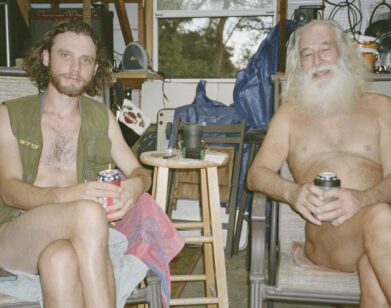
WKW: I have kept in my file a picture of your naked butt. To me, it’s like a metaphor of the way we worked then.
DKF: I could say I wanted to be naked for the whole shoot, or I could claim the heat was getting to me. But mostly I was apologizing (in my way) for not getting all the shots we had in our hearts and our heads. Or perhaps I just wanted to be as true (or do I mean “blue”) as the desert sky.
The happenstances of our shared and separate ways have meant that WKW and I are not able to sit this interview out (i.e., meet to talk). Deadlines have always been less relevant than the one this magazine gave us, so this e-mail is our recourse. As in our approach to our films, it is as much the talking as the gesture that is the content. -DKF
WKW: It is not very often that a director is offered the chance to make a big-budget martial arts epic. I jumped at this opportunity with all my knowledge about this genre, fearing that there wouldn’t be a second chance. To separate ourselves from the previous adaptations, we simply put the original novel aside and went ahead to invent our own vision. It’s more than a standard martial arts film; it’s Shakespeare meets Sergio Leone in Chinese.
DKF: Action is a bitch to shoot, as is football or any endeavor whose rules and conventions are unfamiliar (to me).
WKW: For me, shooting an action scene is no different from shooting a love scene. What really matters is what happens before the penetration and not after.
DKF: We tried to give each episode its particular look. This effort seems to me more evident in Ashes of Time Redux. Is it the music? Or the reworking of the structure? Or have perhaps other martial arts-based films educated our eye?
WKW: You mean Kung Fu Panda put us on the map?
DKF: Well, they say the Minister of Film (or whatever he or she is called) apologized to the Chinese people for not having made Kung Fu Panda themselves. Maybe in the States we should change the name [of our film] to Ashes of Panda.
Monday afternoon at a café in the Toronto airport, watching Roger Federer beat Andy Murray at the U.S. Open. -WKW
WKW: Dear DKF, normally you dance to my music, and now I have to match your steps. Not easy, but let’s figure out the dance floor first: How long ago did we finish Ashes of Time? Fifteen years ago, or four months ago, or at some point in between?
DKF: Fifteen years ago? [The film] certainly is taking its time finding its time, and yet it feels immediate enough to be the new film it has become. Even now there are moments and images I can’t stop rethinking and reworking. Perhaps that is what one does in the films that follow.
On Leslie Cheung. -WKW & DKF
WKW: Another picture that I have kept in my file is of Leslie, taken by you, with a note. May I quote what you wrote then? “Leslie hates me when I say my habitual ‘anytime’ if I’m not completely ready to shoot. He thinks I’m more up and down, emotionally, than he is. But I’m not so sure. We’ve made four films together now, and we intend to make many more. I’ve come to know the fine details of his moods and needs and how much he gets into his role.” The night Leslie died we were shooting Eros [2004] with Gong Li and Chang Chen. When the news reached our office, we thought it was an April Fools’ Day joke. Soon we realized it was true and we had lost him.
DKF: We have not lost Leslie, but I didn’t know that I could miss him so till I missed him so. We aren’t immortal in or through our art-we live in the ways of those we touch to love. Leslie is where he needs to be.