


IDOL
Jeff Probst Tells Mike White What 50 Seasons of Survivor Does to a Man


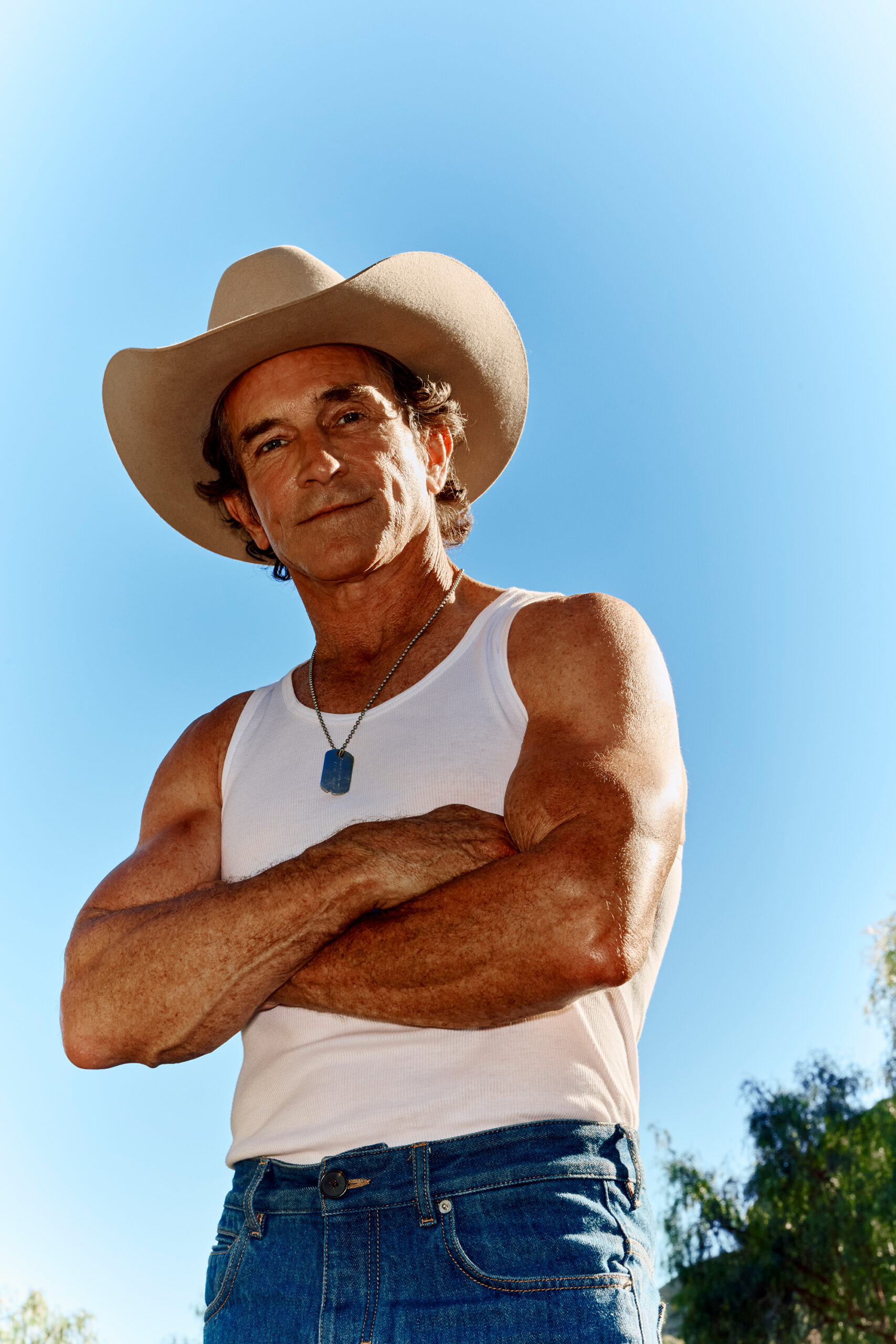
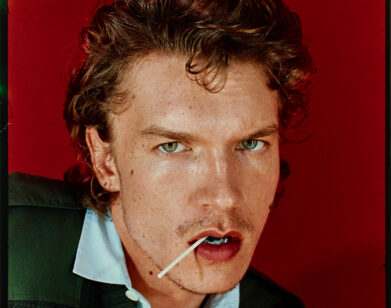
Tank Top Calvin Klein. Jeans Givenchy by Sarah Burton. Hat Stetson.
As the host of Survivor, Jeff Probst has made a career out of watching people betray each other in the jungle, turning a reality show into an American institution and himself into a khaki-clad folk hero. He’s the showrunner now, which means the guy delivering the catchphrase “the tribe has spoken” is also the chief architect of Survivor’s deeper mythology and emotional stakes, something the 64-year-old takes very seriously. To him, it isn’t just a game; it’s an experiment in human transformation. As the show approaches its landmark 50th season, The White Lotus creator and two-time contestant Mike White gets him talking about hero’s journeys, spiritual deaths, and what 50 seasons does to a man.
———
THURSDAY 9:30 AM NOV. 6, 2025 LA
JEFF PROBST: Dude, thank you for doing this. It’s a massive favor to interrupt your schedule.
MIKE WHITE: Oh please, shut up. First, I want to say congratulations on season 50. Such a milestone for you and the culture.
PROBST: Mike, you were the first one to reach out and I couldn’t believe it when you said you’d be a part of it.
WHITE: Very few things are a constant in the culture, and you’re one of them. You said you would not want to play Survivor—you don’t think you’d do well at it. But you’re a survivor of the most gnarly game, which is this business. This is just a random question. Do you feel like you’ve taken things as an observer of the game and used them for decisions you’re making in your professional life? Does the game bleed into your reality?
PROBST: I think so. I can’t give you an example, but I’ve always thought of Survivor as a living sociology experiment. You bring in a new group of people, you remove comfort and control, and you observe what happens. The goal for me is always the same. I’m trying to better understand who we are and why we behave the way we do. When you get 25 years of watching that, it can’t help but influence you in ways that aren’t necessarily something you can pinpoint. One of the things that really struck me is that over the course of being a witness to the journeys of other people over 25 years, I was quietly shaping my own. It’s matured me in so many ways that I can’t separate Survivor from my own life anymore.

Shirt ERL. Pants Hermes. Glasses Tom Ford. Belt Stylist’s Own.
WHITE: I think that’s borne out in your presence on the show, but also as I know you in life. The tone of the show has changed, and part of it is your tone has changed. At the beginning you were more of a hardass, and you became nicer over the years. Is that just Jeff coming through, or does it reflect a change in the culture?
PROBST: I love this question because I was hired first as the host, and Mark [Burnett, the creator] gave me a big voice. But he had a point of view. He wanted me to hold the contestants accountable in a slightly more aggressive way than I was comfortable with. There were many seasons where I behaved in a way that wasn’t fully true to my personality. Then when Mark asked me to be the showrunner, it was my opportunity to take the show where I always wanted to. There were three big things. I wanted it to be even more cinematic, so the first call I made was to our DP, Scott Duncan. What cameras and lenses are we going to use? The second was I wanted it to be a family show. That doesn’t mean soft, but I wanted parents to be able to talk to their kids about complicated situations. And the last was I wanted to inject Joseph Campbell fully into the adventure. From the very beginning, I saw this as his Hero’s Journey, but not everybody else did. Now if you talk to our team, they know that I see this as a game that’s designed to lure you in so you can have an adventure. To answer your question, the guy you see hosting the show today, that’s me. I’m fully happy to be the butt of the joke, and if you press me, I’ll press back. You never take credit for this, but I called you during COVID to talk about the future of Survivor and you gave me some simple advice. You said, “Just make sure it’s fun.” That has never left me.
WHITE: I always thought of it not as a hero’s journey—although maybe it is for the winner—but more of a pagan playground, with all these different archetypes battling it out on a stage. It’s like a fight to the death between the different kinds of people you meet in life, using their skill sets to take each other down. That’s a more acid reading of the show. One thing I’ve noticed about you is that you’re actually very sensitive to the players. You want them to have this good experience, and yet the show is designed to be a heartbreaker. There’s some deep disappointment built into it. So I wonder, are you setting yourself up for frustration when it comes to the experiences of these players? I’ve seen you being really hurt when a player goes on Twitter and says they weren’t happy with their edit or with what happened on the island.
PROBST: Yes.
WHITE: You talk about a very, earnest, positive hero’s journey, but really it’s a lot of carnage and blood on the ground.
PROBST: I’m going to push back hard on this. You said it’s the Hero’s Journey for the one who wins. I completely disagree. It is the Hero’s Journey for anybody who gets up off their couch and leaves the comfort of their living room to take it on.
WHITE: Let me put some spin on it. The people who showed up on 50, I can tell you they were stoked they got invited. But if you’re on the threads, there’s so many negative feelings they come away with, and it’s not because of how they’re treated, it’s because that’s the nature of the game. It’s gnarly. What’s interesting to me is you’re so not cynical.
PROBST: I understand what you’re saying.
WHITE: It’s a beautiful thing, but it’s an idealistic hope for these people. You’re setting yourself up for disappointment or frustration because 80 percent of them are going to walk away feeling like there’s an arrow in their heart.
PROBST: Expectations are at the heart of what you’re talking about. We all have them when we embark on anything, and if you’re a Survivor player, you see one ending and that is winning the season. Anything short of that is going to be disappointing, and you’re going to look for something to blame. You’re going to look at the way you were edited, and you’re going to say, “That’s not really who I am.” And you’re right, it happens with most players every season. And sometimes my heart hurts because I wish they could see what I see. Maybe in that way I am too soft, but that’s just not how I see the world. I see the world as, “You are the people that showed up. You’re the people that lived without anything in the jungle and tried to figure out how to play this complicated game of social politics.” But Mike, when I lose the heart I have for the show, somebody should put an arrow in my chest and retire me because I don’t want to host a show that’s about negativity.
WHITE: As somebody who also runs their own show, when it comes to negativity or criticism, do you have to protect yourself from that because you’re afraid it will suck you into the mud?
PROBST: No.

Jacket, Shirt, and Pants Givenchy by Sarah Burton. Tank Top Calvin Klein.
WHITE: How much are you in combat with criticism?
PROBST: This makes me think about when you texted me during the third season [of The White Lotus] and said, “Now I know what you deal with. I have enough seasons that people are starting to compare them.” Once you have that, one season has to be the favorite and one has to be the least favorite. But here’s how I approach Survivor creatively. I have a point of view and lots of ideas that fit inside that point of view. What protects me from criticism is realizing that it’s not right or wrong, it’s just somebody else’s point of view. I happened to like your third season as much as I liked any of them. I loved the slow reveal of character, and you kept me guessing. For me, it all paid off.
WHITE: I 100 percent believe you at your word. It’s so enviable to have that kind of attitude. It’s definitely a key to your success. When you were little, what did you want to be?
PROBST: When I was eight, I wanted to be a baseball player. I grew up in Wichita, Kansas, so sports was all there was. But in high school, I made a short movie and never looked back. The idea that you could film an image and then edit it to create a certain emotion is what I always wanted to do. What’s weird is right when Survivor came out, I had written a script for a movie and I got a million dollars to make it. We got Ryan Reynolds and James Earl Jones and Robert Forster and Matthew Lillard. I thought I was going to be a writer-director who acted in his own movies because I always wanted to be behind the camera to create the story, and in front of it to execute. I never saw Survivor coming.
WHITE: I see it, but I don’t think people think of Survivor as a vessel for Jeff Probst’s self-expression. [Laughs] But in a lot of ways it is. It’s cool that you’re expressing yourself through the show, but then are you also vulnerable in that way?
PROBST: Absolutely. It hurts when people tell me they don’t like the ideas I brought to it, or they think I’m a terrible host, or that I’m too old and should retire. Because as corny as it sounds, other than my family and friends, this is all I care about. It’s all I think about. I put every single idea I have into the show. I’ll give you a really specific example. I was thinking of something, and I wrote down “loyal to the suffering,” and I thought, that’s an idea I want to explore more on Survivor. Why are we so loyal to our suffering? Why do people hold onto stories that don’t serve them? The reason I know that can fit into Survivor is that it breaks you down. It asks the question, when stripped of everything, who are you? And sometimes what you find out is that you’re chained by ideas that are holding you back and it takes this adventure, being alone in the middle of the night where you don’t trust anybody and you’ve just been betrayed, to realize this isn’t the life I want anymore. If that happens for one person in one season, wow, that’s a massive moment. So I’m willing to put myself out there and take any criticism that comes because I believe in what we’re doing.
WHITE: Right.

Jacket, Shirt, and Pins (worn on tie) Versace.
PROBST: Think of it this way, Mike. What I wear on Survivor is so easily mockable that it’s a Halloween costume for kids. The blue shirt, the hat, the choker, and the shorts. I love it. I understand it’s a shortcut. It instantly reminds people what world they’re stepping into and what my role is inside it. The key is you have to have a sense of humor about it. You can’t take your own mythology too seriously or you’re done. For some people, I’m the goofball in the blue shirt and the baseball cap. For me, I’m living my own adventure on a stage that allows us to tell these grand, cinematic stories for families about what’s possible if you just say yes.
WHITE: Do you ever feel frustrated by the form? Or like you’re not able to explore everything that you want as an artist? Have there been moments where you’ve been like, I need to do something else?
PROBST: Yes. Over the years I’ve had my own challenges with feeling that people would think this is all I can do. But time has helped me understand myself better in that I don’t have anything to prove to anybody.
WHITE: I can relate.
PROBST: Mike, this is kind of a weird thing to say, but the ultimate version of Survivor is The White Lotus. There’s only one big difference between the two of us in terms of storytelling. You create the situation, the characters, their backstory and behavior. In Survivor we create the environment, the situation, the turning points. The only thing we don’t do is tell them how to behave. Maybe that’s part of the reason I’m so galvanized by your show. You have this ability to take all these different people from different walks of life and somehow write their truth. We have an homage to you. God, I don’t know if it’s aired yet, but we took a shot right from White Lotus and put it in an episode. That’s how much we watch your show.
WHITE: I’ve stolen quite a bit from Survivor, so you can steal whatever you want from me. One question I had about observing you— because I’m one of the lucky people who’ve actually been at these Tribal Councils—is when you’re leading that Tribal, I see somebody who is in total flow. Do you get some kind of high from that?
PROBST: It’s awesome.
WHITE: What’s that feeling?
PROBST: That is something no one has ever picked up on. It’s like live improv. Part of the reason I’m able to do it is that from day one, Mark never asked me to wear an earpiece, and now that I’m the showrunner, I really don’t have anybody in my ear. I follow my gut. That state of flow is the most invigorating part of Survivor, and I can’t believe I get paid to experience it. There is no second take. We’re not going to come back tomorrow and redo it. Whatever’s happening right now is happening, and we either find it compelling or we don’t.
WHITE: I wonder where you get your energy. Is it natural or do you have to work for it? Give me hope here. I’m flagging and I’m on season four, so like, season 50? Holy shit.
PROBST: I think you’re being a little over the top, but I get your point.
WHITE: No I’m not, Jeff. I can own it.
PROBST: The thing about hosting a Tribal Council or a challenge is it does require a lot of energy. It’s not something anybody would know unless they’re a performer and they’ve done it. But yeah, you’re tired at the end of the day.
WHITE: Plus you’re a manager of all these people. I mean, you’re the host and you’re also the one walking around showing us how to do the challenge.
PROBST: I’m a control freak.
WHITE: That’s what I find a little extraterrestrial. Like, what is going on?
PROBST: This goes back to the corny part of me, which is, I want this experience to be everything you want it to be. I don’t want anybody else to walk you through the challenge. I want to walk you through the challenge. I want you to hear me say you can do it. And when you hit a balance beam, remember, attack it. Don’t be tentative or you’re fucked.

Jacket, Shirt, Pants, Tie, Belt, Pins (worn on tie) and Shoes Versace.
WHITE: There’s a lot of things I want to do, Jeff, but I’m too tired.
PROBST: [Laughs]
WHITE: Do you ever have a bad day where you’re just like, “Fuck this?”
PROBST: Of course there are days where I wake up and I’m burnt, but I’ve been as honest with you as I’ve ever been in an interview. I have a desire to be of service. It’s incredibly important to me at this point in my life. And when I’m on Survivor, what I’m thinking about is we spent a year trying to find this group of people. We spent about the same amount of time trying to design this silly little game. It may not look like much, but we spend a lot of time trying to find these dilemmas that are going to force you to make a decision, and in that decision, your behavior will be revealed. We will learn something about you and you will learn something about yourself. So if I’m a little tired in the morning, I do say, “Dude, get it together, because they’re out there living in that fucking jungle and you owe it to them to give 100 percent.” And that’s real.
WHITE: Awesome. Just one more question: How much do you think about legacy?
PROBST: I do think about it. I don’t really enjoy talking about it, but I know what I hope. Outside of being a husband or a parent or a friend, I hope there’s somebody that gets what we’re trying to do. Survivor is so much more than a game. I think it’s the greatest TV format in terms of unscripted shows that will ever be created, because it allows you to explore any question you want inside this tiny little framework of strangers relying on each other while conspiring against each other. It brings out so much of humanity, and that’s what I’m endeavoring to do. If you’re willing to say yes, you will leave your ordinary world, you’ll encounter obstacles, and you’ll probably die a spiritual death. Something about your belief system will be reborn and you’ll return home a different person. I believe that. I’m living off it.
WHITE: Awesome.
PROBST: Dude, I can’t thank you enough. Honestly, when Lori said Interview magazine, and they were going to ask Mike White, my first thought was, “Oh man, I don’t want to ask Mike to do anything.” And then selfishly, I thought there’s not a single person, not anyone on this planet, not an Oprah, not a whoever the fuck, it’s gotta be you. Because you get me as a friend and I respect you so much as a storyteller that any question you were going to ask me I knew was going to somehow move me or provoke me or make me think. And it has. I’m fucking pumped right now, and exhausted.
WHITE: Well, I would say one last thing to you, which is that Survivor has been such a fixture in the culture that people take it for granted. Especially as someone who’s seen what you guys do up close. Whether it’s the storytelling or the production, it’s just so A+. And you are clearly the driving force. Of course you have an amazing team as well, but if you ever have a thought that you’ve been taken for granted and nobody sees you, I think you’ll see the flowers will continue. You have a legacy that is enviable to almost anyone who wants to tell stories.
PROBST: Mike, that’s the nicest compliment I’ve ever gotten. Thank you.
WHITE: You’re a guiding star, so thank you.
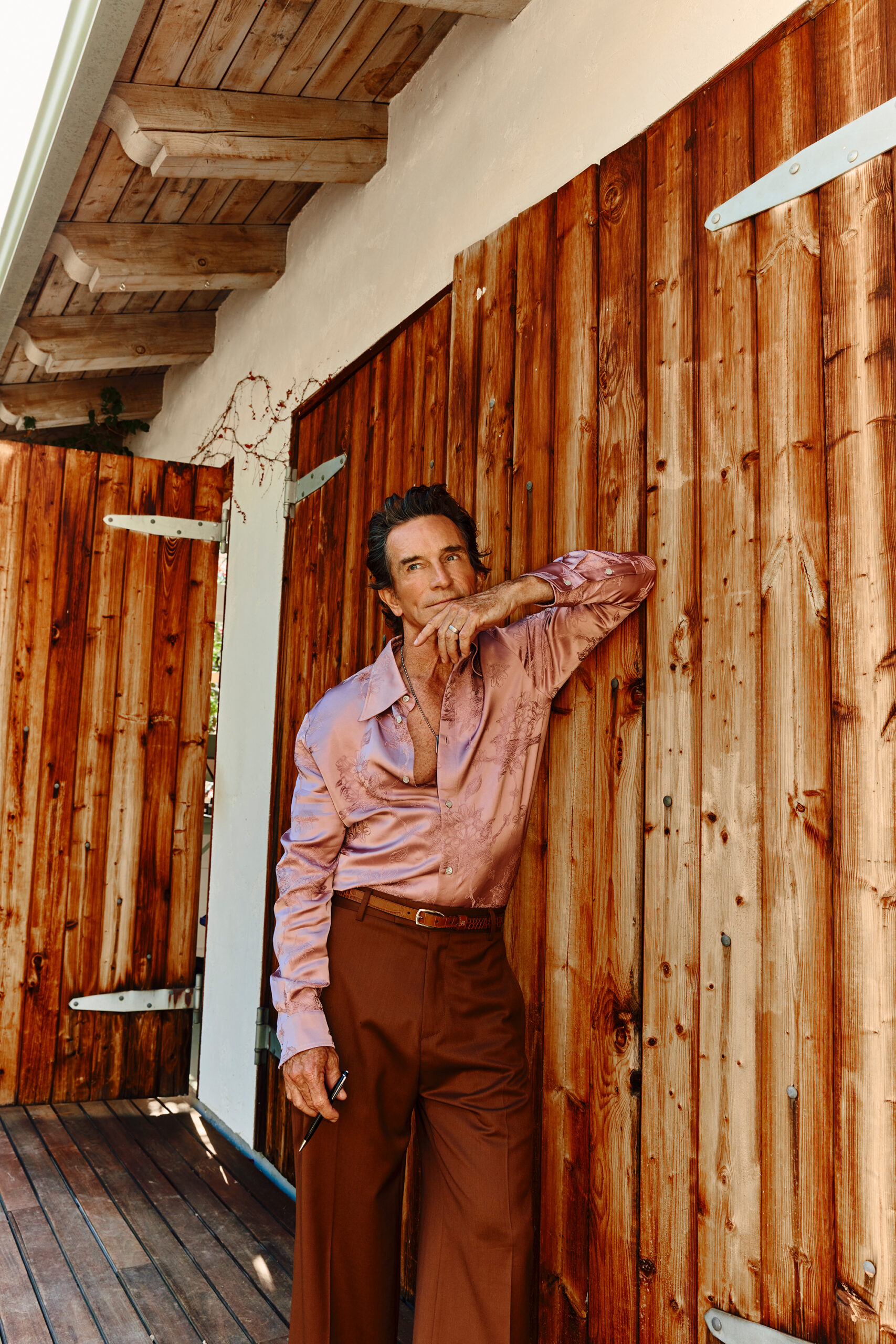
Shirt, Pants, and Belt Amiri. Pen Montblanc.
———
Grooming: Kristen Shaw using St. Meto at The Wall Group
Photography Assistant: Jorge Solórzano
Fashion Assistant: Sophia Ozan
Production Director: Alexandra Weiss
Photography Producer: Georgia Ford
On-set Production: Cecilia Alvarez Blackwell
Production Assistant: Ernie Torres
Location: Topanga Creative Acres