



ACTORS
John Slattery and Richard E. Grant on Ego, Jealousy, and Playing the Cuck



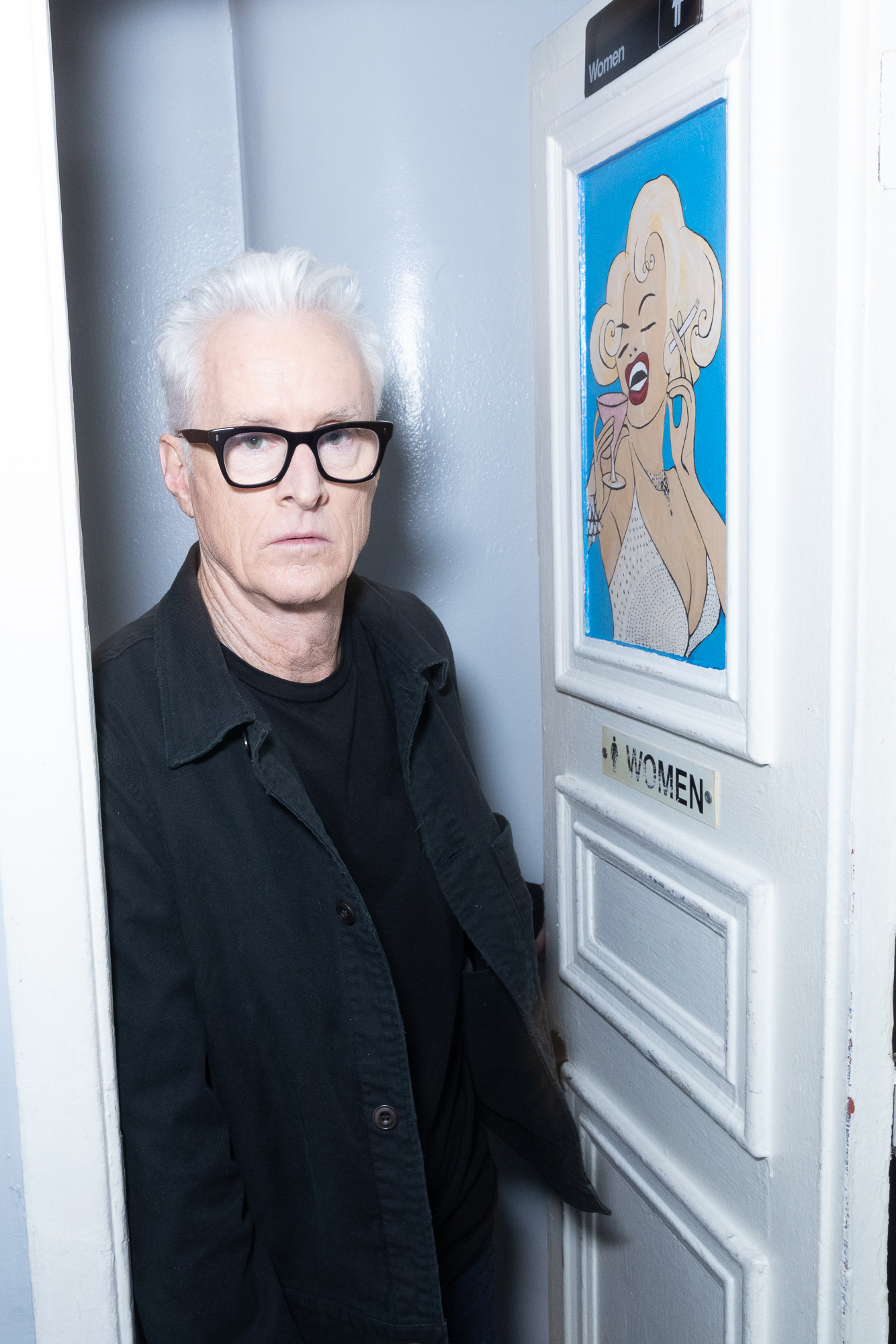
John Slattery, photographed by Myles Pettengill.
When John Slattery first read Vladimir, the novel by Julia May Jonas, he felt an unusual conviction that he was perfect for the role of John in the book’s TV adaptation—and it wasn’t just about the name. “The sense of humor, the knowledge that he’s passed his prime, the self-deprecation,” he told his friend and Nuremberg co-star Richard E. Grant on a Zoom last week. “I don’t know, I just got it.” The eight-part series, starring Rachel Weisz, follows she and Slattery’s John as they navigate the fluctuating bounds of their open marriage, which is complicated furthermore by Weisz’s character’s infatuation with the titular Vladimir, played by Leo Woodall. It’s not exactly a far cry from Slattery’s most iconic role—Roger Sterling in Mad Men—but it took on added resonance as the four-time Emmy nominee grapples himself with the nuances of middle-age. “My motor isn’t the same as it was, not only physically, but as far as love and sex and libido and all that stuff,” he said. “I’m a different person than I was when I was 30.” In conversation, he talked to Grant about it all, from the films that shaped him as a kid to the lessons he’s learned over three decades in Hollywood.
———
JOHN SLATTERY: Richy baby.
RICHARD E. GRANT: How are you Johnny?
SLATTERY: I can’t thank you enough for doing this.
GRANT: You owe me big time.
SLATTERY: I do.
GRANT: You’re just going to have to prostrate yourself.
SLATTERY: Anything you need, I’ll do it.
GRANT: [Laughs] What I love about Interview Magazine, which I have followed since I was a student at college in 1976, is that back then they would say, “John Slattery sitting in his penthouse apartment, Richard E. Grant is sitting in his cellar in Vladivostok. The time is 18:00 PM in London. The time is 13:00 PM in New York City. He was wearing a t-shirt, the other guy was wearing a vest and a button-up shirt. Both are wearing glasses. Both are over 60.” Is that alright?
SLATTERY: It’s very good.
GRANT: When and how did we first meet, Mr. Slattery?
SLATTERY: Well, I thought it was when we did Nuremberg together. My memory is sketchy, but we’d all been talking about you before you got there because you are the legend of you. And I said, “Nice to meet you.” And then you corrected me and said, “We met backstage at a play,” and I’m not sure what play it was.
GRANT: The Front Page.
SLATTERY: Yes, you claimed it was The Front Page.
GRANT: It was The Front Page, I don’t “claim.” [Laughs] I had worked with the lead actor, Nathan Lane, and when I was waiting to see him you walked past me and said “hey.” Which you have no memory of, because you’re fucked in the head.
SLATTERY: Well, I am fucked in the head, but I’m such a fan of yours–
GRANT: You told me that.
SLATTERY: At least I had the good grace to say that.
GRANT: So you’re one of six siblings, right?
SLATTERY: Correct.
GRANT: How did that prepare you for being an actor?
SLATTERY: I don’t know if it did. I think the thing that prepped me for being an actor, was that, for some reason, I was just obsessed with movies and television. I have four older sisters and a younger brother and it was a sort of sports-minded, Irish-Catholic upbringing. But my mother loved movies. I would walk into the living room ready to go out, I’d have my coat on, and my mother would say, “Come here, you should see this.” It was Cary Grant or something. And I’d say, “I have to go, they’re waiting for me.” And she’d say, “Just give it five minutes.” And then an hour-and-a-half later, I’d be sitting next to her on the couch with my coat still on. She got me hooked. And then from there, I would smoke pot and stay up until four in the morning on school nights in front of the television with a clicker. I would get a piece of Jack Klugman in The Odd Couple, switch to Derek Jacobi in I, Claudius, and then to Rosalind Russell in His Girl Friday. I just couldn’t get enough of it.
GRANT: And why did you not pursue sports?
SLATTERY: I played everything, but I was too skinny and not good enough. My father played hockey at Brown University, and he played for the Olympic team in 1952. And my uncle, who lived across the street from my mother, played in the Olympics and won a silver medal in 1952. Everybody in my family was a good athlete, but I was just never good enough to go past high school, really.

GRANT: Do you think that that competitiveness was a good setup for becoming an actor?
SLATTERY: Funnily enough, I think I was okay at sports because I didn’t care if I won or lost. I remember a friend of mine hit me over the head with a tennis racket after I called the ball out that was in and I won. That was the only way I could win—I cheated. And he was so angry that he smashed his racket over the top of my head.
GRANT: Have you ever felt you wanted to smash the head of an actor who got a part that you really wanted?
SLATTERY: I never felt that way about an actor. I’d probably get angry at myself for having fucked it up, ’cause I wasn’t a very good auditioner. But then I found drugs, which I’d take before auditions. That changed my life.
GRANT: So who did you sleep with to get your role in Vladimir?
SLATTERY: [Laughs] I slept with Leo Woodall.
GRANT: Of course you did. So did I. [Laughs]
SLATTERY: If you’re going to sleep with anybody at this point, you should sleep with him.
GRANT: We both worked with him on Nuremberg, it should be added.
SLATTERY: Yes, we did, and he’s lovely. Jokes aside, I actually read the book or somebody told me to read the book, which I did. It is terrific. And then I think I texted Sharon Horgan and said, “I think I’m a good fit for this,” which I don’t do often. And she said, “You are, and we’ve been talking about you…” I don’t even think Rachel [Weisz] had signed on.
GRANT: You said you thought that you were a good fit for this Vladimir character. Describe what you mean by that.
SLATTERY: The sense of humor, the knowledge that he’s passed his prime, the self-deprecation and taking the piss out of himself just as much as everybody else. I don’t know, I just got it.
GRANT: How many times has that happened to you, where you’ve thought a role fits like a glove?
SLATTERY: The first time I remember it happening was an Eric Overmyer play called Mi Vida Loca. When I read that play I said, “I have to do this.” And I ended up getting the job. The Neil Simon play, Laughter on the 23rd Floor, I just knew that I could play the part. At first, they wouldn’t see me, and I had to shoehorn my way in. And then after about four meetings, I got the job.
GRANT: I’ve had this sense about actors where, on the one hand, you have to have a large ego to say, “Give me the job over that other guy.” But inside you kind of go, “Everybody else know what they’re doing and I haven’t a fucking clue.” On Vladimir, did you feel that terror less because you knew who this character was?
SLATTERY: Well, when I met Rachel In the makeup trailer–
GRANT: As in Weisz.
SLATTERY: Yes, of course, the fantastic Rachel Weisz. I said, “We were supposed to be married 30 years, and it’s an open marriage.” Her character had some longer term relationships, and I’ve been excommunicated for having relations with students when it was covert, I suppose, but above board. It was all consensual, and I’ve been MeToo’ed out the door because times have changed and it’s not on. So I thought, “Well, what does that all do to a marriage? What is the scar tissue?” And she said, “I don’t want to talk about any of that. I don’t see it that way. Whatever you want to do is great, but I see it as a love story.” She said, “I think I’m just madly in love with you.” And I thought, “Oh, okay.” And that’s her process. But I thought, “What a smart way to look at it, because the warts of the relationship are in the script.”
GRANT: Yeah.
SLATTERY: So if you sort of line it with a bedrock of this love story, it’s a smarter way. Because I saw it more as sort of a George and Martha [Who’s Afraid of] Virginia Woolf kind of vibe, where they were at each other. And she saw it a different way.
GRANT: What a wonderful moment. She comes back and says, “No, I’m totally in love with you and your character,” I would love to hear that.
SLATTERY: I mean, coming from Rachel Weisz, I was just immediately in love with her too. I fell down the steps of the makeup trailer and was in love with her for the rest of the time we shot the thing.
GRANT: [Laughs] And what is Leo Woodall doing in this? Is it a triangle of a story?
SLATTERY: It is. And he’s the title character.
GRANT: And you become a throuple?
SLATTERY: [Laughs] Well, there are no throuple scenes. I don’t think Leo and I would’ve been able to get through that. But yeah, she becomes obsessed with this fellow, understandably. And that’s the sort of crux of the show—the nature of obsession. And I’m happy for her, but jealous at the same time. It’s an open marriage. I’m stepping out all the time and she’d say, “Where are you going?” And I’d go, “I’m off to see a friend.” That’s happening on my end, so I can’t call foul on her part. But there are hurt feelings. I don’t know any people in an open marriage, but I know that it would be difficult. And that’s what happens in this.
GRANT: And this plays out over how many episodes?
SLATTERY: Eight episodes.
GRANT: Speaking of marriage—in Mad Men, you were married to Mona, who is played by your real- life wife, Talia Balsam.
SLATTERY: Yeah.
GRANT: How is that, navigating real-life marriage and on-screen marriage?
SLATTERY: The first scene we had together was just after a scene in which I had a heart attack after I was literally riding a girl, she was on all fours, and I was singing, “I got Spurs that jingle, jangle jingle,” as I sort of rode her into the office and—
GRANT: I remember it. [Laughs]
SLATTERY: And I had a heart attack in the middle of this. Jon Hamm as Don Draper took me to the hospital and I kept saying the girl’s name and he kept slapping me in the face and saying, “Your wife’s name is Mona,” reminding me that when I get to the hospital, it’s going to be Mona and not one of these women. So the first scene Talia and I did together was Mona coming into my hotel room and me breaking down with the knowledge that I was near death. So as soon as she walked in the door, I completely fell apart. And I don’t know whether that would’ve felt true if it was somebody I didn’t know. So yeah, the history was there. It was fantastic working with Talia.
GRANT: That’s amazing, because before I got married to my late wife, who was an accent and voice coach, I lived with a female actor and I found that it was a compromise in that good news for one person was inevitably bad news for the other. Because if one person got a great role and the other one didn’t, how do you navigate that? Have you dealt with that in your marriage in real life?
SLATTERY: On Mad Men, the character I played moved on, decided he wanted to marry Don Draper’s secretary. So he decides to divorce Mona and marry this girl. We shot in L.A., but we lived in New York, so we would go back and forth all the time and they would only send us one physical script because they knew we would just share it. I was reading it in bed, and that was the script where it was clear that Roger was moving on from Mona. Talia was reading a book and I was reading the script. I closed the script and I was like, “Uh-oh, good night.” And I shut the light off and she was like, “Let me read that…”
GRANT: [Laughs]
SLATTERY: I thought, “Oh shit, things are about to change.” I knew that she wasn’t going to be around as much. So yeah, it’s not great when that happens. But I think in the first episode of Mad Men there was a scene where the Drapers and the Sterlings go to dinner, so it’s me, Talia, January Jones, and Jon Hamm. And when they leave the restaurant in Downtown L.A., they cut to the two cars driving home. Tali and I were in a limousine and we said something like, “Didn’t we see those two on the top of our wedding cake?” I mean, they looked like the little figures, just so ridiculously good-looking. And the other couple is talking about us in their car. And the scenes are so good. There was a part of our segment that was cut where Mona says, “Oh, Roger, roll down the window,” because my character just farted. [Laughs] Every scene we did together was so good and so well-constructed, because they know each other so well. But they ran out of time and we never shot our side of that scene in the first episode. I always think that if they had kept it, that relationship would’ve gone on longer. Because in television, they write for what works, and that relationship worked so well.
GRANT: Do you remember the moment where you thought, “I, John Slattery, have become famous in a way that hadn’t happened before?”
SLATTERY: I did a show called Desperate Housewives.
GRANT: Yes.
SLATTERY: And that was a moment where I realized, “Oh, this is different,” ’cause I had done a season of Mad Men and then I did a season of Desperate Housewives in between. They sort of worked it out. And Mad Men was a cable television show, but Desperate Housewives had been going on for a few years and it was popular. So I just remember being like, “This is happening more often than it had before…” But I mean, I can sneak in anywhere and leave and no one knows I was there.
GRANT: Have you had this thing where people come up to you and they go, “Don’t tell me, you’re that guy from…” And you stand there like a lummox thinking, “What am I supposed to say? Google me.”
SLATTERY: I don’t have a lot of patience for giving people my resume so they can figure out how they know me.

GRANT: [Laughs] And how do you deal with rivalry or jealousy in the profession? Or have you never subscribed to that? Or been a victim of it?
SLATTERY: My peevishness or resentment or jealousy has a shelf life of about a day. An actress who I’d worked with told me about a movie and she said, “I want you to be in it.” And I said, “Okay, great.” And then a few weeks later, I heard about it and they said, “Yeah, that’s cast already. They are interested in you for this other part,” which was a much less interesting part. But the person who was cast in it was probably 10 years younger than me. So I don’t know, there are sour grapes, and then there are a couple of people that just rub you the wrong way anyway. And they’re actually good but everything they do just bumps.
GRANT: I remember Meryl Streep in The Proust Questionnaire at the back of Vanity Fair 20 years ago saying, “There are some actors who I know are really good, but I just can’t stand them.”
SLATTERY: Yeah. I have worked with people who no one ever says a nice thing about and I love them. Even the director was driven insane by them. And you go, “Well, it’s not my problem.”
GRANT: Yeah, exactly. Do you think that your screen persona is anywhere close to who you perceive yourself to be?
SLATTERY: Well, I would say sometimes, but then I often get cast in positions of leadership, like Nuremberg, where I’m this guy with a uniform running around yelling at everybody. And I don’t know how that came to be, because I am not a leader of men. I often think if I get stuck in an elevator with a bunch of people and there’s a person who starts telling everybody what to do, it wouldn’t be me.
GRANT: But interestingly, they would cast you as that guy.
SLATTERY: I remember when 9/11 happened, I was running around trying to find something to do to help out. So I was at the Salvation Army, because they were around the corner from us, and I got into a van with a bunch of people to the site at around five in the morning the next day. It was just a bunch of civilians and the National Guard had built a perimeter around the site and they were digging and it was horrible. But there were just loads of people, civilians just pointing at people, and they couldn’t wait to get down there and tell people what to do. And I find that that happens all the time. I mean, in a vacuum, somebody wants to step in and take charge.
GRANT: Yeah. I remember reading this interview with Bette Davis that was done towards the end of her life. She had an astonishing career and she said that just surviving show business may be her greatest achievement. Just having survived show business and kept around a gig.
SLATTERY: Yeah.
GRANT: Do you ever feel like that?
SLATTERY: I do. I mean, watching my son, who is 26 and just starting and dealing with all that stuff, like not getting parts that he thought he could, and the sort of anger, frustration that comes with it. You realize you have to have that sort of healthy arrogance. You have to walk into the room and think that none of these fuckers can do this the way I’m going to do it.
GRANT: How much do you think social media has changed how actors are? And has it affected you?
SLATTERY: Well, I mean, I’m on Instagram, but only as an observer. I follow you and I follow my kid, but I’ve never posted anything because I’ve never felt compelled to tell anybody where I was or show them what I was eating. I mean, I’ve directed a couple of movies and I probably should have opened an Instagram account so that I could advertise it. But aside from marketing, it doesn’t really affect me, because I don’t really participate that much.
GRANT: You’re 63 years old now.
SLATTERY: Yeah.
GRANT: Do you anticipate doing this until your tights fall down and your makeup runs and you collapse on stage? [Laughs]
SLATTERY: [Laughs] How old do you have to be before you’re too skinny for your tights? Like, is it because your tights lose their elasticity, or because you’re so bony that your tights can’t even stay up?
GRANT: Or you can’t remember a single word.
SLATTERY: I feel like if I can keep going, why not? What else am I going to do?
GRANT: Okay. In conclusion, if you had to sum up Vladimir, is it sex, thriller, love? What is it?
SLATTERY: I would say it is a thriller in the sense that you don’t know what’s going to happen. Like, is this person’s life going to entirely blow up? And is she going to be the person who pushes the button? And I would say it’s also a comedic study of love and obsession and what happens to desire. I mean, I’m 63. My motor isn’t the same as it was, not only physically, but as far as love and sex and libido and all that stuff. I’m a different person than I was when I was 30. So it’s an investigation of that, but it’s a half-hour show as well, and you can’t believe how much story there is in these episodes. It’s something I’ve never seen before.
GRANT: I can’t wait.
SLATTERY: It’s really good.
GRANT: John Slattery, this is your life. I’ve loved speaking to you.
SLATTERY: You are the best. There’s going to be a lot of jealous people out there watching me get interviewed by you.
GRANT: Love to Talia.
SLATTERY: Thank you, pal.