


Kalup Linzy


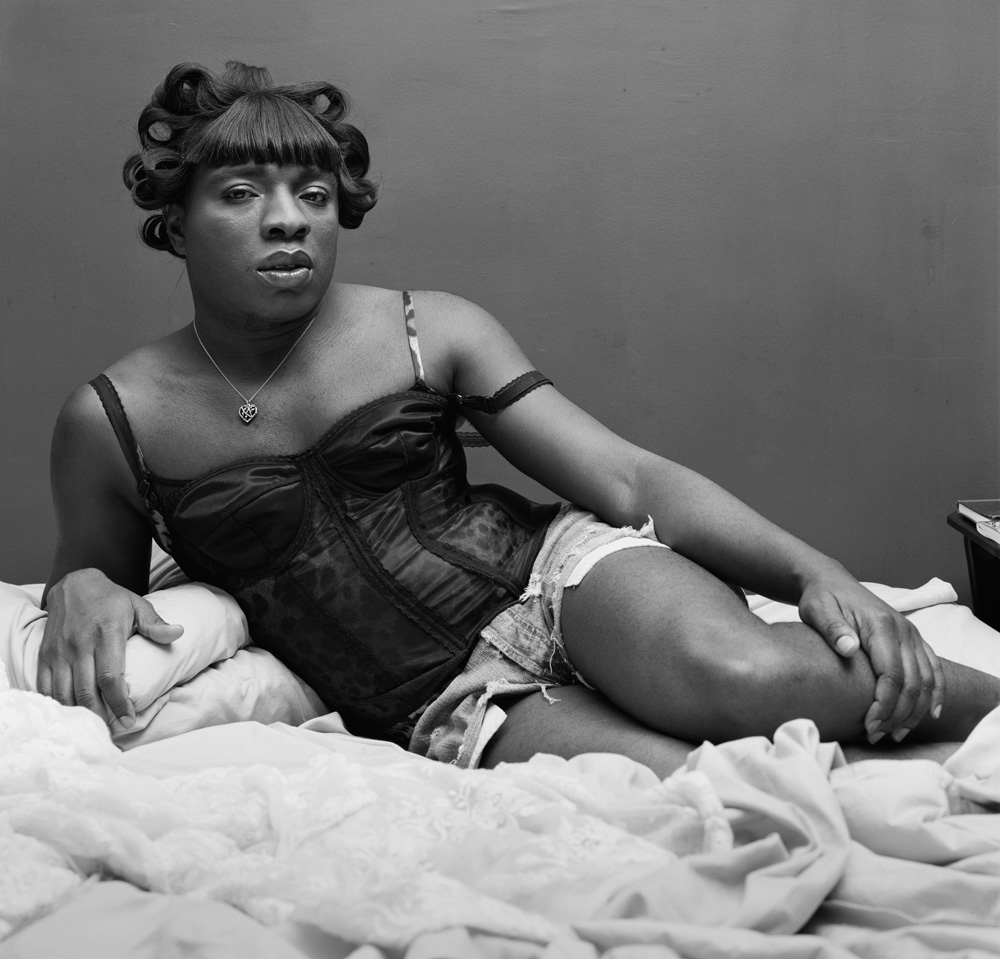
Perhaps the best way to understand Kalup Linzy’s brand of performance art is to stay home on a weekday and watch television. Soap operas in particular play a large role in the Linzy oeuvre, with many of his videos and stage shows built around dramatic characters and episodic conceits. Linzy writes, directs, shoots, and performs in all of his videos, and even composes the music. One of them, All My Churen (2003), chronicles the intrigue and tragedy surrounding the Braswell family, who appear as characters in several of the artist’s pieces, with all of its members—male and female, grandmothers and gangstas—played by Linzy himself. He pulls similar double-, triple-, and quadruple-duty in his MTV-style musical clips, assuming the guises of hoary pop divas and baritone R&B cats singing songs about chewing gum and assholes (Linzy originals) with surprising aplomb. His stage work is no less memorable: For a performance produced by Art Production Fund at the Prospect.1 New Orleans Biennial last November, Linzy took the stage in a flat-ironed wig and a shiny Beyoncé-style black bodysuit to perform a rendition of Bobby “Blue” Bland’s “Members Only,” showing off his soulful, honeyed voice, along with a considerable amount of thigh. But what distinguishes him from the maw of other one-man showmen, stand-up hacks, drag queens, and viral videomakers is both the sharpness of the axe that he swings at issues of race, sexuality, gender, class, and performance art itself, and the purely committed, unbridled humor with which he does it. The former has earned the 31-year-old Florida native multiple fellowships and grants from the art establishment, including aGuggenheim fellowship for the 2007–2008 year. And, the latter, of course, has caused the entertainment industry to come calling.
Linzy’s performance at Prospect.1 New Orleans coincided with the debut of a new video, Keys To Our Heart. The piece is a black-and-white series of three vignettes shot in the style of an old Hollywood movie, in which Linzy stars as a bitter, middle-aged woman who offers a trio of young people—twofemale and one male, with their voices all overdubbed by Linzy—her skewed perspectives on life and love. His work also appeared as part of the Rubell Family Collection’s “30 Americans” exhibit at Art Basel Miami Beach in December. Singer-songwriter Chan Marshall recently connected with Linzy, with whom she once sang “Amazing Grace,” as he was working in his Brooklyn studio.
CHAN MARSHALL: I was so sorry to hear about your uncle.
KALUP LINZY: My uncle?
CM: Didn’t your uncle pass?
KL: Oh, no. My dad died. My uncle is still alive. But he is like a second father to me. He’s the one you met.
CM: That’s why I was thinking it was your dad . . . I’m sorry. But your uncle and your Auntie Di Di raised you, right?
KL: Yeah, and my dad lived, like, a couple of towns over, so I would see him on the weekends.
CM: The reason I brought that up is that I was thinking about your family, and how exciting it must have been for them to visit you when you were down in Miami for Art Basel. How did that turn out?
KL: I think they got a little bit more relaxed about the career thing. They could see that I was making an honest living.
CM: That you’re a certified artist.
KL: Yeah, and so it opened up their minds in terms of what art was—and what it is. Actually, when I was in New Orleans for the exhibition down there [Prospect.1], my uncle called me out of the blue, just on a Sunday, and he said, “I just called to tell you that we love you and you know your purpose in life.” I was so touched.
CM: That’s one of the good things that we all wait for—to have that acceptance from our families. Now what town were you born in?
KL: I was born in Clermont, Florida, and raised in Stuckey, Florida.
CM: When you were growing up, what was it that made you say, “I want to do this”?
KL: I knew I wanted to perform from watching soap operas and stuff like that. But in terms of being in the art world? I didn’t know what the art world was. So, early on, it was just the idea of, “Oh, I’m just gonna do it and go to Hollywood.”
CM: Where did the comedy come in?
KL: I think that I was always interested in both comedy and drama. I was very into Def Comedy Jam and stuff like that when I was in high school, and so, if you take something like All My Churen, it’s a combination of the two—it follows the structure of a sitcom and a soap opera at the same time. But it all grew out of those aspirations of being a performer and an actor and filmmaker. I had all these dreams.
CM: When we sang “Amazing Grace” together in New York all those years ago, I was blown away by your voice. Your uncle is a pastor, right?
KL: Yeah, yeah.
CM: Did you sing in the choir in his church?
KL: Yeah, I did. My aunt was raised Baptist, and she eventually came back to the Baptist church, and that’s where I started singing in the choir.
CM: Now what happened with the live performance that you did for Prospect.1 in New Orleans?
KL: I did a performance with a live band from New Orleans. It was all put together through Art Production Fund. They asked if I could produce a performance for the biennial, so they put together a band, and then I went down for a week or so to work with them.
CM: Was the crowd you were performing for in New Orleans predominantly an art crowd? Or did the neighborhood people come to watch?
KL: It was more art-world people but some neighborhood people did filter in. It was an interesting thing because this band was made up of these neighborhood-y, hometown people who all knew each other. I was a little intimidated at first about what they would think of me—you know, doing this songstress-type character. But they were really open. Having that experience made me rethink my live performances.
CM: The video that you had at NOMA [New Orleans Museum of Art] during the biennial—was that All My Churen, or was it something totally different?
KL: It was another one called Keys To Our Heart. I recorded all of the voices and then people lip-synced to the characters.
CM: So it wasn’t you running around, holding court as every character, like you do in a lot of your videos. How many characters do you play in All My Churen? Nine?
KL: I play the grandmother, the mother, the four children . . . Six. I play six.
CM: Are those characters in your videos at all based on relatives or friends or people you know from Stuckey?
KL: Well, not necessarily. A lot of them are based on archetypes or stereotypes in the culture. But some aspects of them are taken from people I know. When my friends watch the videos, they point out traits that someone in the family or in the neighborhood might have. When I change the pitch of my voice, it sounds like some of my cousins. And then I also look like one of my aunts—or all of my aunts—and my mother. So my friends see that. They deconstruct everything.
CM: If someone said to you, “Here’s a big budget. Write something for me and cast it,” who are some of the people that you’d like to work with?
KL: Well, I’ve always been fond of Meryl Streep, so I would like to work with her. I also like this actress Lynn Whitfield. So I would say Meryl Streep, Lynn Whitfield . . . Gosh, that’s a good question. I would also want to work with Kim Wayans . . . Ashton Kutcher? There are tons of great people, but I’m trying to imagine them in the context of my work, which is a little difficult. But you never know. Sometimes people are good-enough actors that they can transform themselves into something kind of kitschy.
CM: Do you think you’d ever recast All My Churen as a feature film?
KL: I don’t know if I’ll remake it. That could come down the road. One collector I met was saying that she could see some of the pieces working in the theater. But I do like the idea of looking at them as scripts, because some of them are sort of like a series where you could do a stage play by putting them in order and reworking them.
CM: What about making them into an actual soap opera that comes on during the day?
KL: It’s rare that they put on a new soap opera during the day, though. But I definitely want to do a TV series at some point.
CM: What’s your favorite soap opera?
KL: Guiding Light. I also love The Young and the Restless and The Bold and the Beautiful. I would love to appear on one of those shows.
CM: So when you go home to Stuckey now, do you find that there’s a little bit of talk around town about all of the stuff you’re doing?
KL: I can’t really tell. I was performing in Stuckey before I left, so I was always sort of active in the community. I do have cousins who say, “When are you gonna have a movie at the mall?” And if something like that happened, then things would probably change drastically.
CM: So, since everybody back home will be reading this, is it okay if I mention the song “Asshole”?
KL: Oh, yeah. That’s fine.
CM: You wrote that based on a true story about someone you had a relationship with, right?
KL: People always ask me that, but it was based on a poem that I wrote in college, and I can say that after some years, I had a few experiences where I was able to really—
CM: Feel it.
KL: Yeah. I was flipping through the notebook, and at the time I remember just writing it, and then later on when I performed it, the emotion and the comedy were there because some things had happened . . . You know, I’d had some adult situations. [laughs]
CM: I’d love to see “Asshole” go Top 40.
KL: Somebody mentioned that in New Orleans—that I should record it. You think they’d let that go on the radio?
CM: I mean, come on—it’s a hit.
KL: Well, I guess we’d have to deal with the censorship, but I wouldn’t be opposed to that.
CM: So are you still single?
KL: I am still single. But, you know, I was hoping for a situation to develop.
CM: That shit is hard—that love thing.
KL: Relationships . . . Everything is good, though.
CM: There is that time in your life where being a singular person seems romantic, but being with someone can be pretty beautiful. It’s so scary because we’re in that time in our lives when we’re not at the club, you know? We’re not at the bar. We’re grown-ups!
KL: You’re right. At some point I just stopped
going out so much, and I don’t plan on going out too much in the future. You just grow up.
CM: Yes, you do. Oh, wait . . . Hold on . . . My underwear is on my head.
CHAN MARSHALL, A.K.A. CAT POWER, IS A SINGER-SONGWRITER CURRENTLY BASED IN LOS ANGELES. COSMETICS: HIP BY L’ORÉAL. HAIR PRODUCTS: HAIR U WEAR. FRAGRANCE: D&G LIGHT BLUE BY DOLCE & GABBANA. STYLING: ANDREAS KOKKINO. HAIR: ANDRE GUNN. MAKEUP: DANIEL MARTIN.