


FAME
Lena Dunham and Alissa Bennett on the Tragedy of Marilyn Monroe


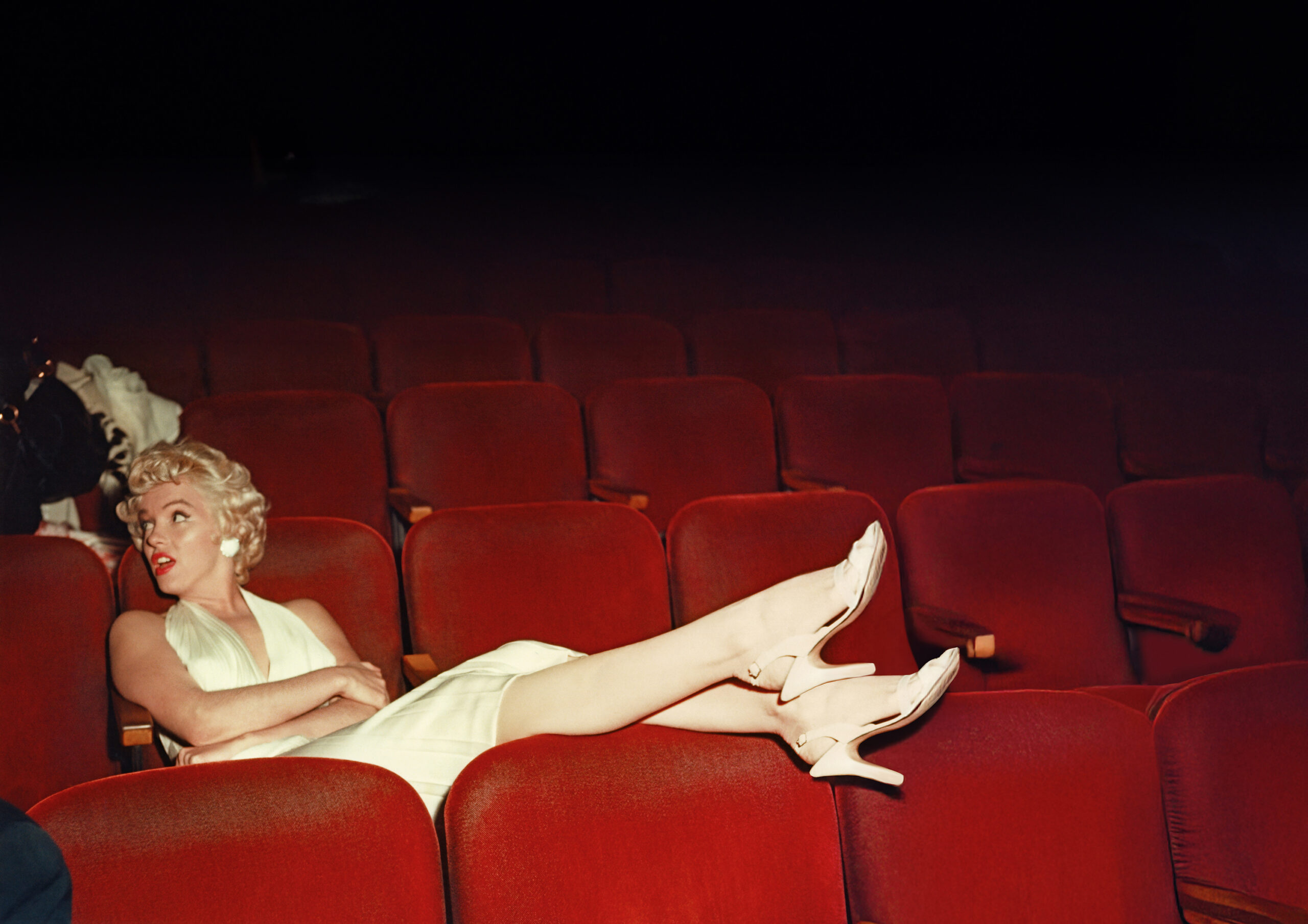
Monroe reclining, New York, 1954. All photos courtesy of The Bernard of Hollywood Foundation Archive.
It’s been 100 years since the birth of Marilyn Monroe, one of America’s most enduring cultural fetishes; we like to talk about what she wore, speculate on the efficacy of her therapy, rate her lovers, deconstruct her magic, and ponder the mysteries of her final hours. The new book by Bruno Bernard, The Marilyn Monroe Century: From Norma Jeane to Icon―A Story in Photographs, looks back on her spectacular life in pictures, but to dig a little deeper, Lena and I got into bed and talked about the distance between Norma Jeane and Marilyn, about what it means when culture loves the idea of someone so much that we mistake our abuse for affection, and why it’s impossible to ever actually know who she was. —ALISSA BENNETT
———
SATURDAY 7 PM MAR. 7, 2026 NYC
ALISSA BENNETT: I’m so happy to be in your bed with you, talking about Marilyn Monroe.
LENA DUNHAM: This is how we always wanted to do it, and this is how we are going to do it.
BENNETT: It’s funny because from the first season of The C-Word, we talked about doing a Marilyn Monroe episode.
DUNHAM: And then we talked about how if we did a Monroe episode, it would have to be a 17-parter, because there was no way to condense all the information into one hour because we know too much. For example, I asked you a question I wouldn’t be able to ask just anyone, which is, “Do you know who the first person was to suggest Marilyn Monroe should bleach her hair?” And you said, “I do as a matter of fact.”
BENNETT: It’s actually an interesting story.
DUNHAM: It’s interesting when you say it.
BENNETT: It was Grace Goddard. She worked cutting film with Norma Jeane’s mother and then became her sometimes-guardian in between orphanages. Grace was obsessed with guess what—
DUNHAM: Movies! Which was very different from the Bolenders, who were Norma Jeane’s first foster family.
BENNETT: Right. The Bolenders were Pentecostal lunatics who worshipped at the altar of Hollywood’s first cult superstar, Aimee Semple McPherson. They thought watching a movie would FedEx your soul straight to Satan.
DUNHAM: So right away there’s a split. It’s also important to remember that Marilyn was an L.A. native, because that’s very rare. Usually, these girls are bused in from the cornfields of Iowa. She’s not a nepo baby, but she’s a tangential baby.
BENNETT: Like L.A. is her other mom?
DUNHAM: L.A. is her only mom.
BENNETT: I think part of why we couldn’t do a Monroe episode before is the complications surrounding the authorship of both her person and her persona are so endless.
DUNHAM: Endless. I find it interesting that we’ve recently been talking about the need to reappraise public women, but Marilyn has been a constant example of a person culture has always felt compelled to defend.
BENNETT: I think that’s partly because her mythology extends in so many conflicting directions. Marilyn has something for you if you’re distressed. She has something for you if you want to walk around in a sheet and a pair of high heels. She’s got you if you want to eat steak in your bed and wipe your hands on your sweater.
DUNHAM: You can be someone who loves the Arthur Miller phase and thinks of her as a misunderstood intellectual, or you can be someone who loves the Joe DiMaggio phase and likes to think about beautiful actresses marrying beautiful athletes.
BENNETT: Do you think DiMaggio was hot? Let’s look at a picture of his face.
DUNHAM: I feel like he’s one of those people you might not “get” from a still photo, but if he walked into the room, you’d drop to the floor. He has fucked up teeth. He’s got that weird nose. I think we would have slept with him.
BENNETT: You know what? I see it.
DUNHAM: He’s tall, he’s got those gangly features that are all too big, but he also has supreme confidence.
BENNETT: Oh!
DUNHAM: Alissa just found a picture of Joe DiMaggio naked.
BENNETT: I mean, that’s pretty whatever.
DUNHAM: I’m just shocked.
BENNETT: All you have to do is Google “Joe DiMaggio penis” and you can see it.
DUNHAM: What’s interesting is he seems to be wet and naked with a group of men all the time.
BENNETT: Well, they’re athletes.
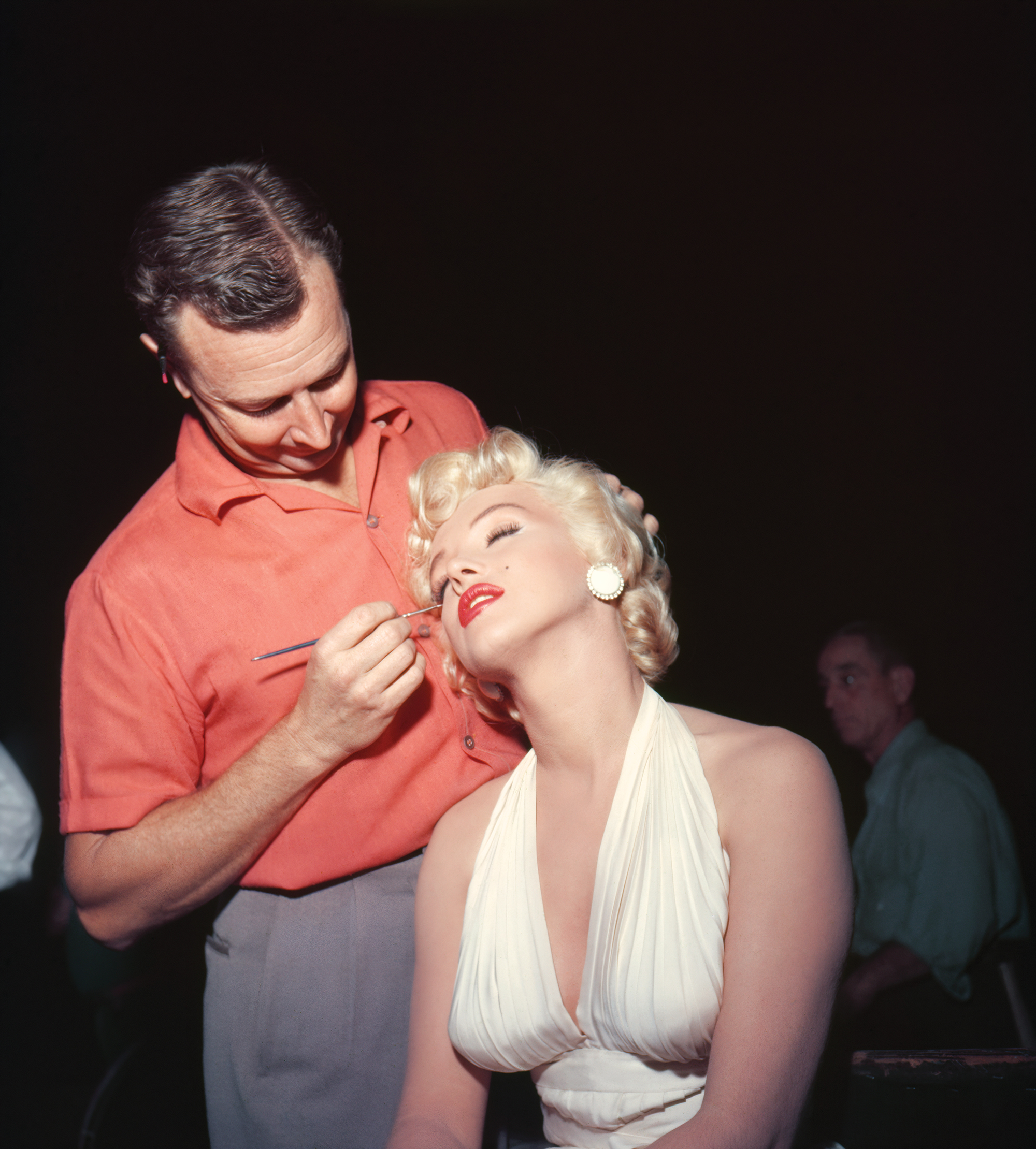
Monroe and Allan “Whitey” Snyder, Los Angeles, 1954.
DUNHAM: I also controversially think we would have done it with Mickey Rooney too.
BENNETT: Womanizing bad boy of the MGM lot?
DUNHAM: Yeah. I think he had a lot of swag, but we’re here because it’s been a century since Marilyn Monroe was born.
BENNETT: I hear that number and I’m like, “That’s it?”
DUNHAM: I know. Can you believe we are both significantly older than she was when she died?
BENNETT: She turned 36 on the set of Something’s Got to Give, her final and uncompleted film.
DUNHAM: And then she died! I think you’d be really surprised how many people don’t know the details of this story.
BENNETT: Well, she was fired for calling out sick too often. There was a clause in her contract that was like, “Bitch, we know you’re going to call out sick every day, so as long as your temperature remains under 103 degrees, you’re expected on set.”
DUNHAM: She had a sinus infection, and she was also using a lot. Being addicted to a combination of heavy-duty amphetamines and sleeping pills doesn’t help, and I say that with deep empathy.
BENNETT: Your eyebrows look great, by the way.
DUNHAM: That means everything to me. They were drawn in. So okay, she’s making this movie, and then what happens?
BENNETT: In three weeks of shooting, she makes it to six days on set. Then she gets the invitation to sing at Jack Kennedy’s birthday party. She gets on a plane without asking because she was doing it with this guy and he was probably too much to resist.
DUNHAM: It’s like when I wanted to go to South by Southwest but I worked at the baby clothes store, so I said, “I’ve had a recurrence of my mono.” Sometimes I think that’s why I got so sick in adulthood. Because god wanted to punish me for that lie.
BENNETT: Bless you.
DUNHAM: The lord stepped in and said, “I will give you your mono back, bitch.” And you think Marilyn was definitely doing it with the President, right?
BENNETT: For sure.
DUNHAM: Are they doing it at that moment, or have they stopped doing it?
BENNETT: You know the type of guy who plays it really hot and cold?
DUNHAM: Oh no, I’ve never heard of one of those.
BENNETT: When JFK wasn’t ignoring her, he was like, “I want you so bad, you’re so hot.”
DUNHAM: And then sometimes he was like, “I’m too busy to talk because I’m the President.” Do you think they did it that night?
BENNETT: I don’t think they did it at Madison Square Garden, but they definitely exchanged a look. He probably groped her behind the bar or something.
DUNHAM: Did he say anything publicly when she died?
BENNETT: I don’t know. I bet he was like, “That’s a real shame for the movies.”
DUNHAM: I bet he was like, “Whores go to hell.” Like, “I’ve never seen that woman in my life.”
BENNETT: So after her big night in New York, she goes back to set and gets the old, “You’re fucking fired.”
DUNHAM: Well, here’s the thing. If I was sick and then decided to take a two-day whirlwind trip to New York City to sing for the President, I would be even sicker when I got back.
BENNETT: Yeah, you’d put your body through it.
DUNHAM: You’re sending a lot of adrenaline signals.
BENNETT: And sexual hormones.
DUNHAM: And she was wearing that beautiful dress.
BENNETT: RIP dress!
DUNHAM: RIP dress, because Kim Kardashian ripped it. Or maybe she didn’t. I don’t know.
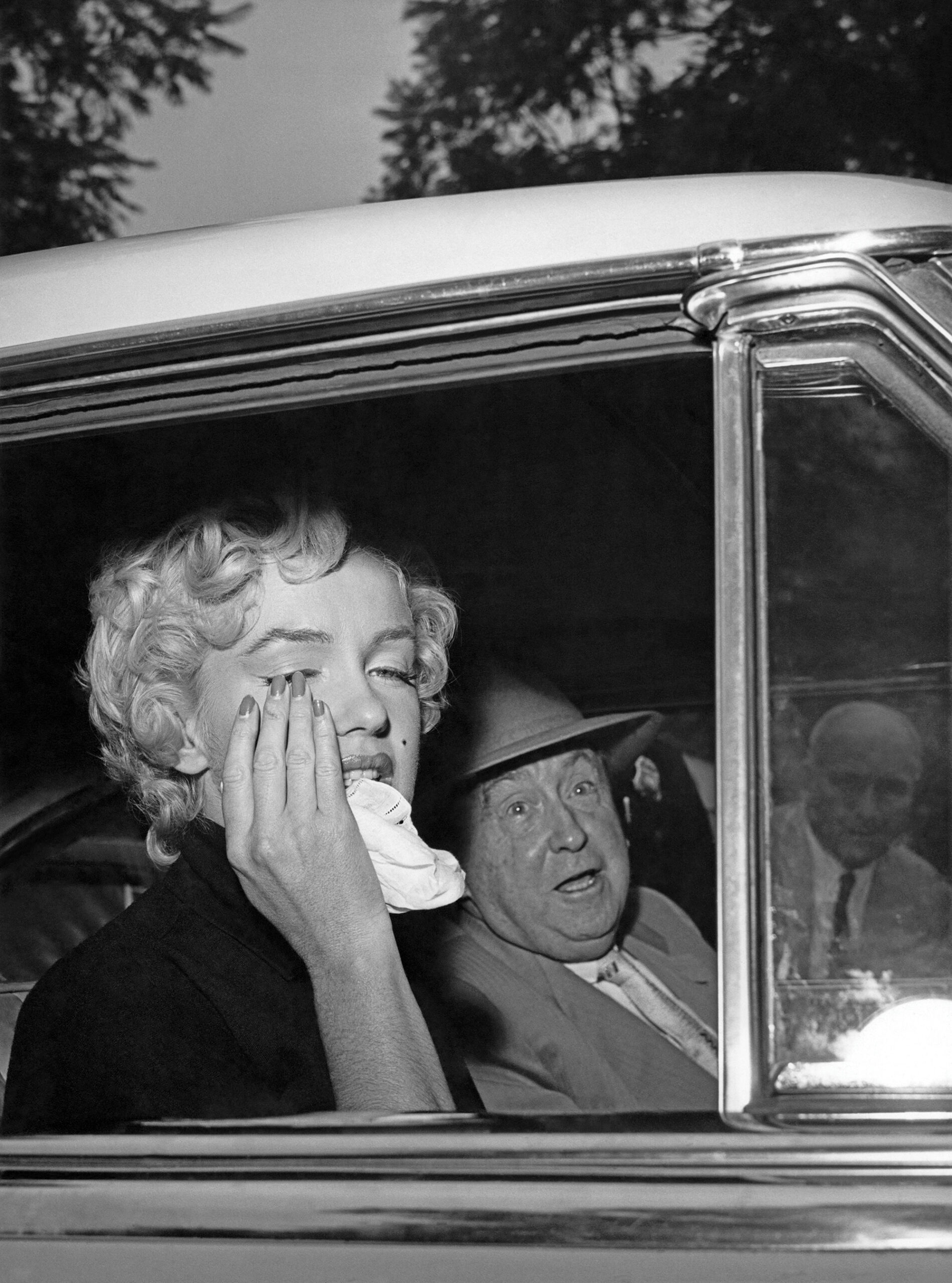
Monroe crying in car, Los Angeles, 1954.
BENNETT: But what does it mean when we expect the dress to be treated better than we treated the person who wore it?
DUNHAM: We treat the dress better than we treated Marilyn.
BENNETT: We’re like, “How dare you rip the sacred dress?” But then we’re also like, “Where the fuck are this bitch’s diaries so we can read who she thought about while masturbating?”
DUNHAM: You’re exactly right. We will never know the extent to which Marilyn was abused in Hollywood. The little glimpses we get of her life are so brutal.
BENNETT: From the moment of her birth.
DUNHAM: Even Grace Goddard, who loved her so much, had a husband who molested Norma Jeane.
BENNETT: It’s funny we’re constantly changing the name we call her, especially since we’ve been looking at this book of Bruno Bernard portraits [The Marilyn Monroe Century: From Norma Jeane to Icon—A Story in Photographs]. He’s the photographer who documented her both before and after she became Marilyn Monroe.
DUNHAM: And it’s really interesting to trace her trajectory in this book, because you can see her move through all her aesthetic arcs. Here she is with her childlike, sweet, chubby baby face. Then here she is looking joyful with her surgically altered nose and bleached hair. And here she is looking hollow, and then here she is looking completely broken. They’re almost like different people.
BENNETT: I think one of the big fantasies we’ve built around Marilyn Monroe is that we’re dealing with two people—Norma Jeane Baker versus Marilyn Monroe—but digging back into the origin story, there’s never a solid origin. In her legal paperwork, there’s Norma Jeane Mortenson, spelled four different ways. There’s Norma Jeane Baker spelled four different ways. None of these identities is solidified enough to hang onto, because she was a completely unprotected person from the start.
DUNHAM: Even in her childhood, she’s playing so many parts. One so her mother doesn’t ditch her, then she plays the person she has to be in the orphanage, then the person she has to be in her foster homes, and finally the person she has to be to charm the older man so he will protect her.
BENNETT: It’s how she moved through the world, like she was on a conveyor belt that perpetually delivered her to the next stage of her identity. When we look at these pictures in this Bruno Bernard book, sometimes she looks fake, like a doll. Sometimes it looks hollow. I’m calling her an it. That’s how complicated this is.
DUNHAM: I think this is part of her mystique. The identity is too slippery to look at in terms of a simple geometry between person and persona.
BENNETT: So what do you think it is about her that makes us still feel all this hunger over 60-year-old pictures?
DUNHAM: Do you remember how you signed the Norman Mailer Marilyn book you gave me for my 32nd birthday?
BENNETT: Oh my god, we’ve been friends for so long.
DUNHAM: Twenty-two years! Do you like that? So, okay, you said—
BENNETT: We should celebrate by hosting a party for everyone we’ve ever talked shit about.
DUNHAM: You inscribed the book “To Lena, who also has something for everyone.”
BENNETT: That’s true. She has something for everyone and so do you.
DUNHAM: It’s about what part of her you feel connected to.
BENNETT: Exactly.
DUNHAM: You and I have always been interested in the broken, sick-in-bed-with-a-fever Marilyn. But plenty of people don’t want to see that darkness. I would be willing to bet the majority of Americans who have strong feelings about Marilyn Monroe don’t actually know the details of her life.
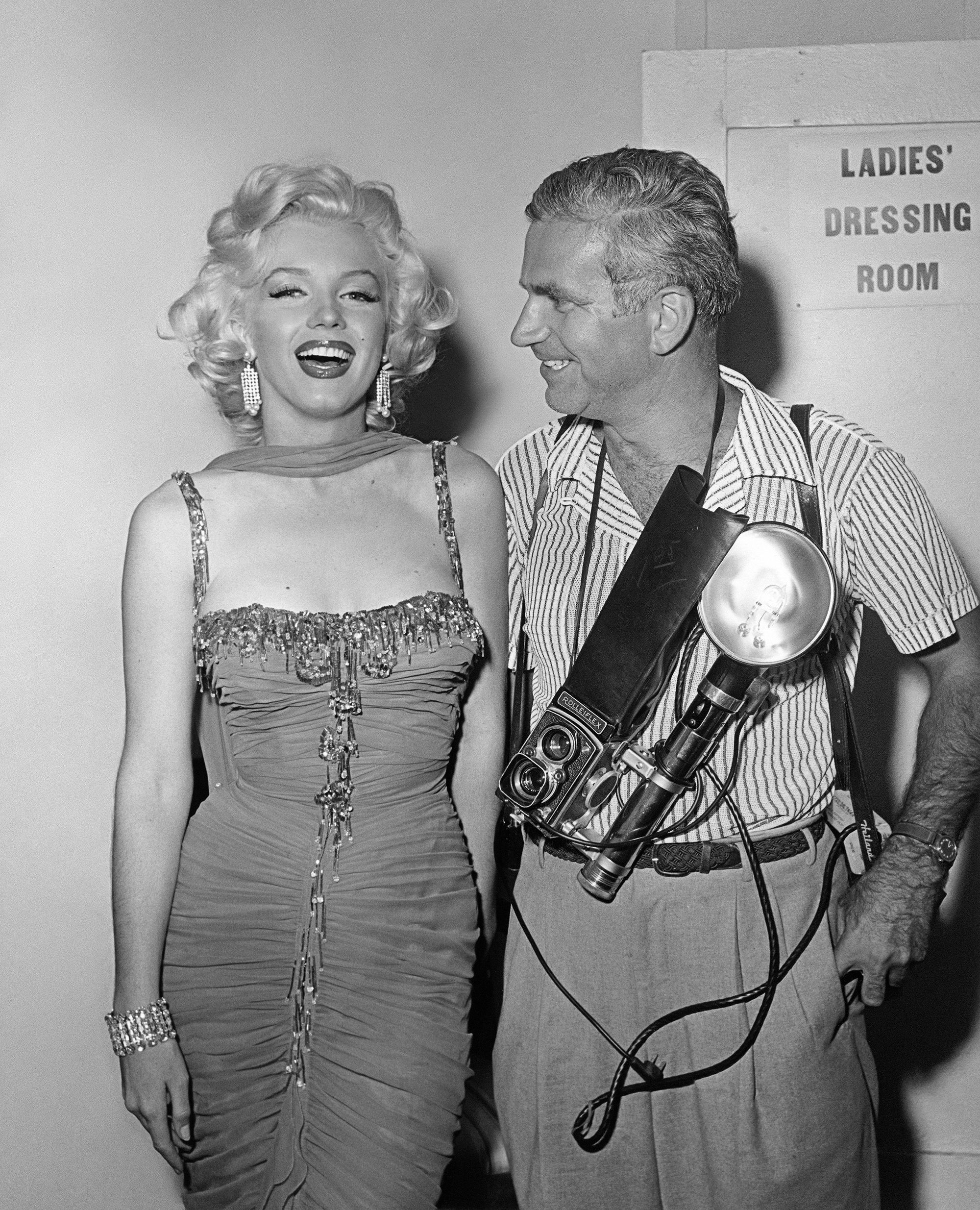
Monroe and Bernard, backstage at Hollywood Bowl, 1953.
BENNETT: Right, because so much of her is reduced to pure image.
DUNHAM: I would be willing to bet that when Kim wore that dress, she was probably thinking, “This represents an iconic moment in American history.” Not, “This is a dress Marilyn Monroe wore on her last big sad night out.”
BENNETT: But the original gesture of that dress was one of absolute desperation. Monroe was calculating how to get an unavailable man to love her back. Wearing that dress was an enormous public statement, directly communicated to Jack Kennedy: “You’re going to look at me.”
DUNHAM: Marilyn Monroe singing “Happy birthday, Mr. President” could be the height of glamour, but there’s a world in which you could think, “Look at this desperate girl,” and that breaks my heart. She’s standing there, boobs out, breathy, experiencing this kind of schism. You also told me a story earlier today about her having a bit of an incontinence problem around this time.
BENNETT: Well, I’d never read the story before, but apparently after she was fired from Something’s Got to Give, she came back to New York and Lee Strasberg was like, “Let me do you a favor and allow you to play Blanche DuBois.”
DUNHAM: In an Actors Studio closed door production of A Streetcar Named Desire.
BENNETT: Yes, so she goes to New York, and she plays this part, and gets so into it that she pees her dress.
DUNHAM: Is it because she’s having so much fun, or because she’s so fervently emotional?
BENNETT: I think she was like, “That’s fucking me. I’m the old lady where you have to turn the lights down low because I’m 36 years old and the President is pretending he doesn’t want to bang me anymore.”
DUNHAM: You know how old Blanche DuBois was supposed to be?
BENNETT: How old?
DUNHAM: 29.
BENNETT: Oh lord! What would’ve happened if she didn’t die? What’s the career trajectory and what’s the life trajectory?
DUNHAM: Had Marilyn Monroe lived and just sort of aged in a typical way, or a Zsa Zsa Gabor way, or whatever way she was going to do it, her legend would have probably faded. I mean, it’s interesting to think about Elizabeth Taylor, who did live for a very long time, and why she was able to keep up the mystique of being Elizabeth Taylor when so many people couldn’t.
BENNETT: Do you know what Elizabeth Taylor allegedly once said about Marilyn Monroe at a party?
DUNHAM: What?
BENNETT: “Get that dyke away from me.”
DUNHAM: Was there any evidence that Marilyn Monroe had been scissoring?
BENNETT: There was a rumor, because there’s a fucking rumor about this poor woman for everything.
DUNHAM: A rumor for every season. I also think it’s because she had these different marriages—her marriage to Joe DiMaggio, her marriage to Arthur Miller—and became different people within them. With Joe DiMaggio, she was basically a—
BENNETT: Catholic housewife.
DUNHAM: Yeah. And with Arthur Miller, she became one half of a pair of intellectuals, which propelled this notion that she’d been misunderstood. From the start, the public wanted to understand who this person actually was.
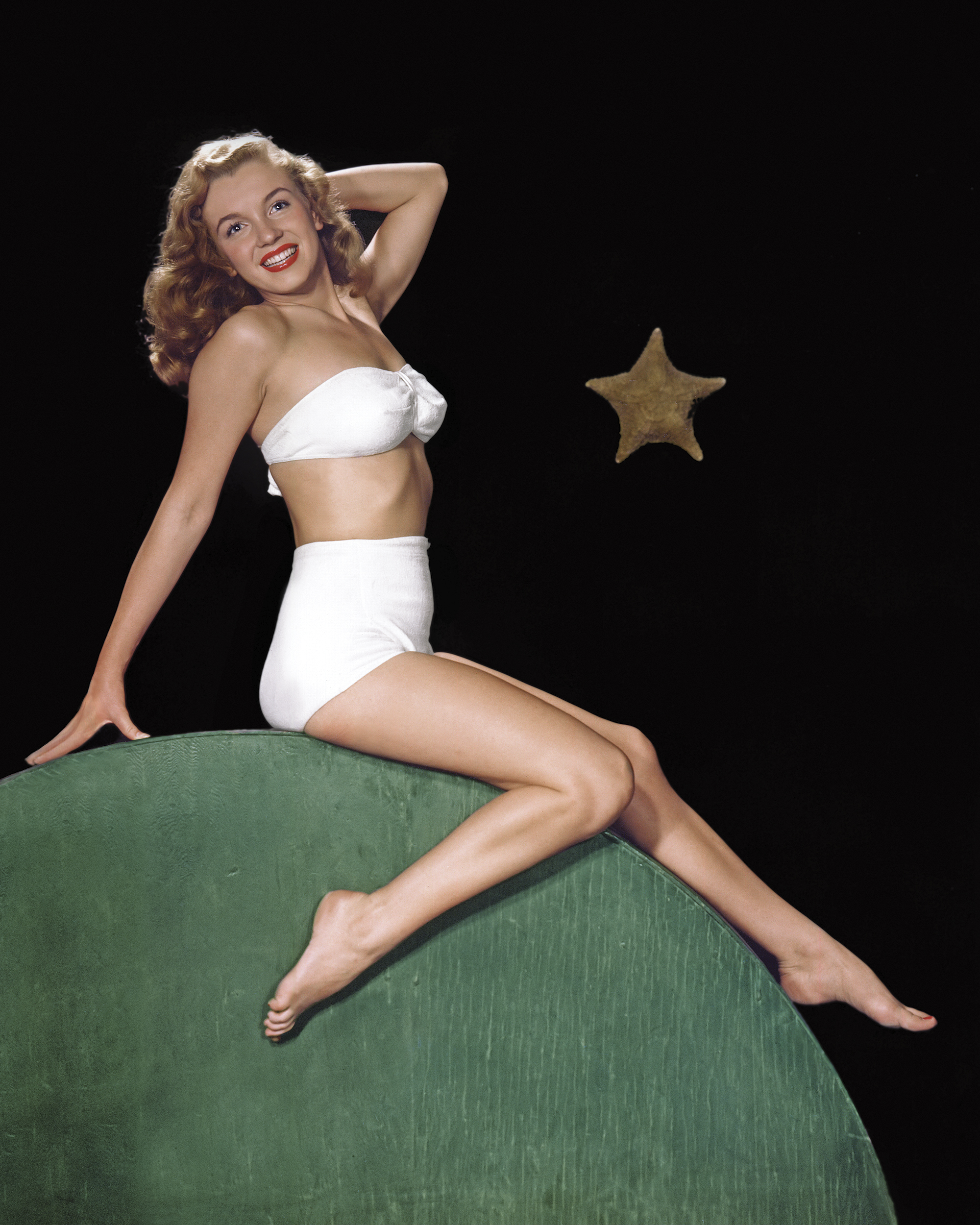
Norma Jeane, in a white bikini with a floating starfish, 1946.
BENNETT: My favorite film in the world is The Misfits, which Arthur Miller wrote for her to prove to Hollywood she was capable of dramatic roles. Part of why I’m so obsessed with it is because there’s so much of her real life embedded in the script: the dissolution of their marriage, what it felt like for her to be so broadly misunderstood, the burden of becoming a very specific kind of symbol for post-war America. Many of the exchanges the two of them had in real life found their way into this thing that was purportedly fictional, which was obviously traumatic for her.
DUNHAM: And this “gift” that’s supposed to be a dramatic role that will elevate her career actually just humiliates her. By that point, her entire fantasy of her marriage is ruptured; the dream that she’d finally found a man who could see her as a real person is o-v-e-r.
BENNETT: A man who happened to be one of the most renowned American playwrights of the 1950s.
DUNHAM: Think about the way Marilyn was held to account for her moral choices. Arthur Miller dropped his family like a hot potato to be with her, and Joe DiMaggio was apparently—and we don’t know because we weren’t there—physically violent.
BENNETT: And we know all of this because America’s most authentic cottage industry is the surplus of gossip that continues to adhere itself to Marilyn Monroe.
DUNHAM: I think it’s been determined that Marilyn Monroe is among the top three recognizable celebrities in the world. You know someone’s really famous when their hair becomes the metonymy of their person.
BENNETT: Murder, or suicide, or accident?
DUNHAM: I heard somebody use the phrase “accidental suicide” the other day, and that’s what I think happened. Let’s just say I don’t think she was actively trying not to die.
BENNETT: Me too. As with every story you read about this woman, you have to take this one with a grain of salt, but there’s an anecdote she related to someone about living at 2 Sutton Place in New York.
DUNHAM: A very glamorous address.
BENNETT: She and Miller were getting divorced, her life was sort of a pile of shit, she was depressed, and she thought briefly about stepping out onto the ledge. She said something like, “I knew I couldn’t look down if I was going to do it, because if I paused for one second and people saw me, it would be worse than being dead.”
DUNHAM: Think about how surveilled, assailed, followed, chased, and scrutinized she was. We still do the same things that culture was doing to her, because there will never be enough information to satisfy our desire for intimacy.
BENNETT: It becomes a sort of necrophiliac impulse to get closer to the body. I think this woman had just had enough.
DUNHAM: This woman had had enough. I was recording my audiobook, and there were long sections I’d forgotten. I was like, “Oh god, I blacked out everything I wrote in here.” I was talking about that feeling where sometimes you reach an impasse in your life where you’re not actively suicidal, but you’ve come to a place where you’re truly without desire.
BENNETT: Like when you’re in a plane and you’re like, “If it crashes, it crashes. Fuck it.”
DUNHAM: It’s almost like she left her body a long time before her—
BENNETT: I would argue she was never in her body.
DUNHAM: I was thinking the closest person we have in contemporary culture to Marilyn is Britney Spears. Her image has been projected upon and projected upon, but she’s dared to do something Marilyn was never able to do, which is age in front of us, and at times messily.
BENNETT: We don’t do this to men in the same way.
DUNHAM: Men certainly love to complain about it, but they don’t actually know what it is. I said this while I was doing press today.
BENNETT: What are you doing press for, Lena?
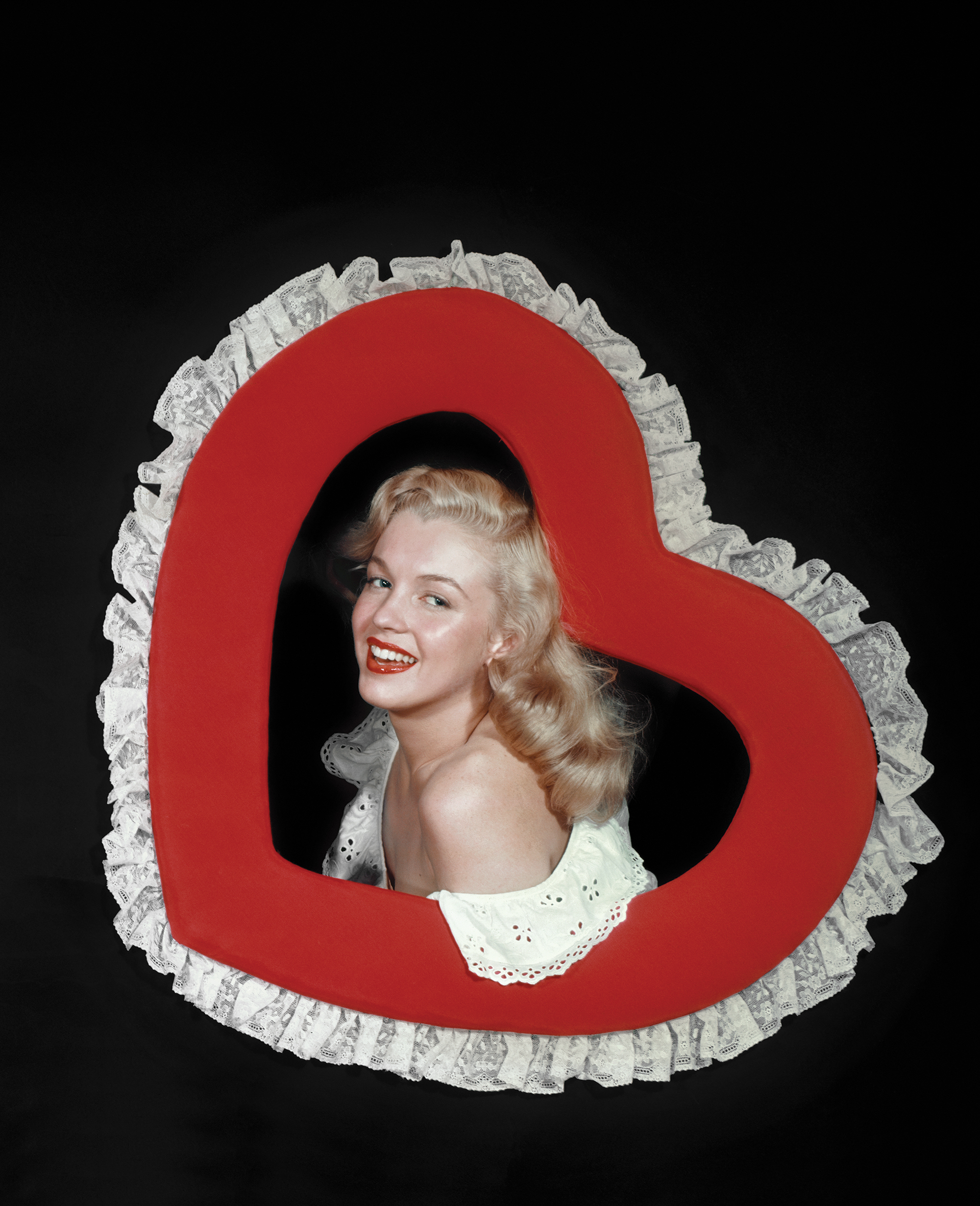
Marilyn as a valentine, late 1940s.
DUNHAM: Oh, Alissa, it’s so funny you should ask. I wrote a book called Famesick, which is about many of these issues, and it’s out on April 14th. But what I was going to say is that there’s this thing that happens when the press gets you wrong as a woman—which it does over and over and over again—you learn to sort of grit your teeth and move on. And the only people I know who fight back against it are men. Women realize very quickly they don’t have any control over how they’re seen. It’s the hubris of men, but also the reality, which is that they actually have a chance to redefine themselves.
BENNETT: Because we’re conditioned to listen to what men say and trust their authority. We don’t trust that women have any authority over themselves.
DUNHAM: No, we trust that everybody else is going to have a clearer sense of where they come from and where they’ve been. You know how smart women always want to be thought of as beautiful and beautiful women always want to be thought of as smart, when really all women are just smart and beautiful? The depth to which Marilyn wanted to be considered a person of intellect and the heartbreak she felt when she found out that her husband, who she thought considered her brilliant, was just another person who wanted to take a bite out of her.
BENNETT: A French philosopher named Edgar Morin wrote a book in the ‘50s called The Stars. He theorized that the starlet has to occupy her body and she has to walk on earth with us. When she transcends the next level and becomes a star, she dissolves into pure projection. She’s no longer a body. She’s drifting through another galaxy.
DUNHAM: Part of what makes us have this continued interest in Marilyn is that she straddles both of these. She is that white light, heat, image projected, but because we’ve become so invested in the failures of her body and her medical issues, she’s still stuck on Earth with us.
BENNETT: It’s like, how do we drag this person back down here with the rest of us? We want to find the flaws that return her to the realm of the human.
DUNHAM: And by the way, it’s so interesting because there are full chapters written about what a pig Monroe was. I mean, we’ve heard all about Elvis eating a fried banana sandwich on the toilet, and it does nothing to diminish his mystique.
BENNETT: No.
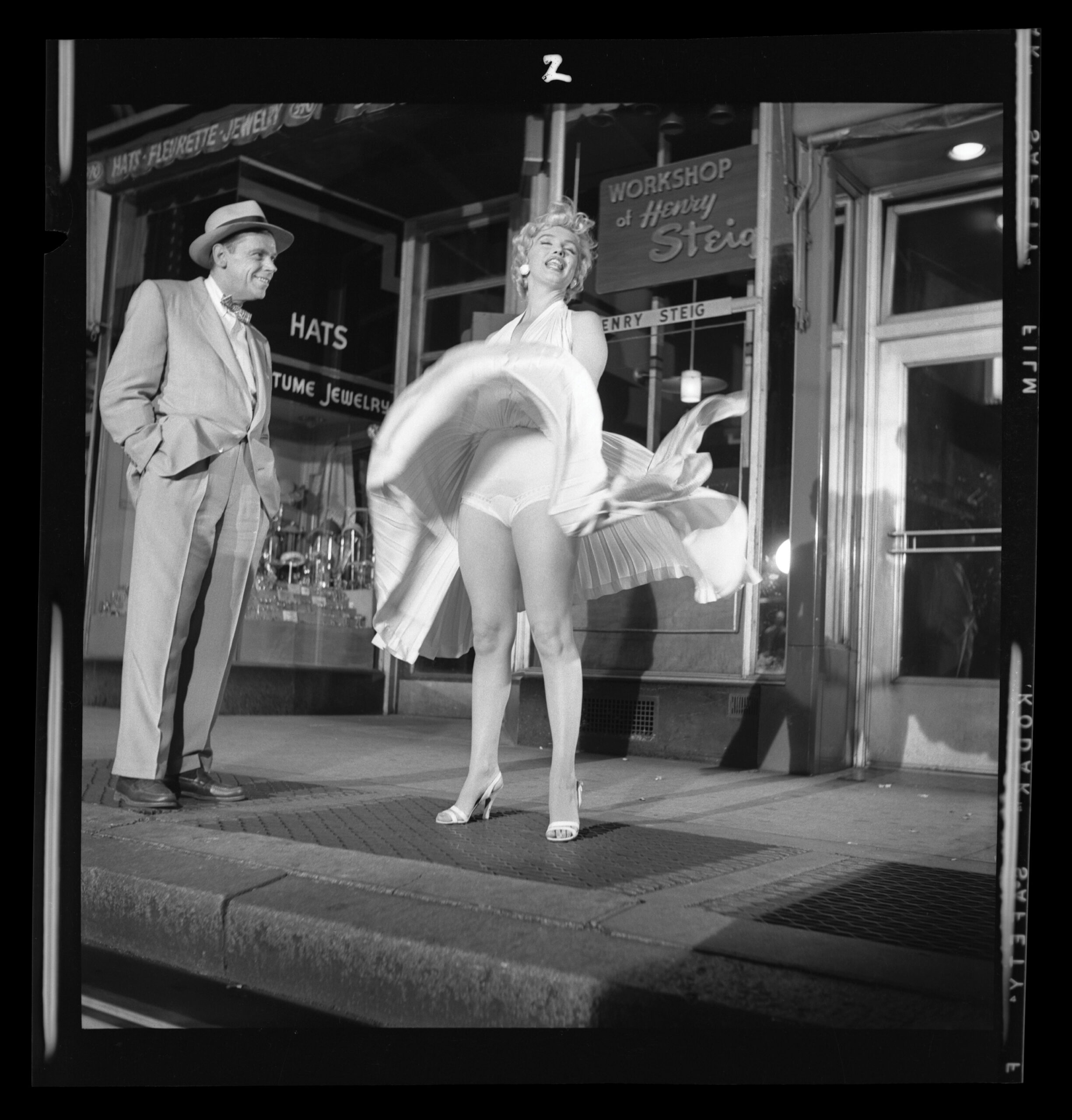
Marilyn in White, New York, 1954.
DUNHAM: But her job was to be this thing. You know what my favorite relationship in Blonde is? It’s the one she has with her makeup guy, who’s with her all the time.
BENNETT: Whitey Snyder. He did her makeup for basically the duration of her career, right up until the end. On the set of The Misfits, he had to conjure Marilyn out of her body when she was kind of not occupying it.
DUNHAM: I hear a lot about people getting their makeup done asleep.
BENNETT: When she came back from rehab she said, “Whitey, will you make me a promise?” And he said, “Anything, Marilyn.” And she said, “If I die, will you do my makeup for my funeral?” And he said, “Yes, as long as they bring your body back to me while it’s still warm, I’ll do it.” And so she had a money clip made for him at Tiffany that said, “Whitey Dear, while I’m still warm. Love Marilyn.”
DUNHAM: Oh my god. I bet she wasn’t warm when he got her.
BENNETT: I bet she wasn’t.
DUNHAM: But I bet she looked fucking beautiful.
BENNETT: I love you so much, Lena.
DUNHAM: I love you so much. And you should know that one of the people who does my hair casually asked me if I’d ever seen a dead body and I said yes. I asked him if he had, and he said, “I did one’s makeup.”
BENNETT: Wow.
DUNHAM: And I said, “What was it like?” And he said, “Well, the thing is you can’t rub anything, you’ve got to pat it.”
BENNETT: The end.
DUNHAM: Good night.
BENNETT: I love you.
———
Special Thanks: Joshua John Miller and Mark A. Frotin.