


Damien Hirst


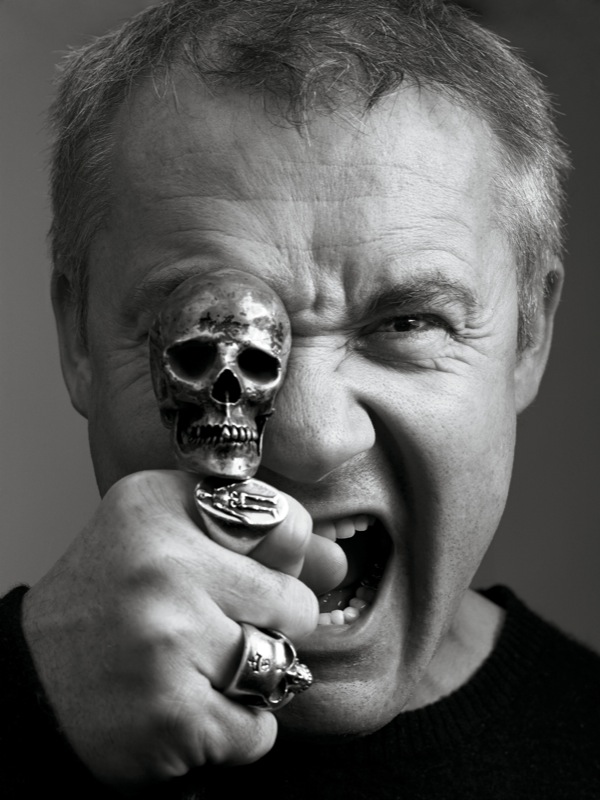
There is butterfly wallpaper in the downstairs lavatory of the Georgian building that houses Damien Hirst’s London office. On the wall hangs a framed flyposter for the newspaper The Evening Standard that reads: HIRST’S £50M DIAMOND SKULL. Artwork in Hirst’s own office, up a flight of stairs, includes a photograph of Francis Bacon, a green Electric Chair by Andy Warhol, and a sculpture of Christ, likewise in an electric chair, by the fast-rising British artist Paul Fryer. The ensemble suggests two of the artist’s salient characteristics-his bumptiousness and his generosity of spirit-since, aside from Jeff Koons, I am aware of few other artists who display the work of their contemporaries and their juniors. But Hirst showed this godfather-ish streak early on when he put together “Freeze,” the July 1988 exhibition in a warehouse in London’s Docklands that showcased his fellow students at Goldsmiths College and played a significant part in creating the British art world as it is today.
The ensemble also shows that Hirst is utterly consistent in his obsessions. An early photograph that has become part of his oeuvre shows him grinning wickedly, cheek-to-cheek with the severed head of a fellow who much resembles the 1st-century Roman emperor Galba; it is perhaps the germ of the diamond skull [For the Love of God ]. This piece debuted at a show at Jay Jopling’s White Cube in June 2007. I took in the rest of the exhibition, then climbed the stairs to where the skull glimmered in a black velvet room. Hirst was standing alone at the door. “What a show, man,” I said. “What a showman,” he riposted.
Damien Hirst has a tremendous ego, but it doesn’t present itself as a warm bath of self-regard; rather it seems oddly objective, work-oriented, and drenched in irony. Many, though, thought the artist had pushed the boat out a bit too far when he announced that he was putting up two years of work, some 223 pieces, at Sotheby’s, London, cutting out both White Cube and Gagosian Gallery, and indeed paring the auction house’s commission to next to nothing. Flooding the market with the work of a single artist seemed an affront both to ordinary practice and common sense, especially as the event approached, and the financial sky became thunderous. Actually, the sale went through the roof and may well prove to be the high point of this particular art-world cycle. So, what next?
ANTHONY HADEN-GUEST: You said even if the auction failed it would open the door.
DAMIEN HIRST: Yeah.
HADEN-GUEST: What do you see happening? What kind of power do you see artists having, specifically?
HIRST: Well, I mean, the art world’s changing, isn’t it? It’s another road where there wasn’t one before. It’s a great advantage to be able to play people off against each other, isn’t it? You go to Christie’s and get a quote on something. And then you go to Phillips’ and you tell them what Christie’s has given you. I like auctions for artists. It wasn’t really like this before, but it is now. Which is great.
AHG: So it’s like Madonna and U2 sacking their labels and going independent.
DH: Yes. It’s better than doing a fragrance, I guess.
AHG: Perhaps you should do a fragrance.
DH: Really? Formaldehyde! Crank! Who knows?
AHG: The argument against what you’re doing is that artists need dealers because dealers put on shows. Artists, especially young artists, get reviewed and get into the information loop. You have to be at a particular level to do what you have done.
DH: I thought it was quite an advantage for young people just starting off to get a bit of interest. The auction houses are interested in being cutting-edge as well as being mainstream. I was thinking of someone like Tim [Noble] or Sue [Webster], for instance, who haven’t really shot off like a rocket but are still at a point where there is a lot of interest in them. They could do a show of 12 works or something, and that could just push them in the right direction. The thing is, it’s risky. But I quite like it to be risky. I’m 43. I’m not ready to sit down in a chair with my name on it yet. I’ve arrived at that point in the art world where there really is a chair that you sit in.
AHG: And in the end, writers will have to go where the art is. If it’s on show in an auction house they’ll have to go and review it in an auction house.
DH: I don’t think it’s an either/or. I think certain things will suit that and certain things won’t. It will just get more complicated and multilayered and multi-faceted. And it will work better all around. I think about Jeff [Koons]. Maybe he’d put his A.P.s [artist’s proofs] in there? He keeps his A.P.s, doesn’t he? He might want to do a retrospective thing like that. Or it might be good just to put one out to test the market. And then be able to sell through galleries. The great thing is that the options are there. I don’t think I invented anything. It’s like I just saw it, just because I did it first. The road was there. It was going to happen.
AHG: Let’s look at your career a bit. You told Sean O’Hagan of The Guardian, “I’ve made maybe four good pieces and the rest are, you know, sort of happy.” I thought that was quite courageousconsidering it was before the auction. Do you believe it?
DH: It depends where you are looking from. You can be brutal. I used to watch Top of the Pops when I was a kid and say “Yeah!” or “Boo!” at every single song. So there was nothing in the middle. You brutally put it on one side or another. If you want to be brutal, I think there are those four pieces that stand above the rest. But you can draw that line anywhere you want.
AHG: When I first saw those pieces they reminded me of some Victorian paintings. They are about life and death. The big issues. Like the insect-o-cutor piece.
DH: Yes. That’s a killer piece, isn’t it? God knows where that came from. It’s one of those crazy things that happen early . . . .
AHG: You have no idea where that came from?
DH: I was pretty down at the time. I was feeling I had to make a piece about something important. Really I was very young to be making something like that. I mean, when I made it, it kind of scared me. I set the whole thing up. I stood back and I felt maybe this is how Oppenheimer might have felt when he split the atom. Because these are living things. I was really worried when the first flies got killed by it. You could feel the pain in it. You think, “Should I be doing this with art? Should I be going in this direction?” It was really quite weird. But it had a kind of beauty about it. I still think that’s the greatest piece that I made.
AHG: And that’s the piece Bacon went to see?
DH: Yes. That’s the one Bacon spoke about. I haven’t got the letter, but I’ve seen it. The letter was to Louis le Brocquy [the Irish painter]. But I’ve still got the piece! I sold it to Charles Saatchi and then bought it back off him.
AHG: You described the auction as drawing a line across your work. No more butterflies. No more spin paintings. What brought this on? You had this incredible machine, a very successful machine. Did it get to be too much?
DH: No. I’ve just stopped some things. I’m not slowing down. I just felt I’d gotten to the end of it really. I don’t know. For me, art is always a kind of theater. When I started the spot paintings I made them as an endless series. But I was never serious about it being an endless series. It was just an implied endless series. The theater means you just have to make it look good for that moment in the spotlight. It’s not the shit going on in the back of the wings-it was never real. So I’ve always been looking for a way to get to the end of it. And then as I got older it has made less and less sense to me. And I just felt this auction was a good way to end things. But like I said . . . I’m doing some very small spots. So it seems to be taking another direction. So I’ll do those. But even with those I think I’ll do something else quite soon as well. I’m doing these . . . [Hirst’s voice lowers. He sounds almost abashed. He is looking at the wall behind me.] paintings. [I turn. Two paintings are hanging. They are tall, narrow. Small vivid dots are urgent, spluttery, bright white, not geo-perfect in any way, against a Prussian blue background. On the right one, there is a small skull facing the viewer frontally. On the left the image is of a skull and spine, as if taken from an X-ray. Both are clearly hand-painted.]
AHG: There was nothing like that in the auction.
DH: No. Because it’s not happening yet. I’m working out what to do with it.
AHG: The first time we talked on the record, we talked about painting. But since then you’ve said that you stopped making paintings at age 15, when you saw Bacon and turned to sculpture.
DH: Yeah.
AHG: Did you know that Bacon was going to make sculpture? He got a frame like a Zimmer frame. A Bacon frame. Peter Beard told me he thought that the Marlborough Galleries talked him out of it.
DH: Really? Wow! [pause] Probably a good idea.
AHG: That he didn’t do it?
DH: Yeah. But you never know. I’ve looked at his print sheets, and they’re not too bad. They’re just like paintings, aren’t they?
AHG: What are you working on now? Sometimes you talk about interesting tech ideas, like suspending droplets of water in sonic beams. But then you’re talking about going into the shed and getting a grip on painting.
DH: Yeah, yeah. I think I’ll do both. I’m actually employing more people. Even though I’ve stopped some of the series.
AHG: How many people now?
DH: Uh, I dunno . . . 160? Something like that.
AHG: In how many work locations?
DH: I think I’ve got six studios. Six, yeah. But mainly the one in Gloucestershire. It’s just kind of expanded. We take on more and more people as we go.
AHG: But these look like pieces you are making yourself? [Meaning the paintings behind me.]
DH: Yes. I make these on my own.
AHG: This is really encouraging. [Hirst laughs] You may laugh. But I was wondering where you were going to go, you know.
DH: Yeah. Paint! I also thought I couldn’t imagine the work getting me to the end of my life. If I were going to live for a lot longer, you know. [pause] I was looking at photographs of Jeff Koons. And the smile starts to crack. Do you know what I mean? As you get older . . . And it is about celebration. He made that great series, “Celebration.” In a lot of the work I was celebrating. And you stop celebrating. But the work still is celebrating. It doesn’t make sense.
AHG: What do you mean, you stop celebrating?
DH: You just get a bit older. I used to walk into a room and get on the table and go, “Hee-hah!” I used to believe I was going to live forever. And then you suddenly become aware that you’re not. You’re celebrating the fact that nothing can stop you. You’re going to fuck everyone! You can’t lose! Like, “Fuck off, this is what I think.” You’re kind of like that and celebrating every moment in that way. And then suddenly . . . I’ve got kids. It’s just gone somehow. You’re not like that anymore. You’ve gone quiet. You’re more cautious. You can walk into the studio one day and just think, This is not me, you know? And especially if you’re doing an endless series. Someone like On Kawara, I mean, I wonder if he ever does that? Like, “Fuck! I’ve just wasted all these years and it’s not me.” He must. It’s artistic doubt.
AHG: Or Daniel Buren.
DH: Exactly. Anybody who’s done that kind of thing.
AHG: There were some great pieces in the auction. But there were some pieces, like the spot painting with a gold background, where I didn’t feel much soul-beating.
DH: Yeah! I think that’s why it’s sort of an end to me. I don’t know, you kind of . . . I quite like that logo thing as well. I’ve got a company called Over the Sofa. I’ve always thought at the end of the day art just goes over the fucking sofa. You can’t take it too seriously.
AHG: Let’s talk about celebrity. Picasso was a celebrity, but he was very wary of it, and it didn’t get into his art. It ate up Dalí. Then there was Andy. But it seems to me that you’ve taken it a step further. You have actually made it into an art material. You have used fame and money as icon painters used to use gold.
DH: Yes. It is an ingredient, I think, in the composition. Especially money. Or power. And all of those things. Even not having it. I mean, it’s important to people who don’t have it. It’s something that’s not to be underestimated or overestimated. A lot of what I did is “What if?” I wonder what would happen if we do this and not that? There are no limits really, are there? But you can get yourself into some awkward situations where maybe you didn’t want to be. I had no money when I was young, so I think that forced me . . . and also Frank [Dunphy], my business manager. He’s totally on my side. He only works with me.
AHG: He worked with Tim [Noble] and Sue [Webster], didn’t he?
DH: He’s worked with them. But nobody sort of took it that one step further. Nobody took him on. Because you have to give away a bit in order to get there. Remember, I was on 50-50 with Jay [Jopling]. And then, when Frank came along, I had to go to 40 percent because I had to give Frank 10 percent. So it was 50 to Jay, 40 to me, 10 to Frank. So that was awkward. But I had the foresight to do that . . . Now, fundamentally, it’s problematic going under 50.
AHG: I was going through the auction catalogues and cuttings and stuff in a magazine office. Somebody asked why, and I said I was off to interview you. One girl squealed and said, “Can I come and hold your tape recorder?” And these are sophisticated people. Jackson Pollock didn’t get that kind of response. Probably not even Picasso got that kind of response. It’s partly because of our celebrity-mad times, but I think it’s also partly because of the changes that you and a few others have made in the art world.
DH: I quite like what happens when you make the kind of money that we made in the auction. Because money does talk. There are a lot of people who like money but who don’t like art. And when you see that . . . I love that.
AHG: Objectively, it’s not that much money. People seem to think it’s remarkable that an artist should make as much money as a footballer, or an actor who is at roughly the same career level.
DH: Somebody offered me a Picasso painting the other day for $140 million. You just go, “Thank God for that! Thank God the value’s there at that level.” It means there’s a long way to go.
AHG: Where are you going to hang it?
DH: No. I didn’t buy it.
AHG: That was a joke.
DH: Yeah. I didn’t buy it. But I would!
AHG: I hear you have a Bacon in your play room. Is it the self-portrait?
DH: In my TV room? No. It’s the scene at the base of the Crucifixion. 1944.
AHG: So now you’re getting back to painting. It’s as if Duchamp didn’t just give up art but wanted to become Picasso.
DH: It kind of makes sense to do it. I think painting like this has more to do with the fly pieces than any of the newer sculptures. If my success as a sculptor is in those four pieces, in that whole career, then I think you can minimize it into painting and have a different kind of success.
AHG: You said, “I want people to say ‘Wow!’ I don’t want people to see how my mind works.” But I think if people look at your early pieces, they are going to get a sense of how your mind works. And if people look at these paintings they are going to get a sense of how your mind works.
DH: Yeah. I think I’ve always been afraid of painting, really. Right from the beginning. All my paintings are about painting without a painter. Like a kind of mechanical form of painting. Like finding some imaginary computer painter, or a robot who paints. Unemotional paintings anyway. I think I’ve gone through that time and time again-paintings that continue emotions but aren’t emotional. Like a spot painting is that kind of grid. But it does awaken something, it works in some way. But they are denying something; they are all denying something. And in the end I’ve just gotten to the point where I can’t deny it anymore.
AHG: Other artists have attacked you for using their ideas. John LeKay said the skulls were his idea. John Armleder never actually said it, he’s too sophisticated, but that the spots were his idea-that he was doing spot paintings. And some say Walter Robinson did the spin paintings first.
DH: Fuck ’em all! Who knows? Before I went to Goldsmiths, I sort of tried to be original. But then there’s just so much in the world, and so much of it is derivative. Everything comes from somewhere and it’s just such a mish-mash. At Goldsmiths we were kind of freed. You don’t have to worry about that! If it looks good, it is good. I remember the fly piece and I remember thinking about the direct references of that. Like Dan Graham for the steel-and-glass, the bus shelter-type things. And Bruce Nauman was in the neons. You know, the fly killer. And then Bacon obviously in the meat. Even Naum Gabo with the flies in space. It’s an amalgam, a mish-mash of everything you’ve ever seen before. Like my medicine cabinets were from Koons. If you are constantly creating visual things, you are getting loads of ideas from everywhere. I think that there’s only been one idea and that was fucking painting your hand red in blood and stamping it on the cave wall. And then, after that, we’ve all just ripped that off and copied it. But what I think is probably different about our generation is that we never felt the need to be original. That kind of frees you up to do what you want. I mean, like the spot paintings. There was Larry Poons.
AHG: Bridget Riley?
DH: Yeah, Bridget Riley. But Richter as well. Richter’s squares.
AHG: Sigmar Polke? Roy Lichtenstein?
DH: Polke, Lichtenstein, yeah. So they are all in there. If it’s a good idea, then lots of people have had it before.
AHG: It seems to me that one thing that distinguishes good artists from the rest is that most good artists are willing to fail. Ben Nicholson was the typical British artist-wonderful, good taste. I think you guys-not just you, but your generation-changed all that.
DH: I think that had to do with Saatchi. He was just there at the perfect point with a huge fucking space. At Cork Street . . . You just couldn’t fit the size of paintings we wanted to make into Cork Street. It’s just that as a student you go and look at all those galleries. And that was the art world, that fucking British art world. There was the Lisson Gallery, which was very snobby. And Nicholas [Logsdail, the director] was virtually saying go back to your studio for five years and have a little think. And even that was a little shop in the beginning. If you were supposed to fit in in the art world you would have had to scale the work down. And then Saatchi did that New York show. I remember walking in and going, “Hey, my eyes!” The whiteness of it! It just blew me away. And it was so not British. And that just totally inspired all of the students. We wanted to show at the Saatchi Gallery immediately. And then we started making work really to fit there. And that’s when I realized we wouldn’t fit into the art world the way it was. So I just went and got a warehouse, and we did that show. That wasn’t very British. You know, Warhol had done Thirteen Most Wanted Men huge. But Peter Blake and Richard Hamilton were still doing these small paintings. And little things. Very kind of local and small.
AHG: You didn’t just conceive the “Freeze” show, you were there making tea and bacon sandwiches.
DH: Yeah. We were all doing it, really.
AHG: I heard you were doing that at Sotheby’s, too.
DH: A bit, yeah. I look at people who have big businesses, and they are fucking mean. They run them like tyrants, treating people like shit, so everybody is on their toes, trying to please. And they are very successful businesses. But I’ve never done it that way. I always try to make everyone mellow down-make sure everybody’s happy. The people I have employed have always kind of stayed with us. In a way you are hiring artists, you know? A lot of people who come to work for you are artists in their own right. And they want to work for you because they want to pick something up.
AHG: Have any of them done okay as artists?
DH: Rachel Howard. She painted spots. She’s got a great painting downstairs.
AHG: The timing of your sale was quite dramatic. I mean, you couldn’t have planned to have banks collapsing around you . . .
DH: I know! [laughs] It’s bonkers. I mean, I woke up in the morning and it said in the newspaper “Black Monday.” And I was like, “Fuck! Shit!” It’s very bad timing. I just thought, This is terrible, you know. And then to sell that amount of stuff when banks are collapsing is just unfuckingbelievable. So, of course, in a situation like that the rumors go flying. Don’t they? And the stories just don’t make sense. [laughs] There’s no cash incentive to rig it. I mean, unless you’re insane. You’d have to be. Why would I do it? I’d have to do it with a view to some long-term goal or invest a $100 million in a long-term gain further down the line. It’s just bonkers, isn’t it? How can you fucking do that? And no one would do that with you. And to get the galleries to do that with you? Everyone’s too mean. [pause] It would be a brilliant scam!
AHG: So the auction worked? It broadened the whole game?
DH: Yeah. A lot of people bought who never bought before. I love that. I’ve got collectors who have never been to either of my galleries. Which is fantastic!
AHG: You know some of them?
DH: Oh, yeah! I made sure that I knew them all.
AHG: You get close to your collectors, don’t you?
DH: Some of them. If they are interested in investing in that kind of stuff. And they are going to build the museums of the future, which is great.
AHG: I met one of your collectors on my way to Basel. She said you called her offering to exchange her fly piece for a better one.
DH: Oh, yeah. She’s great. It’s especially now that I’m not drinking. Because when I used to drink … I remember when I was with [artist] Sarah Lucas, a collector called up and said, “The piece that I bought from you is decaying. There’s something wrong with it.” And Sarah just said, “You can give it back to me, but you’re not getting any fucking money!” I love that! I used to do the same thing when I was really drinking a lot. But then you stop drinking, and you’re not living in the moment as much. It’s like a group show, isn’t it? You suddenly look back, and somebody’s got, like, 10 pieces. And you look at them, and you can see that they should have one of these, and they’ve got too many of those, and if you just switch it around it becomes a better collection. And you can engage with them more. A great collector friend of mine was Jay Chiat, who died. When you get more mortal you really work more with collectors.
AHG: You have really got death on your mind?
DH: You know, I always have. It’s just something that inspires me, not something that pulls me down. I used to get called morbid at school. I have always loved horror films; I like being frightened. I definitely think about it. And every day your relationship with death changes. And every day I sort of feel like I know it more. I’ve always thought about it. Maybe I shouldn’t? I don’t know. We’re here for a good time-not a long time. I love quotes like that. There are no pockets in a shroud.
AHG: How many hours a day do you work?
DH: All the time, really. I’ve never learned to drive because I get lots of ideas when I’m a passenger in a car. I love to get in a car with a driver and just think and work things out.
AHG: The main piece in the auction was The Golden Calf. And you had a drawing that went with it saying “Beware False Idols!” I wondered, were you trying to pull the temple down? And then I thought, No.
DH: It works on many levels. I was working on cow things, and mad cow disease came out, and it became very topical and very of the moment. It’s kind of a happy accident. But it makes it all the more important. So I had an idea to do The Golden Calf. I knew we needed a big piece to kind of pull the whole exhibition together. And then when you think about all the references to the art market, and the stock market, and cash, and belief, and everything, and religion kind of falling apart . . . All of those things made me realize that was definitely the right thing to do. But I never go for a complete obvious meaning and say, “Right, that’s the way I want it to look.” It’s always just lots and lots of universal triggers. And when it’s a combination of all the ideas, it feels right. So I go ahead with it. And the gold! I mean, rather than avoiding it, go with it! Especially since I was aware that I’ve got to come up with something to match the diamond skull.
AHG: What will happen to the diamond skull?
DH: Well, we’ve got an agreement that it will maybe be auctioned. I had hoped that it would get sold privately to someone in the next eight years. It depends what happens with this debt and stuff. But I think it’s starting to look cheap. Isn’t it?
AHG: $80 million is cheap?
DH: I was offered a Picasso for a $140 million, remember? So there’s definitely room. It depends, you know. What happens when Jeff’s bunny comes up in auction. What is that going to go for? [The owner] turned down $60 million.
AHG: I saw Jeff at a party. He looked stressed. I asked how he was coping. He said you just have to keep your focus.
DH: It’s quite a frightening position to be in, isn’t it? For artists it’s a lot easier to make art in bad times than it is in good times. When you’ve got no money it’s easy to just drink your way through it and make great art. But if you’re making lots of money it can be very problematic.
AHG: I’d say four out of five kids in degree shows draw and paint better than the pros. But not many are going to become artists. What are the characteristics an artist needs for success?
DH: First of all you’ve got to be oblivious to other people-the push and pull of other people’s opinions, the way other people measure success. It’s then that you realize you are 100 percent who you are and you have to use that who-you-are 100 percent in order to create great things. And that’s very difficult because everyone wants to be better than they are. You’ve really got to get down on the floor with yourself and get low in order to make great art. I think you’ve just got to accept who you are and do the most unbelievable things. If you’re in a gallery looking at Velázquez paintings and thinking, I want to paint like that, and you’re not able to . . . you’ve got to accept your limitations in order to exceed them. You’ve got to accept that you’re a child-you’ve got to think, Look, I know this is impossible, but I’m going to fucking well go through with it anyway. When I was doing the paintings like Bacon and I gave up, it was really like an ego thing or something. When I started painting again two years ago, I secretly thought that everything I have learned on the other side of the art world has put me in a better position to paint. But it didn’t. The worst thing for me when I started painting two years ago again was that it was exactly like I was when I was 15 or 16, and I stopped.
AHG: You had a show of paintings in New York that was pretty much blasted.
DH: Yeah. The paintings . . . I have to admit they weren’t that great. But I felt it was the moment to say, “This is what I’m doing now,” not to wait two or three years. When I was asked what kind of reviews do I hate the most, I said it’s really reviews like those, where they kind of slag it off. Now the paintings are just infinitely better. Yeah, I think that’s the worst review of all-when you read it and you agree with it.
AHG: What has been the difference since you began painting again two years ago?
DH: The only thing that was different when I began painting again was that I had the belief that if I just went for it, I would get through that Bacon thing, and it would be worth it. And I just believed that by persevering I could get through it. I never believed that before. The only way to get rid of it is to go through it. I’ve got, like, triptychs. And then hopefully I might have a period for a few years which is very much like Bacon and then go off on my own. But that’s what you’ve got to do. Youcan’t bypass it if that’s your natural way.
AHG: When will you show this work?
DH: I haven’t worked out what I am going to do with it yet. I was thinking of doing a show with the Wallace Collection here. [Lucian] Freud showed there in 2004. And I thought maybe something small. But I’m not in a rush. I don’t feel like I did with the other work, like it’s going to go anywhere. I don’t feel in any rush-I just want to get it running. I’m going to get a load of shit for doing it. And I need to be 100 percent behind the work before I show it. The great thing about painting now is that I’ve gotten to the point where I can forget everything just by doing it. And I never used to be able to do that.