


BASEL
“Tartan Is Where It’s At”: Sarah Morris Takes Over Burberry Miami


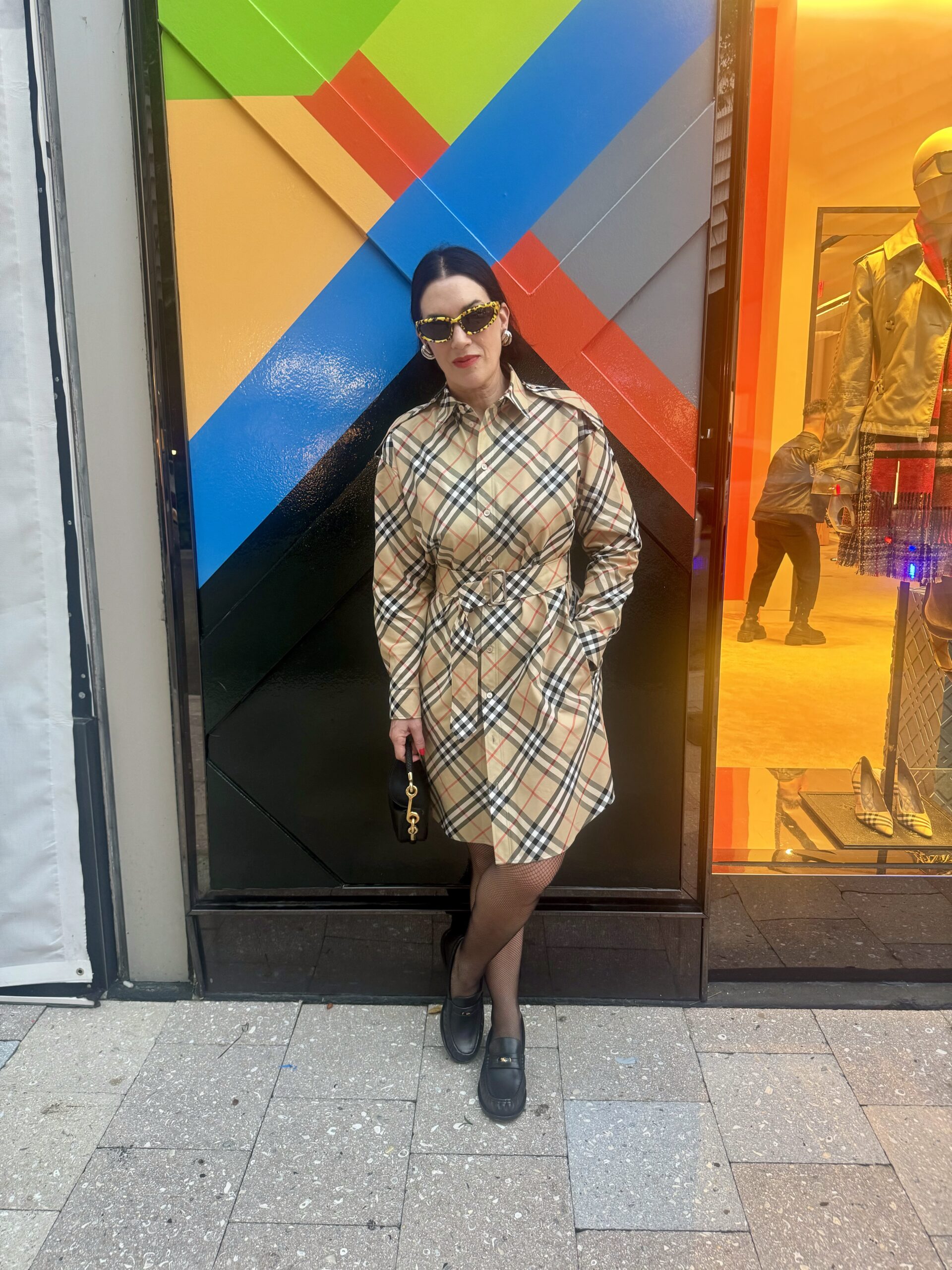
Sarah Morris, photographed by Jake Nevins
THURSDAY 5:09 PM DECEMBER 5, 2025 MIAMI
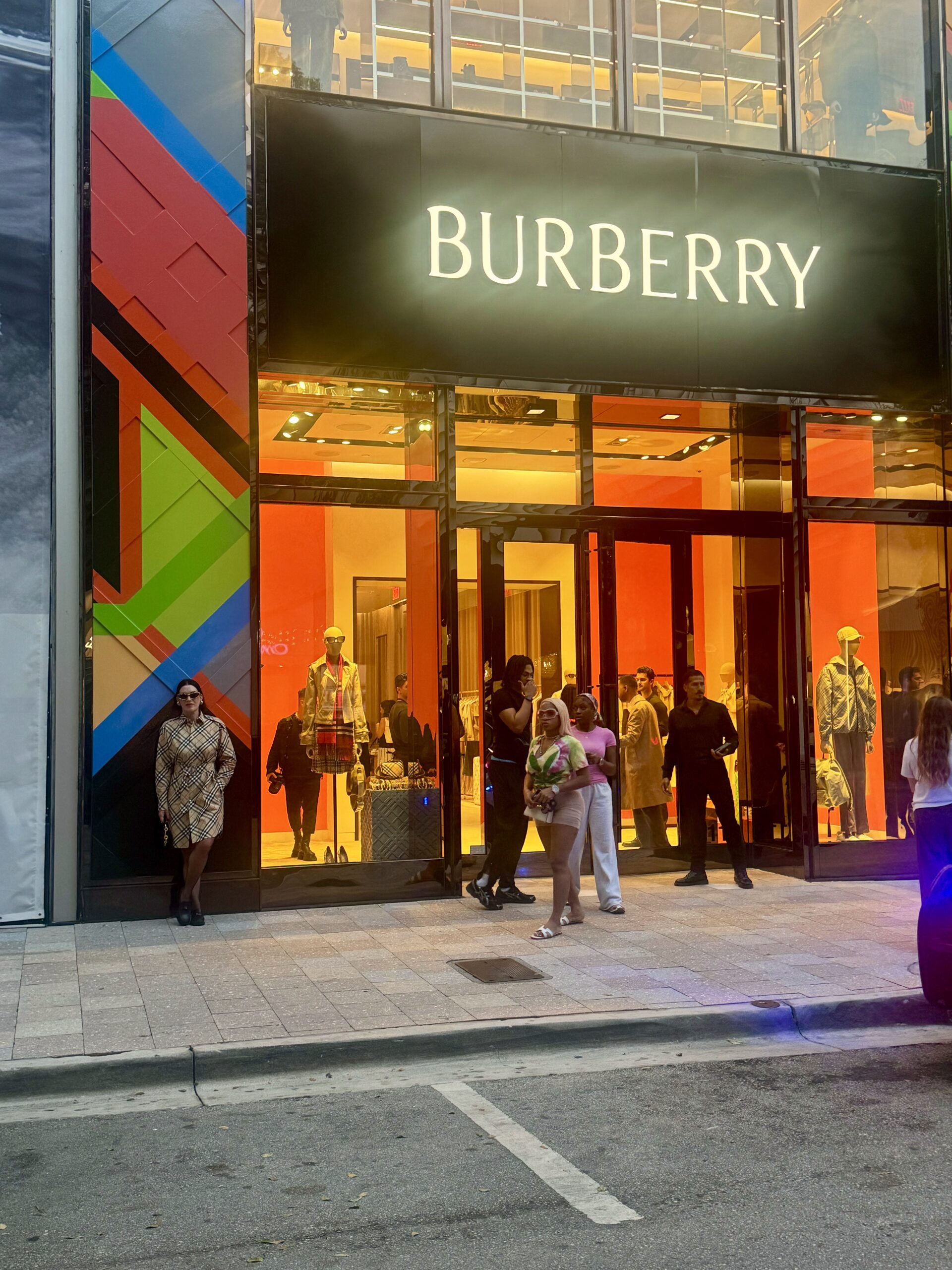
“I do try to avoid art fairs,” the artist Sarah Morris told me outside the Burberry store in Miami’s Design District, where she’s reimagined her 2004 screenprint, “Department of Water and Power,” as a 31 x 27-foot façade in buoyant, geometric technicolor. That fact notwithstanding, the commission gave the abstract painter and prolific filmmaker the perfect excuse to return to Art Basel Miami, where she last visited some 15 years ago, by her rough estimate. To mark the unveiling, Morris and I stepped outside the Burberry store, champagne glasses in tow, to talk tartan, flamingo breeding, and living through the Anthropocene.
———
JAKE NEVINS: First of all, welcome to Miami.
SARAH MORRIS: Thank you.
NEVINS: Tell me how this collaboration with Burberry came about.
MORRIS: They asked me if I wanted to do a wall painting in Miami and do a project for the facade of the store and I immediately said, “Can I see photos?” I knew the design district before it even became the design district because one of the people involved with organizing this was Craig Robins, who is a collector. Then they showed me the facade with these concrete panels, which are all like… I’m going to say tartan. They don’t say tartan, they say check. But I say tartan. If we would go to the dictionary, tartan is where it’s at, right?
NEVINS: [Laughs] Right.
MORRIS: Edward Durell Stone did a lot of three-dimensional facades, so I was immediately like, “Yes, I’m going to do that,” because I really liked this dimensionality to the thing. And then I started thinking what is the closest that my work has ever gotten to that. And I was like, the Department of Water and Power, which is obviously a very famous building in Los Angeles—and it’s sort of the heart of the Chinatown idea of a conspiracy behind water and like, “Should Los Angeles have ever been a city?”
NEVINS: Eight, or was it basically like, a manipulation of municipal resources.
MORRIS: And you could say that about a lot of places. You could say that about Miami now. In the Anthropocene, we can actually see that all of these places are in peril, right?
NEVINS: Perhaps none more so than Miami.
MORRIS: Yeah, exactly. So I thought the Department of Water and Power was apt on several levels. But I also liked the way it interacted when I started doing mock-ups of the design meeting the paneling. When I saw it on the dimensionality of the check I was like, “Okay, this is happening.”
NEVINS: So you’re kind of revisiting a work that you did 21 years ago.
MORRIS: Yeah, revisiting.
NEVINS: As a writer, I can say that my first reaction most of the time visiting anything 5, 10 years later is irrevocable cringe.
MORRIS: Yeah, I know. But I don’t really have that with my old work. I mean, sometimes I look at images of exhibitions and I’m like, “Whoa, there’s one or too many paintings in that room.” Like, I over-installed the show. I’ll look back at photos from Moderna Museet or MoMA Oxford, and all these compromised situations you’re in as an artist where you’re dealing with so many forces and you have to make the best of a situation. I trash certain works too, you know what I mean? Not everything becomes a work, right? I have paintings in my studio right now that probably will never make it out. But when I sort of look back at my archive, it’s something that I treasure. It’s not like, cringe. I am very influenced by Bauhaus, and I do really like this idea that art should be able to be in other situations. “Why not?” as Robert Tan would say. I thought it was a fantastic opportunity to come to Miami again and do a project with a company that has been in my life for a very long time.
NEVINS: Yeah.
MORRIS: Because I’m half-British, so Burberry is classic.
NEVINS: Can you recall the first Burberry item you ever owned?
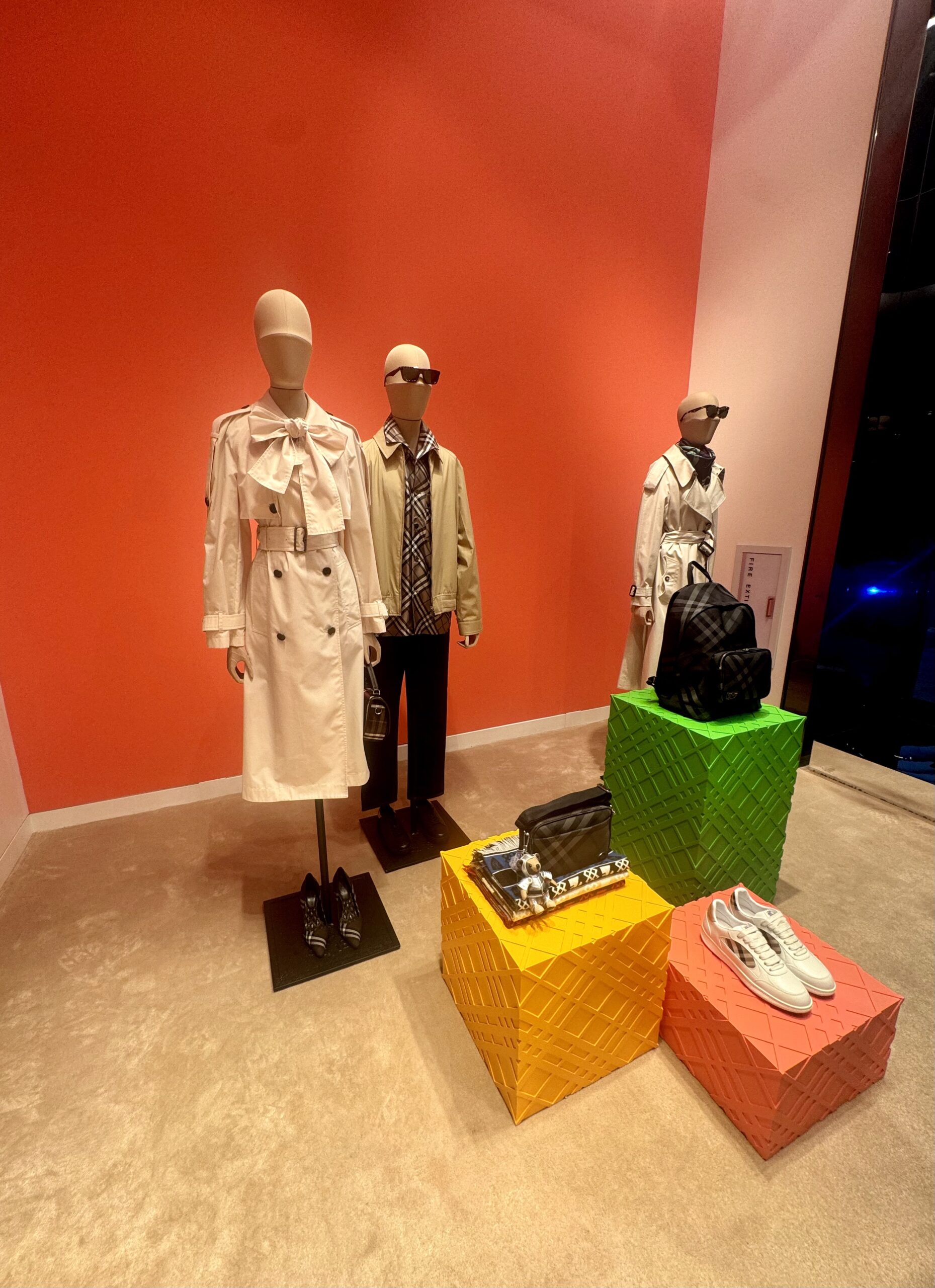
MORRIS: Oh, yeah. I went to a shop on 23rd Street called the City Opera Thrift, and all the money from that thrift store goes to the Lincoln Center. I found a really amazing Burberry trench coat, one of the old ones where you zip in the linings. This has been in my closet now for at least 23 years. It’s very cool. And in fact, I would love to do something with the linings of their trench coats at some point.
NEVINS: You heard it here first.
MORRIS: I’d love to do that because I think it’s like the whole idea of flashing the lining.
NEVINS: So let’s get into some more Miami specific conversation. You’ve made many films about particular cities, New York, L.A., Rio.
MORRIS: 17 films! I made one about Miami in 2002.
NEVINS: So, where does one start with Miami?
MORRIS: Oh, my God. I love shooting in Miami. At the time I was pregnant. We shot at the NASCAR racetrack, which is insanely loud and I actually thought I was imperiling my baby. I shot at the Hialeah Stadium, which is bankrupt and empty, pink and green and smells like a combination of cotton candy and piss. There were pink flamingos breeding in the grounds of the Hialeah Stadium. We shot at the cruise lines, which, of course, apparently the DEA is all over those cruise lines. There was a really great scene in a florist, which was incredible. Another at the monorail that nobody ever uses. And an aquarium scene, of course. There’s a lot of pools. There’s a lot of women in bikinis. There’s a whole workout scene, which is excellent. It’s very OnlyFans.
NEVINS: Miami is a rich text.
MORRIS: Yes, exactly.
NEVINS: Do you have any particularly fond Basel memories here?
MORRIS: I do try to avoid art fairs.
NEVINS: I figured you might say that.
MORRIS: It’s been a while. I go to Art Basel in Switzerland more than I come to this one, but I haven’t had a reason. Maybe I came for a lecture, something like that. But I love The Grange, which was a club. I don’t know how many clubs there are still now in Miami Beach. I passed one last night.
NEVINS: I just know the gay ones.
MORRIS: I passed Twist last night. I really love the scenes in those clubs. There was this place called The Grange that was really famous. And actually, I’m sort of remembering there’s a scene in my Miami film in The Grange, and I believe it contains the Burberry shirt.
NEVINS: Well, look at that.
MORRIS: There’s a guy who’s very sexy, who we do a closeup on, and he’s in the club negotiating something. You don’t really know what he’s negotiating.
NEVINS: One can imagine.
MORRIS: Yeah, classic Miami.
NEVINS: Let’s close out with some rapid-fire questions. Our founder Andy Warhol used to do this.
MORRIS: I love Interview Magazine, by the way. When I conceived of my films at the very beginning, my first film was shot in Midtown, New York. I thought the films were an excuse, the same way Interview Magazine for Andy was an excuse to work with a lot of people. Because frankly, as an artist, you’re in your studio a lot. People don’t realize how much time you’re spending in your studio. But it’s nice to have an excuse to expand your footprint of conversations and thinking about art so, for me, I was always a really big fan of Interview Magazine.
NEVINS: Then you might recognize some of these questions.
MORRIS: What are they?
NEVINS: What did success solve for you?
MORRIS: Nothing.
NEVINS: What’s the lie you tell most often?
MORRIS: “I’m fine.”
NEVINS: What’s wrong with your generation?
MORRIS: Maybe they’re not ambitious enough.
NEVINS: What was your worst idea?
MORRIS: My worst idea would be trying to do something with Elon Musk, maybe.
NEVINS: Oh.
MORRIS: Yeah, that would be a bad idea.
NEVINS: I agree. I bet a Tesla is going to roll by any second.
MORRIS: Exactly.
NEVINS: Who should you call more often?
MORRIS: My friends. Because again, when you’re working on shows and whatever, I can go very tunnel vision.
NEVINS: Lastly, who are you in private?
MORRIS: I’m the same person.
NEVINS: There we go. Thank you, Sarah.
MORRIS: Thank you.