


MIAMI
Inside El Monte, Twins Elliot and Erick Jiménez’s Inaugural Museum Show


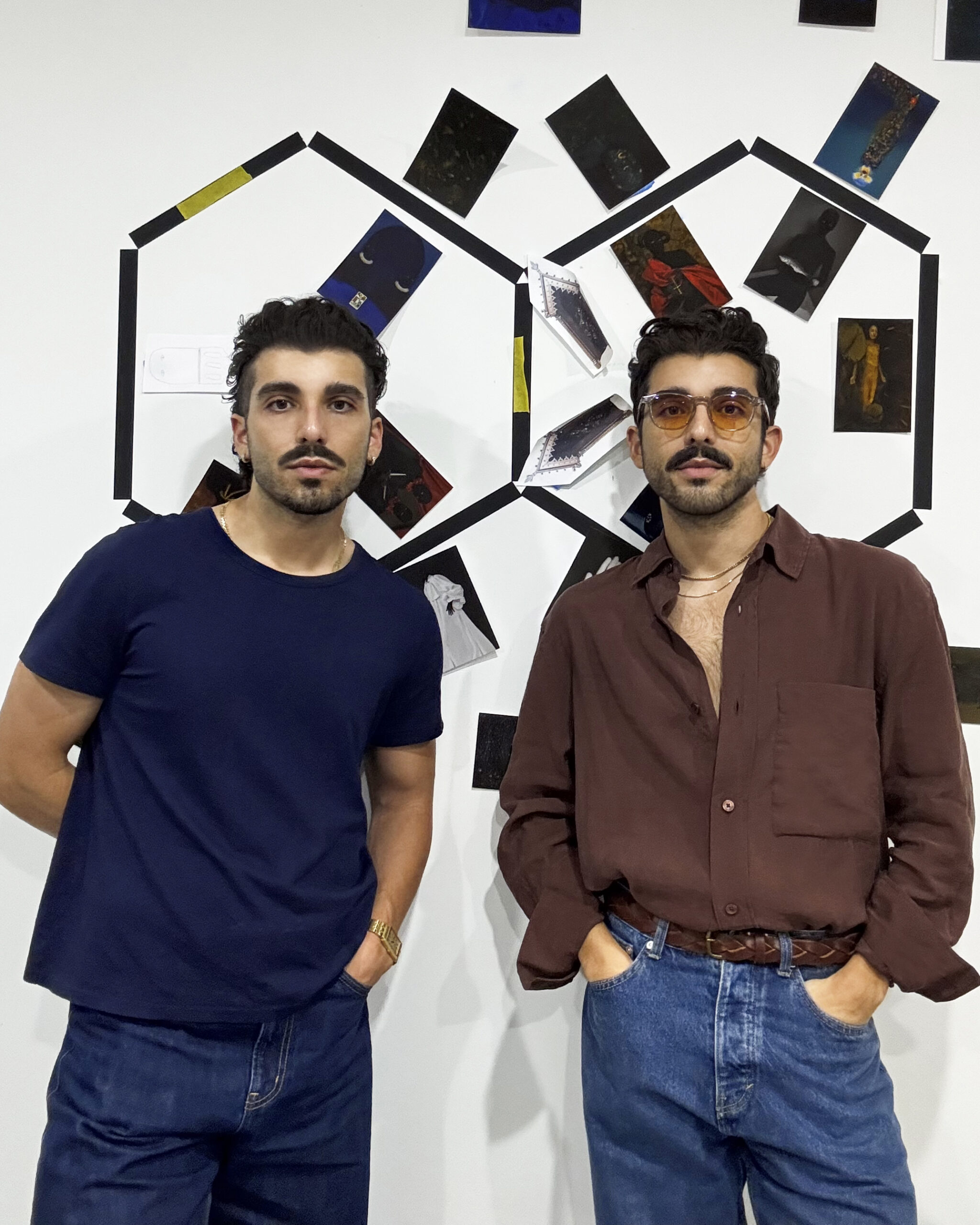
Photo courtesy of Erick and Elliot Jimenez.
“I will go first, because I’m the eldest,” Erick Jimenez told his twin brother and artistic co-conspirator when the pair got on Zoom last week, just before swarms of out-of-towners descend upon Miami for Art Basel. There, visitors will encounter El Monte, the duo’s inaugural solo exhibition at the Pérez Art Museum, a surreal, referential, and at times chilling odyssey through their already prodigious oeuvre. Now 36, the brothers have been living and working between their native Miami and New York City for almost a decade now, hopscotching from art to fashion and back (in 2023, they shot Bad Bunny for Time, the first ever issue of the magazine with a Spanish-language cover). “I feel like Hannah Montana sometimes,” said Elliot of the pair’s creative cross-pollination, in which Afro-Cuban traditions are brought into sharp and harrowing focus. “But it doesn’t really feel so much like a collision,” his brother added. “It actually felt pretty natural.” Below, they take us inside their artistic practice, from their respective relationships to divinity, spirituality, high fashion.
———
ERICK JIMENEZ: Ellie, I will go first, because I’m the eldest.
ELLIOT JIMENEZ: [Laughs] This is so funny, we’re interviewing each other. I think this is a first, for sure.
ERICK: I know we’ve been talking about this, but the last two years have been crazy, especially the last six months trying to put this together. This is probably the most challenging project we’ve ever done, so I’m going to ask you again: how are you feeling?
ELLIOT: I’m feeling good. In a world that feels kind of crazy, we have all these amazing things going on, so it’s a little weird. But I’m trying to take it one day at a time and be as present as possible.
ERICK: Yeah, I still feel tired. [Laughs] It was a lot both physically and emotionally, so I’m still trying to process all of that. But it’s a good feeling of exhaustion because something that we’ve been working towards for so long was fulfilled. So now that this show’s up, is there anything in particular that you hope the audience will take away once they walk into the space?
ELLIOT: Today, everyone’s just skimming through everything. There’s just so much information out there, so much to look at. So creating this space has really allowed us to create a moment of respite, to reflect and sort of slow down. There’s that sound of the crickets and the nighttime forest. Everyone quiets down and gets in that meditative state.
ERICK: Yeah, it demands your attention when you walk in. Thinking about all the years that we’ve been developing our practice and working together, is there any philosophical question that you feel remains unresolved in our work?
ELLIOT: For me, it’s just trying to explore ourselves, our own history, and our connection to this culture. We’ve learned so much about ourselves as artists. But maybe you have something that is unresolved for you…
ERICK: Well, everything is always going to be unresolved for me.
ELLIOT: [Laughs]
ERICK: I like things that don’t resolve easily. Especially with art, it’s more interesting. There’s a certain level of mystery and intrigue in our work, and that’s something that we’re trying to figure out and explore. We’re pulling at so many different aspects of our history and sort of Frankensteining it in a way that creates this new identity. At its core, what I’m constantly trying to figure out is: who am I within the scope of this world that we’ve been constructing? It ends up creating more questions, but I find that interesting.
ELLIOT: I have another question for you. I think we might have different answers, but which piece in the show was the toughest to shoot or to create?
ERICK: It was more so about where we were emotionally, but I’m definitely going to say the Ophelia piece. [Laughs]
ELLIOT: Okay, that’s my second toughest.
ERICK: I mean, I remember that day we were juggling—
ELLIOT: We almost gave up.
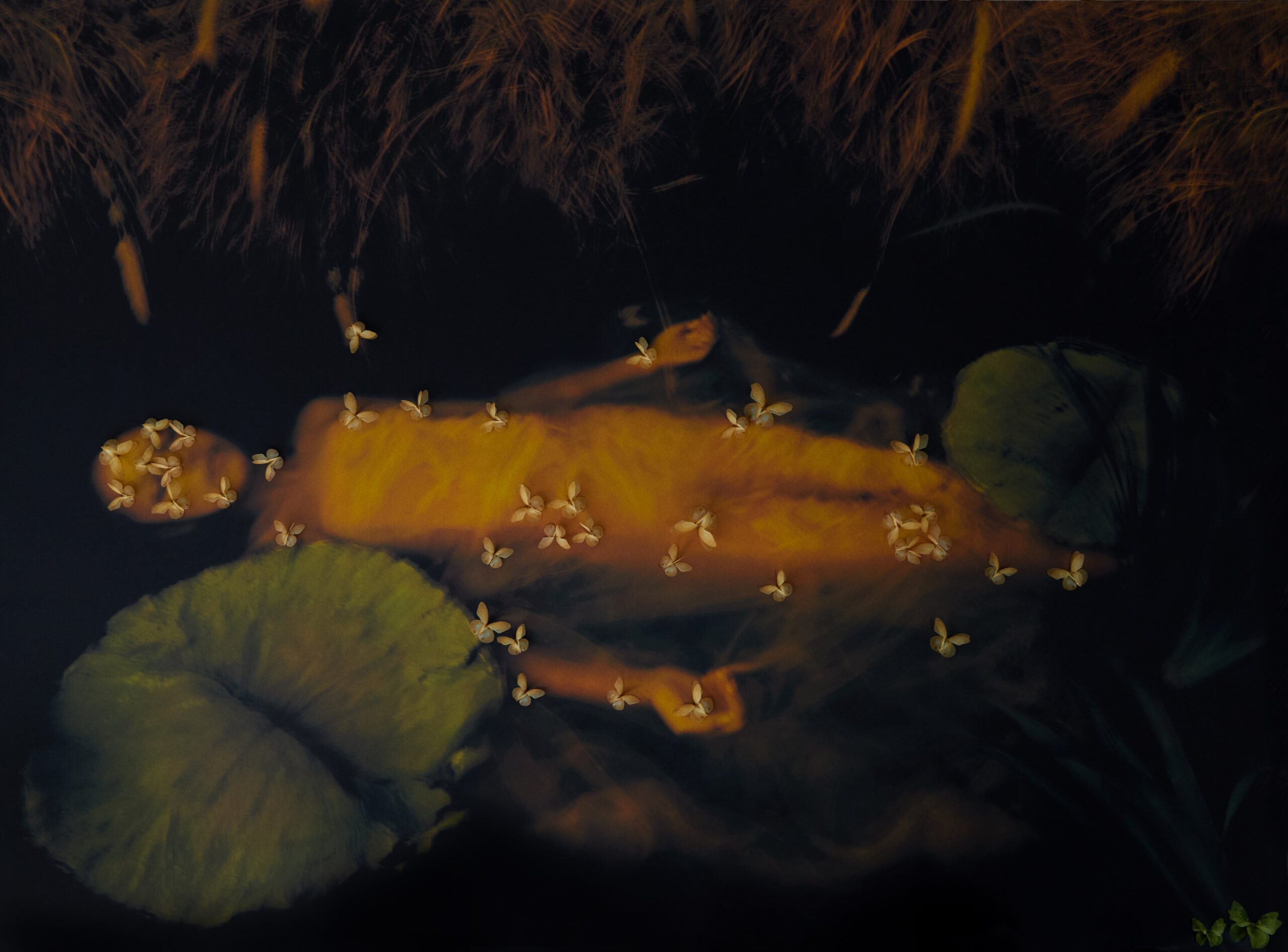
Ophelia, 2025. Courtesy of the artists and Spinello Projects.
ERICK: Yeah, we almost gave up. We were six months away from the show, so it was one of the last pieces that we did. We were finalizing for the exhibition and we were going fucking crazy. We were juggling so much. We were between commercial projects and the show. And then, in true Elliot and Erick fashion, we were trying to do everything ourselves.
ELLIOT: [Laughs]
ERICK: And obviously, with the help of Nycole [Sariol], who was with us on set that day, she was like, “Get your shit together. You either do it right or you don’t do it at all.” The Ophelia piece was so hard because of all the components we had to put together. We had to inflate that pool. That was tough, because we thought it was going to come with some sort of air pump and it didn’t, so Nycole had to blow it.
ELLIOT: [Laughs] And we were shooting it outdoors, in natural light, so we had a very specific timeframe. We wanted that golden light, because the image has a lot of warm colors in it. It was very, very specific.
ERICK: The elements were just not working in our favor, but surprisingly, after the first three shots we were like, “Oh my god, we have it.” [Laughs] But I’m glad we pushed through it, because I definitely feel like that was a breaking point.
ELLIOT: For me, the toughest piece was probably the first one we shot [El Monte (Ibejí)], which was in Montebello. Those fucking bows were a nightmare.
ERICK: [Laughs]
ELLIOT: Those two bows seemed so simple, but it was actually so incredibly difficult to figure out how to get two bows out of one ribbon. But also, it was the first image that set the tone for the rest of the show and we felt a bit of pressure there. We went through an intense research process for almost a year before we actually started shooting.
ERICK: I remember sitting there on YouTube for a good hour-and-a-half just trying to figure out how to put those damn bows together that way.
ELLIOT: I don’t think we’ll be seeing a ribbon with two bows in our work again anytime soon.
ERICK: [Laughs]
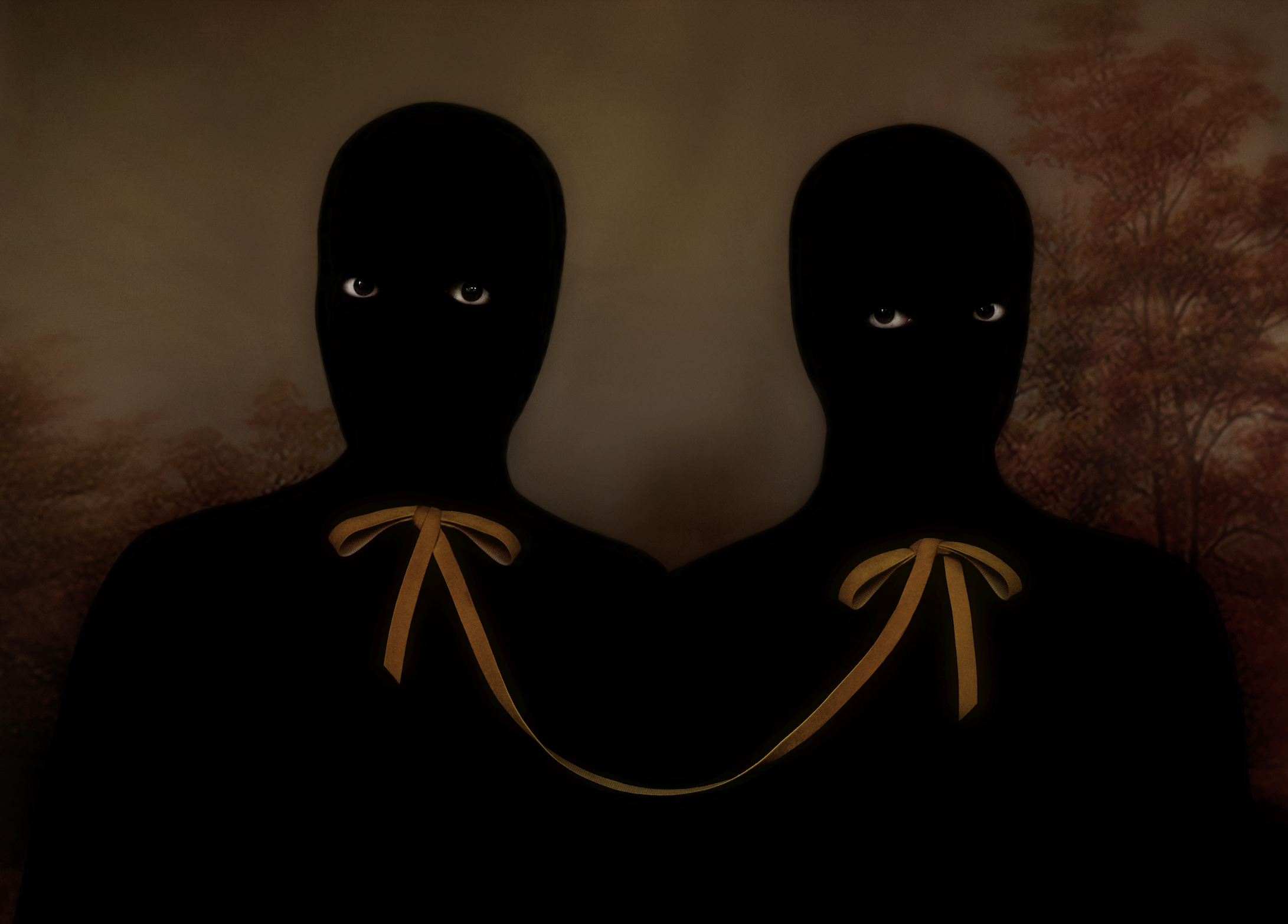
El Monte (Ibejí), 2024. Courtesy of the artists and Spinello Projects.
ELLIOT: I have a question for you. The artwork deals with the history and spiritual elements of Lucumí, but obviously we’re children of the internet era. How do you think spirituality translates in a world that’s run by algorithms?
ERICK: That’s a question that you’re better at answering. But it’s interesting to see how there’s a bit of a spiritual shift within our culture lately. I mean, we were thinking of Hilma af Klint, who’s having a moment, and Rosalia’s new album LUX, and even Guillermo del Toro’s Frankenstein. Spirituality is having an interesting moment right now. Would you agree?
ELLIOT: Yeah, I agree. I mean, everyone has a phone and everyone has a camera on their phone and photography is now looked at in such a specific way. But what we’re doing with photography is interesting, because it doesn’t feel like photography. People assume that there’s maybe some sort of Photoshop element or something digitalized about our images, because they don’t understand how we arrived at the final product. They don’t understand how we’re doing everything purely out of set design, staging, and lighting, and all these other techniques that we’ve been experimenting with.
ERICK: Yeah, it’s one of those things that you have to see in-person to really understand. And the fact that we also work at such a large scale in terms of how we’re printing the works, it really makes a difference when you’re seeing it on a small screen on your phone.
ELLIOT: Yeah, for sure.
ERICK: Let’s jump into the fashion side, casuse we’re kind of existing between two worlds: the fashion and art worlds.
ELLIOT: Like two Geminis.
ERICK: Do you ever feel like we’re living a double life, or do you think both worlds are feeding each other?
ELLIOT: Well, I feel like Hannah Montana sometimes. It’s not just jumping between these two industries, but it’s also living essentially between two cities, between New York and Miami. Obviously, having the exhibition in our hometown, we’ve had to spend quite a bit of time here. Miami right now feels like the art world, and then New York feels like the fashion world. Obviously our experience in fashion has helped us so much in the art world in terms of understanding the business aspect of things, but also the technicalities of the camera and understanding the pressure of deadlines and finishing a project at this scale for our first museum show.

Árbol Dios (Ceiba), 2025. Courtesy of the artists and Spinello Projects.
ERICK: Yeah, this exhibition was the first time we actually had these two worlds collide in that way. But it doesn’t really feel so much like a collision—it actually felt pretty natural. One thing that those who know us well mention is that it doesn’t feel like the images are necessarily very fashion-forward. It doesn’t necessarily scream fashion to you when you walk in.
ELLIOT: The way we printed from canvas to papers and put these works inside antiques, it just creates a whole other experience.
ERICK: Yeah, it does. And now that Art Basel Miami is coming up, and it’s going to be pretty much a new wave of out-of-towners mostly from our community in New York where we’ve been working for the last seven years, I’m curious to see how the fashion crowd is going to respond to the exhibition.
ELLIOT: I guess I haven’t really given it too much thought. I mean, the people who supported us in fashion will be really excited to see another side of us in our work. And maybe people who haven’t worked with us might open their eyes to how diverse our practice is. But I think it’ll be well received.
ERICK: Let’s see. I’m a bit more skeptical.
ELLIOT: You always are.
ERICK: I know, but it’s because a lot of people see us as emerging artists—and I’m totally fine with that title, I don’t mind it. But we’ve been doing this really for such a long time, and fashion can be so insular and very exclusive in terms of who gets a seat at the table. It’s a lot about celebrity culture and about who’s being photographed and who’s important. And this practice that we’ve been moving towards is a complete opposite. It’s all about anonymity. It’s all about identity. And stripping that away, I wonder if they’re going to have the same interest or reaction that they have with our fashion images. But I do hope that both worlds are able to continue to feed off of each other, and that both crowds get to appreciate the two worlds that we’re inhabiting and understand that.
ELLIOT: If they don’t, then I’m not interested in them.
ERICK: I’m going to have to bring up Time magazine with Bad Bunny, because people are always asking us questions about that and that was a significant highlight in our careers. It was our first cover in Spanish, which was a first for us and for Time magazine as well. Do you feel this experience changed the way you think about celebrity visibility and the power that an image has?
ELLIOT: Yeah, for sure. I don’t think we realized at the moment what was going to happen. Obviously we were familiar with Bad Bunny and his music, and we’re fans, but we just felt like it was so rooted in the Latin community. I don’t think I realized how global he was when that cover came out. And of course, for our grandparents who don’t speak English, to see it on the news… That moment like, “Oh, you’re on Telemundo. You made it.” That’s all they care about. But yeah, it definitely had such an impact in our career. After that we photographed Selena Gomez, and there was a moment where people in fashion were like, “Oh, they can do celebrities.” But it’s been interesting to bring them into our world, and that’s why we’ve been so selective even since then about what celebrities we work with. It’s important for us to not just take images just for the sake of taking them. And surprisingly enough, I thought it was so specific to the fashion community, but it actually impacted us, even more so, in the art world in a positive way.
ERICK: It had a very interesting impact in the art community.
ELLIOT: I mean, it shows you the power of Bad Bunny. It was definitely a moment we’ll never forget.
ERICK: I’m going to bring it back to El Monte. If the show had an unofficial soundtrack, what do you think it would be?
ELLIOT: I think it would be “November” by Max Richter. I listened to that song a lot while creating this exhibition. We listened to a lot of Ethel Cain while we were working on these pieces as well. Her album had come out around the time we were embellishing some of the work, so that was kind of cool. What about you?
ERICK: It’s a hard one.
ELLIOT: I see you looking at something…
ERICK: I’m pulling up my Spotify. [Laughs] I mean, I feel like our playlist is all over the place. We’ll have Celia Cruz playing and then we’ll switch over to Ethel Cain and then we’ll switch over to Clint Mansell and then we’ll switch Bad Bunny.
ELLIOT: For anyone who’s reading this, if this even makes it into the interview, we want to work with Ethel Cain. Someone please pair us up with Ethel Cain.
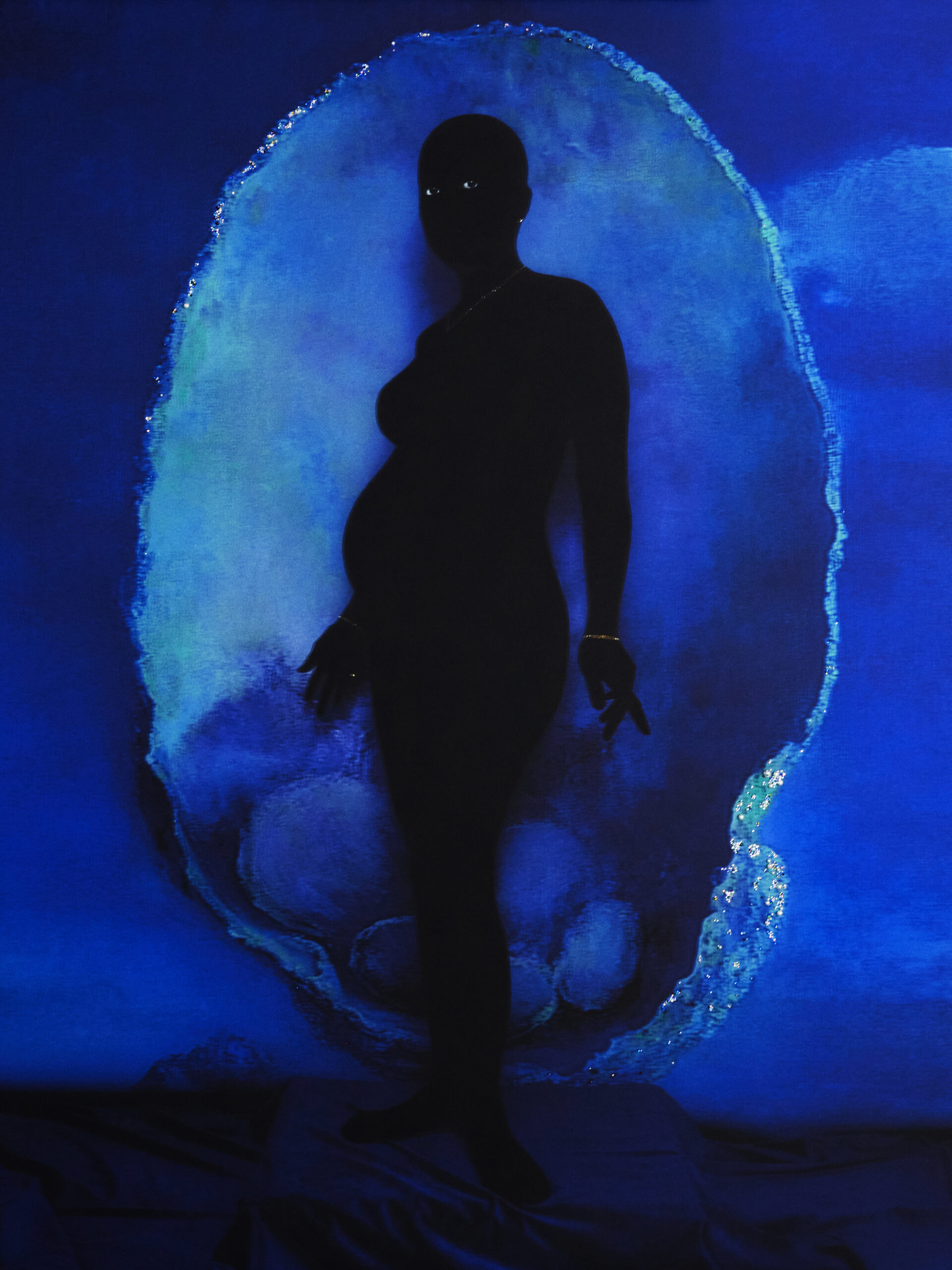
The Rebirth of Venus, 2025. Courtesy of the artists and Spinello Projects.