


BACKSTAGE
Inside the Ragtime Duet That Brought Broadway to Its Feet


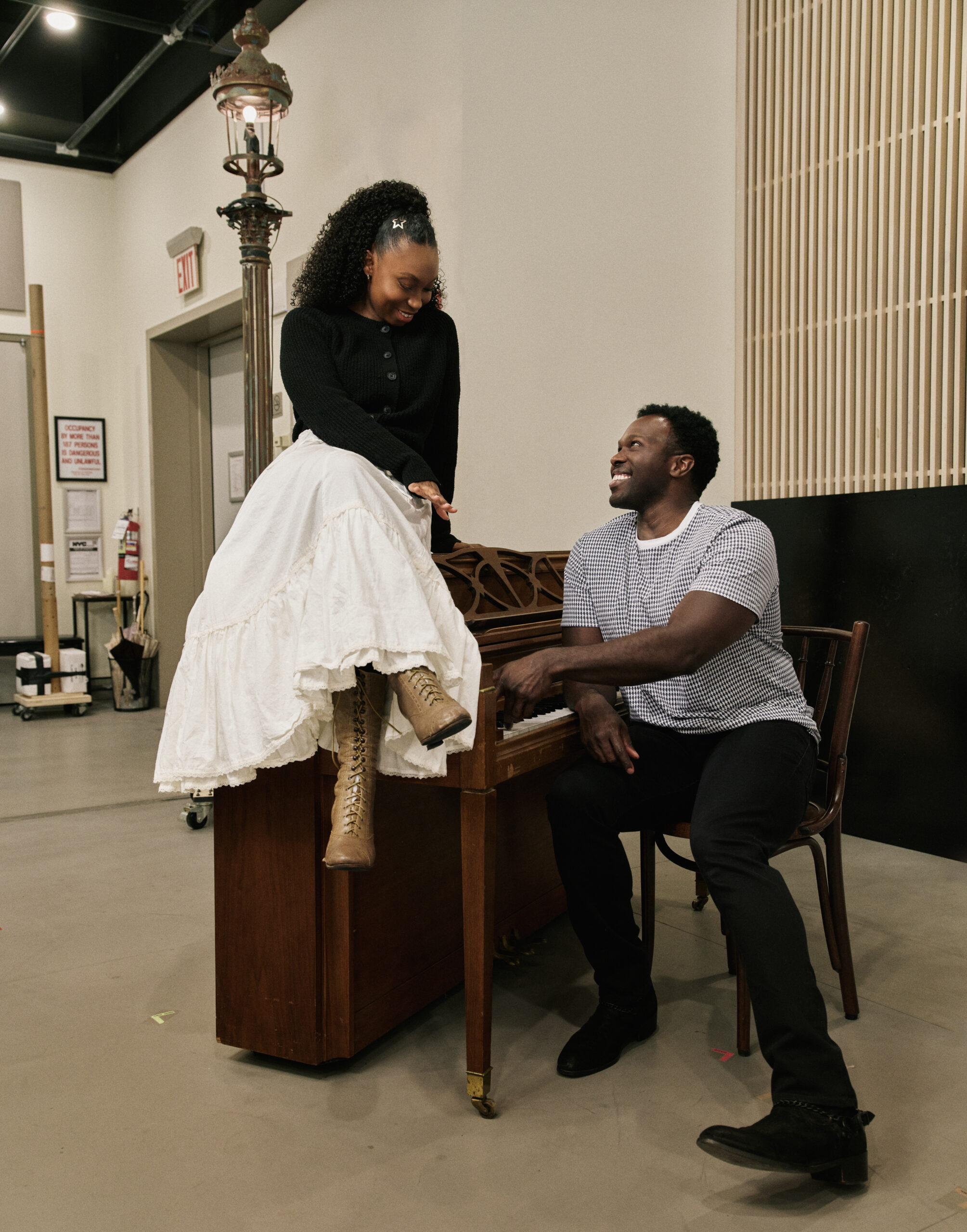
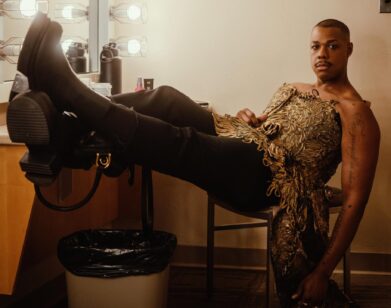
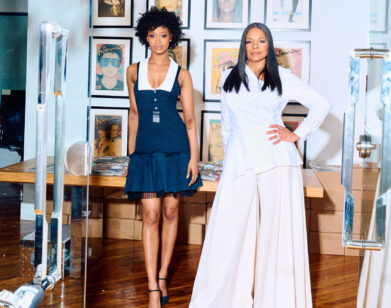
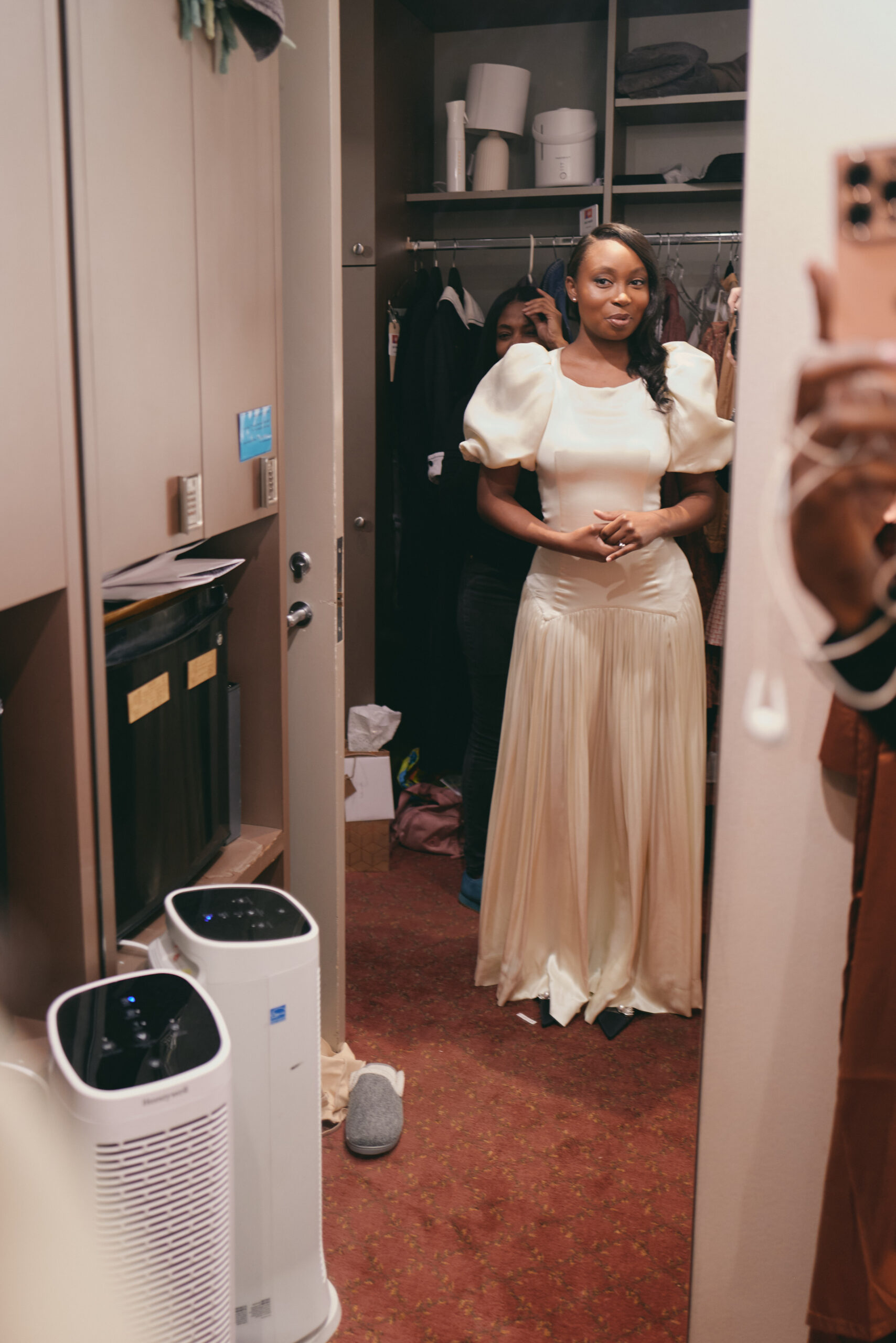
Nichelle Lewis and Joshua Henry, photographed by Emilio Madrid.
The Ragtime revival currently wowing audiences at Lincoln Center’s Vivian Beaumont Theater is, in many ways, the epitome of a true ensemble. With over 40 cast-members, a 28-piece orchestra, and some of the most extravagant costuming to hit New York theater in quite some time, director Lear DeBessonet’s production of Stephen Flaherty’s 1996 musical—itself based on E.L. Doctorow’s 1975 novel—marshals its overwhelming force from a wide variety of spirits, stories, and songs. But one in particular—”Wheels of a Dream” sung by the characters Sarah and Coalhouse Walker Jr. at the very end of a bravura first act—has elicited that rare thing: a mid-show standing ovation. For the performers Nichelle Lewis and Joshua Henry, it’s just another day at the office. “Life don’t slow down for us to do eight shows a week,” quipped Henry when the pair got on a Zoom last month to take us inside their tour de force duet. Before running off to the Beaumont for their nightly show-stopper, they took a beat to talk about vocal code-switching, the Broadway hustle, and chasing Mariah Carey’s whistle notes.
———
JOSHUA HENRY: So it’s just us.
NICHELLE LEWIS: It’s just us.
HENRY: Can I ask you a question, Nichelle?
LEWIS: Yes, of course.
HENRY: What was one of your first encounters with Ragtime, either from the music or from the show?
LEWIS: Oh, goodness. I believe it was in college, and it was either a professor or a student who just came up to me and said, “You should give this a listen and maybe sing this for one of our classes.” I think I was on vocal check, and he gave me “Your Daddy’s Son.” So I took it home and, as one does, you do your research. I went and watched bootlegs of the clips and all the things, and I was just thrown into the world of Ragtime—in complete awe from watching the glory that is Audra [McDonald], and listening to her and Brian Stokes Mitchell and everybody on there. I just remember just being like, “This is amazing and I can’t believe more people aren’t sitting here screaming about this every day.” Also, as a person of color in the industry, seeing someone like Audra, who I know has spoken about her struggles in and getting into the industry, it was so cool and inspiring and beautiful.
HENRY: Did you know all about Audra and Stokes at the time, or was that your intro into them?
LEWIS: I didn’t know about Brian Stokes Mitchell and a lot of the other folks. I knew about Audra, of course—because I am a Black woman, and coming into the theater industry, she was kind of the person that I saw. To be honest, it was her and Cynthia Erivo. I remember doing a little bit of research on them both and just being like, “If they can do it, I can do it.” Watching them as a young person do their thing despite the odds was super inspiring for me.
HENRY: And here you are doing it. Come on.
LEWIS: [Laughs] And here I’m doing it, and it’s crazy! But how about you? I want to hear your story, how you got into all of this.
HENRY: I mean, it was the kind of same thing. A professor told me, “Listen to musical theater—the canon.” One of the things that came up was Ragtime. I was a little freshman, and Ragtime was a big musical. I remember hearing Stokes’s voice and being like, “Whoa, that’s power. That is authority. That’s taking up a lot of space.” I didn’t know what musical theater was, really, even though I was majoring in it. But I fell in love with the art form having listened to that musical. God, it grips you, and it doesn’t let you go. So since then I’ve just been on a quest to make people put down their phones and just get lost in something. I think that’s what we’re doing over there at the [Vivian] Beaumont [Theater]. What do you think?
LEWIS: Oh, 100%. I feel like our stories align so much, because it’s the same for me. I didn’t know anything about musical theater really going into it. I knew about two people, so I’m the same as you.
HENRY: I was the one that was literally like, “Who’s [Stephen] Sondheim? Who is Jason Robert Brown?” Everybody knew but me. I was like, “I know I can sing. Don’t ask me what music theory is, don’t ask me what anything else is.” But that’s why you have to live in that library. Even in the practice room, I was like, “Who are these people?”
LEWIS: Literally the same exact thing here. I was so confused. I remember I had to take a musical theater history class and I was like, “I have no idea who anyone is, but I’m here, and that’s what matters.”
HENRY: What do you think about our cast’s energy? Has it evolved at all from the table read of the first rehearsal to now? How’s it been different?
LEWIS: I feel like we’re so blessed with this cast. Just from the get-go, even from [New York] City Center, everyone’s just been so amazingly supportive of one another. So uplifting, and kind. They bring their everything to work, and they lay it out there every day. I can’t describe how beautiful it’s been to be a part of something where everyone is giving it their all.
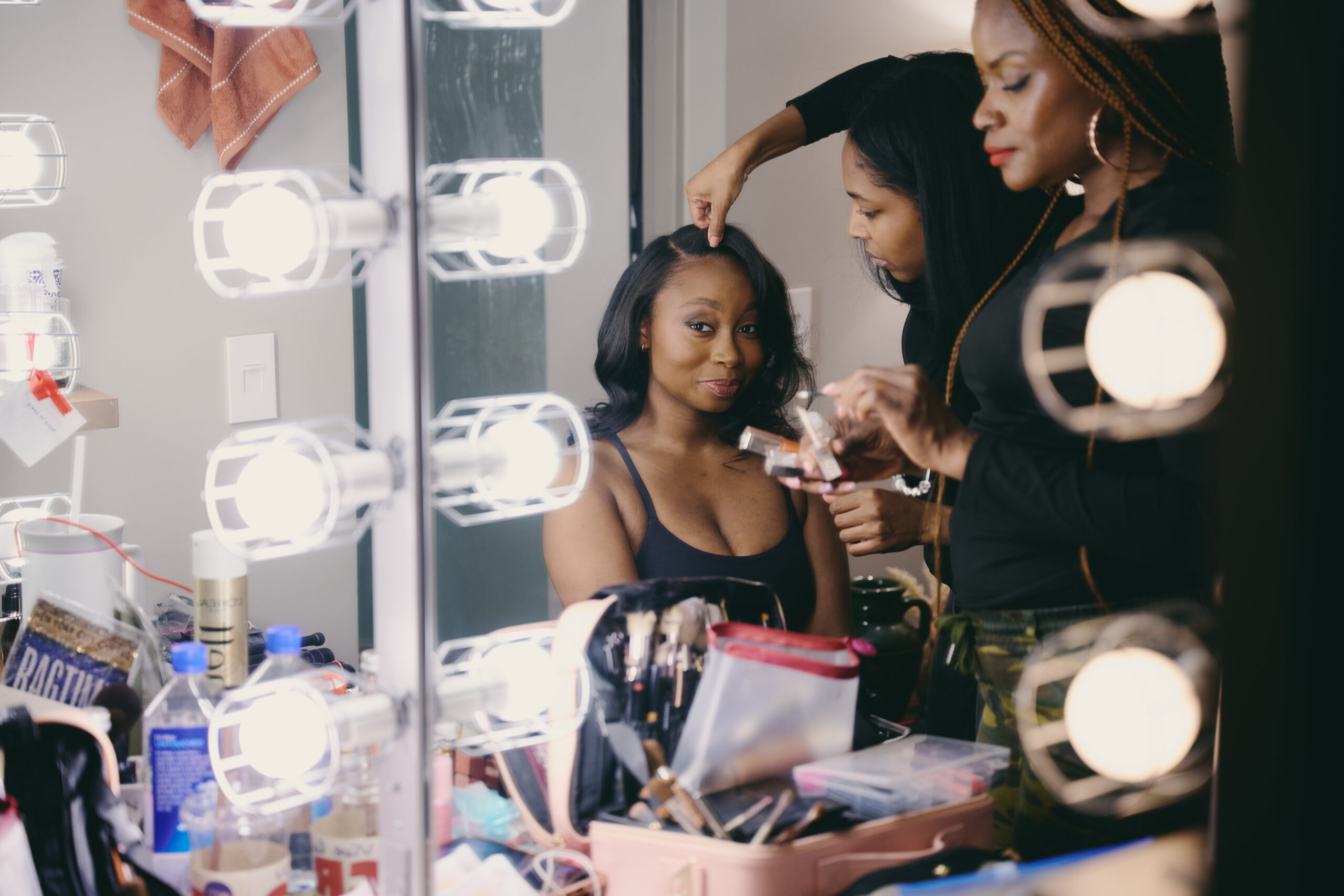
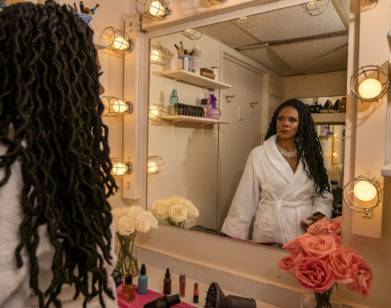
Nichelle Lewis, photographed by Jenny Anderson.
HENRY: Yeah, usually you get one of the three. They could be really talented folks, or the material is really good, but everyone is so sweet. I had a moment this morning where I was like, “I can’t wait to go to work.” I remember getting offstage yesterday and hearing that playoff, and I was holding Brandon [Uranowitz]’s hand and had my arm around Caissie [Levy], and we were just like, “Wow, this is really happening.”
LEWIS: It’s really happening.
HENRY: You pray, you hope, you dream from moments like these, where everyone’s kind, and everyone believes in what we’re doing. I’ll say, there’s something special in the air with this show, and obviously people have been really affected by it. So that feels good, to have an impact too.
LEWIS: I feel like saying goodbye to each other is going to be the hardest day. Every time I go into work, I’m just so happy to be there. There’s just something so special about this cast—like, every single person. You talked about Brian Stokes and his amazing voice, and we all know that you have a god-given voice. Were you in practice rooms working on this specific sound, or have you just always had this? What did you do to get this beautiful voice that just fills up the stage in the theater?
HENRY: Thank you, Nichelle. I really appreciate that. I have been obsessed with the voice. I wanted to know all the styles, I want to know how it feels. I want to talk about it. Scales just fascinate me; dynamics fascinate me. I had a really great voice teacher early on when I was 17, Birgit Djupedal Fioravante, who taught me the importance of just not thinking of limiting your voice. I knew I could sing, but she said, “There are no sounds that you can’t make. There are no songs that you can’t sing.” So that was my base level. So yes, I live in the practice room. When I’m not in the show, I’m singing five days a week. When I’m in the show, I’m there at least an hour before practicing. Yesterday, I was practicing Dorian Scales, Mixolydian scales—I force myself to warm up in different modes and things like that. So I’m a nerd about it. But also, it’s not work because I love it so much, and it’s just an endless rabbit hole of discovery. I have memories of finding different parts of my voice, and for this, I knew I had to really get into a darker, taller sound because Coalhouse is a leader. He is a big figure in his community, so it’s all through the lens of the character. But I’ve been practicing this ever since City Center, many days a week. So now in performance, it is a challenge, but it’s not like, “Here we go…” You take 10,000 jump shots, you’re going to make a few.
LEWIS: I feel like you kind of have to be a nerd about the voice. It’s what we do every day.
HENRY: Let me tell you something—not many people are. I think a lot of people love to sing and it feels nice, but I’m a different level of nerd. But let me talk about your voice for a second, because having heard you from City Center sing a song like “Your Daddy’s Son” and the one we get to sing together, “Wheels of a Dream,” there’s been a huge shift. You sounded amazing at City Center, but what’s it been vocally to feel what you felt at City Center in the nine days of rehearsal that we had versus now being in a run?
LEWIS: I think I’ve had to really think about what is going to be healthy to sustain with eight shows a week. And I think at City Center, I was trying to find Sarah’s sound. I wanted her to sound grounded, but also I want her to sound hopeful, young. There’s so many layers to her that I wanted her to sound like. That’s kind of why there’s tone shifts when I sing sometimes. There’s the one song, “President,” which I wanted to be more floaty. You know how we code-switch in life naturally?
HENRY: Yes.
LEWIS: This washer code-switch moment. She’s trying to see how she can talk to the President. I don’t even think people notice it, but I notice it, so it makes me happy. But I think it’s really cool how our voices just change naturally in daily life. I have a little bit of a southern twang when I talk to my mom, versus when I’m talking to someone from New York and I have to be a little bit more direct and fueled.
HENRY: Right, and less soft.
LEWIS: Yeah. There’s just different ways of speaking, and I wanted the same thing to be applied when it came to singing. I’ve always also been a nerd about the voice since I was very young. My mom would get so annoyed at me singing Mariah Carey in my room trying to do the whistle tones, sounding like a dying cat. But I got there. I’m not super informed on the—you said Diatonic scale or something?
HENRY: There’s a bunch of them. There’s Lydian, Mixolydian, Dorian, natural minor.
LEWIS: Oh my goodness.
HENRY: There’s so many. And the cool thing about those scales is they teach your voice to just vocalize in a different way and they challenge your mind as a singer. So we’re used to major, minor, blues, pentatonic, but some of these other scales can just open you up in a different way as singers.
LEWIS: I need to get into it.
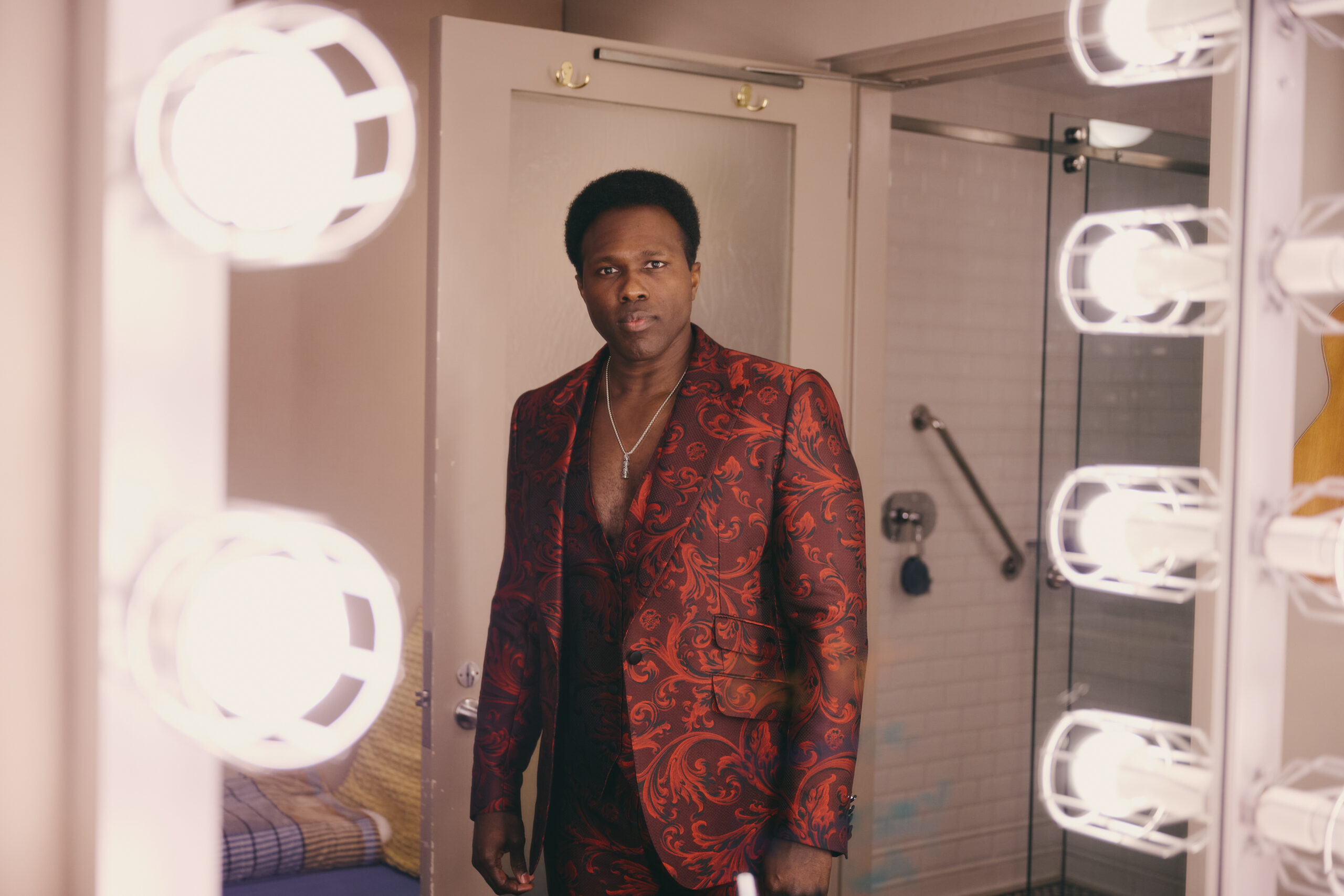
Joshua Henry, photographed by Jenny Anderson.
HENRY: Let me ask you this question: what’s been the biggest challenge in this process for you? Within the show itself, what’s been the thing that you have had to wrestle with the most?
LEWIS: Well, I’ll be honest, I think just the nitty-gritty of life and mixing a show with life, because the show is so heavy. Both of us play characters that do a roller coaster the whole show, and it’s really hard. And I’ve managed to keep myself together, and I have my things that I do after the show as well as before the show, whether that’s making sure that I come in feeling like I’ve had a little bit of a spa day, treating myself, whatever I have to do so that I can get ready and get into such an intense role. But real-life things happen, and then it is hard to continue doing the show where you are bearing your heart. Your heart is completely open the entire time you’re in this show. I find myself having to just take a deep breath, especially after coming offstage from being in such a curled-up position and allowing myself to just feel those things, but not to the point where they’re destroying me. I’ve never done a show where I’ve had to handle so much all at once. Our characters really go through it.
HENRY: You’re doing a great job navigating what’s going on in the outside world with the actual heaviness of the show. It’s a huge challenge. Life don’t slow down for us to do eight shows a week, and it’s wild. But the good thing is, backstage, we circle up and we have our moments. I’ll tell y’all who are reading: sometimes Nichelle and I have just some touch-base moments where we’re like, “Hey, how you doing?” [Laughs] We’ll joke around and we’ll just sing a little bit before a crazy thing happens, because you got to keep it light to do this heavy thing.
LEWIS: [Laughs] I feel like you’ve been such a great leader backstage. Every single time I watch you lead those circle-ups, it’s just so much joy.
HENRY: We’re here to hold each other, especially at this time. I have to say, one of my favorite moments is obviously when we get to do “Wheels of a Dream.” So we’re going to challenge you real quick: Give me three words to describe what it feels like to sing “Wheels of a Dream.”
LEWIS: It’s kind of hard to put it into three words. It feels hopeful. It feels ignited. It also feels… Oh, there’s a word I’m looking for.
HENRY: I see it on your face.
LEWIS: It feels filled.
HENRY: Hopeful, ignited, and filled.
LEWIS: Yeah.
HENRY: I would say for me it feels like flying, when that 28-piece [orchestra] is just roaring. It’s like bliss, and it’s like destiny. Singing “Wheels of a Dream” feels like a divine purpose fulfilled, to be able to show so much hope. What do we have if we don’t have hope, Nichelle?
LEWIS: Nothing.
HENRY: And to be able to embody these characters that we do night after night. We know where the story goes, and life is going to life, but right now we have an opportunity to hope and to dream. Our hopes and dreams don’t stop because something might happen two minutes from now.
LEWIS: Yeah.
HENRY: I really love the word “craft.” To me, what we do as artists is similar to sculptors. We craft something, and we chip away at it. And week to week, day to day, it changes and morphs. The first thing you did here was The Wiz, right?
LEWIS: Yeah.
HENRY: How do you think that you’ve changed since then, from an acting, singing, and movement perspective?
LEWIS: I think I’ve changed in many, many ways. I mean, it truly helped to have such amazing directors like Lear [deBessonet] and Victoria [Davidjohn]. They really were so amazing and just allowed me to just create. Having them there to just allow me that ability to spread my wings and then mold me was so amazing. I feel like I finally kind of sat with the fact that I’m doing this. I’m like, “Yes, I’m here, and I’m doing this, and I’m doing eight shows a week, and I do have what it takes.” Also, getting to be beside you and getting that masterclass every single night, truly, has helped me realize that it’s okay to take up space. In The Wiz, I did have those moments, but I was young. But here, I feel like I’m right where I’m supposed to b. Watching you guys I’m like, “Okay, so what I’m doing is not crazy.”
HENRY: Yes, we’re all blessed and lucky to be here. But you belong here, Nichelle. You belong here. Like you said, you were ready for this moment.
LEWIS: That means a lot coming from you.
HENRY: See you soon, Nichelle. [Laughs] See you at work.
LEWIS: It was so great talking to you, Joshua.