



CLOSING
“I Could Sell a House That’s on Fire”: How Ryan Serhant Conquered Manhattan


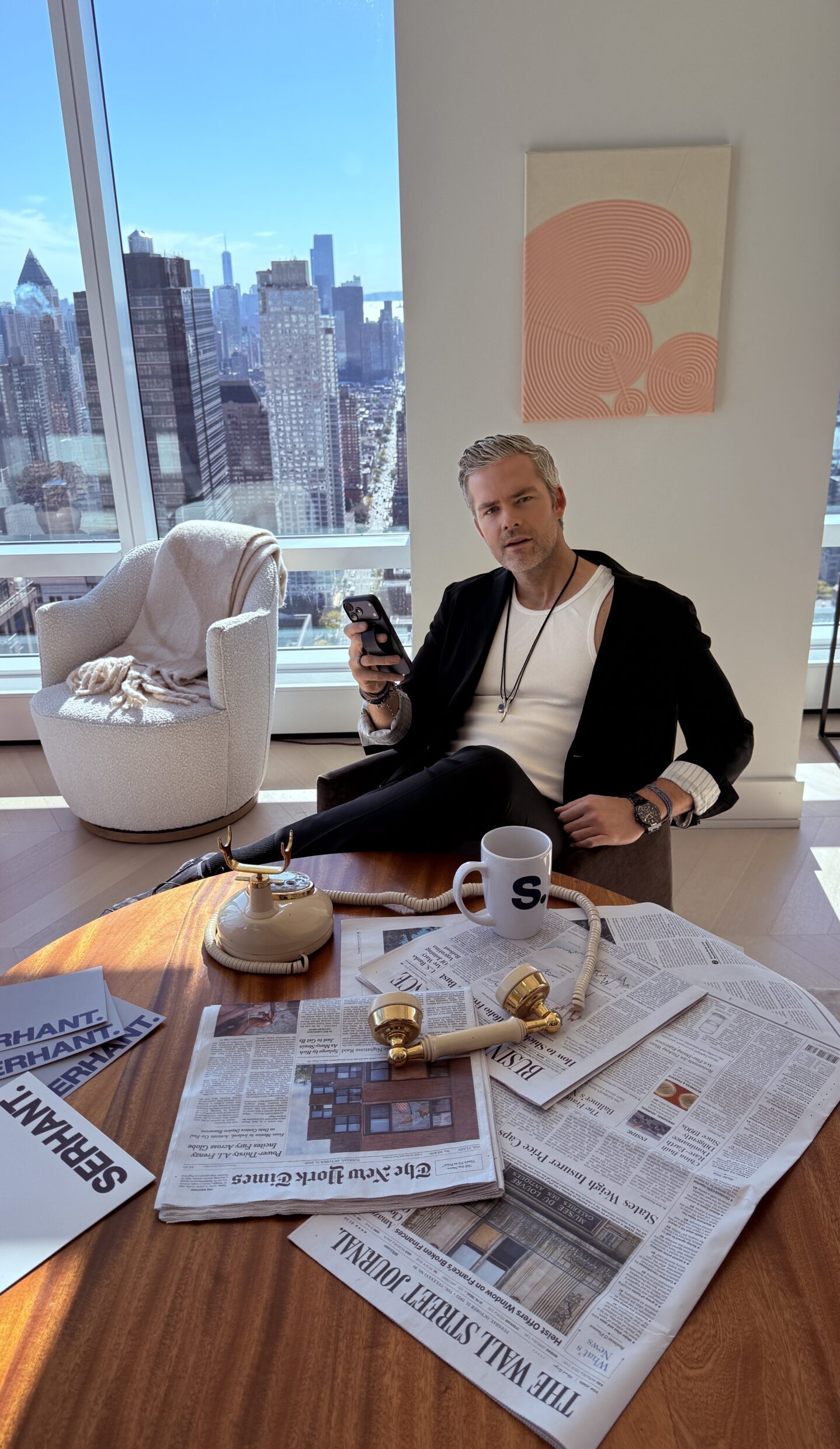
Ryan Serhant, photographed by Isaiah Gill.
When I sat down to interview Ryan Serhant, the most pressing question I had was: how much of Ryan Serhant is actually… Ryan Serhant? The real estate magnate and reality TV workhorse has engineered a persona so convincing it can border on animatronic. He has the TED-Talk cadence of a motivational speaker, every waking second of life optimized, and his sales consistently break new records. But despite his hubris, he radiates a genuine warmth, creating an effect of almost uncanny charisma. “I have an on switch and an off switch,” he told me when we spoke last month. “I think I’ve been on for so long that my off switch is almost completely off.”
Perhaps some of these blurred lines stem from the fact that Serhant, now 41 and the head honcho of his insurgent, self-named brokerage, once pursued acting. But it might also have something to do with the rapid clip at which he’s scaled up his business, both in real estate and on television. Serhant now moves properties valued at dizzying numbers—the kind that call to mind the fictional worlds of White Lotus or Succession, the latter of which he cites as inspiration for his series, Owning Manhattan. (Roman Roy’s apartment at 200 Amsterdam, in fact, is heavily featured in the show’s second season, which landed on Netflix last week).
Over the course of our conversation, I never felt as though I’d truly cracked the Serhant code. But we did cover enough ground to fill the kinds of penthouses Serhant sells, including the art of building a brokerage in the attention economy, why he’ll never take off his stack of string bracelets, and how he’s feeling about New York’s new mayor-elect, Zohran Mamdani. (Spoiler: not great.)
———
SANDSTROM: Where are you?
SERHANT: In my office today.
SANDSTROM: The office on West Broadway?
SERHANT: Yeah, in the clubhouse. Serhant House, New York.
SANDSTROM: Fun. Well, congrats on season two. The first question I wanted to ask is sort of diving in at the deep end. But how much of Ryan Serhant is a character?
SERHANT: I think, like most people, I have an on switch and an off switch. And I think I’ve been on for so long that my off switch is almost completely off. I have friends who have nine-to-five jobs, and they work so that they can live. But myself and a couple other people I know live so that they can work. It’s not necessarily by choice, it’s almost by divine intervention where I feel like I don’t have another option. My friends who have jobs so that they can live when they are “off from work,” they’re in what you would call active rest. They’re scheduled. They’re going to sporting games, they’re traveling. Because that’s what excites them, not what they do Monday through Friday. For me, my Monday through Sunday is what excites me, so my off switch is not active rest. It is literally sitting in silence sometimes just to find and sometimes recalibrate to the center for me, because I spend so much time being on, because I work every day and there’s no downtime. There was no downtime when I was a real estate agent either, and there’s definitely no downtime now.
SANDSTROM: Do you feel like you’re ever going to crash out or lose it?
SERHANT: No, because every day is different. I think burnout comes from excessive repetition. Crash outs come from repetition without an end goal. You eventually just can’t do it anymore because you just don’t know where you’re going. If you got in a car and you drove with no end in sight and the road looked the same the entire time, eventually you would pull over, because you’re going to either run out of gas or you would lose your mind. I have a pretty clear end goal and I like that every day is different, and I like that I’ve backed myself into incredible challenges.
SANDSTROM: Well, what is the end goal? How much of this lifestyle is enough?
SERHANT: I mean, I don’t do this all day long to make money. I want to build the go-to for luxury real estate and salespeople around the world, and I want to be number one at that, then I keep moving. What motivates me is to help change the way people buy and sell homes, to change the way they live, to enable the way salespeople live, work, and build incredible careers that have no ceilings and have no floors. If I was in this just to make money, I wouldn’t be doing this. It’d be terrible. It’s way too much work. But I made that decision in 2019. It was my first year crossing $20 million in annual commission income as a real estate agent. I was number one in the country. I’d done it. We were on season eight of Million Dollar Listing New York. I had done a spinoff called Sell It Like Serhant, I had done a spinoff about my wedding. I had a media company, I had an education company. And again, none of this means anything to most people, but to a realtor, it’s like, “All right, so I guess I figured it out.” It wasn’t nearly enough for me, so I made the choice to blow up my life in 2019 [when SERHANT was founded] and said, “If I could do this as one, imagine what I could do with many.”
SANDSTROM: How do other real estate agents who maybe haven’t had a similar background in media or entertainment respond to you?

SERHANT: I think people in our industry are thrown into three buckets. Bucket one are people who are inspired and who aspire to work with or work like me. It’s one of the reasons SERHANT grows so fast–the brokerage arm of the business, anyway. Our customer acquisition cost is zero because there are agents all over the world who have grown up with me who now get to say, “Let me know when you’re coming to my market. Let me know when you’re coming to my state.” In the middle, bucket two, you have people who just don’t care. They’re just so different from what we do. They don’t love or hate. It doesn’t really affect them. Bucket three are people who really, really dislike what we do, how we do it. They’re loud about it, they’re legally aggressive about it. I think there’s jealousy there, but if I’ve learned anything from that bucket, a lot of this is driven by ego. People talk about me because when they talk about themselves, no one listens.
SANDSTROM: Love that, I’m going to steal it. I’m wondering if people ever say to you that your career in entertainment undermines your work as a real estate agent. Is that something that you hear a lot?
SERHANT: Of course. I think television, media, and now social media are just mediums for attention and awareness for product. Just because I do it the way that I do it doesn’t mean it’s wrong, doesn’t necessarily mean it’s right, and the proof just has to be in the success. Then success begets success. We are doubling in size every year organically. On the brokerage part of my business, we have the greatest margin profile in the industry, and we’re profitable. I’ll do nearly $10 billion this year, which was unfathomable to me when we started in 2020/2021. We spend zero money on advertising. You look at any other competitor company that we have, they have massive spend on ads, right? Massive. Because they have to create awareness. On December 5th, 300 million people will see that Owning Manhattan is an option for them to watch. They can watch it or not, and I don’t spend any money to do that. It’s a new world. People probably said the same thing about companies that were advertising on the internet 25 years ago.
SANDSTROM: You’re kind of the real estate company for the attention economy.
SERHANT: Yeah. Someone said we were like the Mr. Beast of real estate.
SANDSTROM: There we go. One of the things I want to ask you about is what you like to splurge on financially?
SERHANT: All I think about is work. I get excited about spending on our people. Why would I buy a watch or a car? I don’t drive. Where would I drive? I have nice watches, but I only have so much wrist space. I have too many bracelets.
SANDSTROM: Actually, I really wanted to ask about the bracelets.
SERHANT: Yeah. I bought this one, this weird gray one in 2014 in Hawaii, and I put it on and it’s a piece of string and it never comes off, no matter what. I did Million Listing New York for a long time, and one woman and her daughter sent me this pink one and said when her mom got breast cancer, they would watch reruns of Million Dollar Listing when she was going through chemo. They sent this to me, probably not thinking that I was going to take a random stranger’s bracelet and put it on. This one’s from an army veteran. This one from the same thing, a guy and his dad prostate cancer. But they just don’t fucking fall off. What am I supposed to do? Wake up tomorrow and cut them off? I won’t do that. And then another year is going to go by.
SANDSTROM: That’s funny. That was not what I was expecting. I wanted to ask, what would it mean for you to take a day off? Do you take days off? When you’re describing work, it sort of sounds like an addiction.
SERHANT: I mean, season two of this show is in part about addiction in a way that I wasn’t anticipating. The show is also about being your own worst enemy. In every reality show, you have your hero, you’ve got your villain. And I spend the season looking for my villain only to realize my villain is me. So to your point, I view time off as honestly, when I’m spending time with family. I’m not on my phone, I’m not on appointments, I’m not in meetings, I’m not on Zooms, I’m not here at the office. I’m at the park trying to convince my daughter that it’s okay to do the monkey bars backwards.
SANDSTROM: Nice. I want to talk about the new mayor.
SERHANT: Yeah, sure.
SANDSTROM: And the real estate market–
SERHANT: Has done nothing.
SANDSTROM: Sure. But initially there was a lot of speculation that it would. I want to know your thoughts on it. I want to know your thoughts on Zohran. I want to know your thoughts on whether people will actually flee.
SERHANT: They will not flee. New York City is the most resilient city in the world. It is not built on the back of any one individual industry. I spent time in markets that are. There’s a lot of different industries and businesses in San Francisco and Portland and Los Angeles, but it’s predominantly focused on individual industries. And you see what happens when you have a different governing body that is anti-growth. You’ve got to run a city like a CEO, unfortunately, because you have an entire contingent of people that do not always see eye to eye. I think there was a lot of consternation about the mayor, but when it all comes down to it, New York isn’t going anywhere. Worst-case scenario, we have four years of no to very little growth. So for the real estate business, what does that mean? It means you have no new competing inventory. The reason you’re seeing–since he was elected–so many trades so quickly, especially in the luxury sector, is because for the next couple of years that might be all there is. The way to lower prices, the way to increase more housing, is to build more fucking housing, create more incentives, bring more jobs. To have a mandate of taking, instead of a mandate of creating, is the antithesis of real governorship, and being a real mayor. What we have now is a student body president who was elected by the senior class, “Let’s go, free lunch. Let’s go, recess. Senior pranks,” all that stuff. That’s who voted.
SANDSTROM: Okay.
SERHANT: I said this to Adam Newman. I did a panel for him last week and in Miami right after Mamdani had won. Everyone was so surprised and I’m like, “What are you talking about?” Who votes for anything, an online poll, an election? It’s the people who haven’t won yet, that’s who votes. The people who voted for Cuomo are not Pro-Cuomo, but they had already won the game. Their kids are in the best schools. They have one or two houses, they can move whenever they want. They’ve already figured it out. Everywhere else, regardless of where you fall between socialism, capitalism, communism, income or no income, haven’t won yet, and New York is fucking expensive, and a lot of life is not fair. So you’re going to vote for the person that calls that out. So, obviously he won. I think a lot of this stems from poor education and poor parenting. Two things that are clearly hard to fix.
SANDSTROM: But let’s talk about something you just said, the people who haven’t won. You have built a career in one of the most unequal cities in the world.
SERHANT: Sure.
SANDSTROM: How do you feel about people trying to get a start? Surely there’s a part of you that must feel emotionally tickled by the inequalities you see all the time.
SERHANT: But I never, ever, ever felt like what’s yours should be mine. That’s never been in my blood. If you can make it in New York, you can make it anywhere because it is the hardest city to survive in. Which is why I think TV shows about New York City are so exciting, because the city is such a character itself. Not just architecturally and aesthetically, but the energy is ruthless here. But instead of looking at the success of people in New York City and saying, “That’s unfair.” I look at it and I say, “Wow, if he can do that, so can I. Why not me?” I think a lot of people who complain also have never traveled a day in their life. Go to India, go to China. In Hong Kong, on the same street, you have the wealthiest of the wealthy and on the other side of the street, the poorest of the poor in a way that you’ve never, ever, ever even seen in the United States, let alone in New York City. People just need to be educated. They need to see what the rest of the world is like.
SANDSTROM: There’s a big part in my notes where it says, “Routine.” So much of what we’ve spoken about work and performance makes me wonder, how do you do this?
SERHANT: I don’t have another choice.
SANDSTROM: It’s just innate?
SERHANT: I’ve been let down by so many people who make decisions based on how they feel that I subconsciously made a decision a long time ago to make decisions based on what I commit to. There will be people who cancel, who are late, who don’t feel well, they have a tummy ache, and that’ll be a last-minute change for me. I’ve learned to understand the value of those minutes and I can take them back. It’s like god gifting me time to have freedom.
SANDSTROM: I’m realizing we haven’t spoken about the properties themselves. I’m wondering what’s your least favorite property that you’ve had to sell? What are the biggest challenges for you?
SERHANT: So many, and it’s always only because of one thing. It’s just because they’re overpriced. They’re not priced to meet the market. I could sell a house that’s on fire, but if it’s priced to meet the market, then it doesn’t matter. I could sell the weirdest, craziest thing ever. On season two of Million Dollar Listing, I sold a Spanish Gothic sex church apartment. It was renovated by swingers. There was a confessional in there, there were cameras everywhere and sex swings, but we priced it and we sold it. Right price per square foot, little renovation costs, sold it for just over $4 million. It didn’t sell for 6, it didn’t sell for 8, but it sold where the market was.
SANDSTROM: I want to know what the feedback has been from season one of Owning Manhattan, and season two from anyone who’s seen it?
SERHANT: Owning Manhattan changed my life. It was a risk and I had some control over it. I didn’t want to do Million Dollar Listing two, “The College Years.” We weren’t going to do Selling Sunset, which was created by people that looked at Million Listing New York and at Housewives and said, “What if those were together?” We had to create something new. And the shows I like to watch at that time when we were inventing Owning Manhattan, were like Succession. And on the reality spectrum, Vanderpump Rules was the number one show in the world. So we asked, “What does that combo look like? And then what if there’s a voiceover like Gossip Girl?”
SANDSTROM: Are you a big Gossip Girl fan?
SERHANT: I was, yeah. And we asked, “What if there’s a narrative thread and it’s not just random parties and then the fallout from a party and then another party and then the fallout from a party? What would that look like?” It took us a while to figure it out. But season one really redefined the genre, and I think that’s why we got a second season pick up so fast, and why so many people watched it. Season two is an emotional skyscraper.