


CONTENDER
Wagner Moura Is Doing It for Brazil


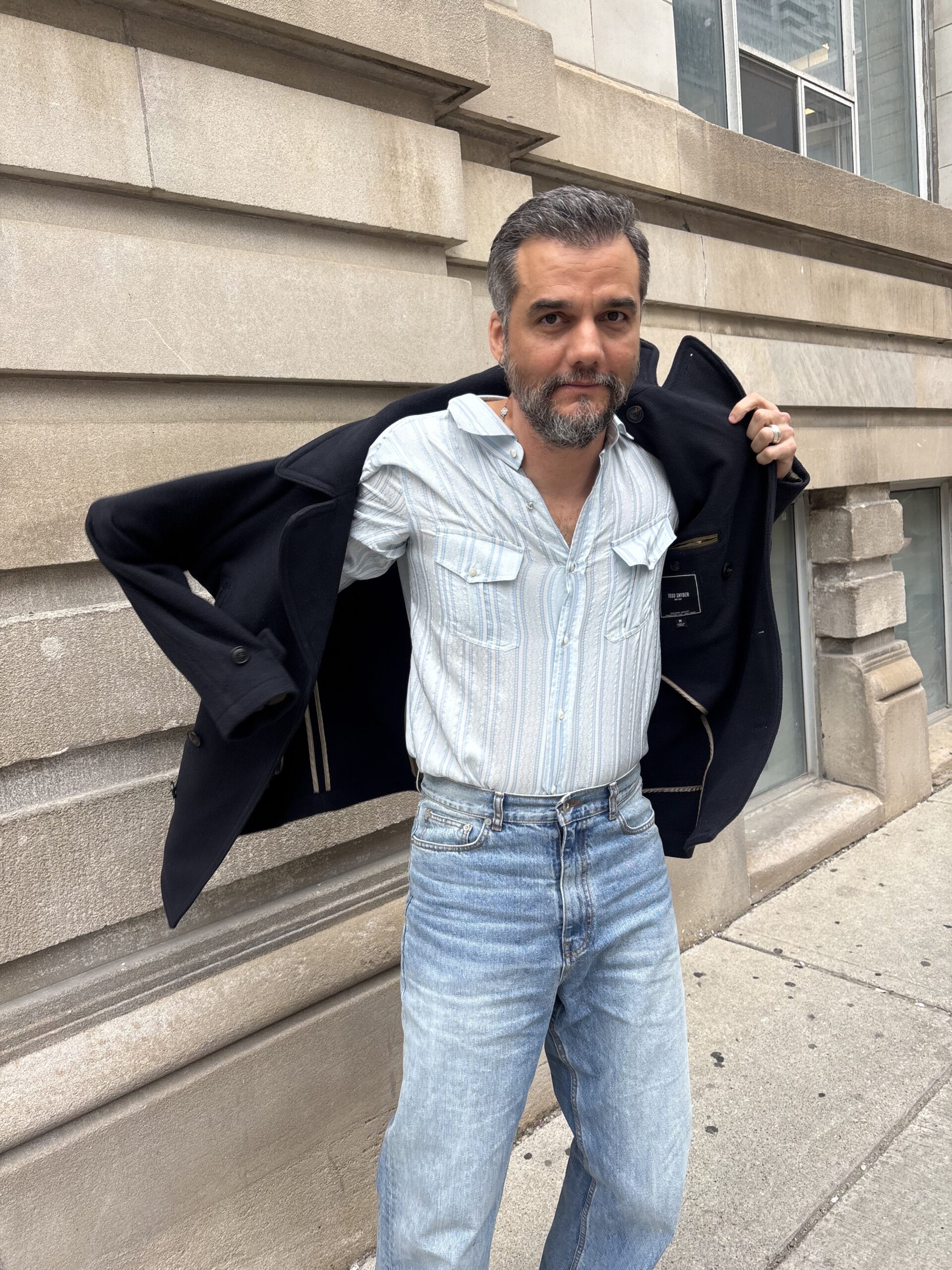
After his breakout role as Pablo Escobar in Narcos and anchoring the A24 blockbuster Civil War, Wagner Moura has delivered the performance of his life in The Secret Agent. In Kleber Mendonça Filho’s shapeshifting thriller, Moura navigates a labyrinth of political paranoia that feels terrifyingly current. The role earned him Best Actor at Cannes and serious Oscar buzz, a triumphant return home for an artist who has never shied away from confronting Brazil’s polarized politics. To discuss the resurgence of Brazilian cinema and the chaos of awards season, he hopped on a call with his Shining Girls co-star and longtime pal Elisabeth Moss for a transatlantic catch-up.
———
ELISABETH MOSS: Hi, Wag. Look at you. You look great.
WAGNER MOURA: You too. Where are you? New York?
MOSS: No, I’m actually in Florida for Thanksgiving.
MOURA: I’m in Paris. It’s cold here.
MOSS: What are you doing in Paris?
MOURA: I’m promoting the film. It’s too cold and I’m too Brazilian. Today I had some time off and walked two blocks and said, “What am I doing?” The sky was so gray.
MOSS: [Laughs] I spent a lot of time in Paris a couple of years ago, and it rains more in Paris than in London. But I’m just laughing because it took you maybe 10 seconds to say that you’re too Brazilian for something.
MOURA: [Laughs] Hey, I miss you.
MOSS: I miss you, too.
MOURA: Long time, we don’t speak.
MOSS: I don’t like it. And then when this movie happened and everyone started talking about how amazing you were in it, Lindsay, my producing partner, texted me and she was like, “They’re saying he’s going to get nominated for an Oscar for this.”
MOURA: I’ve been working more in Brazil than I used to, which is great. I was just doing a play there.
MOSS: That’s what I read. I was doing my research last night, which meant I went online and looked at pictures of you and your wife at Cannes and then I read one interview. That was it. [Laughs]
MOURA: That’s good enough.
MOSS: How is your family?
MOURA: They’re all good. My boys are now 19, 15 and 13.
MOSS: No!
MOURA: Yeah, it’s crazy.
MOSS: That doesn’t make any sense!
MOURA: [Laughs] It doesn’t. I’m preparing myself for them to go do their thing, go to college, and I don’t know what I’m going to do.
MOSS: Wow.
MOURA: Maybe move to Italy so we can do that movie.
MOSS: I still want to do that movie and I still want to do your movie. I don’t know what I’m allowed to talk about.
MOURA: You’re absolutely allowed to talk about it. I think we’re going to shoot it in November, finally.
MOSS: You tell me when, I’ll be there.
MOURA: For me it’s important not only to have great actors, but my friends, people that I love because it’s the first time I’m going to direct a film here in the U.S.
MOSS: You have to have as many people you trust and friends around you as possible. It’s the best. You’ll have the most fun if you’re surrounded by people that you like to hang out with. I think it’s going to be easier than you think. You’re not one of those actors who’s completely in their own head. You know where the camera is, you know where the other actor is, so you know what your own performance is and you are very good at being like, “I want to go further in that direction, or I’ve done that version, I want to do the other version now.”
MOURA: That’s exactly how I feel when I’m working with you.
MOSS: Well, my number one question was going to be, what was your favorite thing about working with me? And then, what is your favorite piece of mine that I’ve done?
MOURA: I’ll totally answer that.
MOSS: [Laughs] No, no, no. I want to talk about your movie.
MOURA: Let me ask you about you a little bit, because I know you’re living a beautiful moment in your life.
MOSS: Thank you. I’ll have to send you pictures.
MOURA: You have to send me a video because now I can’t see babies talking anymore because I feel like I’m becoming so emotional with these things.
MOSS: That was something I wanted to talk to you about. I know your relationship with your boys and how much you love them, and seeing that scene in the car with your boy when he’s asking about the mom and you do this—let me just compliment you for a second. You look in the rearview mirror, I think he says, “It’s so sad,” and you do this thing where it looks like he punched you in the stomach. And you see it go through your body and in your eyes and then it’s gone. And then you have to answer your child. You have to tell him it’s going to be okay. I lost it. It’s such a beautiful moment.
MOURA: You are a mom and you know how this is.
MOSS: The way you have to speak to him.
MOURA: Yes. The way we have to speak with them and to protect them, but also to be honest with them. Protecting is not lying.
MOSS: I’m curious, what was the thing that came out of this movie that happened that you were not expecting and you were surprised by?
MOURA: It’s always a surprise. It’s really hard to work with directors or actors that are not open to surprises.
MOSS: It’s impossible.
MOURA: It’s really hard because you’re closing one billion possibilities that can appear in that very same moment. And the thing that I love most about working with you was that every take that we did in Shining Girls was something different. I was just looking at you and going, let’s just give myself to her and go into that. So the whole film in a way was sort of like that. Otherwise it’s boring.
MOSS: Right.
MOURA: I knew what this film was going to be about but the making of it, I was so happy Lizzie, and it’s interesting because not every time that you’re happy on a film set results in a good film. And the opposite is also true, right?
MOSS: Yes, absolutely.
MOURA: But this film, everything was great.
MOSS: I don’t feel like there’s a point to doing anything if you don’t try different things. Theater’s the same because it’s different every night. I don’t know what you’re bringing to the theater. I don’t know if you just got into a fight. I don’t know if you just got good news. I don’t know if you slept an hour. Whatever it is, we don’t know, and that’s the best part.
MOURA: But not everybody goes in that direction. Things are becoming too controlled.
MOSS: That’s not what art is. There is no formula. I mean, look at this film, a Brazilian film with a brilliant director.
MOURA: He doesn’t follow any kind of rule. You only kind of start to understand what’s going on in that film after an hour and a half. It’s outside of the algorithm’s realm.
MOSS: Yeah, because you can’t prescribe it.
MOURA: I wish you were here in Paris now.
MOSS: Do you know how much time I spent in Paris?
MOURA: I would have an Aperol.
MOSS: [Laughs] Many, many, many Moscow Mules.
MOURA: [Laughs] Moscow Mules.
MOSS: I don’t drink Moscow Mules as much anymore. It’s very sad. I need you in my life.
MOURA: I don’t drink anything as much as I used to.
MOSS: [Laughs] What have we become?
MOURA: But at least when you have a glass of wine or two now, you’ll appreciate it.
MOSS: It’s very true. Anyway, I suppose I hate it when I get asked this question, but I’m going to ask you because as your friend. You’re doing so much press. Do you love it because you love the movie?
MOURA: That’s exactly the right answer. If this wasn’t a movie that I was really connected with—especially after I’m Still Here, which was such a huge success—it’s reconnecting Brazilians with the Brazilian films after a very difficult political moment in Brazil where the far right was transforming artists into the enemies of the people. So the connection that the Brazilian audience is having with Brazilian films is so great. Sometimes I’m like, “Oh man, I’m tired.” Especially when I’m in another time zone. And again, I can’t drink the way I used to and now I have to sleep for eight hours. I used to drink at night, and then wake up. And the other day I was like, “I can’t, I feel like shit.”
MOSS: No, you can’t do that anymore.
MOURA: But hey, what are you doing now?
MOSS: I just finished doing a show in L.A. It was very back to back because I basically worked my entire pregnancy and then I was prepping the final season of [ The] Handmaid’s Tale during the pregnancy as well because I directed four of those episodes, and so I didn’t really take much of a break. And I had a three-month maternity leave, but I was prepping during that time anyway. Then I went back and did the whole season.
MOURA: You directed four episodes?
MOSS: Yeah. And then went and did this Apple show. My deal internally and with my collaborators was that I would do this, but then I would take a break. So I’m taking that break now.
MOURA: How’s it going?
MOSS: I love it so much, but I think it’s because I have her. Before, three months would’ve been about the limit. I would’ve been getting very antsy, like, I need to travel, I need to work, I need to be on set. It’s just very different now. I just want to spend time with her.
MOURA: Are you already thinking about schools and things like that?
MOSS: No, I’m just trying to just enjoy every day with her. Working so much when she was little made me really appreciate even more getting to spend the time with her.
MOURA: For me, this has been an impossible balance. I came to realize that because I’ve tried to bring them with me. I’ve tried to go back all the time. I’ve tried everything. It was very heartbreaking when I’d go back home and see they grew up. But also it’s beautiful to see their understanding of it. I was doing the play and I spent two weeks with them in L.A. and then I started doing these trips and I was like, “Guys, I’m sorry, I have to go.” And they were like, “Hey man, I get it. This is what you do.”
MOSS: Wow. That’s amazing. But it’s a testament to you and your wife and how you spoke to them about the work. I can’t imagine how proud they must be of you. I don’t know how much you talk to them about politics, but when they get to look back on the history of the time that they lived in and the time that their father lived in and to see how their father stood up for their country and stood up for what was right and stood up for others, and helped other people to have a voice and to be able to fight for what they believe in—I mean, what you have done with this marriage of art and life and art and politics is not normal. It’s rare, Wag, and to have somebody who is a voice for their country and a voice for the arts in their country, that is an extraordinary achievement. I think your sons are going to be, and already are, so proud of that.
MOURA: Thank you.
MOSS: Do you talk to them about the films about that side and the politics and everything?
MOURA: I do, because Brazil, like the U.S., is so polarized politically. There are people on the internet that don’t like me. [Laughs]
MOSS: I think that’s what the internet is for.
MOURA: I also want to make them aware that they might also read things about me. This is another issue about the internet—how to protect your kids from that.
MOSS: Yeah. That’s a whole other…
MOURA: I hope this takes you 15 years, but you have to live with that.
MOSS: It’ll be something else by the time she’s older. How do we deal with something like that we haven’t even seen yet?
MOURA: Exactly.
MOSS: It’ll be something totally new. You’ll be like, “Remember the days when there was just Instagram and it was so easy?”
MOURA: Now we have to deal with this robot in our house telling our kids what to do.
MOSS: Holograms. I feel like I should ask you other things about the movie.
MOURA: You don’t need to. I’m so happy to be talking to you.
MOSS: I’m so happy to be talking to you. This is so lovely.
MOURA: Sometimes I think about you often.
MOSS: Me too, honestly. I really do. I have to ask you because it’s just such a moment. What was it like at Cannes? Were you expecting that award? Well, of course you weren’t expecting it, no one’s expecting it, but what was that like?
MOURA: It was so fun. But on the day of the awards, I was in London shooting. Do you know the story? Saturday was my day off, but then the production asked me to shoot with the third unit. So it was just like close-ups of my hand, and I couldn’t say, “I’m going to be in Cannes because I think I’m going to receive an award.”
MOSS: [Laughs] Oh, you literally can’t say that. Somebody should have said it for you.
MOURA: I know, but you know how I am.
MOSS: You’re such a team player. It’s not a real unit by the way, Wag.
MOURA: No Lizzie, it’s people that I had never seen in my life. They hadn’t read the script. They didn’t know anything about the film, just doing stock shots of things.
MOSS: Oh no.
MOURA: And then I had the break and one of the crew members called me in a video call and he was showing Kleber, the director, on stage. I was like, “Holy shit, Kleber won,” and then he turned the phone to himself and said, “No, you won.” I was like, “What?” So I went to the set and this is the thing that I was doing. I was putting a plastic bag on my hand and picking up dog shit on the ground, while I was thinking, “Holy shit, I won this.”
MOSS: [Laughs] “I won best actor.”
MOURA: And I couldn’t share it with anyone because I didn’t know anyone.
MOSS: Wait, that’s amazing.
MOURA: I was alone, picking up dog shit.
MOSS: [Laughs] Okay. I want to ask you another question about the movie so that I’m a good journalist. How do you look at how you choose your projects?
MOURA: I’ve never done anything for money, that’s for sure. I’ve never done anything because it would lead me to another thing. I’ve never done a film because it was a big blockbuster. I’d like to think that when I look back that I’m coherent with the choices that I made, so I see that many of the films that I’ve done are very political because I like politics and also I tend to see social and political meanings in things that others probably don’t.
MOSS: I don’t know if this is a good question or not, but what do you want to see for Brazilian cinema? You’re such a big part of it, and it feels like you’re going to be doing more of it.
MOURA: Yeah.
MOSS: Not that it’s your responsibility or it’s only on your shoulders, but what do you want to see for Brazilians?
MOURA: It’s a very good question because it really matters. I want Brazilians to see themselves in what we do as artists, because no country develops without that notion that we can only understand who we are when we see ourselves in our books, in our plays, in our films. That’s when we get a notion of what kind of country this is, and this is given by their artists. To this day, there is a big discussion in Brazil: should the government fund arts? I think it’s going on everywhere in the world. The extreme right is like, “No, we shouldn’t spend money on that shit.” And I think that actually is strategic, not in terms of propaganda, but in terms of self-esteem. For Brazilians to see ourselves, I think it’s even more important. This is what I want. Because Brazilian movies are very dependent on government funding, so if it depends on the government, it’s over. I wanted this to be a policy of state, not government policy, to be steady—because it’s a fucking unique country in terms of culture, and it’s beautiful.
MOSS: Very much so. I love that.
MOURA: I love you so much.
MOSS: I love you.
MOURA: I don’t want to spend more than a year without connecting.
MOSS: I’m always watching though, thinking about you and admiring what you’re doing.
MOURA: You take care, Lizzie. Thanks for doing this.
MOSS: Of course. Okay, I’m going to text you. I don’t have WhatsApp anymore. I have to reload my WhatsApp, but are you on WhatsApp or are you on regular phone?
MOURA: Yeah, I also work with Messenger.
MOSS: Okay, I’ll text you.
Grooming: Kiki Heitkotter @ The Wall Group.