


SMOKE BREAK
Designer Alexander May Wants to Bring Back the Big Daddy Desk


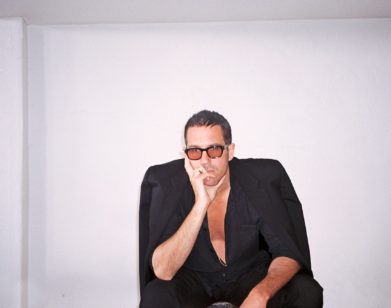
Alexander May. Photos by Emily Sandstrom.
THURSDAY 5:15 PM NOVEMBER 13, 2025 SOHO
In 2025, the idea of the office has been warped beyond recognition, having morphed into something evermore abstract since lockdown. Now we work from home, hunched over couches, or out of WeWorks with open-floor plans. The cubicle, along with the Rolodex and the power lunch, have become relics. But lately, a nostalgia for the workspaces of the 80s and 90s has been bubbling. Between the corporate-core trend, fascination with early technologies, and endless reposting of American Psycho stills, it seems we’re once again pining for a time when the office was considered something of a status symbol.
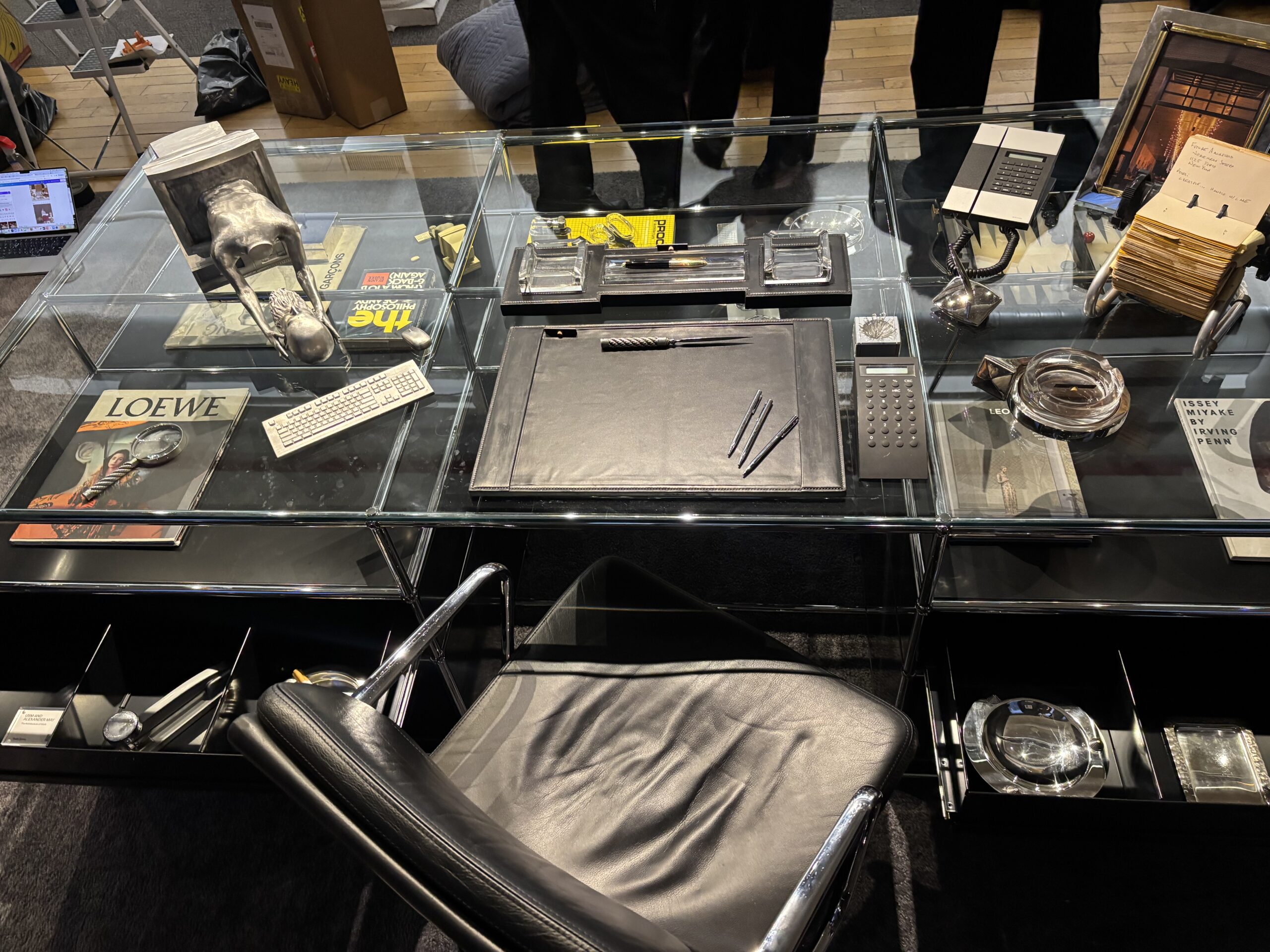
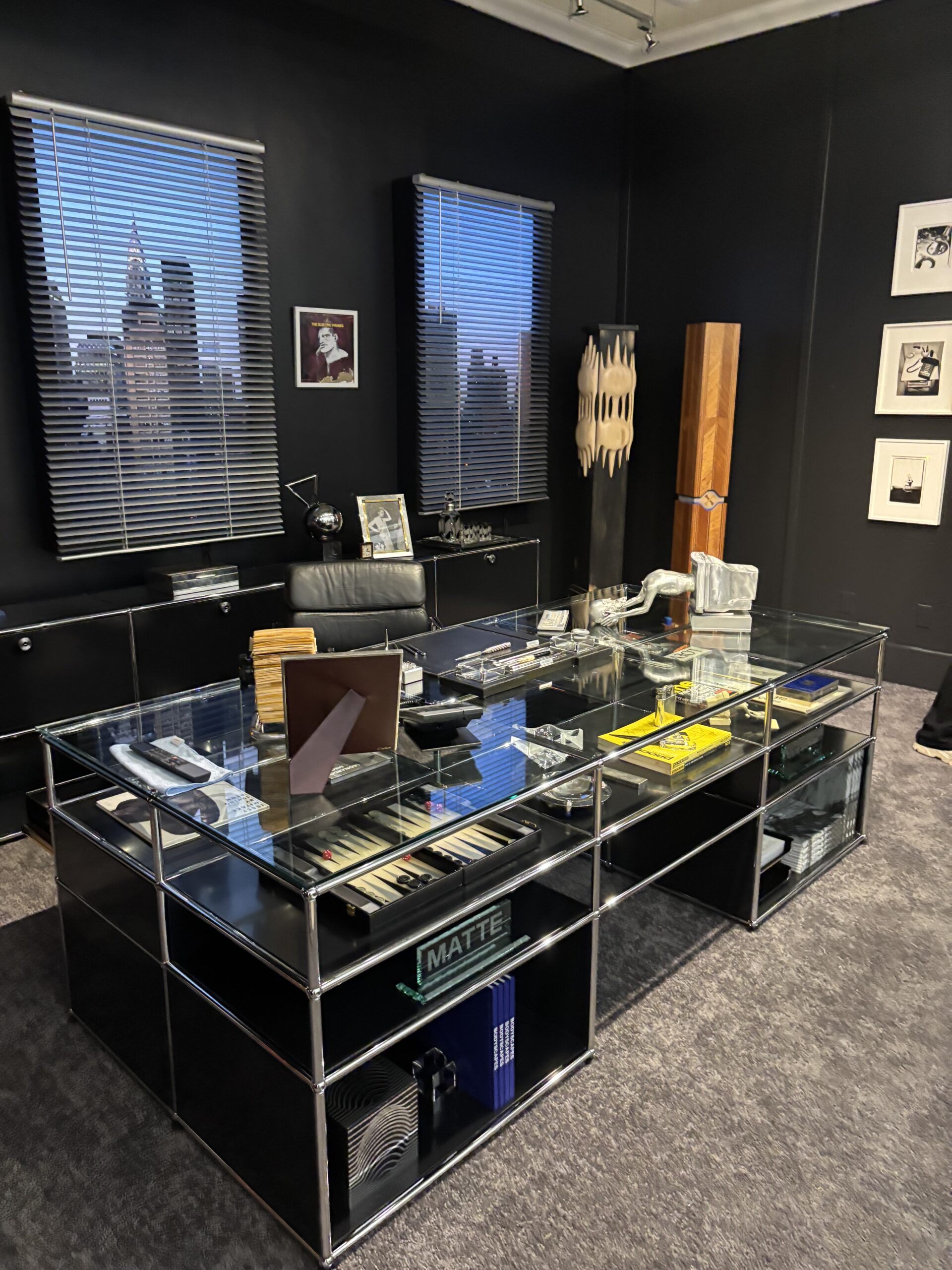
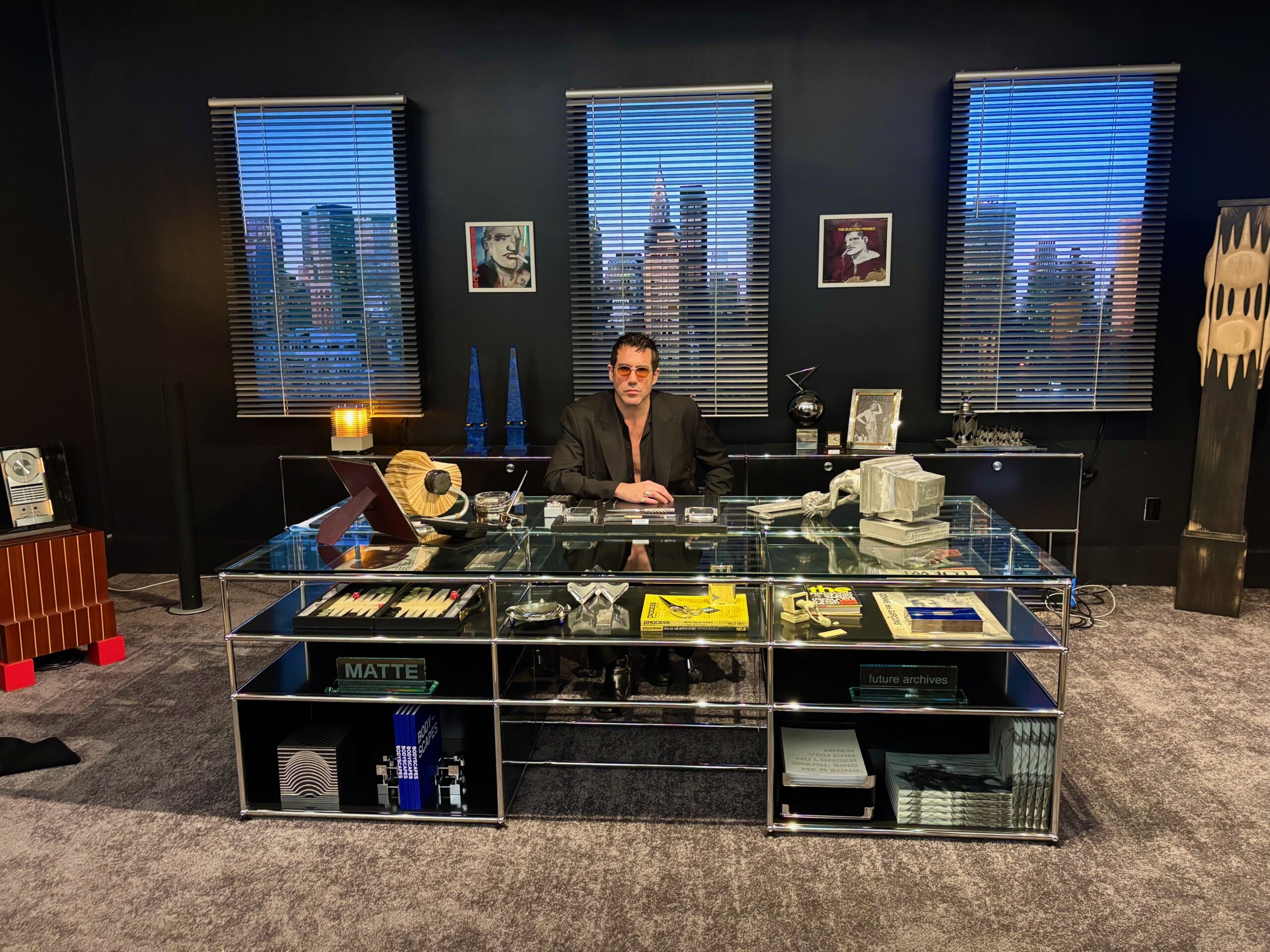
As Alexander May told me last week, “People are starting to crave their own space, and their own identity around work.” In his new collaboration with USM, The Architecture of Work, the designer explores exactly that: how place shapes practice, and how our environments constantly influence our process. Displayed at the Basic.Space pop-up in Soho, the show features one of six modular officescapes, including “The Collector,” a cinematic ode to ’80s New York and its spirit of glamorous, hyper-corporate minimalism. Embellished with art-deco collectables from Mantiques Modern, and fitted with layered lacquered draws, the unit sits boldly in front of a flickering projection of the New York City skyline. On opening night, I stopped by for a quick cigarette with the designer, curator, and confirmed desk smoker to ask all about his own work habits, design dont’s, and why dingy corporate is back.
———
SANDSTROM: Alright, the recorder is on. Tell me about the collaboration. Where did it begin?
MAY: Well, I’ve known Jon Thorson for years, and when I moved back to New York in March, we wanted to figure out a way to work together. I really wanted to hear about his goals with regards to where USM is now and where they want to be going. I wanted to get more to the core of what they feel like is missing in the brand, but also what they want to be projecting.
SANDSTROM: What did they feel like was missing?
MAY: They felt like there was a big opportunity to explore this concept of what an office feels like. I thought, “Well, how can I inform something that’s been reinterpreted so many different times?” So, I really wanted us to focus on their core materials and shapes primarily, instead of making new shapes, and then do my color tone and color ways. Then I also introduced some new vibes like sheets of glass that they haven’t really used yet.
SANDSTROM: It feels like you’re scratching at something really nostalgic and glamorous here. Like that quintessential 90s office period, and the increased presence of the skyscraper.
MAY: I think my aesthetic runs in that direction. I’m 42, so I have a relationship to the 90s for sure. I feel like my aesthetic kind of runs the gamut between deco-inspired materials, but also a 90s black and white minimalist positioning. I love the deco movement of the gloss, the lacquer, high shine, super-top materials done in an artistic way. But then also the positioning between the gray, dingy, corporate look. I love the idea of having big daddy desks, too.
SANDSTROM: It feels very cinematic.
MAY: Right. It’s very powerhouse.
SANDSTROM: Very powerhouse. I want to see a movie shot there. Obviously the nature of the workspace has changed so much over the past five years. What do you make of that?

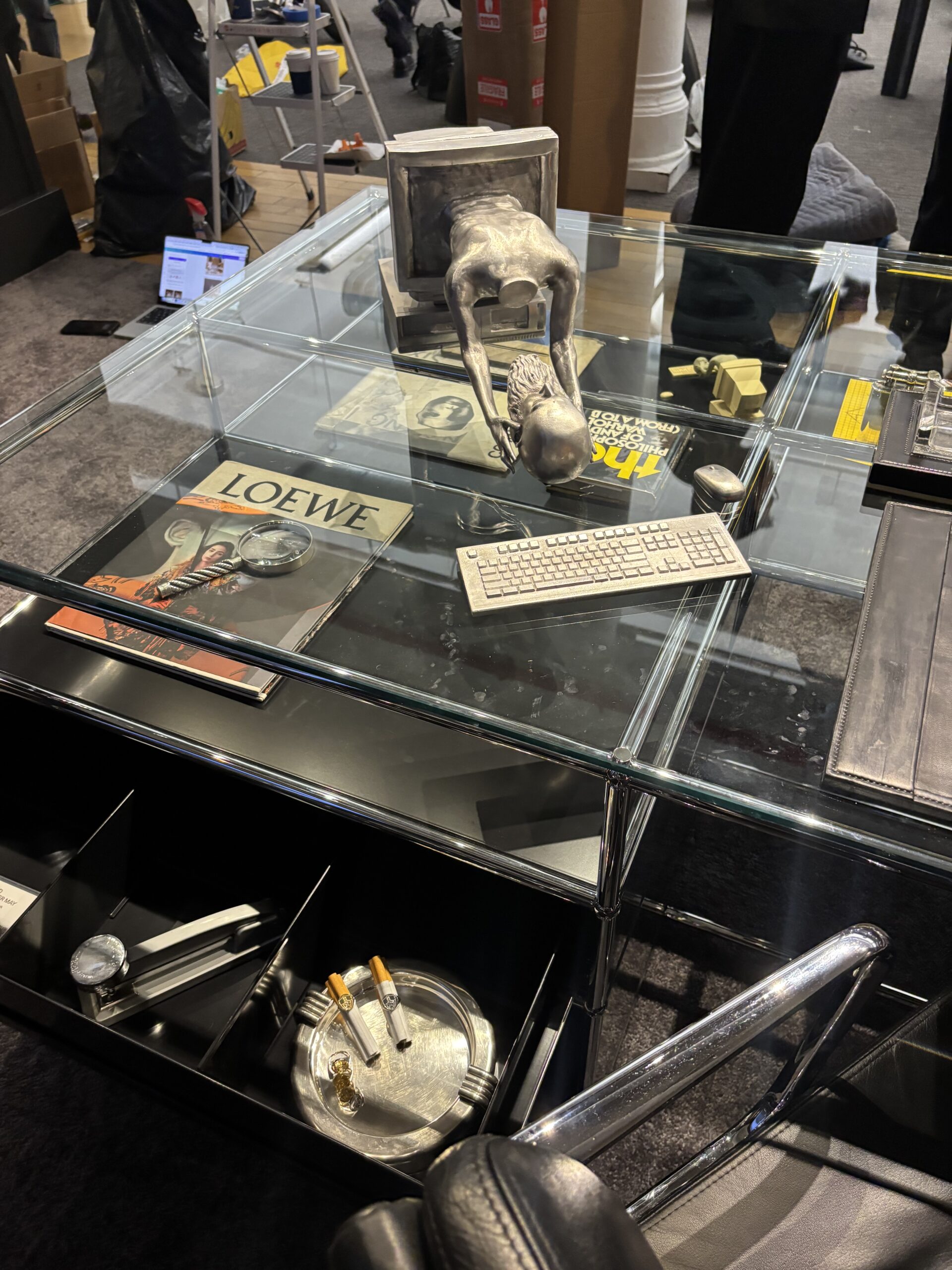
MAY: I’ve had so many variations in my life, but I’ve always gone to a studio or an artist studio when I was a painter for many years. Personally, I’m a surface queen. I love a large surface. I need space to put things out and feel like I can really explore. I’m also quite tactile, so surfaces for me are really important to be able to position things. But the design has a front and back and it has open shelving at the bottom. So you can have a clean surface, but underneath, you can have all your books open, your objects. It’s this weird duality where you can have your visual inspiration for the day, but still have a clean surface to work off.
SANDSTROM: It feels like you kind of solved the clutter issue.
MAY: Yeah. It’s like a curated clutter.
SANDSTROM: I love that. Would you say you’re a perfectionist?
MAY: I would say I’m a perfectionist in a curated way. I’m very focused on self-curation, and curation in anything that I do. It’s definitely a visual perfection, for me.
SANDSTROM: Are you that way with your style too? I know you always have your glasses on.
MAY: Yeah. My style is definitely a uniform and it’s consistent. A black suit is basically at the core of things. For me, getting dressed isn’t necessarily how I express myself. Some people love doing that, but I like to wake up and know what I’m putting on in order to start thinking. There’s certain things that come into my life that I hold on to and spend a long time wearing, and then that evolves and shifts and changes. Then there’s the glasses. I’m also pretty blind, so they are prescription.
SANDSTROM: You’re kind of giving Adam Kesher in Mulholland Drive. Has anyone told you that before?
MAY: I’ve heard the Mulholland Drive energy before, yes.
SANDSTROM: Tell me about the video behind the desk.
MAY: The installation was designed by MATTE Projects, which is the creative and productive partner for Basic.Space. There’s been a lot of conversation around work and office, and about coming back to a location as a place of actual engagement, especially now with this A.I. world of god knows what.
SANDSTROM: Slop.
MAY: Slop. So I think the physical is going to become really important next year. When they approached me they were like, “We love your desk. We want to explore this and put it into this installation of this 80s office myth.” Then they created a set and produced images of New York on those screens and gave it that flicker effect.
SANDSTROM: It’s really fun. What was the best era of corporate design for you?
MAY: The American Psycho aesthetic is just hero. I think that’s the dream in a lot of ways of what work is. That era was so defined, and I think the pendulum has swung almost in the complete opposite direction. But now we’re kind of experiencing it swinging back.
SANDSTROM: Yes.
MAY: It’s like, everyone’s on the same desk and have these open concepts and blah, blah, blah. But people are starting to crave their own space, and their own identity around work again.
SANDSTROM: Yes. I struggle with my open concept office. I have to go sit in a stairwell sometimes or in a different room to think.
MAY: Oh, 1000%. I need a door.
SANDSTROM: What type of worker are you?
MAY: What type of worker am I? I’m definitely a hard worker.
SANDSTROM: What does your actual desk look like?
MAY: Well, I have one desk at home, which is a circle, high gloss, black circle. It’s wood and it’s black lacquer.
SANDSTROM: What’s the last thing you rearranged at your desk?
MAY: The last thing I rearranged at my desk… I emptied an ashtray full of cigarettes.
SANDSTROM: You’re a desk smoker?
MAY: Yes.
SANDSTROM: Nice. What is one design cliche that you secretly love?
MAY: Hmmm. I wouldn’t say no to an L-shaped sofa.
SANDSTROM: Is that considered cliche? I guess it is a little suburban, maybe.
MAY: Yeah. I’ve never had a sofa. I personally never have been able to commit to that size of an object without it being modular. My place in L.A., I had six twin mattresses that I had upholstered in black leather. That was my version of a big L-sofa. I would never buy one in my life, but I secretly want one.
SANDSTROM: How does clutter make you feel?
MAY: Crazy.
SANDSTROM: Bad?
MAY: I have a really big issue with clutter. I’m very sensitive to visuals, so I’m quite neat. Clutter makes me go crazy.
SANDSTROM: No drinks stacked, no post-it notes?
MAY: No, no, no, no. Post-it notes, no way.
SANDSTROM: Fuck. All right.
MAY: I have my notes in a black book that closes. I need to have a visual plane that I can put in anything when needed, if that makes sense.
SANDSTROM: No, that makes sense to me. I just live so opposite. I need things to get completely disgusting before I can really get into things. I just have stuff scattered everywhere. Then I clear it all out and start again.
MAY: That’s so funny. I can’t even handle a cord. But I can handle a black cable.
SANDSTROM: It has to be black?
MAY: I don’t mind a big, black, thick extension cable. But any other type of cable gets me anxious.
SANDSTROM: I love finding out how other people live. What is your worst work habit?
MAY: I think it’s probably the scroll.
SANDSTROM: The scroll?
MAY: The scroll. When you get on the scroll, you’re like, “I’m kind of working, because I’m looking at things for work.” But then I’m like, “No, this is not productive.”
SANDSTROM: What are you scrolling on?
MAY: It’s tough to say out loud, but I do like to make many folders on Pinterest. Right now, it’s a tool.
SANDSTROM: So incredibly fair. Okay, what makes you feel like you have your life together?
MAY: A blazer.
SANDSTROM: What is your best work habit?
MAY: My focus.
SANDSTROM: What’s a design trend you hope never comes back?
MAY: I would say exposed light bulbs. I like a low light, but I don’t like an exposed bulb. Or subway tile.
SANDSTROM: Current design obsession?
MAY: Cars. I’ve been getting into a lot of 80s and 90s Ferrari’s.
SANDSTROM: Oh, fun. Favorite object that you own that costs less than $20?
MAY: Hm… Well, I got it for free.
SANDSTROM: That’s a really good way to cheat that question.
MAY: It’s an heirloom from my mother, and it’s a hand-hammered silver bowl that she got in Mexico 45 years ago.
SANDSTROM: Gorgeous. Other than the scroll, what is your favorite way to procrastinate?
MAY: I’d say probably the steam room or the gym.
SANDSTROM: What is the last thing that you splurged on?
MAY: Probably my The Row bag.
SANDSTROM: Nice. Which one is it?
MAY: It’s the black bucket bag. It’s the best bag. Literally, it carries everything. Full laptop. And it always looks clean.
SANDSTROM: What do you personally collect?
MAY: All sorts of things. I have a lot of pottery. I’m a big fan of terracotta. Of course, lots of books. I’ve been into jewelry lately. But to be honest, I’ve moved so much of my life over almost 30 times.
SANDSTROM: Wow. Why?
MAY: I just grew up like that, moving around everywhere. So I collect in waves, but one day I really would like to just have a place to put it all and continue to collect. I mean, I collect visually. Collecting for me is like, I get to enjoy things for the time that I’m with them, but I don’t carry them with me.
SANDSTROM: That’s nice.
MAY: Because I like to be light.