


COMPOSERS
“Turn Up the Sad”: Max Richter Takes Finneas Inside His Hamnet Score


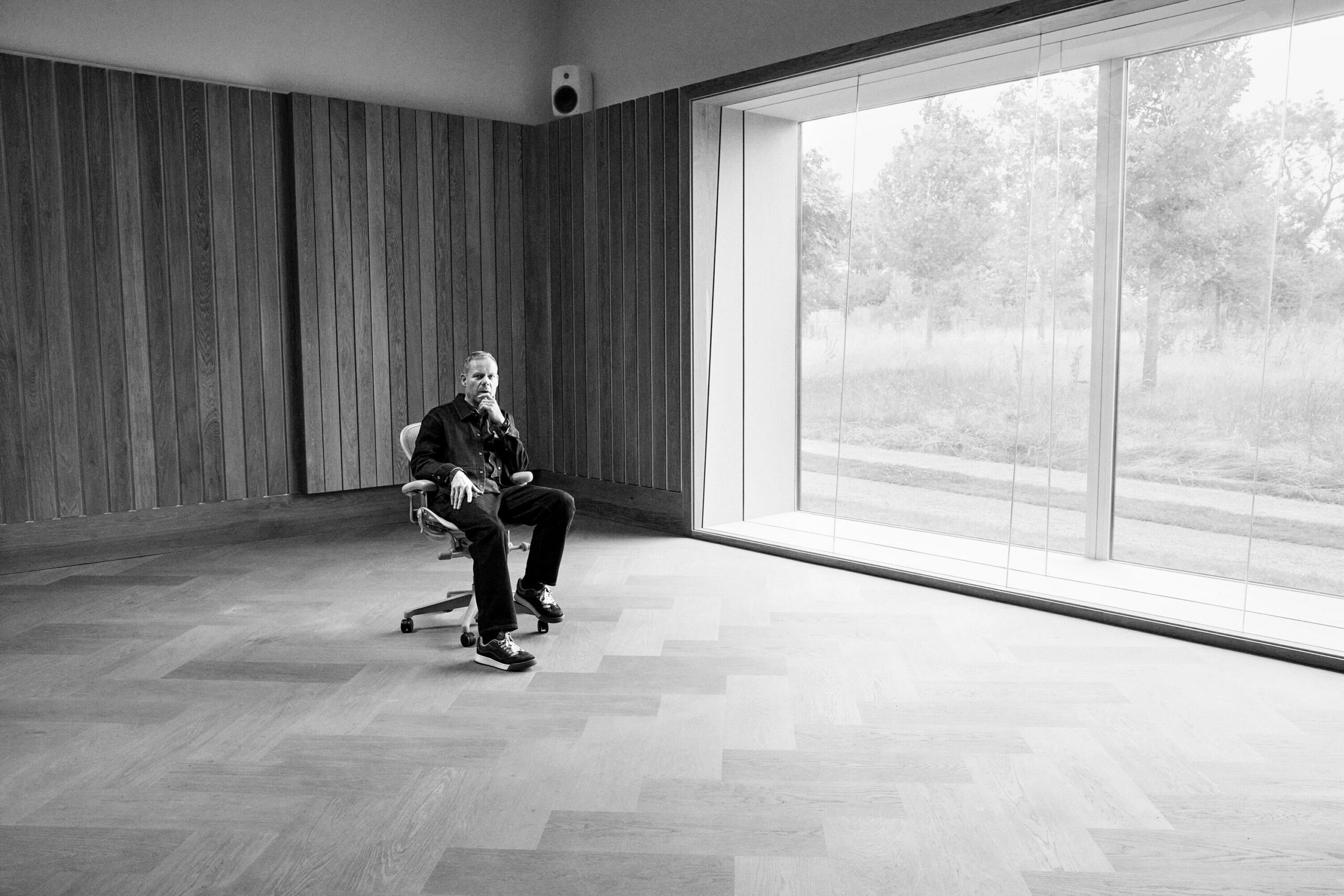
Max Richter, photographed by Rory Van Millingen.
Unlike the rest of Tinseltown, Max Richter hadn’t pulled an all-nighter to tune in to the 98th Academy Awards nominations announcement two weeks ago. But lo and behold, the 59-year-old German-British composer received his first nomination for his harrowing work in Chloe Zhao’s Hamnet, the Jessie Buckley-led adaptation of Maggie O’Farrell’s critically acclaimed novel that reimagines the lives of William Shakespeare and his wife, Agnes, as they grieve their 11-year-old son. It’s a recognition that’s long overdue for Richter, whose distinctive, genre-bending work will be familiar to fans of Arrival, The Leftovers, Ad Astra, and Mary Queen of Scots. That same day Richter learned of his Oscar nomination, he called his friend and fellow music savant Finneas, who knows a thing or two about the awards season circuit, having won two Academy Awards with his sister Billie Eillish for the original songs they wrote for No Time to Die and Barbie. After exchanging notes about the sometimes-surreal experience of promoting a movie in perpetuity, they went deep on sadness, Shakespeare, and the joyful puzzle that is scoring a motion picture.—SIMON DWIHARTANA
———
FINNEAS: Howdy, howdy.
MAX RICHTER: How are you doing?
FINNEAS: I’m great. Congratulations, Max.
RICHTER: Oh, thank you so much.
FINNEAS: Are you in England right now?
RICHTER: Yeah, I’m at my place.
FINNEAS: So not waking up at 3:00 in the morning L.A. time to find this out?
RICHTER: No, exactly. [Laughs]
FINNEAS: Congratulations. How are you feeling?
RICHTER: I feel good, really. This movie is just an amazing bit of work from so many different people. Obviously, Chloé [Zhao] front and center, but the cast was amazing, Jessie [Buckley] and Paul [Mescal]. Everything just came together, and I feel like these kinds of projects don’t come along that often.
FINNEAS: Absolutely.
RICHTER: It’s funny because it’s such a heartbreaker of a movie, but the vibes in the crew and the team were just amazing.
FINNEAS: That’s awesome. And to me, having gone through this a couple times—not for score, but for original song—when the Oscar nominations get announced, you think two things. You think, “Okay, so there’s light at the end of the tunnel,” because that really is the final one.
RICHTER: Right.
FINNEAS: And you also have this feeling of, “Whoa, there’s still another month-and-a-half of this.” You know what I mean?
RICHTER: Right.
FINNEAS: It’s funny because you go to these things—The Globes and the Critics Choice, whatever—and they have a similar structure to them. The same 10 films are nominated for most of them. And you see your buddy that you talked to at the last one, then you see them at the next one.
RICHTER: Yup. This is what happens now.
FINNEAS: We’re going to talk about One Battle [After Another] and we’re going to talk about Train Dreams. It’s a funny, unique microcosm of a thing. But it sounds like you had such a nice time working with everybody and Chloé on this film—what a treat to have these excuses to see each other.
RICHTER: Yeah, that’s really struck me because it’s like there’s a Hamnet village with all these sort of slightly mad people who just get to hang out now. And it’s so nice because, you’ll know this from your work scoring, you don’t see people that much.
FINNEAS: No, never.
RICHTER: Your stuff comes mostly after all the actors have gone, so it’s actually just really nice to just hang with people and catch up. It makes it so much easier to have your buddies around you.
FINNEAS: Absolutely. And when I saw you a few weeks ago, you were cooking up a live performance of pieces from this score in London. Has that happened yet? Or is that about to happen?
RICHTER: Yeah, we did that Monday night. That was amazing, actually. We did it in this cathedral in London—Southwark Cathedral. It’s where Shakespeare went to church.
FINNEAS: Wow.
RICHTER: It’s where his brother is buried, too, so it’s got lots of Shakespeare vibes. And what’s lovely about it is you’ve got that cathedral acoustic.
FINNEAS: It’s amazing, right?
RICHTER: That is quality reverb right there.
FINNEAS: Were you up on stage playing piano?
RICHTER: Yeah, I played piano and we had a 60-piece band and the choir. It went over really beautifully.
FINNEAS: I’m just asking from a selfish perspective: you compose these pieces and you record them, and obviously some of them are recorded way in advance, right? You read the script, you record various things and motifs, and then you go through and you actually adjust to picture? What was the process of taking these pieces that, I assume to some degree, have been conformed to the scene?
RICHTER: That’s an interesting puzzle, isn’t it? You’ll come across this yourself. It’s like this idea of musical logic versus it having to work on the picture and do the job. You’ll be working on something and you think, “Wow, I need two more bars here,” because otherwise it’s not good music.
FINNEAS: Yes.
RICHTER: But it still works on the picture. With this one, actually, because there was quite a lot of back and forth with Chloé over time, we managed to retain the intentions of the music so that it still made sense. But putting it in front of a live audience is always like, “Will it fly?” You don’t know. It weirdly reminded me of this kind of ritual that Chloé did before all the festival screenings, where she had everyone sort of close their eyes and follow their breath, this kind of meditative introduction. And it made me think, “Yeah, we’re in a church. We’re ready to receive.”
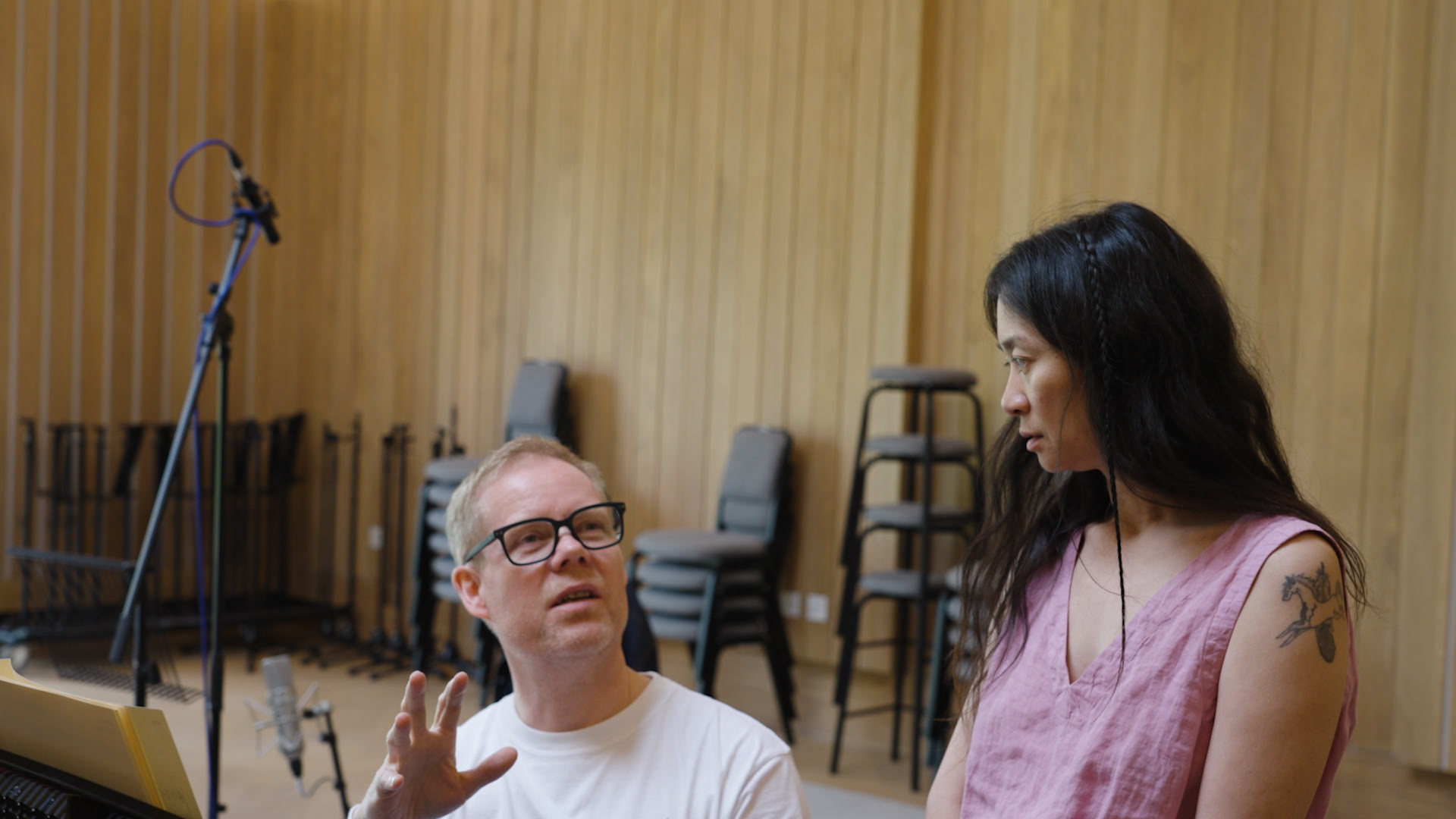
Composer Max Richter and director Chloé Zhao during the scoring session for Hamnet, courtesy of Focus Features.
FINNEAS: That’s amazing. So the only challenge for this interview is that I asked you some of these questions when I saw you two weeks ago. [Laughs] I may rehash a couple of them. We talked about sampling the time period-appropriate instruments and re-imagining and reinventing them. We talked about the orchestral component and the vocal component. How did you come to that sort of place?
RICHTER: When I read it, I just immediately wanted to work with a female voice to try and get to some kind of archetypal sound—human, but more than human, some kind of color that would reflect the universality of the story. So it’s Jessie’s character, Agnes, as a mother, but then also Mother Earth and the whole cosmos and everything beyond.
FINNEAS: I felt that while watching the movie. For the first hour-and-a-half, there’s these two components: there’s her worldview and her narrative, which is a little spooky and witchy. And I feel like the vocals really underscore that. And then there’s their love story. And then the kids enter, and that’s obviously intense and emotional. I felt like the music really pivoted, not in a jarring way, when the kids all show up. How did you approach that?
RICHTER: Yeah. At the beginning, it’s like scene-setting. There’s this relationship, there are connections starting to happen. But once the kids are in the movie, the stakes are much higher, and also trouble starts to happen, right?
FINNEAS: Mm-hmm.
RICHTER: And then you just basically just started to lean into these electronic versions of the acoustic instruments, almost like they’re haunted versions of themselves. So all this sort of pulsing kind of stuff, that’s all made from vials. It doesn’t really sound like vials, but it does have a bit of acoustic texture, that granular sort of quality. So that was just instinct, honestly. I just thought, “No, I need to use a different color here.” It was really quite instinctive, the whole thing.
FINNEAS: You’re obviously privy to the script and you visited the set, which is all the things you hope for as a composer, right? Did you feel, as you wrote pieces and then watched the assembly or the first edit, like, “Okay, I have this piece that I really like for this scene in the third act. Let me try to get there.”
RICHTER: Those kinds of things do happen, I think, and working backwards is actually quite good because you know where you’re going, right?
FINNEAS: Right.
RICHTER: Which is an amazing thing because that never happens. So it’s like, “Wow, I know where I’m going.” That can be really good. I do push things around a lot across the pictures just to see how to calibrate them, how much to turn them up or down in terms of intensity and density and texture. And that, again, is kind of experimental. That’s one of the things I really like about working in films—the sort of puzzle-solving thing. And it’s not just you sitting in a room on your own. It’s a bunch of conversations, which I really like because the rest of my world is just me sitting in a room. I tend to basically have no plan and just try to discover what the material wants to do that day. I mean, in a way, there is a plan, but I also don’t want to know where I’m going too much.
FINNEAS: Oh yeah, and that’s the reason it’s super fun for you.
RICHTER: Exactly. It’s discovering.
FINNEAS: Hearing you talk about sampling the period instruments, that leads me to believe that you’re an engineer, producer, composer, that you’re very savvy with your computer and loading sounds and processing.
RICHTER: My studio basically tells a story of what I am.
FINNEAS: Can you show me? [Richter pans his camera around his studio] Here we go. Big piano.
RICHTER: That’s that. And then you’ve got these guys.
FINNEAS: Oh, sick. I am not competent enough to write sheet music, but it sounds like you totally are, right?
RICHTER: Yes, that was my background. You just had to write it on paper. That was it. If you wanted to cheat, you could try it on the piano, but basically the deal was, “You hear it in your head, you write it on a piece of paper.” And because I was into electronic music and punk when I was a student, I was like, “Really?” I felt frustrated by that process at the time, but I’m grateful for it now because it’s great having that sort of toolkit.
FINNEAS: Totally. And I’m also assuming that if you’re sitting at your computer and you’ve taken some sound and you’ve processed it and now it has become this ambient, textural color, you’re probably hearing melodies over that?
RICHTER: Sure. I mean, the creative process doesn’t stop. The composition doesn’t stop when you start recording. That’s just like a continuum. It’s like you keep going, and you’re finding stuff.

Composer Max Richter, photographed by Agata Grzybowska on the set of director Hamnet.
FINNEAS: Maybe this never happens to you, but it happens to me, so I’m curious what you do if it happens to you. When you make a piece of music in film and it is what it is, hopefully you feel good enough about it. Then the filmmaker says, “You know what? I’m just not connecting to this piece in the scene. Start over.” What do you do?
RICHTER: I mean, my take on that is it doesn’t mean it’s bad. It just means that I’m not the director of the film.
FINNEAS: Totally.
RICHTER: In a way, I see composing as composting. I’ve got this infinite pile of stuff, so that piece will then go onto that heap of things.
FINNEAS: It gets dissected, broken down, changed.
RICHTER: Five years later, I’ll look at it and I’ll be like, “Hmm, what’s that?” And I turn it into something else.
FINNEAS: That’s sick.
RICHTER: Nothing ever disappears, it all just floats around. They find their spot in a project or maybe they land somewhere else.
FINNEAS: Yeah. So if somebody says that—”I’m not connecting with this”—do you then ask a bunch of questions? You go, “All right, what’s the thing that we’re not achieving? What are we looking for?”
RICHTER: Yeah, and having really good conversations with directors is so important, right? Just being able to find a way to talk about stuff, because talking about music’s hard, actually, especially for people who maybe have no musical background at all. It can be difficult for them to get their ideas across.
FINNEAS: All that stuff that we giggle, like talking about inherent sadness or melancholy or joy in a chord, it’s for real in a movie. You know what I mean?
RICHTER: Yes, it is.
FINNEAS: If the scene has a death in it and your chord isn’t sad enough, that’s sort of inarguable. You’re like, “Fair enough, let me find a sadder chord for this sad scene.”
RICHTER: Turn up the sad, yeah. But it’s a strange one, isn’t it? Because sound does affect us emotionally. And that to me is, I mean, how can that even happen? It’s crazy. We spend our lives doing this stuff, but it’s still a puzzle, right?
FINNEAS: Yes.
RICHTER: It’s just air bouncing around.
FINNEAS: Yeah, it’s one of the few woo-woo things about me. We’re all kind of vinyl, you know what I mean? When you put your record on the record player and the needle touches the groove and out of your speaker comes this song by The Beatles that you’ve known your whole life you’re like, “That’s crazy.” And then you’re like, “Yeah, but that’s me. That’s how I interact with the world. That’s how stimuli interacts with me.” So as much as it is all sort of miraculous, we are all just vibrating organisms.
RICHTER: We are deeply analog. And one of the great things about Hamnet is that the acting is so incredible that I really felt like I didn’t have to do very much. The music could really just sit back and let us watch this thing happening. I mean, it was amazing.
FINNEAS: Every frame feels so proper, Elizabethan. It really feels like these oil paintings of the forest or of old London or something.
RICHTER: Completely. Yeah.
FINNEAS: Well, I’m very honored to get to ask you these questions and learn about your process. And again, I love the work. I just love the way that this score sounds.
RICHTER: Oh, thank you so much, Finneas. It’s really good to talk to you.
FINNEAS: Hope I see you sometime.