


INSIDER
How Matt Belloni Became Hollywood’s Ultimate Reality Check


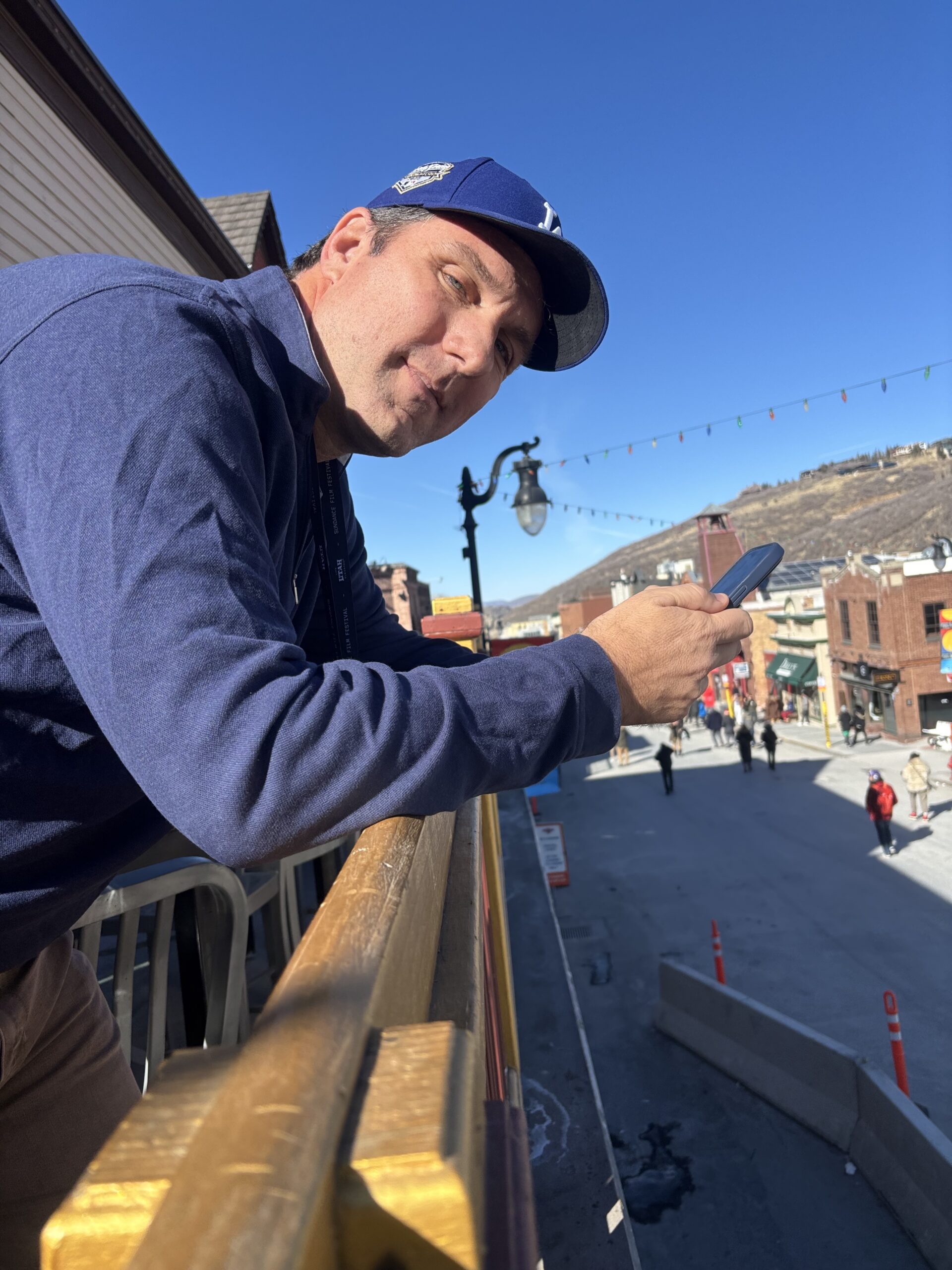
There’s a case to be made that Matt Belloni is the most influential journalist in Hollywood. The former Hollywood Reporter editor-in-chief left traditional publishing in 2021 for the next frontier of new media, co-founding Puck News, where his newsletter “What I’m Hearing” offers no-holds barred analysis and commentary and has become required reading for Hollywood power brokers and anyone trying to understand what the hell is going on in the entertainment industry during a time of mega change. On his equally popular podcast The Town, Belloni ignores PR-friendly talking points and goes straight for the jugular while interviewing everyone from theater chain owners to movie producers to studio heads. His outsized presence in Hollywood was cemented when he appeared as himself in Seth Rogen’s industry satire The Studio. Belloni, a former attorney, bet on himself and won. Last week at Sundance (where he was almost as recognizable as some of the stars in town), we met up at the No Name Saloon to talk about his old-school hustle, his ultimate goals, and the best places in L.A. to take a meeting.
———
BEN BARNA: Just before you came here I saw that you broke news about a bidding war for The Invite on X. How do you obtain that kind of information?
MATT BELLONI: Sourcing.
BARNA: Are you seeking it out, or is somebody sending it to you unsolicited?
BELLONI: Listen, I’m no longer in the breaking news game. If I was at The Hollywood Reporter back in the day, I would have a team of people here who are trying to scour the buyers and the sellers to get little tidbits like that. I don’t seek it out as much, but if it’s a film I’m interested in… That one I’m particularly interested in because I went to the premiere and I thought it was really good. The Olivia Wilde story is interesting because she’s very talented as a filmmaker and is also a big personality. So you talk to people, then tips come in, and I decided to break it on Twitter.
BARNA: Do you get a dopamine hit when you tweet out scoops like that?
BELLONI: A little bit. I still like doing it for fun mostly. There’s no reason why I need to do that stuff. I have a forum on my show and a forum with my newsletter where I can break news when I want to, but I still like having fun with it. Like this morning, I broke two things. I broke the Olivia Wilde bidding war and I broke the coming Amazon layoffs. So just little things that I like to keep people on their toes.
BARNA: Is it a flex against your former publication?
BELLONI: No, I don’t care. I’m friends with a lot of them. I do my own thing. My explicit goal with launching the newsletter and the show was to not do what the trades do because I came from that world, and they do some things really well, but I didn’t want to be in the casting scoop game. That stuff, in my opinion, is all commoditized, and there’s no real value there.
BARNA: What is the value of the trades in 2026?
BELLONI: There’s always going to be a forum for industry news that is managed and within the lines and informative. People need to know this stuff. I don’t hate the trades at all. In fact, I read them all the time. I know enough about them to know that there are a lot of flaws in how the news is produced, and I know this because I experienced those frustrations when I ran one of them.
BARNA: Is someone calling you?
BELLONI: Spam risk. If it’s not a spam risk, I answer my phone.
BARNA: That was one of my questions. Do you screen calls?
BELLONI: Only if Apple screens them for me.
BARNA: So you’ll pick up no matter what?
BELLONI: I do. Unfortunately it leads me to a lot of hangups when it’s like, “Do you realize you could get 10 percent off your car insurance?”
BARNA: In terms of your methods of communication, how would you rank email, text, and phone? What’s the hierarchy?
BELLONI: 70 percent text, maybe 20 percent phone. That’s not true. 60 percent text, 25 percent phone, and then other platforms, whether it’s Signal or people DM me on socials.
BARNA: What does your inbox look like on an average day? Who’s reaching out?
BELLONI: Everyone from normal sources to random people, like “I went to this party and this happened,” or people that anonymize their emails. Some are clearly fake Gmail accounts, or it’ll be from something like Concerned Writer.
BARNA: What about publicists?
BELLONI: I’m not a bomb-thrower, so no one’s ever surprised by what I write. I always let them know, so I try to maintain those relationships. Now, obviously there are publicists that I won’t work with who have lied to me in the past.
BARNA: Name names.
BELLONI: I talk about them all the time. People who have outright lied to me. But most publicists I have good relationships with.
BARNA: Do you work out of an office? What’s your day to day like?
BELLONI: I work at home and it’s great. I don’t know if you know L.A. that well, but it’s close to Beverly Hills. I can go out. Sometimes I will have breakfast, lunches, and dinners or drinks, so I can do all that—
BARNA: What do you mean?
BELLONI: I’ll meet a producer for breakfast, and then I’ll have lunch with an agent, and then I’ll do drinks or a premiere or something at night. It’s sort of weird. I have this new platform and newsletter and podcast, but the way I operate is very old school. Most of my tips and my knowledge comes from interactions. I’ll be at an event, I’ll be at Sundance, I’ll be wherever. I just feel the need to do that.
BARNA: How many nights a week are you out?
BELLONI: Four.
BARNA: How does that work with your family?
BELLONI: I have a nine-year-old, so he doesn’t love it. My wife’s in the business so she knows that it’s part of the job. Some times of year are busier than others. The summer kind of lightens up.
BARNA: Do you think you have any rivals?
BELLONI: Not really. You tell me.
BARNA: What do you read religiously, in terms of where you get your information?
BELLONI: I read a lot of analyst reports—smart financial analysts who are giving their insights on what the business of these companies looks like. I read all the traditional sites, like the [Wall Street] Journal, the [New York] Times. I read the Axios morning newsletter.
BARNA: Do you read anything in print?
BELLONI: I don’t. I used to get the L.A. Times, but now I do digital. I read Vulture, I read Bloomberg because Lucas [Shaw] is on my show and he does a lot of good work. I’m trying to think of commentators. I love Ben Thompson at Stratechery.
BARNA: Do you pay attention to the L.A. restaurant world?
BELLONI: A little bit.
BARNA: Have you been to Max and Helen’s yet?
BELLONI: I prefer NORMS. I’m sure it’s delicious, and I’m sure the $10 hot chocolate is amazing. I saw Phil Rosenthal and I congratulated him on getting people to pay $10 for hot chocolate. I mean, it’s a diner. I’ll go, but I’m not waiting three hours.
BARNA: Where are you a regular?
BELLONI: My wife and I go to Honor Bar a lot, which I know is very normie.
BARNA: I’ve never heard of it.
BELLONI: Oh, it’s a Hillstone property. It’s next to South Beverly Grill.
BARNA: Okay.
BELLONI: Let’s see. Centro, the pasta place, is great. We go to AOC a lot. I go to the Polo Lounge for work events. The older Hollywood elite types will want to go there. I go to The Grill [on the Alley] for lunch a lot. I don’t go that often, but I do like Craig’s. I like Craig himself. He’s a nice guy. I go to Tower Bar a lot and that’s about as cliche as it gets.
BARNA: It’s cliche for a reason.
BELLONI: Yeah, it’s classic and I’ll do drinks meetings there. When people come in from New York, they always want to go there.
BARNA: Are you ever off the clock? Do you ever unplug?
BELLONI: No. Never. Again, my wife hates it.
BARNA: Do you ever think that you should spend less time on your phone and more time being present with your son?
BELLONI: It’s a trade-off. Listen, I used to write my newsletter on Sundays. I would do Sunday and Thursday. I did that because I thought there was a lane there on Sunday nights. There was no more Ben Smith in the Times and I could get ahead of the news for the week. It worked for three and a half years and helped establish me, but then my kid got old enough to where he was having sports on Sundays, and my wife hated the fact that I was always stressed out on the weekends. So after a lot of debate and talking with the Puck people, we moved it to Mondays, and we haven’t seen a drop-off in open rates. It didn’t end my life professionally, and it drastically improved my life personally. I’m always on, but the way I see it is that I’m kind of always available for my kid as well. If it matters enough, I can be at his school play. I can go to his games. I can do things at four in the afternoon.
BARNA: That’s the beauty of not being chained to a desk.
BELLONI: Exactly. I would never have been able to do it at The Hollywood Reporter because I had a staff of a hundred people that were sitting there waiting for me to sign off on pages, and they couldn’t leave until I did. So in some ways I’m always on, but in some ways I have the greatest freedom I’ve ever had.
BARNA: Do you think what’s happening in Hollywood at the moment is good for business?
BELLONI: I hesitate to say that because it sounds almost like a vulture, but it’s the most interesting time since I’ve been covering the business, and since I’ve been working in the business, which goes back 25 years. So having started what I’m doing at the exact moment where Hollywood had its ultimate meltdown has been a really interesting challenge, in that I really have to lean on all of my background and my financial and legal knowledge to get what’s going on and explain it to people. But also there’s an opportunity, because everyone is so effing freaked out all the time, so there’s real demand for no-bullshit analysis, and that’s what I hope to achieve.
BARNA: Do you have an end game, or an idea of where you’d like to take this?
BELLONI: I don’t know. When I started almost five years ago, I wanted to establish Puck as a real thing that would be a viable business, and that’s a combination of what I do, but also the team in New York. I’m one part of a larger entity in Puck, and I’m very grateful that they let me do what I do and I don’t have to be involved in a million meetings that I used to frankly have to be involved in at The Hollywood Reporter. But I wanted Puck to be a real business, so that mission was accomplished, and I wanted to raise my own profile so that I wasn’t the guy behind the counter at a big faceless publication, but where I would be thought of as someone who was a media entity unto myself.
BARNA: You’re doing it.
BELLONI: I think I’m getting there. I never anticipated it would be the podcast that traveled as far as it did, because I get emails from all over the world. And I credit The Ringer for helping me with that because we made a conscious decision when we started Puck that the first show we did would be with a partner. Puck owns all of its other podcasts.
BARNA: Which podcasts do you listen to?
BELLONI: I like Pivot. Kara [Swisher] is a model for me. She’s the best-case scenario of someone who successfully leveraged an area of coverage that she was very good at to become a bigger media personality and build a successful business around that. She’s where I would like to be someday.
BARNA: Is there anything that makes you feel old or out of touch?
BELLONI: Last night I was reading about this guy, Clavicular. Do you know what Clavicular is?
BARNA: No.
BELLONI: He’s a very popular TikTok and YouTube creator whose whole thing is looksmaxxing. Do you know what that is?
BARNA: I’m sort of familiar with it.
BELLONI: It’s where you punish your body to make yourself look better, and he hammers his chin to make it look better. But I was reading about this and I’m like, “Holy shit, who is watching this guy? What does he do?”
BARNA: Millions of people are.
BELLONI: Teenage boys are like, “Oh, I’m ugly. I need to look like this guy.” It’s kind of terrifying, but also it’s an area of entertainment that I don’t understand. The creator economy and what pops, what doesn’t, and how things can go viral and how they don’t, that’s an area that makes me feel old, but also intrigues me.
BARNA: What do you think of the role of print magazines today, particularly when it comes to celebrity covers as a vehicle for promoting projects? Are we still relevant in your eyes?
BELLONI: Print accomplishes a number of things for the celebrity industrial complex. It can frame the initial conversation around a movie.
BARNA: I felt that when we put Demi Moore on the cover when The Substance came out. It helped kickstart her entire awards campaign.
BELLONI: And there’s still a cachet to that. You could say, “This magazine that is considered cool thinks that I’m cool and this movie is cool.” That’s why they do long lead. Timmy does Vogue before everything else because he’s establishing himself as Vogue-worthy. So that’s still a thing for like four or five magazines. The rest, god help them. Secondly, the balance of power has shifted so much to the talent that you can essentially get whatever you want out of a magazine. There is no risk. It used to be that if you were going to do Vanity Fair or Vogue, you had to put yourself out there a little and subject yourself to a loss of control, both in the images and in the interview. Nowadays, the power is all in the star’s hands. They can dictate photographers, they can literally approve the cover shot. They can nix quotes in certain places. I’m not saying that happens at Interview, but they can do that, and these outlets know better. They know that if there’s something in the Timmy profile, they’re going to hear about it from the star. He has a way bigger, more powerful platform than they do, so they fall in line. And to me, that’s not interesting.
BARNA: Are you going to the Oscars?
BELLONI: Yeah, I usually go.
BARNA: What do you like the most about being there?
BELLONI: Not the show, per se. It’s pretty boring. It’s mostly the sushi bar, which is delicious. Wolfgang Puck, man. I don’t understand how the food at the Governor’s Ball is as good as it is. It’s literally 10,000 people. Have you ever been?
BARNA: No.
BELLONI: It’s amazing food. It’s done in a way that it’s not finger food, but it’s also not a seated dinner.
BARNA: So it’s more buffet style?
BELLONI: There are buffet tables everywhere, and sometimes they’ll bring food to some of the reserved tables. There are pot pies that are delicious, and salmon in the shape of an Oscar.
BARNA: I’ve seen those.
BELLONI: There’s an amazing raw bar. But that’s not why I go. I go because it’s an event that everybody goes to. In my world, you can hit so many different people and talk to them and get that update in the relationship, and things come out of it all the time. And then there are also the moments when shit hits the fan and they announce the wrong Best Picture or someone gets punched in the face. It’s nice to be there.
BARNA: Do you ever go see movies for fun?
MATT BELLONI: All the time.
BARNA: What’s your favorite theater in L.A.?
BELLONI: It used to be the Landmark, but it closed. Then it was the Westwood Theater, but they’re under renovation. We like the IPIC in Westwood for having dinner and drinks while we’re watching a movie. There’s a theater in Culver City that’s owned by Amazon. It used to be an ArcLight. Nobody knows about it.
BARNA: Really?
BELLONI: Yeah. If there’s ever a movie that has a big opening weekend, you can go to this theater. It’s right next to Culver Studios, which Amazon owns, and Amazon bought the theater, and they use it for premieres and screenings and stuff, but they don’t advertise it.
BARNA: Do you ever feel uncomfortable at industry events or do you like going to these parties and schmoozing?
BELLONI: There was a moment when I first started covering the business, you go to these things and you don’t feel like you know anybody and you don’t feel like you quite know what’s going on. Then one day it kind of flips and you know people and now people come up to me. I don’t even recognize it. I only see it through the eyes of my producer [Craig Horlbeck], who’s like a 30-year-old guy and works with The Ringer.
BARNA: What do you mean you see through his eyes?
BELLONI: We were trying to get into the party for The Invite on Saturday and it was a total shit-show. Craig was like, “We don’t have to go to this.” But I saw a producer that I know and started talking to him, and next thing we knew he brought us in. No line, no anything. I didn’t even think about that, but Craig was like, “Huge flex, man. You just got us into this party.” I was like, oh, I guess that is the benefit of having come here for 20 years and knowing someone. And he probably wanted me at that party because he wanted to build some buzz. And that’s not just me. There’s other media I’m sure would benefit from that, but there’s a lot of media that wouldn’t know how to do that. So I see that as a benefit of having done this for so long.