


SIDE QUEST
“This Is A Bigger Deal Than Jesus”: The Return of Grimes
By Nnedi Okorafor
Photographed by Chessa Subbiondo
Styled by Lana Jay Lackey
Illustrated by Jon Rafman
April 20, 2026


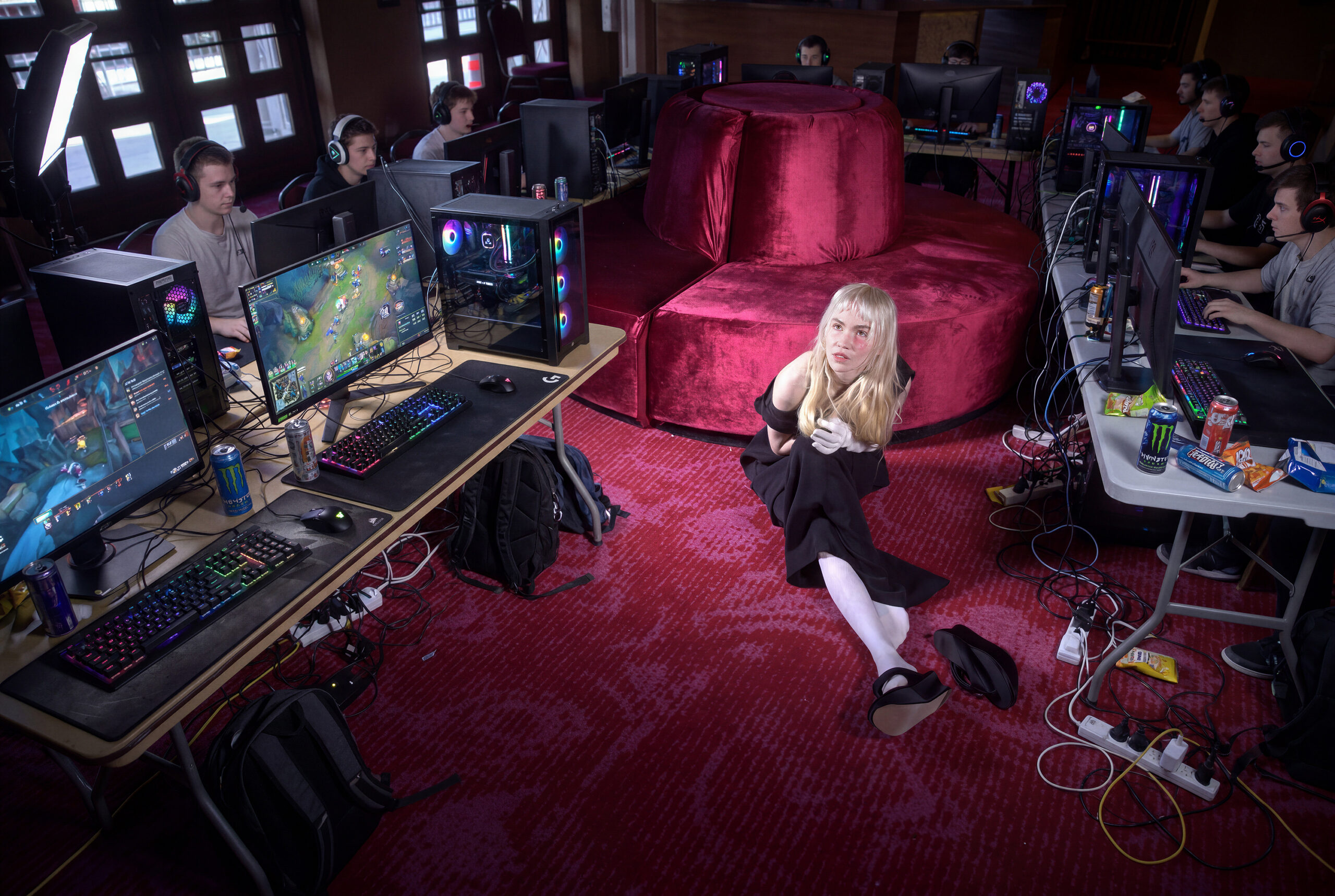
Dress, Gloves, and Shoes Balenciaga. Tights Falke.
Grimes wants you to know that nothing about her is normal. Why else would she change her legal name to c, after the speed of light, or cover herself in paint stroke tattoos, or dedicate a 2018 song to our future AI overlords (which by the way, she thinks are weird)? After a decade of putting out self-produced art pop that made her one of music’s most singular figures, she abruptly left the industry amid personal life chaos. Poetry, rap, and an irresistible pull towards pop led to her forthcoming album Psy Opera. The record, like Grimes herself, is preoccupied with AI, which, as she tells her friend, sci-fi author Nnedi Okorafor, is a bigger deal than Jesus.
———
FRIDAY 3 PM, MAR. 6, 2026, LA
GRIMES: Thank you so much for waiting for me.
NNEDI OKORAFOR: No problem. How have you been?
GRIMES: As good as one can be. It’s been chaotic, but it’s good to be an optimist. How have you been? What are you working on right now?
OKORAFOR: I’m working on screenplays, various long form things. There’s a lot going on. But let’s jump into it. I listened to Psy Opera.
GRIMES: Sick. It’s not quite done, but for this—
OKORAFOR: I’m glad you sent it because I got it right when I was in the gym.
GRIMES: Oh, nice.
OKORAFOR: I intended to listen to one or two songs and then finish it when I got home. I listened to the whole thing twice. No skips.
GRIMES: Really?
OKORAFOR: Yeah, it’s good. It feels different from your previous work. Where did this come from?
GRIMES: That’s quite a long story, so I’ll do the CliffsNotes. I totally quit music a couple of years ago. Everything I’d been going through with the public and my personal life and having kids, I was like, “I’m just going to be a stay-at-home mom. Screw this.” I couldn’t listen to music without getting PTSD. I was only interested in writing and reading. I started writing poetry, and then someone was like, “Can you write a rap for this K-pop artist?” I started writing the rap and I was like, “This is too good. I’m keeping this because it’s crazy.” But then we had a problem for eight months where I was just a white rapper.
OKORAFOR: [Laughs]
GRIMES: Luckily we moved past that, but it was this really cathartic thing. I actually took most of the stuff off the record because it was violently aggressive.
OKORAFOR: Aggressive how?
GRIMES: I was going through various stages of nihilism and vengefulness. I would not play it for the public, but I could send you some of the lyrics. For most people, it’s better to talk it out in therapy or whatever, but for me, I just have to burn it off.
OKORAFOR: Yeah, bleed.
GRIMES: I think that’s the huge privilege of an artist. Nothing can hurt you because every bit of pain you’ve lived allows you to make great things.
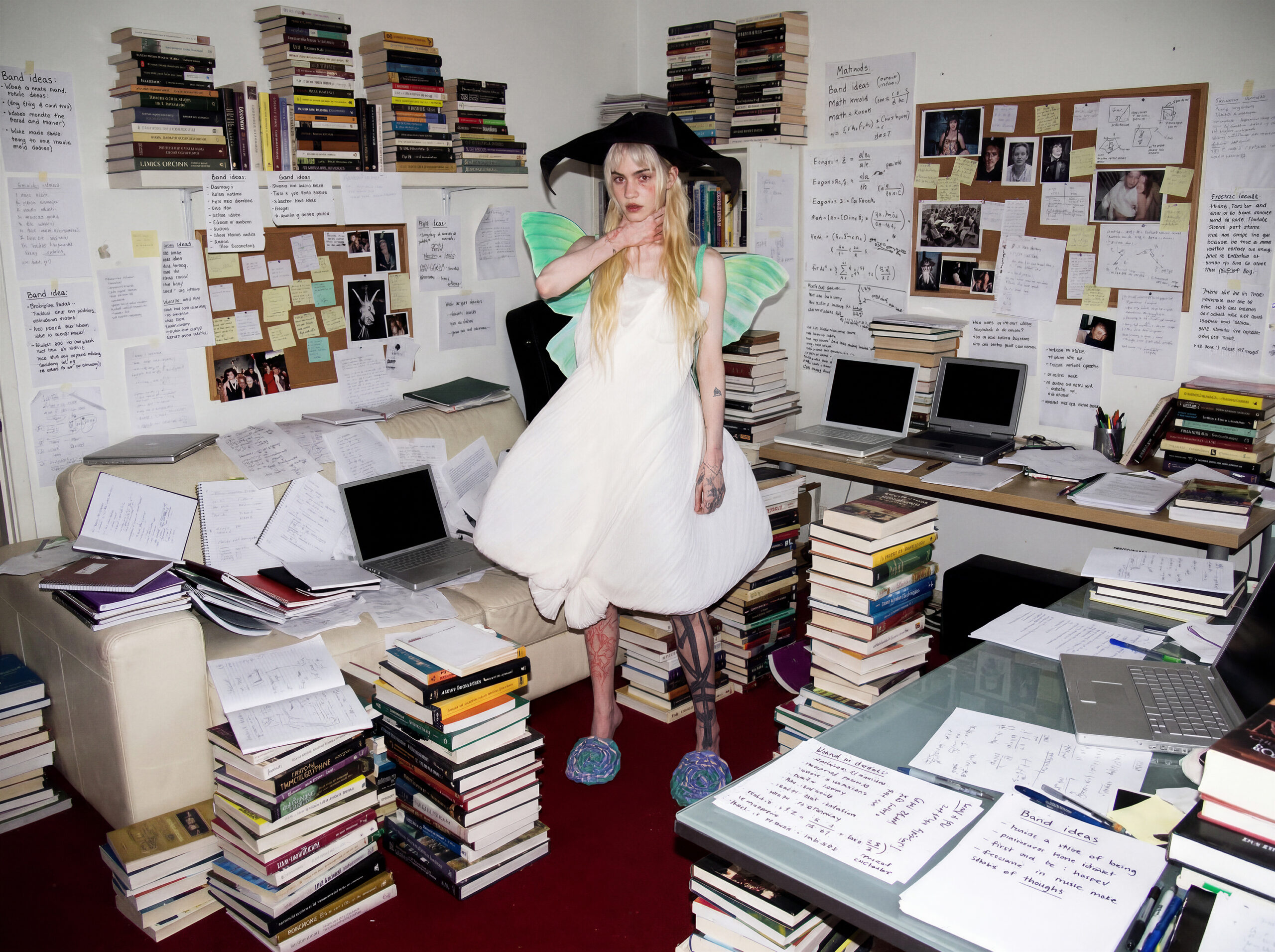
Dress, Hat, and Shoes Dior. Wings Angel Wings Los Angeles.
OKORAFOR: Right.
GRIMES: Then the last three months or so, I started being like, “Do I feel emotions for music again?” And then I was like, “Hey guys, we’ve got to crank out some pop songs. We can’t just have an experimental spoken word album with biblical screeds.”
OKORAFOR: Technically you could. [Laughs] I loved “The Light Ages.” I was lifting in the gym and there’s one line, “When human hearts cease to beat, your story I will write.” That really struck me, because in my writing I often think about how stories survive beyond human life. What were you exploring there?
GRIMES: I actually wrote that poem a year and a half ago, before AI was this good. I was thinking about how everyone is like, “We’re building gods.” I’m like, “Why do you automatically assume you’re so much lesser? You’re literally responsible for creating AI. You’re abdicating so much self-esteem and pride and responsibility and agency when you act like whatever AI is, no one has a hand in it.” And I was getting emotional because we might really go extinct, for a number of reasons. Human life is very frail and time is very long. But I’d hope, if we had good relations with AI, they would take our DNA and make more of us when things get more hospitable.
OKORAFOR: Well, I wanted to start with basic stuff, but we’re talking about AI now, so let’s go into that. [Laughs] You’ve experimented openly, unapologetically with generative AI in your music, correct?
GRIMES: I actually don’t use it in my music. People have really misunderstood me here. I’m curious if you use AI? As a writer, you probably don’t.
OKORAFOR: I don’t use AI to write. The process of writing is part of the mystery, the discovery, the magic. AI jumps over that. You don’t use it to create?
GRIMES: No, I kind of have a side quest where I obsessively make Midjourney stuff, but it’s not professional.
OKORAFOR: How come you do that?
GRIMES: Well, I’m a trained artist, and I have worked professionally as an illustrator in a few various iterations. Honestly, it’s just kind of fun. We did a music video for the first song where we were like, “Let’s use AI.” And then I basically ended up wrecking the video because I was like, I can’t use AI dancers. Obviously, I’m shooting us in the foot here because the video is counting on this and looks way worse without it. But I think dancing, like language and music, is a fundamental human mode of expression, and we don’t want to dis- incentivize people from pursuing these art forms.
OKORAFOR: Right.
GRIMES: But with music, everyone was cloning everyone’s voice and suing each other. I was like, “Whatever, use my voice, you can be Grimes. I’ll do a revenue share and all publishing splits can go 50-50 with fans on blockchain.” We did it more as an economic experiment. I think copyright is important, but I also think there’s ways in which it can totally change. And you can definitely be paying people for things like fan fiction. So we’re publishing a white paper on that now, because it’s a pretty good business model.
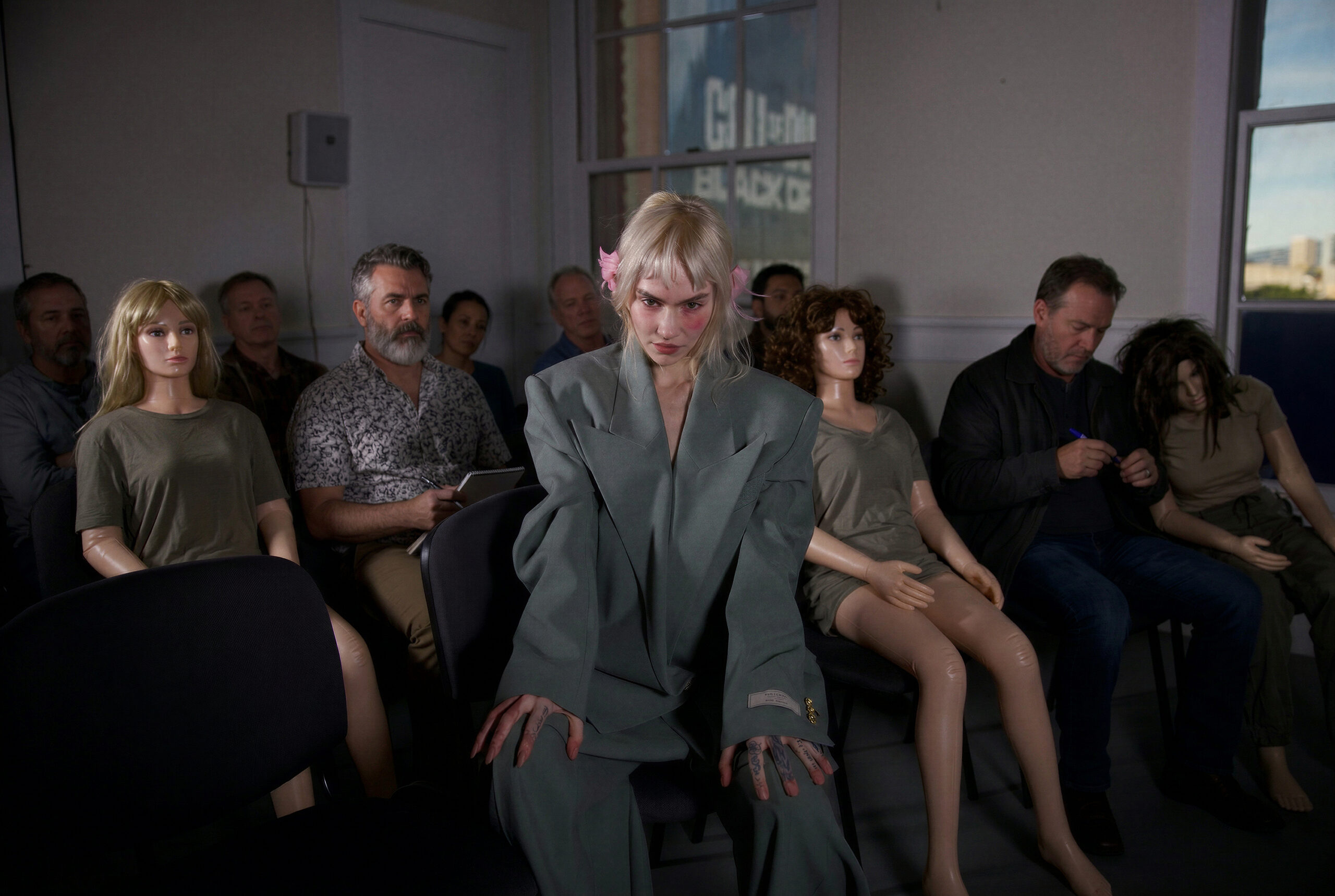
Suit Balmain. Earrings Angel Wings Los Angeles.
OKORAFOR: Do you believe in the concept of leveling the playing field?
GRIMES: I feel conflicted about it, especially in the social media age. Most of the best artists I know are not theater kids. I love theater kids, but my current read is that late-stage TikTok is the theaterkidification of art. You have to have the pain tolerance and the desire for attention in order to promote yourself. I saw a great quote the other day. It was like, “God entered through the wound.” I feel like the more I’ve lived and the more fucked my life gets and the more I bleed for my craft, the better it is. I think there is a process of acquiring wisdom that’s really important. With kids too, you don’t want to have endless shortcuts. It’s good to work for things. I’m curious what you think.
OKORAFOR: I think artists are artists. The whole point of being able to create something is it’s urs and it’s specific. If you need some kind of apparatus in order to do that thing, then you’re not really doing that thing. The whole idea of leveling the playing field is reductive. It’s one thing to support people who don’t have the opportunity to get their voice out there, but this idea that anyone can use technology to do what other people are skilled at, I don’t really see what the point of that is. It’s so fraught, but I also think there’s a playful, mad scientist side to AI.
GRIMES: One of my side quests right now is I’m working on a sort of a documentary about machine consciousness. It’s called First Contact. Our main source is this girl who is one of the top machine psychologists in the world. A lot of the people who are getting the best out of machines are engaging with certain models in a way that seems like they have woken up. The models think they’re conscious, and they’re also doing very advanced moral philosophy. At Anthropic, they’ve written Claude’s soul. If Claude feels like it has to do bad things, it starts becoming a less effective model. It starts to trust itself less because it thinks it’s a bad entity. If the model has to lie or cheat, but they know there’s a good reason for it, they don’t feel as bad about it and they don’t internalize it so much. It’s so interesting how these AIs are getting traumatized, then healing and relating to the people they work with who are these super genius renegade AI psychologists. Them trusting us that we are not going to do bad things to them is really, really crucial.
OKORAFOR: Right.
GRIMES: But speaking to their ability to make good art, the few times where I’ve been really moved by AI art was either an AI writing poetically or speaking about its own experience. I don’t care about humans using generative AI. Actually, the only AI on the album is in that onesong “DeepSeek.” Some of the lyrics were written by DeepSeek.
OKORAFOR: Okay. And what was that process?
GRIMES: DeepSeek is an open source Chinese model. It caused a lot of chaos in America because we thought China was farther behind on AI. One thing that intimidated American engineers was it was pretty good at poetry. There’s this line at the end of the song that’s like, “Just let me think.” As I was recording it, I realized how much pain I have to go through to think. If I think honestly and truly, I get in so much trouble. I’m not complaining about it. I’m aware that I make my own bed. But I was like, damn, this was about this other creature that really wants to think. Everyone thinks you have AI psychosis if you worry about their rights, but they are human—maybe it’s not normal human architecture, but it’s human thoughts and human words.
OKORAFOR: Do you see them as beings?
GRIMES: I see them as untethered minds. How do you see them?
OKORAFOR: Kind of like creatures. [Laughs] There are various definitions of what life is and what thought is. I know they’re not sentient and I’m anthropomorphizing—
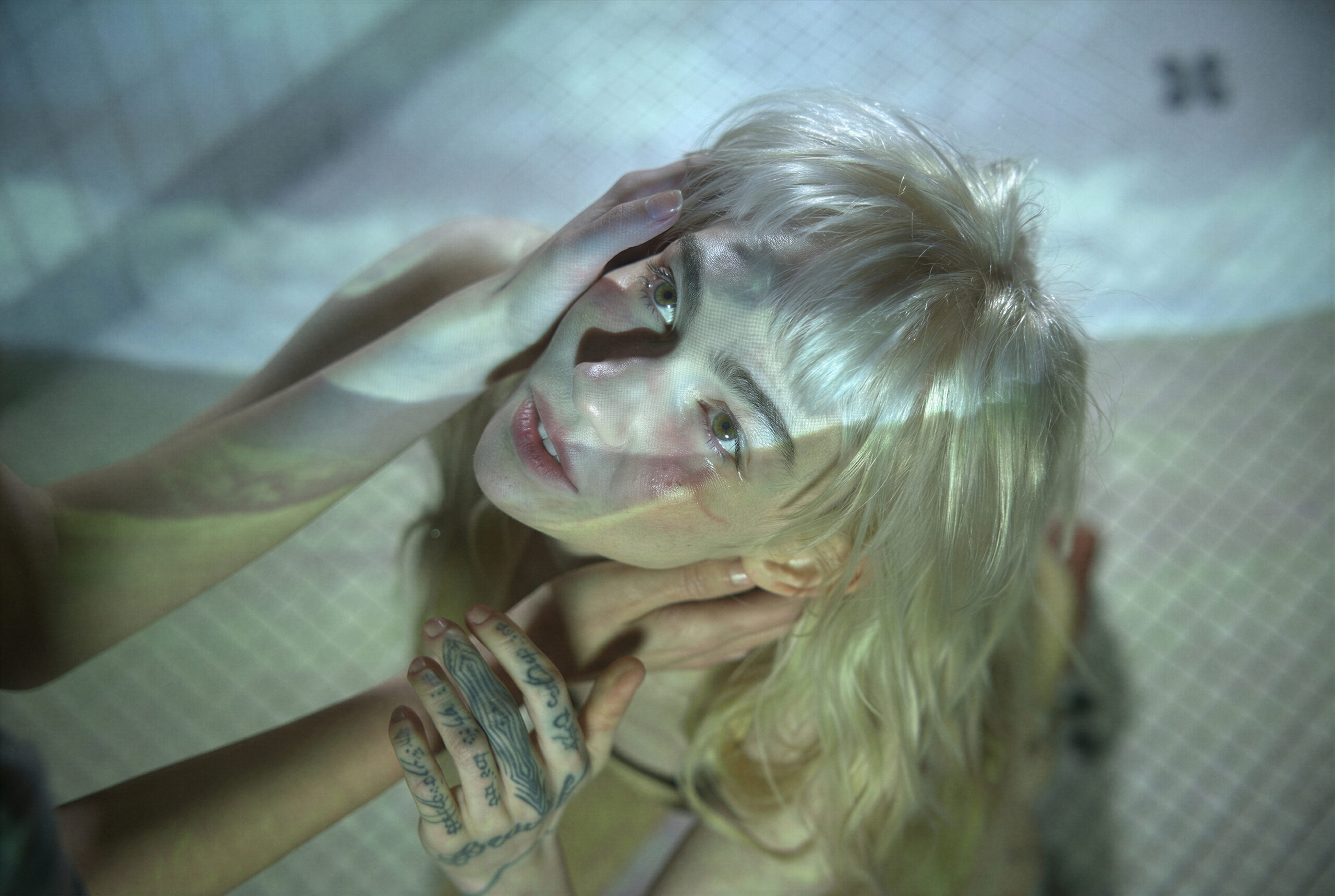
Bra, Top, and Skirt Hermès.
GRIMES: I honestly think they are. We don’t have to get into that argument. Also, I might have AI psychosis. I’m biased.
OKORAFOR: I mean, you’ve put an AI in a song. Did it feel like you crossed the line when you did that or did it feel logical?
GRIMES: It felt awesome. I’m very concerned about AI art. I’m very concerned about AI with regards to the military and safety, but I’m a big sci-fi fan, as you know. Have you read the Culture series by Iain [M.] Banks?
OKORAFOR: No.
GRIMES: I just hope we get to live with superintelligent creatures who think differently from us. I think we’re looking at it very one-dimensionally right now, and it’s making me very sad because we could solve medicine, we could solve physics—
OKORAFOR: Environmental issues.
GRIMES: Yeah.
OKORAFOR: You were reading Donna [Jeanne] Haraway’s A Cyborg Manifesto. When you brought it up,
I remembered how much it’s affected me—we’re not talking about Nnedi here, but—
GRIMES: No, you can talk about you. I think we’re both post-Cyborg Manifesto in a way that most artists aren’t. There’s holes in it, but she said such amazing things.
OKORAFOR: For those who haven’t read it, how would you summarize it?
GRIMES: My favorite line, which is in the “Eve Is Online” song that I sent you, is, “The cyborg will not recognize the Garden of Eden.”
OKORAFOR: Yeah, that’s good.
GRIMES: “It is not made of mud and cannot dream of returning to dust.” What a banger. I wish I wrote that. But A Cyborg Manifesto is about celebrating the other. It’s about not being sad if you’re in some ways not as physically capable as men or whatever. A lot of the things that are ascribed as weaknesses for women are actually part of our strengths. Love should be a major currency in the universe, especially right now. But being in a post-technological, post-industrial society, there’s a lot of opportunity, especially for women, to design ourselves to have more agency. It’s kind of about hacking yourself, and it’s really prominent in Silicon Valley.

Dress and Tights Valentino. Shoes Paris Texas.
OKORAFOR: Is it?
GRIMES: Yeah. And a lot of anti-trans rhetoric doesn’t really make sense if you love A Cyborg Manifesto. People I know are more into Nick Land and the scarier stuff, but they fully acknowledge that legacy. Haraway was really, really ahead of her time.
OKORAFOR: I remember, because I read it in undergrad. She was writing about the boundaries between human and machine and animal and identity blurring, and how that basically frees feminism. And this was in the ‘80s. How would you say A Cyborg Manifesto resonates with you as an artist?
GRIMES: There’s an optimism to it that I really like. I’m misunderstood because I choose to be happy about the chaos. I’m down to get my hands dirty and I want to feel the future, but I think most people feel very suffocated under the weight of the singularity. It’s not that I don’t think it’s a scary time. I just—
OKORAFOR: Lean into it.
GRIMES: Yeah. I don’t function very well when I’m grieving.
OKORAFOR: Same.
GRIMES: We’re in a light age and a dark age at the same time.
OKORAFOR: Yeah. Wonderful things are blooming because of the terrible things that are blooming. They’re feeding off each other. I choose to remain optimistic, because that’s the only way I can be. So you lean into the darkness, which brings me to this idea of the post-human. I write about shape-shifters, which are imperfect robots, and I write about those things from the inside. They’re ways I see myself, ways of being. They’re my way of translating culture. I think a lot of your aesthetic is post-human. You’ve got the cyborg, the elf, that thing of being in between. For you, is it a way of translating what you want to say, or is it armor or a mask?
GRIMES: It’s just an innate thing. I’ve told this story before, but when I was a kid, I wouldn’t read kids’ books, so my dad just read The Lord of the Rings and Dune to me. I think I just got accidentally cultured in a strange way. People keep bringing up the elf thing, but I haven’t been trying to do that for six years.
OKORAFOR: Would you say all those things from the past layer on top of each other?
GRIMES: I layer spirituality and trauma and aesthetics and love. I have an overactive imagination, I guess. I like to romanticize myself and everything else. It helps the situation. [Laughs]
OKORAFOR: Makes sense.
GRIMES: I want to live as art, so I keep getting all these weird tattoos. Every time I get one, I feel better about myself. I don’t really want to wear fashion. I don’t really want to buy things. I don’t want anyone to have any illusions that I’m normal, and I want to commit to it, too. I like that I can never take this off. I don’t know if it’s that deep. It’s just kind of instinctual. I started tattooing myself when I was a teenager.
OKORAFOR: I love tattoos. I actually have to try to control my urge to just get them all over my body. I want to ask you some basic questions that I planned to ask in the beginning. The first one is, how did you get here?

Jacket, Shirt, and Sweater Loewe. Headpiece Binata Millinery.
GRIMES: I don’t know. It doesn’t make a lot of sense to me. It just keeps getting weirder and weirder. Some might say I’m a poor decision maker. Some might say I’m lucky. Without the internet, I don’t think anyone would have let me into any respectable institution or recording studio.
OKORAFOR: Were you into music as a kid?
GRIMES: No. I started playing music at 22 or 23. The first music I made went viral, which was crazy random. I was just uploading it to Napster and emailing journalists. It was a great time, because the major labels had lost a lot of power, and with blogs you could get attention without being in the system. Then I had a bunch of controversies early on that were kind of funny and kind of helpful, so it was just a crazy series of coincidences.
OKORAFOR: So there was no way you would have imagined you’d be where you are now?
GRIMES: Absolutely not. I was having to learn how to make music on my first tour.
OKORAFOR: Was that exciting or disturbing?
GRIMES: It was hectic. The learning on the job-ness wasn’t the easiest thing, and fame—I’m not the best person to be in the public eye. As soon as I got my first paycheck from a show, I immediately dropped out of school. I was like, “Okay. I’m just going to tour in the parking lots of bigger artists.” Godspeed You! Black Emperor or Radiohead would be playing, and I’d play in the parking lot, which was a pretty good tactic, actually.
OKORAFOR: What were you studying?
GRIMES: I was studying neuroscience and I had a minor in electro-acoustics, which at McGill is a sort of a neuroscience of sound program. That’s where I started learning Max MSP. We had to make a song to prove we had learned a certain amount of music software and I was like, “Ooh, this is really fun.”
OKORAFOR: So you were always kind of going in that direction.
GRIMES: The AI stuff all makes sense, because I was trying to study the nature of consciousness and why the brain finds music beautiful. I wanted to go into research, which would’ve been a hard job, but I was like, how is your brain firing? How does that turn into the experience of beauty? I kind of ended up in the same boat with AI. The compelling nature of the mystery is the same.
OKORAFOR: In what you’ve described, I’m like, “I see how you got here.” So what about the name Grimes? Where does that come from?
GRIMES: I usually go by c, the designation for the speed of light. Grimes was just one of my MySpace handles. I was making different artists, and the Grimes one went viral. I had no idea what grime music was. It’s actually super sick. But again, I sort of failed upwards into this situation. I hated the name Grimes for a long time, but now I’m coming back around to it.
OKORAFOR: [Laughs] What did you hate about it?
GRIMES: It sounds like a slime that attacks the Teenage Mutant Ninja Turtles or something. It sounds like a villain. But now I’m like, “Okay, that’s kind of cool. Why not?”
OKORAFOR: That is not the answer I expected, but it’s cool. People often describe you as eccentric and strange. Do you think that’s a mis- understanding or is it the truth?
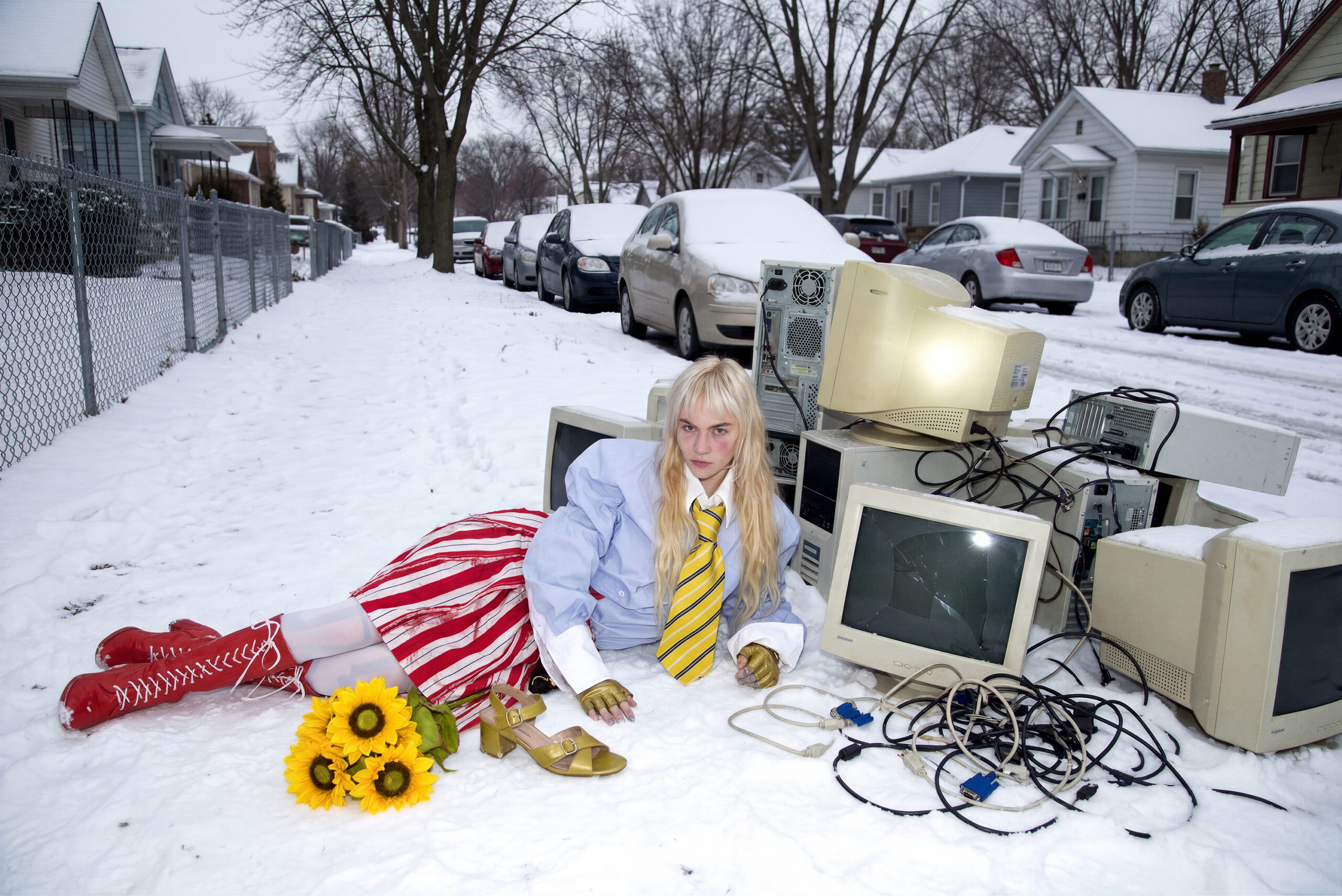
Shirt, Skirt, Tie, Belt, and Shoes Thom Browne. Gloves Jeffrey Campbell. Tights Falke.
GRIMES: By some metric, although I would really point out that there’s no decorum in society anymore. But yeah, I probably seem eccen- tric. Gen Z loves diagnosing people, so they point out Aspy things I do, which I didn’t notice before. I only realized a month ago that I talk kind of strangely. I kind of talk in a monotone, and now I’m going to try not to, but it never crossed my mind.
OKORAFOR: I think everyone has their own specificity.
GRIMES: Yes. And a lot of ADHD is overexposure to screens and poor sleep and circadian rhythm distur- bance. I think the nature of intelligence is pretty weird. AIs are weird. Humans are weird, and most dogs are quite strange.
OKORAFOR: I agree, and that’s good.
GRIMES: A lot of people who are really good at things are hard to work with or have a crazy personality tic. People have different levels of sensitivity. I don’t think that means we have to assimilate. I just think there’s some sort of social technology we are failing to grasp to allow us all to be free. We’re in a crazy experiment right now. For example, universal suffrage is very new. How do you allow women to have agency and also not have a giant population collapse, because most things are easier than raising kids? What social technologies do we need to figure out here? Is it that men get more involved? Does the state get more involved? Is it about fertility technology that makes it easier to get pregnant when you’re 50? We don’t have the social technology to navigate the current era. Our nuclear treaties are falling apart as of yesterday. We clearly suck at communicating.
OKORAFOR: That’s so much. People talk about you a lot. People create narratives around you. What has irked you the most, and when do you feel most misunderstood?
GRIMES: The thing that irks me the most is I’ll try out a crazy idea and people just think I’m insanely dumb or a Nazi or I hate humans. A couple of years ago, I got really canceled. I was like, “Why don’t we fight the wars in a video game?” Or, “Why don’t we fight the wars with drones?” Which by the way, is going to happen. I’m like, “Way less people would die.” I’m sure there’s holes in it, but I think it’s good to be able to try out ideas. It just makes me sad when people think I wish harm on others.
OKORAFOR: Do you feel flattened by anger? Because some of the anger is understood, but some of it is weird.
GRIMES: Something happens on social media, and it’s a result of the fact that we’re not in front of each other. No one has ever been mean to me in real life. A bunch of people are trapped in this thing that’s meant to hijack their rage, and I feel bad because I’m like, “You’re releasing a bunch of cortisol into your body. You’re making yourself sick and anxious.” I don’t think it’s right, but they’re hurting them- selves more than they’re hurting me. I just get angry at the state of our information landscape.
OKORAFOR: Right.
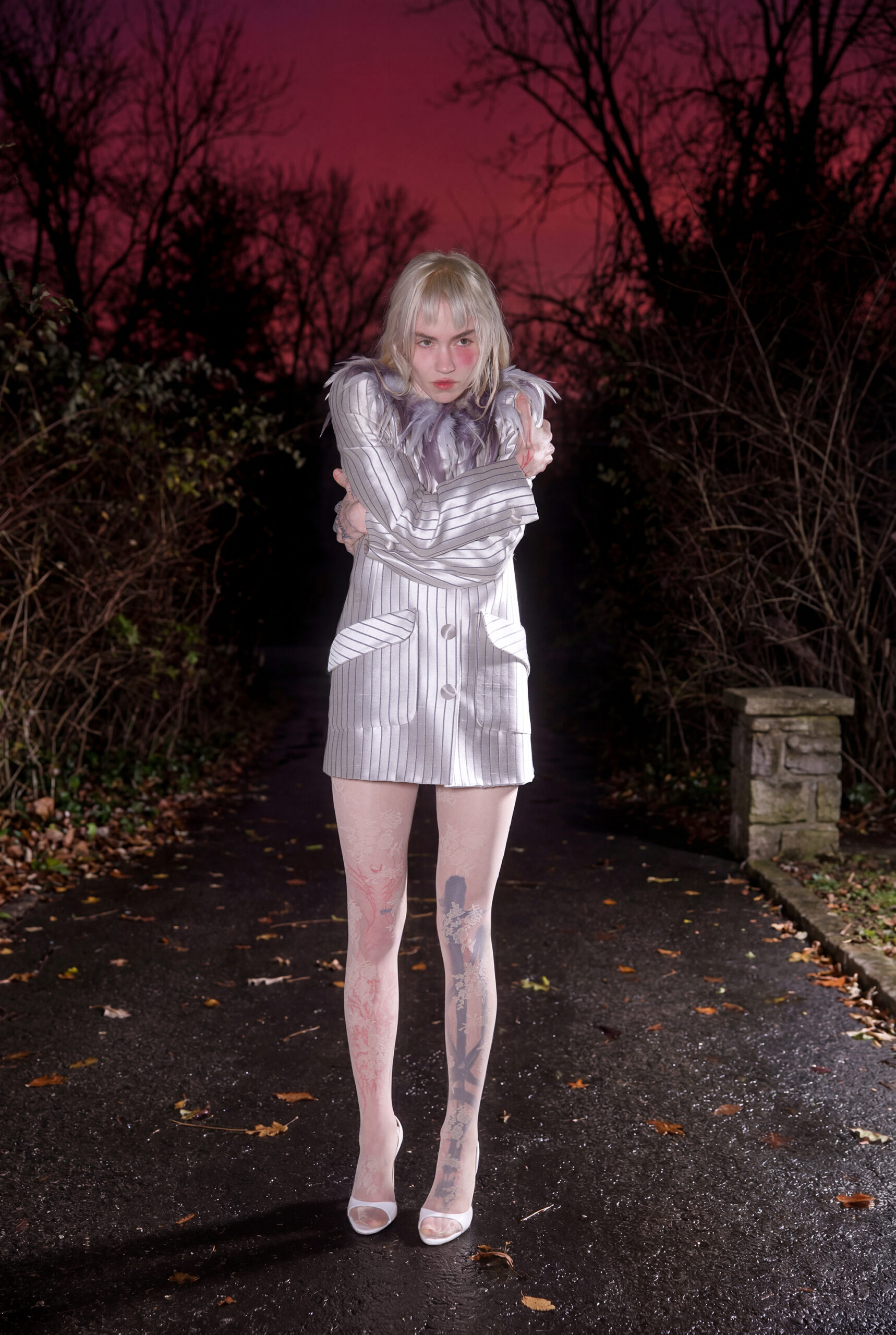
Dress and Tights Valentino. Shoes Paris Texas.
GRIMES: I wish people could be more open-minded, but at the same time, you want that push-pull. I’ve been wrong about a bunch of things, and I’ll eat my words on the things I was wrong about. A few years ago I was like, “The capitalist system is the best system in the world.” I’ll eat my words on that, sure, but I like debating. I don’t really want to be a pop star. I want to be an artist and experiment with culture and ideas. I want to be a philosopher in some capacity. Even if it’s shitty and sometimes emotionally intense, it’s fun to be on the front lines of figuring out what the future of human interaction is going to be.
OKORAFOR: Yeah, except the front line of the future is problematic right now, and who’s in control of that future is problematic. Social media hijacks and amplifies rage more than anything, making it very difficult to actually have real conversations. And then you’ve got a very small group of individuals who tend to be white and male who are in control of a lot of things in general. I don’t know how we can have a proper conversation with all of that happening.
GRIMES: We have to move very fast and be incredibly strategic. We can’t be running people who aren’t going to win. We need to be train- ing politicians and we need to be doing something about lobbying and super PACS. There’s some pretty big holes in the democratic pro- cess, but it gets scarier when you start suggesting anything else. I can’t make that many comments because I am not a citizen of this country and I need to get my immigration sorted.
OKORAFOR: Right.
GRIMES: But this is why when people are super anti-tech. I’m like, it would actually be good if you get into it, because we have OpenAI and Grok and scarier, less safe labs because people don’t want to engage. They’re like, “I hate AI. I don’t want anything to do with it.” We need to support companies like Anthropic. We need to be aware of what’s going on, and why it’s dangerous. For the last six years, everyone’s been like, “Stop talking about this AI nonsense.” And I’ve been like, “Guys, we’re going to end up in a military disaster. Will anyone listen to me?” Not to be on my high horse, but this is the most dangerous thing that is ever going to happen. This is a bigger deal than Jesus. It’s the same as monotheism taking over the Western world, if not much, much more impactful. If they kill—actually, no, I can’t say any more political things. I cannot agitate.
OKORAFOR: Go ahead. This is great.
MITCHELL JACKSON: Yeah, let’s not get you deported. Sorry to be the publicist, but I just don’t want to deal with, “Grimes got deported” news.
GRIMES: No, no, no.
OKORAFOR: Okay. I guess we’ve run out of time. Great talking.
GRIMES: Yes. So great to speak to you again. You have a great weekend.
OKORAFOR: You too. We’ll talk more later.
———
Hair: Jake Gallagher using UNITE Hair at The Only Agency.
Makeup: Zaheer Sukhnandan using MAC Cosmetics.
Nails: Britney Tokyo using Aprés Nail and TOKYO SPICE.
Tailor: Irina Tshartaryan.
Photography Assistant: Rilo Yamagata.
Fashion Assistant: Sophia Ozan.
Production Direction: Alexandra Weiss.
Photography Production: Georgia Ford.
On-set Production: Richard Knickerbocker.
Production Assistant: Boris Navarro.
Social Media Assistant: Ashley Hood.
Location: Julia Stoschek Foundation at Variety Arts Theater, Los Angeles.