


FACE CARD
Dr. Rachel Westbay Sounds off on Botox, Botches, and Big Bimbo Lips


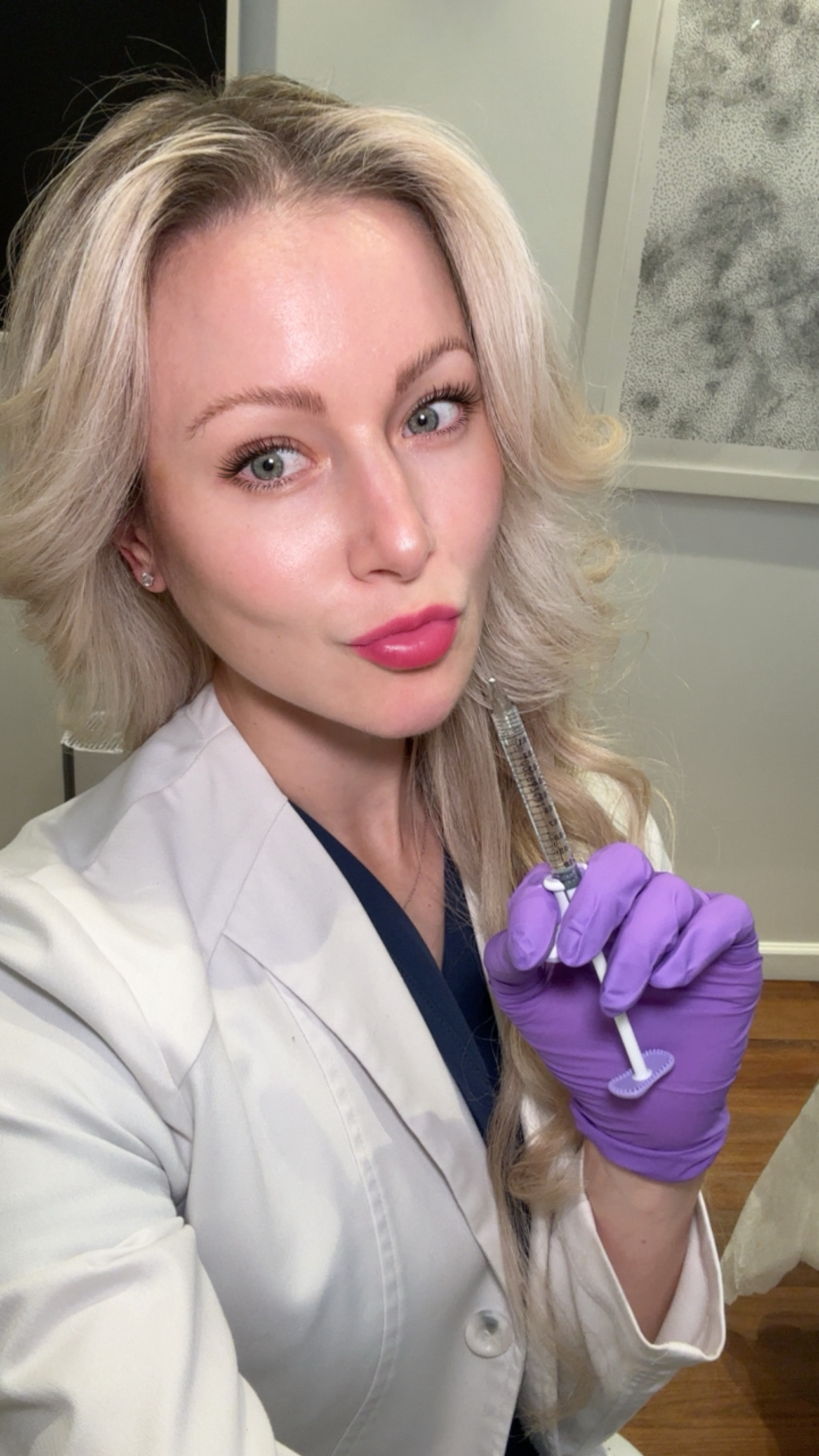
Are people really injecting cadaver fat into their faces? And do lasers actually tenderize your tissue like an overcooked chicken breast? These were some of the questions on my mind when I called up Dr. Rachel Westbay, a young dermatologist whose Upper East Side practice has earned her a cult following amongst young mothers in one of New York’s wealthiest zip codes. Westbay is the kind of doctor you instantly trust. She’s honest, open, and to the point—especially when it comes to beauty. Her secret? Staying true to her clients’ natural looks. That, and a whole lot of lasers.
———
TAYLORE SCARABELLI: How are you?
WESTBAY: I’m well. I just found out that I’m doing a live news segment for CBS, so I’m rushing to get my hair done so I don’t look a mess on camera.
SCARABELLI: What’s your glam for that?
WESTBAY: I always just go with a nice beach wave blow out, and then I do my own makeup.
SCARABELLI: Do you wear foundation?
WESTBAY: I don’t, not even when I go out for dinner or a night out. This has only happened in the last 4 to 5 years, as I’ve seen the summation of all the work I’ve put into my skin. I just wear a little Rivision tinted moisturizer. And if I have a little redness left over from a breakout, which, even as a dermatologist, I still get, then I’ll do a little concealer.
SCARABELLI: Fab. So I want to start by asking you who your clients are?
WESTBAY: The niche that I’ve really honed in on is the Upper East Side mom, early 30s to late 40-year-old moms who have little ones or kids in high school. Part of the reason I have that demographic is because like calls to like.
SCARABELLI: One hundred percent. So what are these moms coming to you for?
WESTBAY: People are generally coming to me with more of an open-ended, “Hey, I want your expertise, your eye, and your opinions on how I can look like the most elevated version of myself.” Those cosmetic consults involve multiple modalities: Botox, filler, laser, skin tightening, depending on the patient.
SCARABELLI: But you’re operating in one of the wealthiest zip codes in New York City. There must be people coming to you wanting the next best thing in skincare. I’ve been reading about cadaver fat transfers. Are people asking for that?
WESTBAY: A popular procedure at our office is something we call a nano fat transfer, which is very similar to what you’re referring to. What we can do bedside, without the need for general anesthesia, is take a little bit of fat with a suction cannula from an area that you either dislike or don’t mind losing fat from and put it, for instance, in the pre-jowl area.
SCARABELLI: I didn’t know you could do that at the doctor’s office.
WESTBAY: Yeah. Some dermatologists do lipo. It’s not hooked up to that big, big canister that you typically see in a movie with plastic surgery, but the cannula creates a suction. Believe it or not, Taylore, we can do small-volume liposuction at the bedside if a mom has just that little periumbilical pocket of fat around the belly button without the whole setup and the operation of lipo.
SCARABELLI: Goals. Are botched clients big for you?
WESTBAY: For sure. I see botched clients from a whole number of different practices. Not to be the dermatologist on the soap box putting down med spas, but I see it from more your Peachy’s and other places where people have less robust training with the needle.
SCARABELLI: Right.
WESTBAY: Without naming names, there’s a dermatologist in the city who dabbles in cosmetics, but that’s not what their main practice is. Whenever something goes awry with a patient, they send them to me to fix the error and pays for the patient’s procedures. Like anything else in medicine, including surgeries that are medically needed, when things go wrong in cosmetics, things can go terribly wrong.
SCARABELLI: Give me an example.
WESTBAY: One time, a young mom who was, like, 3 months postpartum, had gone to her regular provider for Botox. She reports having had excruciating pain the minute the Botox was injected into her forehead, so much so that she went home and had a horrific headache and nausea and vomiting. She ended up developing these giant firm bumps everywhere that the Botox was placed. I think her dermatologist also presumed these were inflammatory reactions. From what? They didn’t know.
SCARABELLI: A mystery.
WESTBAY: So he did multiple injections of cortisone, the same cortisone you would get if you had a big pimple before a wedding, but a higher dose. The biggest side effect of cortisone injections is something we call atrophy, which means that the skin, largely at the level of the fat, loses its tissue and becomes indented. And so this patient came to me with six to eight deep indentations all across her forehead. It was bad. She had deep craters on her forehead.
SCARABELLI: That’s crazy. I wonder if that’s what happened to Brandi Glanville.
WESTBAY: I’m not sure, but this patient was sobbing to me in the office because she looked like that for her photoshoot with her newborn. Anyways, her doctor sent her to me because the forehead is an exceptionally precarious area to treat with filler—multiple major vessels run in the forehead. The most feared complication of filler is an occlusion, meaning it gets into a blood vessel which can then cause death of tissue, and in the worst case scenario, blindness.
SCARABELLI: Right.
WESTBAY: And so she came to me with these massive indentations all across a landmine area for filler. I understand completely why that doctor didn’t feel he had the competency to inject her. It was a 6-month plus process of me doing filler and using every single strategy I knew to mitigate that risk. I was getting tachycardia, meaning my heart was racing every single time I treated her.
SCARABELLI: Wow.
WESTBAY: As it turns out, the medical assistant who was diluting the Botox accidentally drew up a vial of hypertonic saline, which is what we use to destroy veins, instead of regular saline. So it literally caused a massive inflammatory reaction and then presumably a necrosis of her tissue.
SCARABELLI: Jesus. Okay so on the flip side, how do you talk patients off a ledge? Injectables are a slippery slope and once you start getting them it’s easy to find more and more things to “adjust.”
WESTBAY: I always maintain that a good cosmetic provider will tell you what you need and what you don’t need. When it comes to asymmetries, one thing I always point out are asymmetries in my own face. I say, “Listen, if it were so asymmetric that I noticed it myself in consultation, you would have a compelling argument to treat it. But if I have to literally get 2 inches from your face to see the asymmetry, it’s not worth it.” And we have to remember that symmetry is the opposite of beauty. There’s actually studies in cosmetic literature that show that if you mirror an image and make a perfectly symmetric face, people, 10 times out of 10, choose it as the lesser attractive face than the one that has asymmetry.
SCARABELLI: What if somebody comes to you and they want a more unnatural look? If they’re like, “I like big bimbo lips.”
WESTBAY: It depends on how extreme we’re talking. As long as it’s within the realm of reason, I’m happy to do it to deliver the aesthetic they want. But if they’re coming to me asking for cheeks that are ballooning out of their face or lips that look like they’ve got caught in a pool drain—I never want to tell the patient they’re wrong. They have the prerogative to do whatever they want to do. But I just say, “I don’t know that I’m necessarily the best person to create the aesthetic that you’re looking for.” I’m very protective of my brand and I’m very protective of my art, and cosmetics is an art, at least if it’s done well.
SCARABELLI: That makes sense. Can you explain the difference between ablative and non-ablative lasers?
WESTBAY: So what you’re referring to are the category of lasers we call resurfacing lasers. Resurfacing lasers target water, and because a majority of your dermis, which is the meaty part of your skin that contains collagen, is water, when you heat up that water, you fragment the collagen. Much like if you boil an egg or scramble an egg, it changes the egg’s consistency because the protein denatures. And so that forces new, better collagen to be made in place of the damaged collagen.
SCARABELLI: Okay.
WESTBAY: Non-ablative lasers are lasers that simply heat the dermis. So those are like your Clear + Brilliant, MOXI, Fraxel. Ablative lasers, as I describe it when I’m teaching my residents, they vaporize tissues. Those are your CO2 lasers, or what we tend to use at our practice, erbium lasers, which give the equivalent results but with shorter recovery and less complication risk. And because they vaporize tissue, they can contract tissue, and so they have more tightening abilities than lasers that heat.
SCARABELLI: I’ve seen some before and after images of older patients you’ve done, and it literally looks like they’ve had a facelift.
WESTBAY: Contour TRL is the name of the fully ablative erbium laser that I use, and I love doing that laser. It is the most gratifying laser of all lasers to perform as a physician and as a patient because the transformations are wild. If the settings are correct, I can reliably take a decade or more off someone’s face. The downside of lasers of that nature is they require downtime that isn’t for the faint of heart. I’m very transparent about what that downtime looks like, but I’ve never had a patient go through it and then say, “I wish I hadn’t done that.” The other disadvantage is that those lasers cannot be used on skin of color because the risk of hyperpigmentation or scarring, or even hypopigmentation, meaning loss of pigment, is way, way, way too vast.
SCARABELLI: I’ve heard people say it all depends on the physician actually administering these lasers. What can go wrong?
WESTBAY: It’s just a matter of experience. I would say, yes, you have to make sure that you go to someone who, this isn’t their first rodeo, they have a lot of experience operating that laser. I would say the most common complication, which does still self-resolve, is redness that lasts longer than 3 months. But you can have permanent discoloration, you can get scarring, and when you treat around the eyes, you can get something called ectropion, which is where there’s such contraction of the tissue that your eye actually turns out, and then you can’t close your eye completely, you get corneal abrasions because you can’t appropriately get tears across your eyes, or around the lip, eclabium, when your lip turns in. That’s why we call it laser surgery. We don’t say that to make our jobs sound fancier than it is.
SCARABELLI: So can you do a deep plane facelift after getting those lasers or does it, like, screw up your tissue?
WESTBAY: I know this is a very common concern among patients, and it’s a reasonable one. I mean, I will be the first person in line for a facelift when I need mine. But I’ve talked about this with many a plastic surgery friend and colleague of mine, and I’ve never had anyone even remotely consider the possibility any laser of any kind would affect a facelift, and that includes ablative lasers. In fact, many plastic surgeons will actually perform an ablative laser while the patient is under general anesthesia at the same time as their facelift. And many of them do it after a facelift as well. Another common question is, “Will hyaluronic acid fillers or biostimulatory fillers like Sculptra and Radiesse preclude me from getting a facelift?” Every time I’ve asked a surgical colleague, they have all said an equipped and skilled surgeon has absolutely zero issue operating in a face that has had any of those things.
SCARABELLI: On that note, how young is too young for Botox?
WESTBAY: It’s funny, some people are so, “Oh, I don’t want to do Botox until I’m 30.” But Botox is one of the number one minimally invasive, cost-effective interventions you can get to make you look much younger, and it has a preventative benefit. The analogy I create is you repetitively fold a paper along the same line for years. That’s the equivalent of you contracting a muscle against your personal contraction pattern your whole life. If you wait too long, then no matter what way you try and iron out that piece of paper, you’re going to still be left with lines etched at rest.
SCARABELLI: Who’s the youngest person you’ve given Botox to?
WESTBAY: As early as 18, but that’s usually just a lip flip for someone who’s looking to give the illusion of a slightly fuller lip without filler. And And then true Botox, between the brows, as young as 22 or 23. Everyone’s variably expressive. If you’re a very emotive person, you’re going to need Botox earlier than someone who isn’t as emotive. I’ve seen 23-year olds who legitimately have etched static lines, meaning at rest, they have wrinkles.
SCARABELLI: It’s true I have friends in their 40s who don’t need Botox at all, and I’m like, “My elevens are crazy.”
WESTBAY: Yeah.
SCARABELLI: And that’s just what it is.
WESTBAY: That’s exactly the take-home point.