


LONER
Raf Simons Steps Inside Steven Shearer’s Reclusive World


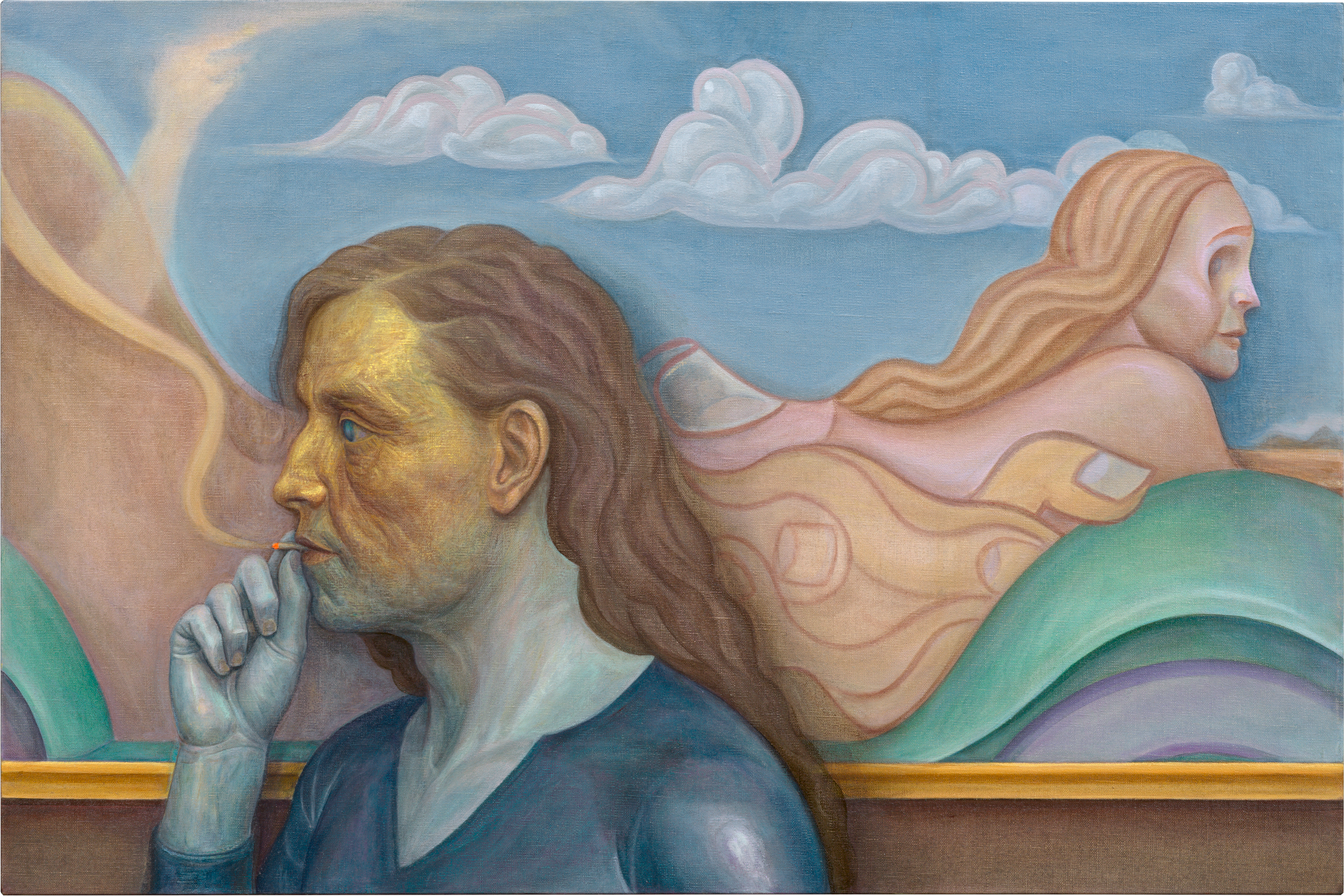
Tokerman, 2026.
For a reclusive artist who rarely leaves his studio in Vancouver, Steven Shearer sure gets around. For the past three decades, Shearer’s peculiar brand of painting—haunted psychedelic portraits, most often of men, that merge rebellious youth with canons of Old Master works, often the freakier the better—has gained a global cult following. His paintings and drawings of long-haired metalheads have become his signature, but he’s also versed in photography and collage, employing his massive database of found internet images to create odes to themes like sleeping and blowing. Shearer likes to let his work do all the talking (he never allows his photo to be taken and rarely grants interviews). This summer, Shearer is showing a new suite of paintings, many of which were created with the help of AI, at David Zwirner in London. He hopped on Zoom with his friend, designer Raf Simons, to discuss growing up in isolation, following the art world from a distance, the greatness of JPEGs, and the creative freedom of the ’90s.
THURSDAY 12 PM APR 23, 2026 VANCOUVER
———
RAF SIMONS: Wow, that’s a lot of paint on that table behind you.
STEVEN SHEARER: It’s my official credentials back there. How are you?
SIMONS: Not too bad. We’re in the middle of two shows. You seem to be in very good condition. You already have so many paintings ready for your show. It’s crazy. I haven’t seen that before, in all the years I’ve known you.
SHEARER: [Laughs] Yeah, I haven’t either. It was a bit of a surprise.
SIMONS: Are you happy with the show?
SHEARER: It’s hard to say. I was happy when all the paintings were here and I was working on them. But once they’re out the door, I’m back to trying to figure out where to go next.
SIMONS: They’re not all out the door yet, are they?
SHEARER: I was working on one but I ruined it. The other one here I’m apprehensive to work on because I might do the same.
SIMONS: What do you mean when you say you ruined it?
SHEARER: It got a head transplant that wasn’t for the best. I have ways in the studio of channeling my antisocial energies. I used to slash the paintings and destroy them. Now I just do other things, and the paintings survive. Hopefully I’ll return to it and it’ll be for the better.
SIMONS: You have 10 new paintings for this show. Usually, you borrow a lot of your older work and combine it with your new work.
SHEARER: In the past, each time I had a gallery show, I would try to borrow as much work [as possible] and create a survey of the strongest things I had done over a longer period. I took it on as a challenge for this show to try and work through a group of paintings and let it take shape and be committed to doing that. In recent years, it’s not unusual for me to make between one and four paintings, because I’m doing prints or other projects. In 2023 I only made one painting. But I really focused for the last year on trying to come up with a group of paintings, and it’s worked out.
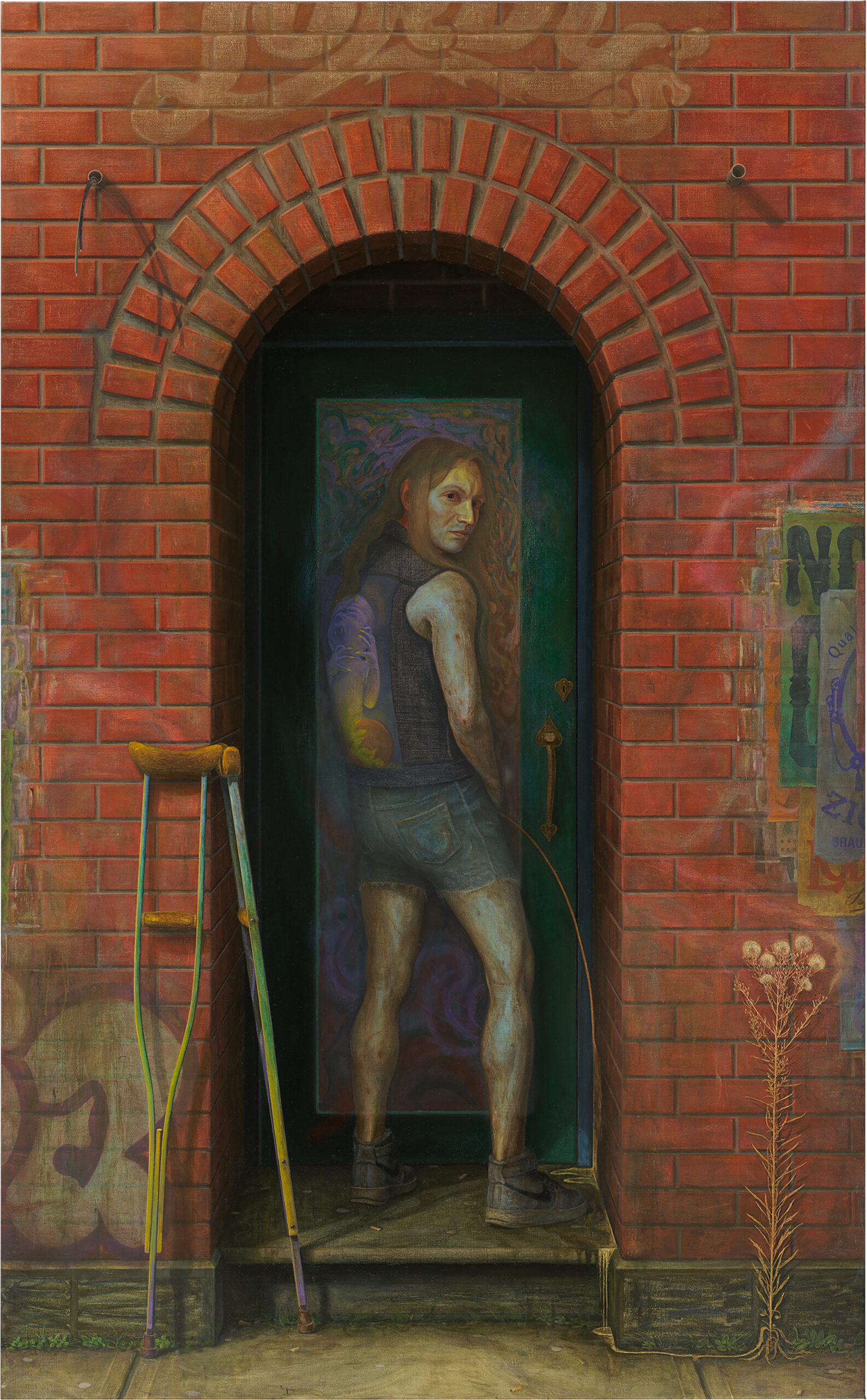
The Wizzer, 2026.
SIMONS: There’s one painting called Tokerman. When I saw it I was like, “What’s going on in the background?” You think it’s a hand, but it’s a foot, right?
SHEARER: I think it’s more a car. But it has toes painted on it. It’s a mélange of different elements. There’s a Renaissance low-relief figure in the front, a more modernist relief figure in the background, and then a more airbrushed landscape of clouds.
SIMONS: While I listen to you, I’m trying to see the car. Now I see. What were you thinking?
SHEARER: Well, the thing is, I have an idea when I start the painting, but I have no idea what needs to happen to make it feel finished. If I knew how it was going to look finished when I started, I would lose interest. I have a nonproductive drive that as the painting becomes more finished and I start to see it realized, rather than just accept it as finished, I try to paint the next painting on top of it. If I look at the stages a painting goes through, there might be four or five faces underneath.
SIMONS: Oh, wow. Maybe it’s more helpful to do more paintings in a shorter time span.
SHEARER: I think so. I have a collection of over 70,000 digital images—JPEGs I’ve collected for 25 years. I’ve started using AI to create offshoots and permutations of images I liked but that didn’t initially inspire a painting. The new works have references to past images, but they are also inspired by portraits from art history. Once I blocked in the faces on the canvas, I could go back to AI and ask for more permutations. You can give AI prompts and restrictions on the source image, as well as stylistic cues, so I got a lot of permutations on one composition. It’s sort of like inbreeding the reference images. I can make 200 variations of an image and none of them are quite resolved.
SIMONS: I’ve always thought your paintings and drawings had the quality of the Old Masters. I think that’s been there from the beginning, in your paintings of the long-haired men in the early 2000s. Do you feel like you have the same subjects in mind as a starting point? Sometimes I think I have the same subject in my work all these years, although it does evolve. A part of me is still obsessed with youth, but also you mature in your work. I’ve always perceived your work as having an obsessive interest in a certain kind of youth. I remember thinking early on, “Yeah, it’s all death metal, but it’s not all death metal.” Your figures tend to have very specific hair, for example. Why do you think that is?
SHEARER: I guess the image collecting I did was probably about building a cultural starting point in a biographical sense. Over time that distilled and combined with looking at art history and being interested in portraits, without really having a hierarchy. A found photo of a random guy can be as compelling as a regal portrait from the Renaissance. It comes down to a person’s sensibility. I didn’t know what I was driving at or where I was going. I just knew what I was drawn to, and I sort of followed along.

Morning Fantasist, 2022.
SIMONS: Were you always interested in Old Master paintings?
SHEARER: Being in Vancouver, images from art history only exist in books. I didn’t grow up seeing actual artworks, and there aren’t many historical artworks here. Artworks in books were similar to a found photograph of a person, without a real hierarchy of importance. Combining them seemed really interesting, making a painting where the subject’s manner of appearance was something I could relate to from my experience or from my time, but still echoing the sensibility of a different era. It’s like the ghosts of old paintings animate these portraits.
SIMONS: You never paint from life, do you?
SHEARER: I don’t want anyone here when I’m making portrait paintings. That’s the irony of it. I am alone with the work, and that mood transfers to the paintings. I try to find a balancing point between androgyny and stillness. But really I just make what I want to make and then see how it fits afterwards. I’m making more effigies than portraits. I really want to create a presence in the painting that is born out of that painting. Its complexion is made of paint, not flesh, and that’s part of the logic of how the color works. Being here in this studio in Vancouver, not wanting to venture out of it, I really am attracted to the idea of making something that pulls people in, a painting that’s desperate for someone to look at it. The paintings go out into the world and engage with people in a way I wouldn’t feel comfortable doing.
SIMONS: I see what you mean. When you were in art school, which artists inspired you?
SHEARER: Here, it was libraries.
SIMONS: Yeah, but you know your shit. Which artists did you love?
SHEARER: It might have been artists I saw in books: Ernest Luthi, Hans-Peter Feldmann, Philip Guston, or Luigi Ontani.
SIMONS: But who have you loved forever and ever? Maybe you don’t have that. For me it would be [Pieter] Bruegel [the Elder]. You showed with some amazing gallerists once you got out of art school. Like Colin de Land in NewYork in the 1990s. You and I were born the same year, 1968. What was starting out as an artist like for you in the ’90s?
SHEARER: Being an artist back then was like taking a vow of poverty. I managed to work with Colin and lots of other great dealers without ever meeting them first, working away in Vancouver and sending the work. It was a time when you could send JPEGs of your work, or people would see JPEGs, which was good for me because I could be isolated in Vancouver but my work could circulate. JPEGs were a game changer.
SIMONS: It seems like everyone is romanticizing the ’90s now. We talk about it a lot at work. But it’s interesting to think back on when you first made contact with art, especially since you and I both grew up isolated from that scene. In the ’80s, when I was a teenager, I was very attracted to art but I didn’t know why. I also didn’t know that much about it. We had this incredible curator in Belgium, Jan Hoet, who did exhibitions that were like nothing I’d ever experienced in that moment. In my small town, our main medium was TV.
SHEARER: Oh, yeah, me too. Watching TV and collecting stamps. Making drawings, collecting comic books.
SIMONS: For me it was watching TV and collecting fossils.
SHEARER: Hanging records up on my wall. My mom was really into presentation. Everything was really organized. This idea that you could shape and organize the world around you was really attractive to me from early on, because I wanted to shape some kind of world elsewhere.
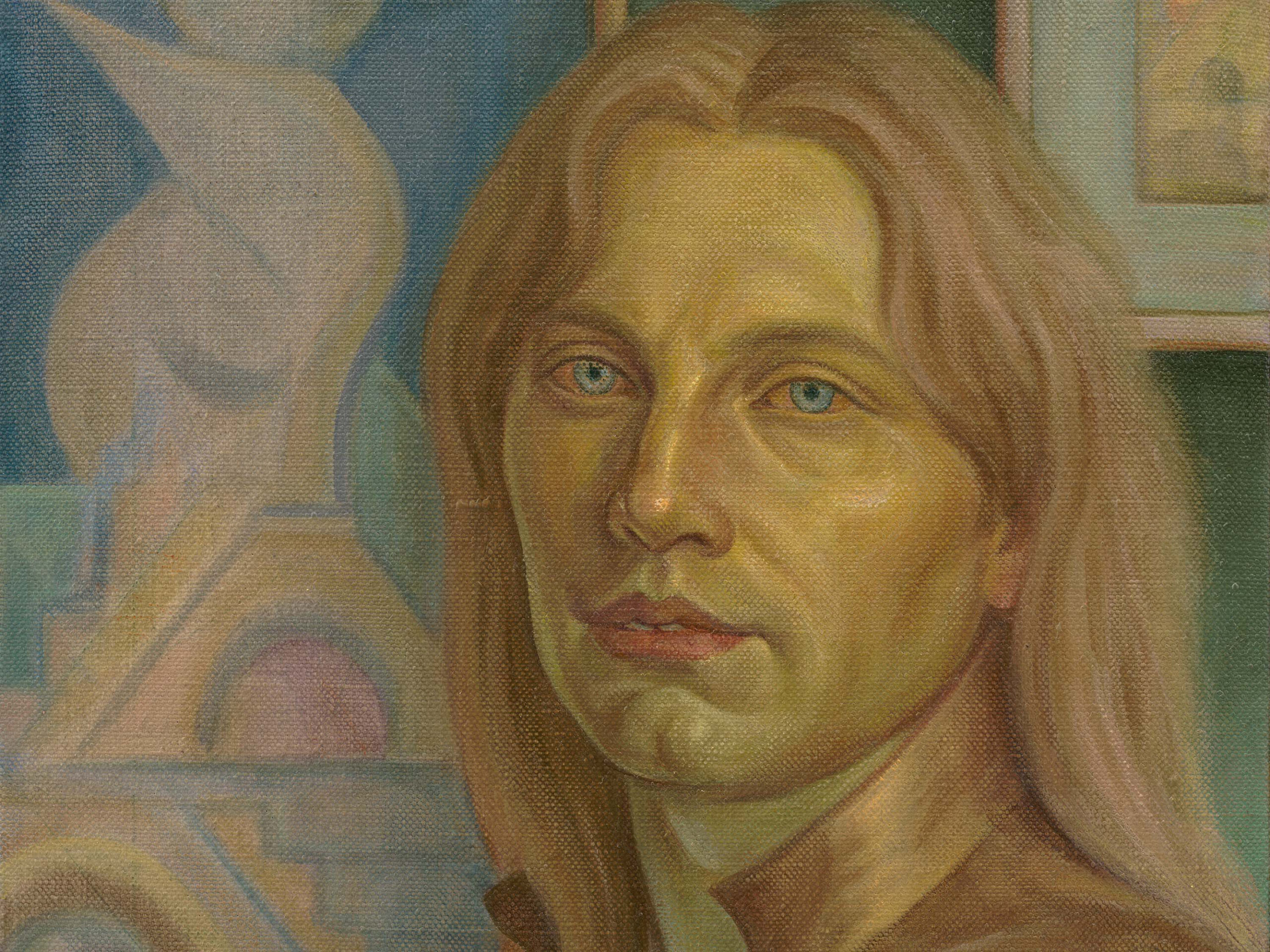
The Pastel Tutor, 2025.
SIMONS: It’s crazy how much we have in common. I wonder if it’s purely a generational thing, because I had all these stuffed animals organized on my bed, which now seems so Mike Kelley, but at the time I just liked these animals and their colors together. I got them from a very specific yearly market we attended where people would make things and give the money to Greenpeace. When I was a child and people would ask me what I wanted to become, I said, “Greenpeace activist.”
SHEARER: I think that sense of wanting everything organized is part of having your own sensibility. Do you think that’s what carried you into fashion?
SIMONS: When it was time for school I didn’t study fashion. I studied industrial design. But I used to go to London a lot because it was close to Belgium. That was during the birth of a very hardcore art scene: Sarah Lucas, Damien Hirstand that whole generation, the “Sensation” show. That was all going on parallel to the birth of what the world called the Antwerp Six. I also ended up doing an internship with one of the six, Walter Van Beirendonck. But it was all such a small world then, and most of it was very extreme. I don’t think the designers or creators have changed so much from back then. It’s the systems that have changed. And with the evolution of technology and the way things are, I don’t know how it is for you, Steven, but I started in 1995, and I was really naive, thinking, “I want to express myself with clothes.” Clothes were a medium to express how I see people, their manner, and how they behaved. It was almost more of an attitude thing. I didn’t do a show in the first four seasons. I never even thought about a show. It was just about getting it out. But it was also about being in dialogue with people from my generation. We would hang out in the same café in Antwerp, talking about art and fashion and design. It felt at the time that everything was possible. There were no systems.
SHEARER: That resonates. I don’t think the creators have changed. It’s the landscape. I was impressed by how open things were. If you were invested and curious and wanted to be a part of what was happening, people were glad to have you around. I was not career-minded at all, from the beginning. My entry into all these great galleries I worked with was through other artists showing the dealers my work. That was just part of the spirit of the time.
SIMONS: I have the same feeling.
SHEARER: It allowed me to advance without actually coming out of my shell in a lot of ways. I could keep my head down and just keep making my stuff.
SIMONS: I think we were simply unaware of the systems. These days, the young generation is extremely aware of them. When I was teaching for five years in Vienna, the students would come up to me and ask, “Where do you think I should show? Who should be our press agent?” My response was, “The only thing you should worry about is making a pant that gets the attention of one or two people because they think it’s something new they can’t find anywhere else. If you can do that, whatever you desire will find you.” I still believe that. But I’m also now aware that it’s more and more complicated to find that opening and then be able to grow into it like we did. I still think there is fantastic young talent awakening, but fashion has grown by a gigantic scale. It’s so popular. Fashion used to be very niche. I remember when friends wanted to go to fashion school and their parents would be freaking out, like, “That means you’re going to be poor, you’re going to have no work, you’re going to be gay.” It’s completely different now.
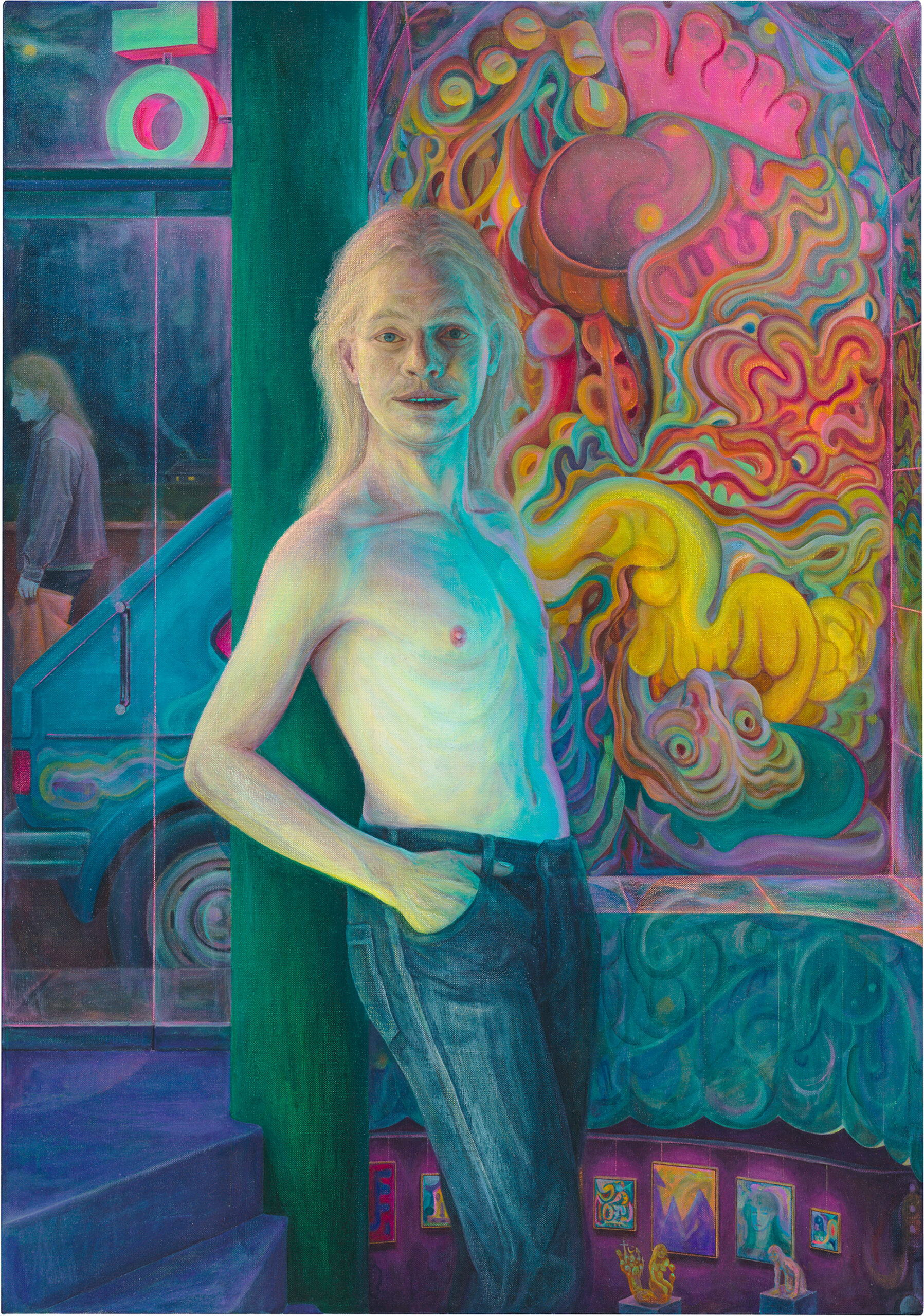
The Underground Exhibitor, 2024.
SHEARER: When I started out, there were a few artist-run centers here in Vancouver. It was more a senior art generation and there really wasn’t a commercial market for art here. In some ways, there still isn’t. I enjoy that I have no business here. I don’t have a gallery in Canada. That gives me space to do what I do.
SIMONS: Except for when they force you to takedown billboards of sleeping people because they think they are dead people. [In 2021, during the Capture Photography Festival in Vancouver, Shearer’s billboards had to be covered up because of public outcry.]
SHEARER: Yeah. My dabblings in exhibitions haven’t gone so well here. But that’s okay. I have a really abstract connection to my work when it’s shown. I had the luxury, when I started pursuing art, to have six or seven years when no one was interested in what I was doing, so all my decisions were guided by personal necessity and what I was attracted to—what I gravitated toward and what I made. I think that’s a real blessing.
SIMONS: It can be a real curse to have a lot of expectations about success, especially in the short term. I definitely did not have any expectations.
SHEARER: Yeah, me neither. On paper, it didn’t look good.
SIMONS: So coming back to my earlier question, who are your favorite artists right now? Or who inspires you now? I think we are not going to get an answer, right?
SHEARER: [Laughs] When I’m making the paintings, I can’t help associating different artists’ sensibilities to them. “Oh, this face looks like a Conrad Felixmüller” or “This face looks like a da Vinci.” The lucky thing is it’s always different artists.
SIMONS: Okay, Steven. I’m coming to London for your opening.
SHEARER: I’m glad you’ll be there.