



VIBRATION
Arthur Jafa on Strip Clubs, Transhumanism, and the Boundless Black Imagination


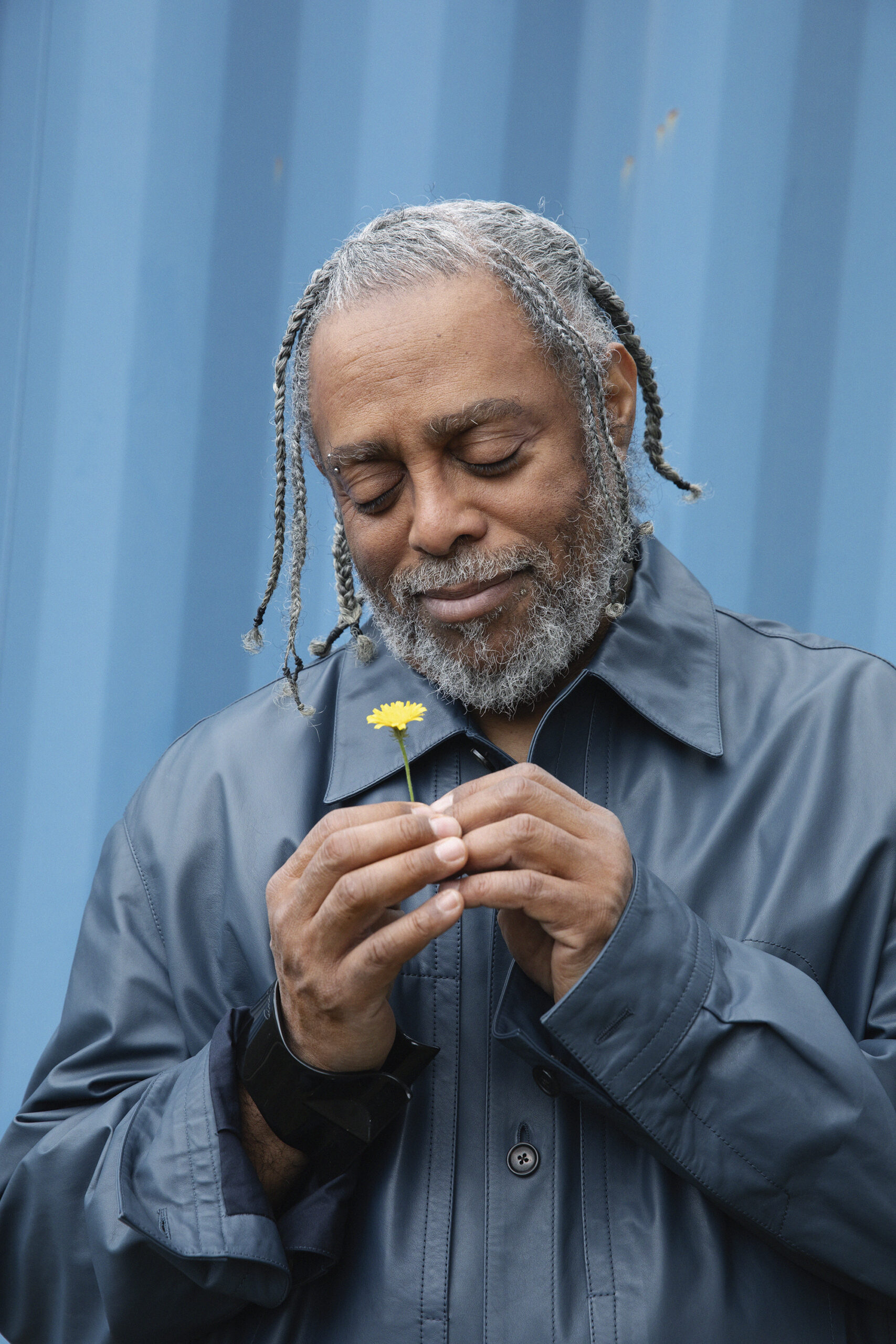
Arthur Jafa wears Jacket Hermès. Bracelet Arthur’s Own.
Any claim that art no longer moves culture can be disproven by dropping one name: Arthur Jafa. His 2016 magnum opus Love Is the Message, The Message Is Death, set to Ye’s “Ultralight Beam,” hit harder than any think piece. Now the Los Angeles-based artist adds curator to his résumé. For MoMA’s Artist’s Choice series, Jafa gets the keys to the museum collection to assemble Less Is Morbid, mixing Basquiat with Cady Noland and Roy DeCarava. Last fall, the 65-year-old artist-filmmaker-provocateur spoke with his friend, musician Christelle Oyiri, to talk about control, collapse, and everything in between.
———
TUESDAY 10 AM OCT. 14, 2025 LONDON
CHRISTELLE OYIRI: Hey, J. My camera is not on because I’m sick.
ARTHUR JAFA: It’s alright. I was like, Christelle was out late.
OYIRI: No, I’m okay. I love the title for your Artist’s Choice, Less is Morbid. The play on words of [Ludwig] Mies van der Rohe’s “less is more” is really cheeky. And for you, less is morbid.
JAFA: Like a lot of things, it started off as a joke, but the more I thought about it, I was like, huh. It seemed to suggest something about us being in a different place. “Less is more” is bound up with certain ideas of progress and is a counter response to certain ideas of scarcity versus excess. But some of those things don’t hold anymore once you get to the digital spaces that we’re at. Even just for me as a filmmaker, when I came up, part of shooting yourself was managing a finite amount of film stock. But once you go digital, it’s not really a factor anymore. It’s like when you sit at a piano, nobody’s parsing out or rationing the notes that they hit on a piano.
OYIRI: Of course. It’s supposed to come in abundance.
JAFA: Exactly. So the statement is a little bit of a redress to the whole idea that we should operate in a psychological space of scarcity. We should operate as if the abundance is infinite—infinite in terms of infinite possibility, infinite potentiality, infinite worlds.
OYIRI: I love that.
JAFA: In my exhibition practice, people operate as if I have a horror vacui, that I feel the need to fill every space. I would call it an impulse for things to be full and abundant. You know what I mean? Nobody’s going into a DJ set rationing the music they play.
OYIRI: Absolutely. There’s an inherent abundance in music because of sampling. Hip-hop in particular opened that portal of infinity and abundance in that way. You can actually make a lot from just one note or one sample. I love that you’re speaking about the scarcity mindset. I feel like a lot of people that have a scarcity mindset went through trauma. When I think about my grandparents that went through war and things like that, they operate from a scarcity mindset. They experienced their food being rationed.
JAFA: It’s deprivation. Once I got older and started to travel a bit, I’ve gone to some places that on one hand were full of abject poverty, but at the same time were incredibly rich places to experience. Of course there is poverty, and we should end it, but it has nothing to do with material possibility. There are forces in the world that are invested in folks being deprived of basic needs. But by the same token, you go to the “third world” or second world countries, or even increasingly now, first world countries, and you find people who on the surface seem like their lives are full of material lack, but simultaneously they seem to have a rich possibility of being. For me, growing up in Mississippi and in the Delta, I saw a lot of people who lived in homes that by most standards were considered abject, but that’s not how people occupied those spaces. My grandfather died when I was four. I don’t even have a visual memory of him. My impression of him is purely haptic—how things felt, how he felt, how his space felt, this primordial sense of home. His house smelled different from my parents’ house. Whereas we had wallpaper, my grandfather’s house had exposed wood slats. It was a shantytown.
OYIRI: It’s the same for my grandmother. In Guadeloupe, she was living in a metal shack. You see that in the Caribbean a lot. She had a garden and had several mango trees, and she was happy.
JAFA: To me, Less is Morbid is more about mindset. We should operate with a sense of abundance, because the one thing we’re never lacking is imagination. I remember Paul Coates, Ta-Nehisi’s’ dad, saying something to the effect that when Black people in America were enslaved, at the end of the day when the sun went down, they couldn’t do any more work and they had to shift into the mode of maintenance. We have to prepare for the next day, to heal, tend to our wounds, feed ourselves, cleanse ourselves, and sleep. But he was saying there’s that liminal period between when you stopped working and before you went into the maintenance mode when you just had this free space. What did Black people imagine in that moment? I said that it seems like they could imagine anything. He said they imagined us. It was such a profound thing when he said it.
OYIRI: That’s beautiful.
JAFA: It’s a mentality that even in spaces, plantations, slave ships, whatever, where we were radically constrained, our imaginations are always free. So we have to operate like that, because there’s never a shortage of space to think.
OYIRI: This is why Black resourcefulness is revered in the world. How did you approach this project within a canonical institution like MoMA? Did you see it as an opportunity to own the collection?
JAFA: Initially I had an idea that revolved around Wifredo Lam’s painting “The Jungle” in MoMA’s collection. They used to have that painting next to the coat rack for years, and that was bothering me. I used to be like, “This is intentional. Somebody up here has a bad sense of humor.” So I thought, “First thing I want to do is put the Wifredo Lam facing off against Picasso’s ‘[Les] Demoiselles [d’Avignon].’” Because I do think it’s as important a painting as Demoiselles. But you know my position on this shit. There’s no modernism in contemporary art as we understand it without Black aesthetics. Part of what’s genius about Picasso’s thing—and I’m speaking of him as an exemplar of European artists gaining access to African artifacts—is that they can see how alien and sophisticated they are in terms of their formal complexity, but a lot of times they have no idea what they’re about.
OYIRI: They see the form. It’s like the pyramids as well. A lot of people cannot fathom that African people built them. They just take the form. They don’t actually engage with the profoundness of it.
JAFA: I studied at this place a long time ago called the Frantz Fanon Lab for Decolonial Psychology. The first thing they would start off with was this idea that there are two dominant modalities of cognition. One is called object measure cognition, which is typically Western. The other is symbolic affect cognition. It’s two ways of comprehending the world. It’s like judging the magnificence of the pyramids along the lines of, it’s big and geometrical, and all these material assessments. Not the assessments that are vibrational or fundamentally immaterial, even though it has a profound impact. You see that a lot. There was a whole discussion at one point about Jay-Z versus Future, who are both great. Someone would say Jay-Z clearly is way more powerful because he’s sold so many more records. But it’s not a one-to-one correlation. It’s not like the person who sold the most records had the most influence. That’s not how it works.
OYIRI: No, it isn’t.
JAFA: Even with Michael Jackson, for example. Thriller is the biggest-selling album of all time, but anybody who thinks that Thriller’s a superior record to Off the Wall is out of their mind.
OYIRI: Thriller created moments that were trans-generational, which means that if I show a Thriller song to my 15-year-old niece, they’re going to know the songs word for word, and they don’t speak English. It transcended language. It’s a very odd record in that way. But I agree that from a standpoint of Black music, Off the Wall is just more soulful.
JAFA: Totally. But trying to assess Michael Jackson’s or James Brown’s greatness purely on musical terms misses the point. It’s the way they move, their presence, the way they look. Michael Jackson’s look alone. It’s a paradigm shift.
OYIRI: I don’t think people talk about it enough. Especially in regard to your work “The White Album,” [2018]. I’d love to hear you talk more about Michael Jackson sometime.
JAFA: Don’t get me started on Michael Jackson. At one point these producers were going to do this Michael Jackson TV show, a dramatic thing. They wanted to hire me as a consultant because they heard me talking about him. There are videos of me talking about Michael Jackson back when he died, where I would be saying things like, “Michael Jackson was a shape shifter.”
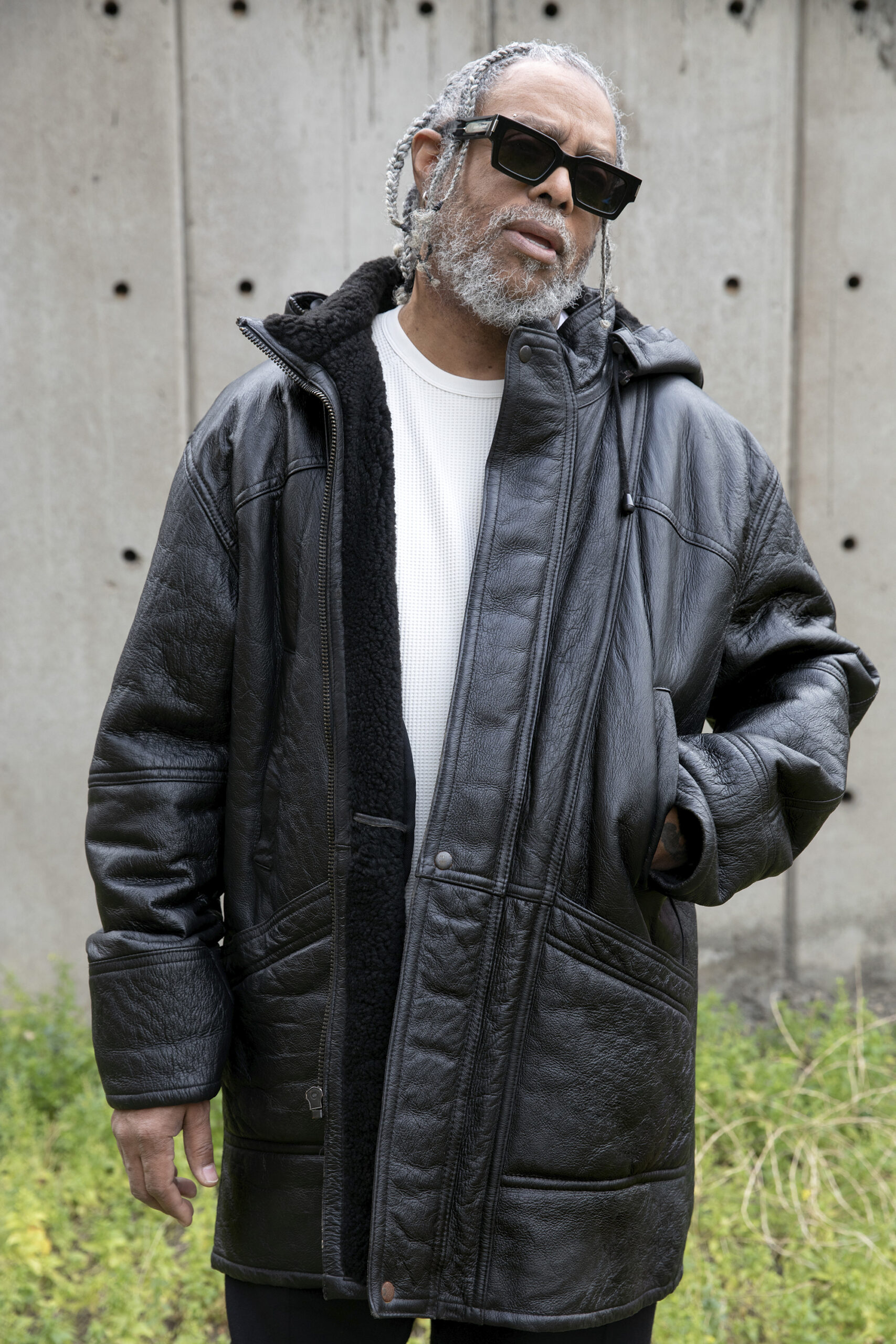
Jacket Stylist’s Own. T-shirt Goldwin. Pants and Sunglasses Arthur’s Own.
OYIRI: But he was.
JAFA: That’s what I’m saying. People thought I was crazy when I said it, but in a sense he’s one of our earliest shared exemplars of what is fundamentally transhuman. He’s a trans avatar. A hundred years from now, you’re going to be able to look like what you want to look like. If human beings are still around. It’s just the technology, from BBLs and the advances in plastic surgery, and CRISPR where you can edit your genes. People are going to be able to look like what they fucking want to look like.
OYIRI: That’s true.
JAFA: At that point, a lot of metrics of “racial control and constraint” are going to fall away. They’re going to have to figure out other ways to segregate people, because the way you look is going to be a choice. For example, do you know the whole Second Life thing?
OYIRI: You mean like The Sims?
JAFA: You know BLUPRNT at all? He’s fascinating. His name is Mansa Morales. He’s behind this whole community of—who knows if they’re Black people or not? One presumes they’re Black. You have to choose your body to be in this online space. Mansa’s thing is that he designs bodies and clothes. You can get anything. If Demna comes out with a new season of clothes, man, they have copied all that stuff.
OYIRI: That’s crazy.
JAFA: You can wear anything that comes out. I kid you not, Christelle. Some might assume what this kind of stuff would tell us is that everyone would choose to look white, but that’s not what people are choosing. You can tell who the contemporary models are, it’s LeBron James and Teyana Taylor.
OYIRI: For me the epicenter of Black aesthetics is the strip club. Go to an Atlanta strip club, especially 10 years ago. Even today.
JAFA: Yeah. Back in the old days of segregation, you had all these Black spaces where white people’s aesthetics didn’t matter. Nobody was thinking about white aesthetics. These were truly Black spaces. But now that we’re integrated, you have to find these spaces. When I was working on a TV pilot about 10 years ago, we went to Magic City in Atlanta for research. It had a profound impact on me. You could see that it was a space where Black aesthetics ruled, no compromise. In terms of the body aesthetics, the adornment aesthetics, the musical aesthetics, it was full-on blackity Black. The church used to be the nexus of Black culture—the music, the dance, the oration. But it’s really clear it has shifted to these strip joints. Once you start seeing sisters wearing stripper shoes at church on Sunday, you know shit has shifted. But Black culture originally had the Protestant church, which had a very strained relationship with visuality.
OYIRI: My mom raised me as a Catholic.
JAFA: Same with me. At one point I thought I was even going to be a priest.
OYIRI: I didn’t know that. What role does music play when you’re working?
JAFA: I don’t work to music. I listen to music very intensely. A lot of times I’m just dreaming when I have music on. I tend in general not to have music as wallpaper when I’m working. When people say, “In your cinema or in your art practice, do you want to make stuff with Black music?” I always say, “No, I don’t want to make stuff with Black music, I want to make stuff like Black music.” It’s the same when people say, “You want to make work about Black people.” No, I want to make work that’s like Black people.
OYIRI: You’re such a punch liner.
JAFA: It’s a philosophical wrestling match all the time. How do we open up space for us to think about these things in different ways? Anything that’s a good idea, it’s like a meme—it should have punchiness. It should have staying power.
OYIRI: I think you have a lot of vocal prowess. Your talks are as important as your art, low-key.
JAFA: Not low-key. It may be more important than my art at the end of the day. It’s almost like my art bears witness to my visions. For years that’s all it was. There was very little production. Back in the early ’90s, I had just moved to New York and I was starting to do talks. There was a famous Black filmmaker who came up to me after one of my talks and said, “Me and my cohorts, we come to all of your talks and we scratch our heads because we don’t know what you’re talking about. But then we look at your work. …” At that point my work was one thing, and it was that I shot Daughters of the Dust. So from very early on, I learned that the relationship between ideas and work is a complicated thing. But he made it very clear to me what legitimized or verified me as a person worth listening to was not the sheer power of what I was saying; it was the work. My practice, such as it is, is largely conceptual—it’s ideas. And the work is just evidence of the ideas.
OYIRI: But it’s not just conceptual, it’s also very sensorial. Your art is built like mixtapes or albums. There’s a sequencing to it that feels very physical and vibrational. So for me you’re an idea guy, but I also think you’re a vibrational person.
JAFA: The work has to be materially dynamic and vibrationally intense. It’s got to be affective. In my new show in London, one very big piece is about Larry Levan. He’s the avatar of mixing, the greatest DJ supposedly of all time—
OYIRI: Ever.
JAFA: That’s transhumanism right there, mixing things. It’s like some Octavia Butler shit.
OYIRI: It’s opening a portal, and as a DJ, it doesn’t always open because it’s a magical thing. It truly is superimposing and creating dialogue between different pieces of art and creating your own in real time. Also anticipating the next song because everybody is dancing to a song, and you have the next song in your headphones, so you’re always ahead of time in a way. I love that you show so much love to DJs.
JAFA: Oh man, you can’t overtheorize it. I don’t think people really have come to terms with the full implications of what DJs do. All this CRISPR stuff with editing genes and how we’re about to become transhuman, the DJs are the forerunners of that. The whole idea of the boundary between one thing and another thing, between this record and that record—DJs erase those boundaries. They erased the boundaries between I and We. You and Me. It laid the groundwork for all this stuff that we’re doing now: transhumanism, integration, diversity, all these kinds of things.
OYIRI: It did. Coincidentally, when you’re talking about transhumanism and really great DJs, I’m thinking about Juliana Huxtable, who’s in my opinion a show-stopping incredible DJ, and I can’t separate it from her trans identity.
JAFA: That’s what that T stands for—transhumanism.
OYIRI: I want to ask you about your first love, which is cinema. How did you first tap into that?
JAFA: I wanted to be an architect initially. That’s the first thing I can remember doing with my hands. Lincoln Logs. When I was a kid, my thing was putting things together in different forms and shapes. That evolved into wanting to be an architect. Now, I got to Howard [University] and I studied architecture, but I got very disenchanted. Not the art itself, but like, “Man, nobody’s going to let me build these things.” I didn’t even see a path. I was like, “Black people mostly don’t even own their own homes, much less are commissioning an architect to make something experimental.” At the same time, I had my longstanding parallel interest in images—not even moving images—just still images. I grew up on television, man. Sometimes when people are talking to me they just be like, “I can’t believe how much fucking junk is in your head.” There’s a lot of “good shit” let’s say. But mostly it’s Hazel and [The] Beverly Hillbillies and Gilligan’s Island. So much of this whole cinema thing is about how do we align motion pictures with Black vibration? How do we make the shit vibrate like Black people and Black music?
OYIRI: What’s currently haunting and driving your practice?
JAFA: My big dream is to make a feature film. It’s something I’ve been moving towards.
OYIRI: Fictional?
JAFA: Yeah. My parents do not consider my shit movies. My dad wanted to see AGHDRA [2021], my wave film, so I put my monitor up so both he and my mom could see it. They had two very funny responses to it. As soon as it started, my mom said, “Ooh, I don’t like this, this is scary.” My dad looked at it for a little longer, then just turned to me and said, “You get paid for this?”
OYIRI: These are the real questions.
JAFA: I said, “Yes, sir.” And he said, “Okay then.”
OYIRI: I want to put the energy in the world that you’re going to make a feature film. And if you get to Paris, come visit.
JAFA: Definitely. Thanks, Christelle, this was so much fun.
OYIRI: Honestly, you’re a very generous artist.
JAFA: Well, I’m generous because I have no sense of scarcity, so it’s not that generous. I don’t feel like I’m giving away anything because there’s so much out here.
———
Grooming: Bianca Simoné Scott at Forward Artists.
Photo Assistant and Retoucher: Nimie Li.
Fashion Assistants: Fainche Burke and Freya Reeves.
Production Director: Alexandra Weiss.
Executive Producer: Georgia Ford.
On-set Producer: Indy Davy.
Location: Crixus Studios.