


DIRECTOR
Park Chan-wook and Sandra Oh on the Crisis of the Modern Man


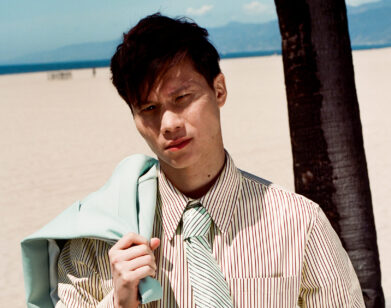
Park wears Jacket and Sweater Loro Piana. Glasses Jacques Marie Mage.
Park Chan-wook is one of the greats. A born director who seamlessly marries style with substance. The Vengeance Trilogy—Sympathy for Mr. Vengeance, Oldboy, and Lady Vengeance—transformed violence into opera, while the erotic thriller The Handmaiden made him a marquee name in America. Since then, he’s explored psychological horror (Stoker), spy fiction (The Little Drummer Girl), and romantic noir (Decision to Leave), bending genre to his obsessions. His latest, No Other Choice, is a darkly funny take on capitalism gone feral. Here, the South Korean legend sits down with the star of his HBO miniseries The Sympathizer, Sandra Oh, to unpack morality, madness, and why horror and humor are just two sides of the same knife.
———
PARK CHAN-WOOK: Hi.
SANDRA OH: So good to see you. How are you?
CHAN-WOOK: How are you?
OH: Good! I just started my first opera at the Met.
CHAN-WOOK: You’re singing in the opera?
OH: No, this opera has a speaking part. It’s called La Fille du Régiment, so I speak French. I’m so happy to see you, and congratulations.
CHAN-WOOK: Thank you.
OH: I love the movie. It’s about so many big things, and so specific. I hope you had a good time making it. Did you?
CHAN-WOOK: Yeah, it was a very relaxed working environment. This was my first time working with [lead actor] Lee Byung-hun in a long time, so we would joke a lot with each other, and then we would tease each other about how our jokes are not funny. And other than Byung-hun, I worked with actors I haven’t worked with before, but they were everybody I’ve always wanted to work with. So that was all very exciting.
OH: I wanted to talk about tone. How do you execute tone, how do you think about tone, and how do you translate that to your department heads? But also, in the context of your cast. How do you talk about tone in your company of actors?
CHAN-WOOK: I first sent the script to Byung-hun, and after he read it he called me. The first question he asked me was, “Am I allowed to be funny in this film?” Which goes to show how complicated the tone was. Because Byung-hun said he laughed out loud as he was reading the script, and he wanted to make sure—is it actually the director’s intention to make it this funny? The other cast members and heads of departments also had the same questions. So I answered with, “Yes, this is supposed to be a funny film.” But when I was talking to my cinematographer or my production designer, I made sure to let them know that you don’t have to express the comical elements explicitly, and I had the same message for the cast. You don’t have to intentionally try to make the audience laugh, because if the audience reads that intention and that purposefulness, it’s not going to be funny anymore.
OH: The film is a satire, an absurd comedy, a thriller, and it’s also body horror. It’s anxiety-provoking. But how would you describe it?
CHAN-WOOK: I love the expression, body horror. I guess with the image of this naked body that’s been tied up like a bonsai, it almost comes off like a postmodernist artwork. It’s beautiful but also grotesque. I don’t know if it was just me, but I also found it very funny. I think that single image explains the overall tone of the film, but not to say that body horror itself could be enough to describe the entire film. I would have to say it’s a satire about the middle-class laborer and people who are part of the middle class who are working within the capitalist system. It’s about their psychology and the actions that they take.
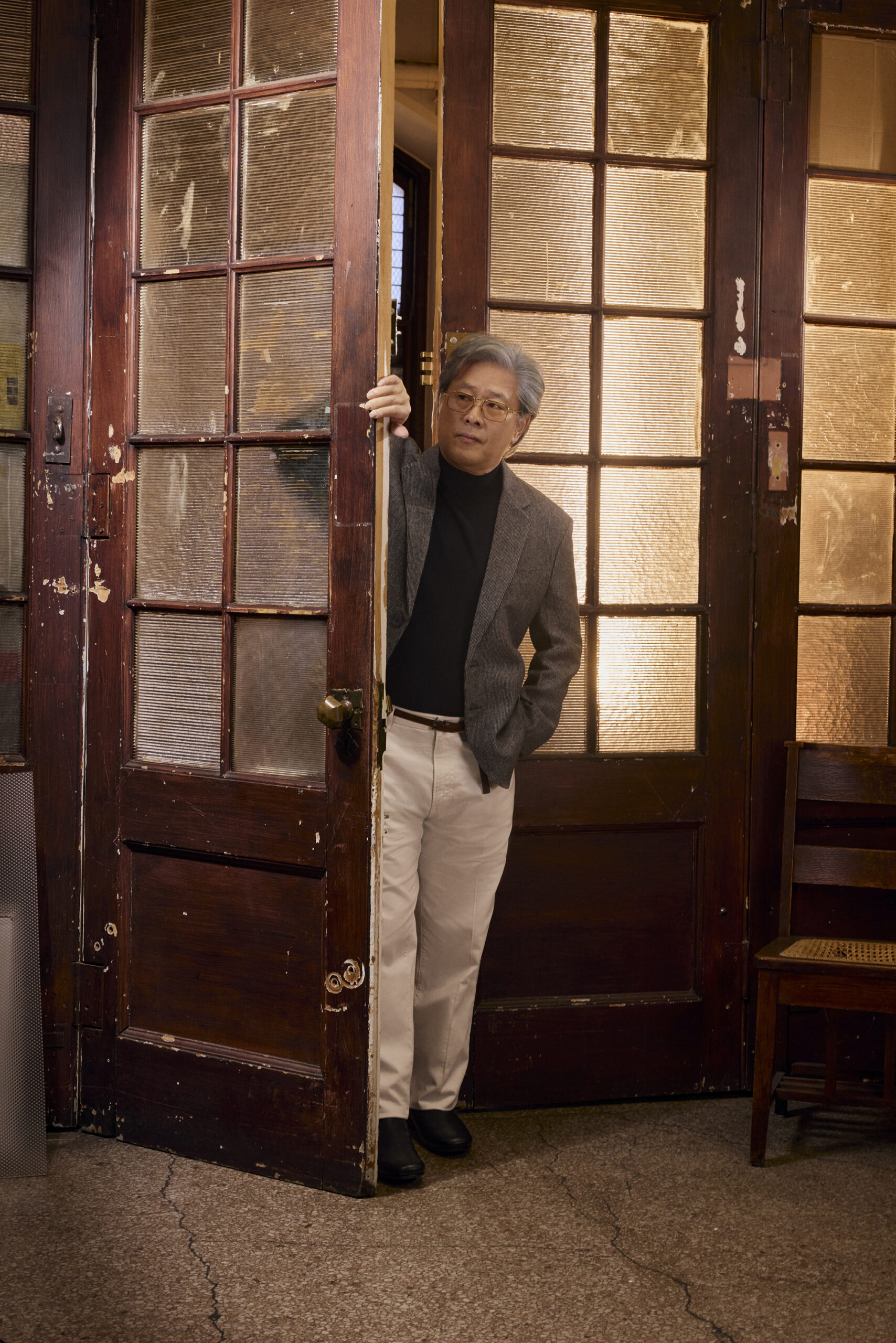
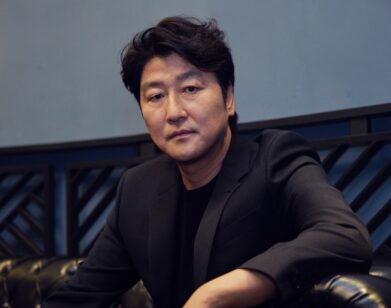
Jacket, Sweater, Pants, Belt, and Shoes Prada. Glasses Jacques Marie Mage.
OH: In some ways one of the biggest things I want to talk about, which is—oh my god, I wrote all these notes. [Laughs] This film addresses the effect of capitalism on the male psyche.
CHAN-WOOK: Yes.
OH: Because you see how the advent of automation, technology, AI, and the loss of human jobs puts these male characters in a position of desperation, humiliation, fear, and depression. My larger question is, what do you think are the next set of skills men need to learn to modernize?
CHAN-WOOK: I guess the answer would be to find oneself. To not solely define someone by their job or their position at a workplace, or what field they work in. Also to not only define themselves simply as a father or a husband. Of course, all those things are important, but that’s not what someone’s entirely made up of. After [Yoo] Man-soo [the protagonist] is fired from his job, he feels that he’s lost everything. He loses his self-confidence. He feels that he’s no longer the breadwinner, so it’s like his entire existence has been shattered. He feels as if he can’t behave as a proper man, and he’s also become useless as a human being, which is why he turns to those pathetic methods of crime.
OH: Another question that I have—I don’t know if I can talk about this because I don’t want to give anything away, but whatever. Basically, Man-soo doesn’t get to that self-discovery. Here is our protagonist; he’s killed all these people and got this job. It’s like, he’s won. But the image of the factory, the automation, that is horror to me. Where was that factory?
CHAN-WOOK: Somewhere in Chungcheong-do, in Korea.
OH: Gosh, that factory. By the end of the film, you’re with your protagonist who you really like, but he is continuing a delusional legacy that ultimately doesn’t help his children understand how to really survive. The fact that he wins is so wrong, so sad. But we’ve understood along the way why he does it. That doesn’t make me feel good, but it’s interesting. Does that make sense?
CHAN-WOOK: [Laughs] I think as an audience, unless the protagonist is explicitly defined as a villain like Hannibal Lecter, typically we wish for them to be well, and we assume they’re a good person. It’s an old habit for audiences that has built up in film history, and this film also starts off that way. But we begin to question if he really is a good person. I wanted to lead the audience to critically observe the protagonist. Lee Byung-hun as an actor is very moving in his performance, and he has such big, sympathetic eyes. The audience naturally leans toward that, but at moments they begin to criticize him and wish that he stops doing what he’s doing. That was my intention, for the audience to dramatically waver between those two opposing states.
OH: The image of the dead body underneath the tree, and the story of it being a pig, is such an amazing metaphor for the lack of taking responsibility for how you have gotten your house, how have you gotten your family. I’m saying this wrong, sorry.
CHAN-WOOK: [Laughs]
OH: But there’s something in here, because the metaphor of the dead body underneath the tree and the story of that—it’s just a pig—is just a way of showing how Man-soo and [Yoo] Mi-ri are teaching the next generation and thinking there’s going to be no consequences because of their survivalism. They think they’ve won, but I’m telling you, that dead body is going to come up. They’re behaving like there’s no consequences. I love that image so much because it’s really challenging the audience to ask themselves, “What have you buried down below that now you are presenting as something so beautiful like an apple tree?” We can say that for ourselves and definitely we can say it for the countries we live in. Sorry, I’m talking too much.
CHAN-WOOK: [Laughs] That’s exactly the story I wanted to hear regarding the interpretation for the film: this garden that’s in the house that’s very old, but it’s also lovingly and very much well maintained. And what lies beneath it is what is so horrifying about it. So Mi-ri, she has seemed to have forgiven Man-soo, and they hug it out, but the family can’t go back in time to before all of this has happened, especially not the son. So what awaits after the happiness they have retrieved after Man-soo has his job again? Like you said, I wanted to give space for the audience to interpret it in a larger context, whether it can be seen in the context of capitalism or the middle class or anything else. And I enjoyed that horrible image of that thought of the body that’s been tied up. It releases, it’s found, and it crawls back up again. It’s a horrible but very fascinating image.
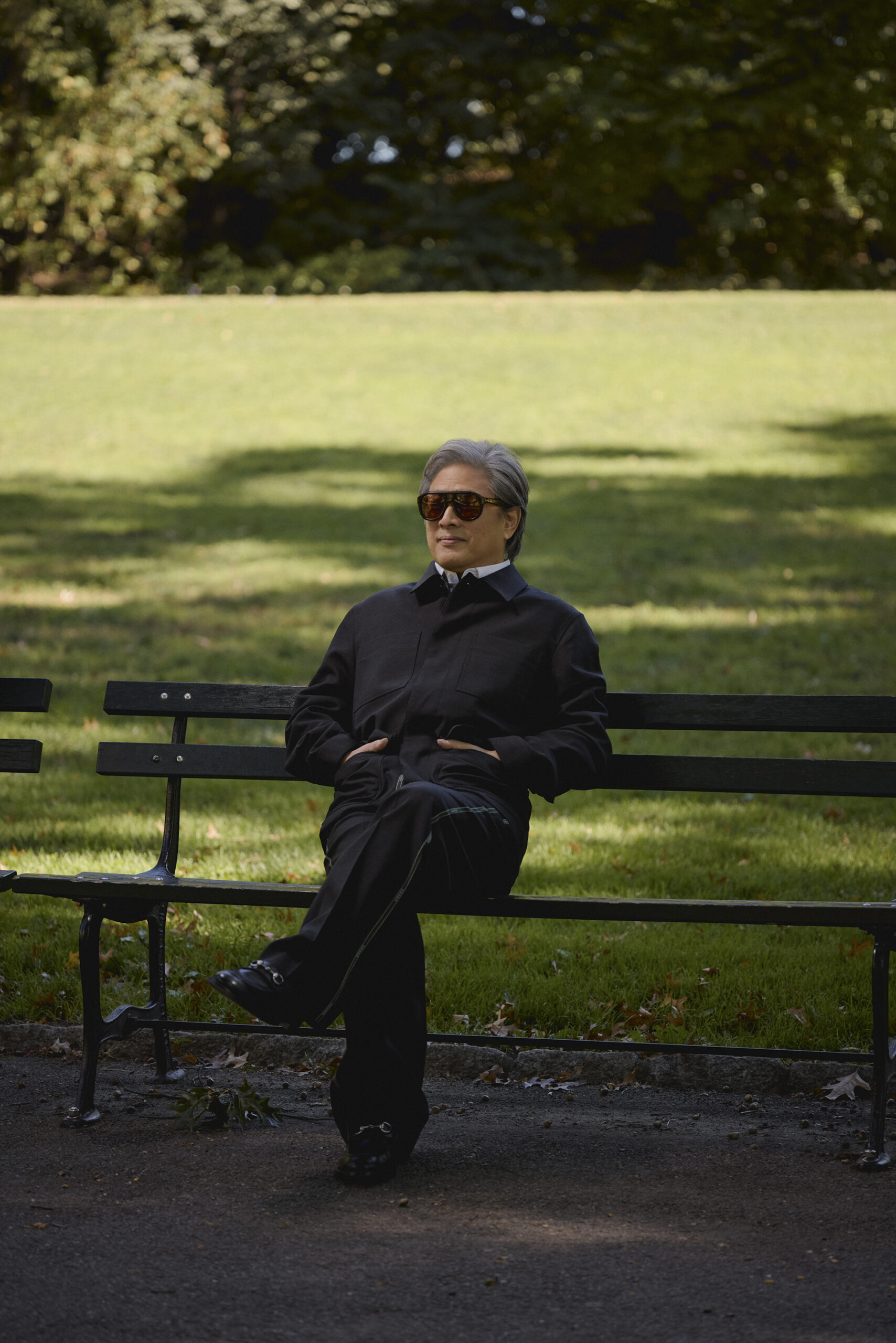
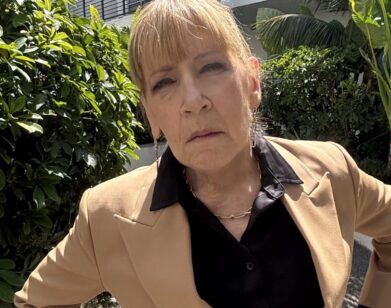
Jacket, Shirt, Pants, and Shoes Gucci. Glasses Jacques Marie Mage.
OH: How do you choose something? Meaning you had this book, right? The Ax, by Donald [E.] Westlake. What was it about the book? But more specifically, how do you as a filmmaker choose something? Does it come to you like an image? Does it come to you like a feeling? Does it come to you like a question?
CHAN-WOOK: First of all, I liked how the original novel shows this man who’s been used up by this capitalist system and eventually pushed out after that happens. He doesn’t plan revenge on the capitalist system, nor does he question it. Instead, he decides to replicate what they do. He makes a company, he puts up a job post, collects resumes, and picks out candidates. I found the irony of that very interesting. I like how he resolves his son’s situation, how he’s regained self-confidence from murders and becomes a proper father. That also made me laugh. So what I was ultimately drawn to from this book was the humor that comes from moral dilemmas and irony.
OH: We as human beings, we really miss the mark. We really, really miss it. Can you name something in the film that you as a filmmaker have satisfaction over? Can you name one example in the film where you just go, “Okay, I feel good?”
CHAN-WOOK: The scene has been mentioned many times already, but where the couple are in an embrace and talking together. There was no special technique or technology that was used. It’s a very bare-bones, pure scene that relies solely on the dialogue and the performance of the actors. Very simple camera movements and editing. So it’s very minimalist, yet it achieved everything it needed to. These are the kinds of scenes I find the most satisfaction in.
OH: How much more can I keep talking? I don’t want to take too much of your time, but I will still keep asking questions.
CHAN-WOOK: [Laughs]
OH: Easy question. Director Park, you have made many movies and you do international press tours on them. So let’s say you’re kind of in the middle of your press tour. Do you feel like when you talk about your film that you learn anything new about your film or yourself?
CHAN-WOOK: Yes, I hope to, and I want to take away things from the press tour. The entire press tour kind of feels like a tiring march at times, so I always go into it with the mindset of wanting to learn something new. And when I meet interviewers like yourself who have great questions and unique thoughts about the film, it helps me learn a lot. And in my response, I also realize new things that I hadn’t known before. So I find satisfaction and enjoyment from these conversations, but they only happen occasionally. I would say the hardest part of the press tour is those parties where you have to stand and hold your drink and talk to other people. I think that’s the hardest one to get adjusted to as a Korean.
OH: Just one more question. When I asked what you feel are the skills men need to learn to modernize, your answer was it’s really to find oneself. How do you do that?
CHAN-WOOK: Yeah, that was actually the homework for myself. I chose this story even though I wasn’t familiar with the paper industry. I could empathize easily with the characters because like them, I define my job as my entire life. Without my job, I am nothing. So how the characters feel about the paper industry is the same way I feel about the film industry, and I realized while I was making the film that I shouldn’t continue to live that way. So in that scene where Mi-ri is telling Man-soo, “you shouldn’t have worked that hard,” that was actually a line I wrote for myself to hear. I don’t know the exact method in which to find oneself, but I want to continue to search for that answer—how I should define myself other than as a filmmaker.
OH: Wow. Boy, am I ever glad I asked that question.
CHAN-WOOK: [Laughs].
OH: So good to see you!
CHAN-WOOK: So good to see you, Sandra!
OH: Congratulations, congratulations, congratulations.
CHAN-WOOK: Thank you, thank you, thank you.
———
Grooming: Jae-Manuel Cardenas using L’Oréal Professional Hair Care at Tracey Mattingly.
Photography Assistant: Zach Helper.
Fashion Assistant: Parker Harwood.
Production Director: Alexandra Weiss.
Executive Producer: Georgia Ford.
Post-production: Nikita Shaletin.