


Laurence Graff


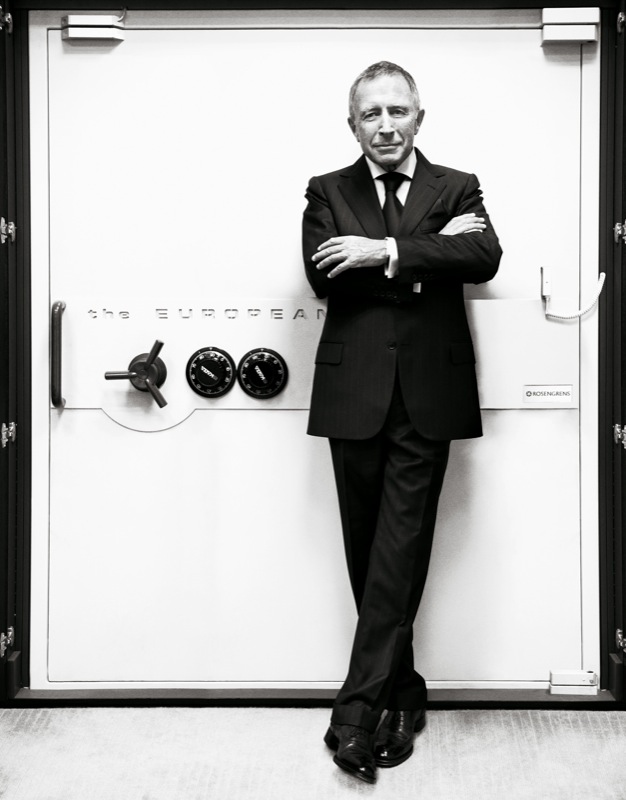
Laurence Graff is sometimes called the king of diamonds, sometimes the new Harry Winston. This self-educated, self-made East End Londoner has bought and sold some of the most famous stones in the world and his clientele includes royalty from Riyadh to Hollywood. His company, Graff Diamonds, is based in London and is one of South Africa’s largest producers of polished diamonds. Mr. Graff himself is a polished gentleman of extraordinary means and taste. Last March, Forbes magazine ranked him #462 on its list of the world’s top billionaires. But who’s counting? Interview’s chairman, Peter M. Brant, a longtime friend of Graff’s, changes the subject from diamonds to art, because Graff’s art collection is another lode
of extraordinary gems.
PETER M. BRANT: It’s great to go right to the roots. Tell us about how you got interested in becoming a jeweler.
LAURENCE GRAFF: I started when I was very young. I left school at a very early age. By the time I was 15, my mother—who passed away several months ago at the age of 98—took me to a jewelry-manufacturing workshop in London to sign me on as an apprentice to learn the trade. All I really learned in those first three months was scrubbing floors, cleaning toilets, and running errands. [laughs] For some unknown reason, after three months they didn’t think I’d make the grade, so they very politely asked me to leave. I went to another job and sat down as a proper apprentice, learning how to make jewelry. It involved a lot of remodeling and repairing. It was a bad time in England in those days and people didn’t have much money—they would repair a ring rather than buy a new one. They would thicken up the gold. I learned all the ways to make something look new again. That job lasted a few years. The company ended up in bankruptcy, and I decided to start a little company of my own. I started in a tiny, tiny room. I took an older man as my partner. He was the craftsman; I was the salesman. It was a twosome. We managed to do repair work, which gave us a bare living—I always made sure he earned much more than I because he was a family man and I was 17 years old. I managed to get contracts to do repairs, which gave us constant work. And on the back of that, we started to make jewelry—artistic jewelry that resembled this period of Victoriana, which was quite popular in England. We sold pieces for two or three pounds each. The rings were made with semiprecious stones, and they were handcrafted. I managed to get credit to buy some diamonds, and I sold a ring for a hundred pounds. And then I sold one for 200 pounds, then 500 pounds. That was basically how it started. I took over my partner’s share and assumed the debt. And very, very slowly, I started to build up. I traveled the world because there wasn’t enough business in England. First, I went to Australia and Singapore. The Far East was where I first started to make some money. I was a young man from the East End with the gift of gab, as they say. I always believed, right from the beginning, if you’re going to do something, do it the best. If you’re going to work, you want to enjoy it-make a product that you really enjoy selling or owning. Eventually we went into the retail business. And all the time my diamonds were getting more and more interesting in size. In the early ’70s we had the birth of oil money. We had all the Arabs-and it wasn’t long before all the royal families came to me.
PB: When did you start designing jewelry?
LG: I can’t draw. I can’t paint. But what I can do is tell somebody else what to do. I’m a creator. I can tell an artist what to do. I can be behind the artist. I have the eye, so I can move things around. I can put stones together. I can match them.
PB: I’ve always noticed you cut the diamonds in a way where you preserve the most perfect part of the stone. It has fewer flaws than most cuts that you see.
LG: It’s the rough diamond that dictates what you can get out of a diamond. You can’t say, “I’m going to make this,” or, “I’m going to make that.” It’s nature. Whatever nature gives us, we explore and we build on. We can’t create something that is not in the stone, so we take away as many imperfections as we can. Sometimes, you can’t take them all away. But mostly, our cut, our polish, the life we put into the stones, the beauty that we bring out is exceptional.
PB: I remember when I was a kid, I was always fascinated that one of Interview‘s favorite characters, Liz Taylor, was a great lover of jewelry. I remember Richard Burton buying that great diamond for her. Did you actually have any dealings with Liz Taylor?
LG: Yes, I did. Over the years I’ve met her a number of times. The first time I met her was around 1970 when she wanted to buy a gift. She was in London staying at the Dorchester and we got a call to come over and show something to her. I thought, Well, Miss Elizabeth Taylor—I’m going over myself. She’s a beauty and I love beautiful women. So I went there and I was asked to wait for a while in the hall. And while I’m waiting with my case, an Arab sheikh came along. He said, “Ah, Graff, what do you have here?” I said, “I have some beautiful things, Your Highness.” He said, “Well, come up to the penthouse and show me what you have.” I said, “I’ll be right up. But first I have to see Miss Elizabeth Taylor.” She came out. She selected a piece, and she said, “I saw you with that interesting character.” I said, “Well, that’s the king of Saudi Arabia’s brother.” She said, “Oh, I’d love to meet him.” And I said, “Then come with me. I’m just going up to see him now.” So I took Elizabeth Taylor up in the elevator to the penthouse of the Dorchester hotel and knocked on the door: “Your Highness, I have a guest who I’d like to introduce you to-Miss Elizabeth Taylor.” It meant absolutely zero to him. Maybe he thought I was presenting her to him, you know? [Brant laughs] I remember she threw herself in my arms and said, “Laurence, I’ve really embarrassed myself. What did I do?” It was an interesting experience.
PB: That’s great.
LG: Later on in years, she came to my house in La Rosée in the South of France, where I now have the famous portrait, the Red Liz. She actually sat in front of where I eventually hung it. But you know, I have always been a buyer of art. Even when I didn’t understand it, I bought the stuff.
PB: When did you first become interested in art?
LG: I used to go to art exhibitions. I remember one of the first artists I saw was a magician who appeared on television. His name was Chan Canasta and he used to tear up telephone directories. But before he did that, he would flick through the pages saying, “Tell me when to stop.” And you’d say, “Stop”-he would tell you what it said without looking. It was amazing. He was also an artist. He painted under his birth name-Chananel Mifelew. I was very naïve and I was not a connoisseur of art. But I went to one of his exhibitions. It must have been in the ’60s. I ended up buying around five paintings. So that might have been one of the occasions that I started buying art—all good for the dustbin years later. But I started that way. I was always a little bit of a collector and a hoarder. And whenever I got involved in anything, whatever it was—even when I was a kid and I collected cigarette cards-I really got into it and had the most. So when it came to paintings, once I got the bug, I always wanted to buy something. But I really knew nothing about art. In the early days in New York when Andy [Warhol] was still alive, I saw him delivering Interview magazine up and down Madison Avenue. I didn’t even know who he was—I just knew he was a bit of a character. But my friends in the business would speak about some of these artists, and later on about Keith Haring. I could have bought those paintings for very little money, but I had no interest. I didn’t know what they were. I didn’t follow the ’80s artists. So I bypassed them. At the time I really was a collector of art, but it wasn’t contemporary art, it was impressionism.
PB: It’s similar to my story. I was a collector of coins first. But you really started with impressionism?
LG: Yeah, yeah.
PB: But you came seriously to art in taking an established position with impressionism.
LG: I went to an auction in the late ’70s and bought a small Renoir. People said, “Why did you buy a Renoir that size?” I said, “I can put it in the safe with my diamonds.” And that was a true story. I bought it to put it in the safe.
PB: So you looked at it as a diamond.
LG: I looked at it like a diamond. It’s beautiful. I didn’t want to put it on the wall. I put it in the safe. Anyway, I soon learned to put it on the wall. And then I thought, You know, I really am proud to own this Renoir. I made myself a promise: Every year I’d buy an impressionist painting. I came to New York for the Havemeyer sale.
PB: The great Havemeyer sale, yes.
LG: There was one painting by Monet that I loved. It’s a canal scene with a little red in it. It’s really beautiful. So I said to my wife, “Anne-Marie, I’m going to buy the painting.” She said, “I don’t want that painting in my house.” I asked, “Why?” She said, “A million-pound painting hanging on my wall? You’ve got to be crazy. I don’t want the responsibility.” I said, “I’m going to New York to buy that painting.” So I came to New York because when I want to do something I usually go ahead and do it. I was so embarrassed, being a jeweler, that someone would see me bidding on a painting. [Brant laughs] I didn’t know how to go about it. Sotheby’s, which was on Madison Avenue in those days, invited me upstairs. They were having caviar and champagne and treating their clients very well. And I got the jewelry expert to bid for me. The estimate was a million. I said, “Go to a million one.” In those days, if a painting was $1 million, it brought $1 million. It didn’t bring $2 million. So it went to $1.2 million, and I was hiding. I didn’t want anybody to see me bidding that sort of money. I lost it. And I always regretted it.
When I bought the Red Liz at $12.6 million, that was a breakthrough in prices . . . from there, it took off. it was unheard of for a portrait to bring that sort of money.Laurence Graff
PB: How did you bridge into more contemporary art?
LG: It’s a very strange coincidence. I was walking down Madison Avenue and somebody stopped me and said, “Are you going to go to see the electric chair show?” I said, “What electric chair?” He said, “Warhol’s.” I said, “Well, what are they?” I had no knowledge of Warhol whatsoever—zero. I was not interested. I said, “Well, let me go up and have a look.” So I went up to the gallery on Madison Avenue. I see all these Warhol electric chairs. I said, “What are they worth?” Someone said, “$800,000.” I said, “Who wants an electric chair?” I didn’t understand. Then they had a dinner that night, and I was invited. I said, “I can’t go. I’m not a buyer of contemporary art.” “Oh, you have to come.” So I went. Sat down. Philippe Ségalot is sitting on my left. I’d never met him before in my life. We get to chatting. He said, “Do you buy art?” I said, “Yes, I buy impressionist paintings.” He said, “Have you started contemporary?” I said, “I’m really not interested in it. It’s not my scene.” He said, “I want you to come to Christie’s tomorrow. I want to show you a very small portrait. It’s an Orange Marilyn.” I went. I loved it. They had it on an easel in the corner.
PB: The Orange Marilyn from 1964.
LG: Yeah. I ended up bidding $3.6 million on something I didn’t understand. I stopped bidding. The hammer went down. And I lost it. I thought, To pay $3.6 million for a painting that’s valued at $2 million, and it’s contemporary art-there are hundreds around. I went to a few exhibitions. I bought a few books. I studied up a little bit. I asked around. And then finally I realized why it was special. I realized what it was. It wasn’t long before I managed to buy another one of the colors-the lavender one-for $4.6 million.
PB: The Grape Marilyn!
LG: That was the start of my interest in contemporary art. Although, I have to declare, prior to all of that I did make a move. I bought a Bacon. I bought Portrait of Lucian Freud, which I paid 700 pounds for, in London. And it was my first contemporary piece.
PB: Yeah.
LG: But after that Warhol Marilyn, I said, “I have to collect all these icons. Wherever there’s an icon, I think I should buy it, especially ’60s work.” And as you know, I started going through the icons and started collecting them.
PB: The Red Liz.
LG: When I bought the Red Liz at $12.6 million, that was a breakthrough in prices. I think when I paid that price I might have been the leader in the new level of prices. Because from there, it took off. Prior to that it was unheard of for a portrait to bring that sort of money. But from Warhol I went to Basquiat. From Basquiat I went to Ruscha. And from Ruscha, to a series of other American artists.
PB: You’ve also supported a lot of contemporary artists and purchased works of younger artists.
LG: Yes. I started with some of the younger artists. Although, having a son who’s an artist, I was hesitant-I think he was a little anxious when I bought another young man’s work. But it might have encouraged him in the long run.
PB: I think it did encourage him, for sure.
LG: He has a brilliant eye. I don’t have somebody who really advises me on art and says, “You should go for this.” Maybe an advisor would have been better, maybe not. I don’t know. But I’ve gone on my own judgment, like I do in many things in life, and I seem to have had an eye for nice things. I’ve put together a great collection.
PB: You have a circle of dealers who you constantly talk to and compare notes with. And you’ve made yourself available to so many people in the art world.
LG: I’ve found it a fascinating group of people. I don’t know if you remember, once some years ago we had a birthday of mine at Harry’s Bar in Venice. I stood up and made a few words. I said, “One of the great things about collecting contemporary art is that you mix with contemporary people.”
PB: You’re a collector who really is interested in getting involved in the whole picture.
LG: The art I’ve bought, I’ve bought because I loved it. And in recent years I’ve sold off things which I didn’t think were worthy of my collection, and I’m still tidying it up all the time so I can have better and better things. I like to hang it wherever I can-some in London, some in the South of France.
PB: I think there are a lot of dealers who don’t appreciate that process in a collector. A collector sometimes has to . . . You know, it’s not that you don’t necessarily like the work; it’s just that everything has to fit into the collection that you’re building. And there’s nothing wrong with selling something and making a mistake in selling it or doing the right thing for your collection. It’s a process that you have to experience.
LG: You must make mistakes.
PB: I’ve noticed in knowing you for a long time that you’ve said on many occasions, “Peter, I’m just not ready for that yet.” And then two years later, you adore the work that you were not ready for. Your mind is very flexible and you’re open to understanding more. I think that’s one of your strongest points.
LG: Well, the reason for that is your eye becomes more mature. What you don’t see the first time, you keep looking, and eventually you’ll see it. And when you are confident with what your eye sees, you know you’ve got to have it.
PB: Some collectors don’t want to admit that.
LG: Well, you learn about yourself when you’re collecting art. You learn what you’re capable of. After all, we’re not speaking about pennies-we’re speaking about vast sums of money. I do it on my own back without advice, so I’ve got the confidence to do it.
PB: What piece of advice could you give a collector who’s beginning today that would help the most?
LG: Don’t try to buy as an investment. Buy something you really love because you’re going to have to look at it again tomorrow. And an investment can go up or down. Buy something you really adore, you really like, and you want to live with. And if you decide some years later you don’t want to live with it anymore, sell it. Get out.
PB: What about the work of younger artists?
LG: Well, I’m attracted to it, and it’s affordable compared to mature art, so you can take a chance much easier on a younger artist. I can’t say that I’ve found an artist who I think is going to be the next Bacon or Warhol. You shouldn’t have to do that really. You go forward, and you find something new.
PB: Is there anyone you feel very confident about in terms of their talent or achievement?
LG: Well, unfortunately, some of them are becoming fashionable. And anything that’s fashionable can become unfashionable. So one has to watch that. And it’s very easy today because there are so many events—art fairs, gallery openings, etcetera. In fact, that’s another thing that concerns me, the quantity of gallery openings. In my office in London, I get back after a week, and I have 30 invitations. It’s too much.
PB: Way too much.
LG: It’s becoming commercial. It’s becoming a business. Like the Chinese artists. It’s a business.
PB: I’d rather stay home and read about art.
LG: It’s like an avalanche being poured down your throat. You know it’s going to crack, eventually it’s going to go out of fashion. I wish there was much less happening. I wish there were fewer art dealers. I wish there were fewer auctions. I wish there were just two auctions a year. It’s just too much. And at the end of the day, if you’re a dealer and a professional, fine, that’s your business, that’s all you do. But as an individual, if you’re not a dealer and it’s not your business, you need time for these things. You need time to study what’s happening. You need time to understand the market. You need time to go to a museum. You need time to see a show. You can’t go to one every day. It’s becoming a trend. I think a lot of people are involved in art because of the fashion of art and the conversation. It gives them a certain sophistication, something to speak about. That’s not really what art’s all about. Art is, if it’s conceptual, really about understanding the concept. And if it’s beautiful, it’s about seeing the beauty. It’s gone much further than that now. And I’m not sure that I understand how far it can go or if it should have come as far as it’s gone. There’s too much commercialism attached to art. That is a dangerous thing. Because if the market cracks one day big-time, you’ll frighten so many people away who will never come back. They’ll say, “Why did I buy art? I could have bought something else.” Because they don’t really feel for art. People who buy art should feel for it. They should want it because they love it, they want to live with it, they want to enjoy it, they want to look at it on their walls.
PB: That’s for sure. Obviously more people are educated in art today, so there’ll be more of those people interested in it. In the future, there’ll be more collectors because there are more knowledgeable people. But, yeah, everything cracks at one point. And then you lose those people who really don’t have that interest.
LG: If you really love the art, it makes no difference. If the Red Liz that I paid $12.6 million for is worth $45 million today and it goes down to $12.6 million again, I’ve still got it.
PB: If I asked you what was the biggest disappointment for you that you think about now, would it be that Monet that you missed?
LG: Yeah. The Monet. I learned at a dinner party one night from a man sitting on my left-and he wasn’t being facetious, I think he really meant it—when I told him the story, he said, “Well, you know, we bought it.” I said, “What? You bought the painting?” He said, “Yes. And I have to tell you we sold it and we got $35 million for it or something.” I don’t care about the profit-I love the painting.
PB: And which is the work that you did go for that you’re the most satisfied that you purchased?
LG: I remember when I asked you, “Should I buy a Liz or a Marilyn?” You thought very carefully and said, “Go for the Marilyn, because she’s the true icon.”
PB: I told you to go for both. [laughs]
LG: Yes. That was my mistake. I eventually tried to go for both, and I missed the second one. But I should have gone for both. The thing is, though, when I look at either of them today, I don’t see a Marilyn or a Liz. I see a Warhol. We all have that “Why did I miss it?” feeling six weeks later. But something else eventually comes along. Another problem with collecting art: It becomes a drug.