


BACKSTAGE
Lesley Manville and David Schwimmer on Grief, Growth, and Making It in America


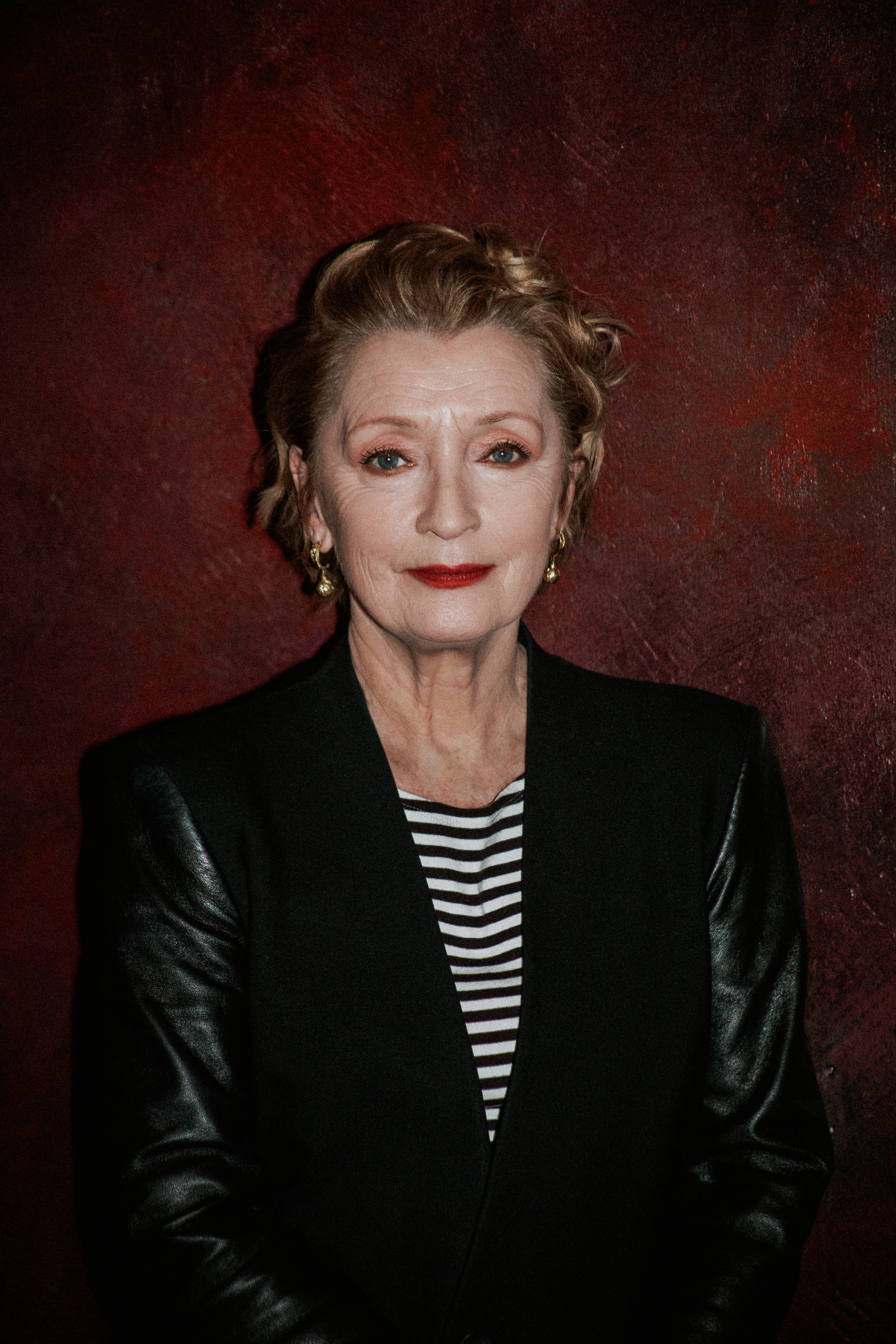
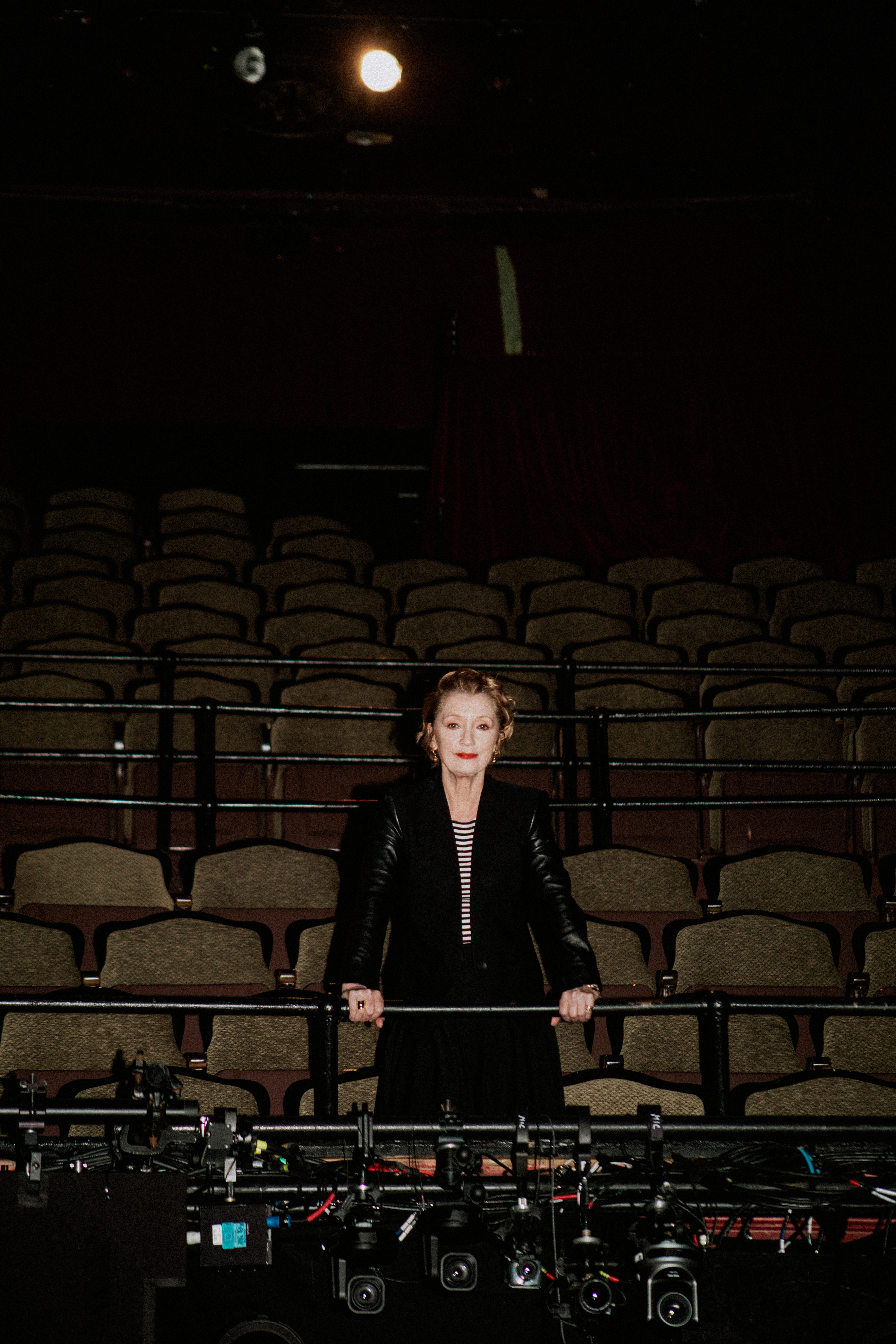
Lesley Manville, photographed by Patrick Donovan.
Lesley Manville and David Schwimmer go way back—far enough to dispense with pleasantries. Two decades ago, they met onstage in Neil LaBute’s Some Girls in London, where Schwimmer, fresh off sitcom superstardom, found himself opposite an actor he was already a “major fan” of. By then, Manville had become one of director Mike Leigh’s most trusted collaborators, evolving from a self-described “performing jazz-hands kind of actor” into a shapeshifter who disappears, dazzlingly, into every role. This season, the 69-year-old powerhouse brings that precision to Studio 54’s Oedipus, Robert Icke’s contemporary retelling of Sophocles’ tragedy, reimagined and modernized as a high-stakes election-night thriller. Opposite Mark Strong, Manville’s Jocasta shifts from poised first lady-in-waiting to a woman undone by revelation in real time. Reunited after Schwimmer caught Oedipus—“I want to see it again and again,” he confesses—the longtime friends got on a call earlier this month to talk aha moments, staying grounded, and why instinct, after all this time, remains Manville’s sharpest tool.—OLAMIDE OYENUSI
———
DAVID SCHWIMMER: Well, hi, Lesley. How fun is this? I’m really “chuffed,” as you say, to be doing this.
LESLEY MANVILLE: I’m really glad you have, because it’ll be one of those intelligent interviews. [Laughs]
SCHWIMMER: Well, fairly intelligent—semi-intelligent. So, we will get to Oedipus. If you’d prefer, I will use the British pronunciation.
MANVILLE: I don’t mind. You roll however you want to.
SCHWIMMER: First of all, I was thinking about our friendship, which now spans 20 years since I got to work with you on stage in Some Girls in London. I was a major fan of yours already because of your work, particularly on Mike Leigh’s film at that time, All or Nothing. And I know you’ve collaborated with him on many films, and you’ve talked with me about that process, which I think is unique compared to other filmmakers. How does that differ for you from, say, coming onto a show like Oedipus?
MANVILLE: Well, as you know, the thing about Mike is he works in an absolutely one-off kind of way. There is nobody else you could work with that will do anything like that. So when you sign up for it, it’s a very full-on commitment. I mean, unless he knows you’re going to have a more minor role in the film or the play, you will be employed for the whole time. And by “the whole time”—with All Or Nothing, with Another Year, with Topsy-Turvy—I mean my commitment to that job was nine or ten months. He has ideas and notions and themes in his head, but he doesn’t share any of that with you. He wants you to come absolutely as a blank page.
In the end, it’s like doing any other job, because obviously you have to have a script. You never improvise on camera. You couldn’t shoot a film if you were all just improvising all the time; you would never be able to cut it together. So by the time you film it, there is a text—a script—but it’s the route to get to that that’s so unique. And it’s been very formative for me, my work with him. I mean, I met him when I was 22 or 23, and I’d been working since I was 16, but up until then I just played myself. I hadn’t been to drama school as such, so I had no notion of playing somebody that wasn’t a version of Lesley.
SCHWIMMER: You’ve naturally led into two of my other questions that I had thought of for you. One was: was there a specific moment or experience you had as a child, or a young girl, or a young woman—the aha moment—where you just knew, “This is what I’m going to do with my life”?
MANVILLE: It was working with Mike. I was 22, and he was going to do a play for the Royal Shakespeare Company. Long story short, that play never came to fruition, but that’s when we met, because I was already working at the Royal Shakespeare Company, and he had to use people that were already in the company. Although I don’t think he thought I was the ideal candidate, because I was still a bit “performing jazz-hands” kind of actor. But there was a light bulb moment, and I remember it. He was still only in his late 30s, Mike. We’d started to work on this play, and he’d got me to play this character that was a million miles from me, and I loved it. And I remember we sat in this rehearsal room, and he said to me, “You’re really very good, Lesley. You can do this.” And nobody’d ever said that to me before. And it was in that moment that I realized that what I got a buzz out of was playing this woman who was so not like me—and that was so formative.
SCHWIMMER: That’s a great story. I’ve seen you many times on stage, but seeing you in Oedipus and then having dinner with you just recently, I just wanted to know, as your friend and as an actor, what it is you do to prepare for such an emotional rollercoaster. It deals a lot with terrible, terrible grief. And I was just curious about your process. And really, my question is, how much of what you do is instinct?
MANVILLE: I think I’ve felt much more in the last 20 years: instinct, instinct, instinct. But you can’t just suddenly decide to act on your instincts. The instincts are there because of the decades of experience—life experience and art experience. With Oedipus, I do a lot of work beforehand, before rehearsals begin. As you know, I’m going back to London after this to do Les Liaisons Dangereuses at the National [Theatre]. I’m learning it. And in the process of that learning, you’re thinking. It’s all starting to cook already. I do a lot of prep, and I work very hard and seriously and in a concentrated way.
On a day-to-day basis now, I can go into the theater here, put my makeup on, get the wig on, and boom—I’m on stage, and I’m in it. And I don’t need to do the psychological prep, because I honestly feel, as I have done with various other plays in my life, particularly Long Day’s Journey into Night and Ghosts, the language is so powerful. But I can honestly say—in the 104 performances we did of Oedipus in London, and every performance we’ve done so far here—every time I do that speech about 13-year-old Jocasta being forced into having sex with an old man, it gets me. I can’t prep for that in the dressing room, because she doesn’t know that the day is going to unravel this cataclysmically. You can only know in the moment, and the language of this amazing speech gets me into that moment every time.
SCHWIMMER: Right. I was thinking about how you are one of the healthiest people, let alone actors, I’ve ever known. You could have quite a big head and ego given all the awards you’ve won and being a film and stage star, et cetera. But you’re one of the most down-to-earth, funny, warm, open, trusting people I’ve had the privilege to know and call a friend. But it occurs to me that there’s got to be another reason for you to have such a healthy relationship to the industry and what you do.
MANVILLE: Well, thank you for all those lovely words. You are a good person yourself, and so it means a lot.
SCHWIMMER: Well, that’s why I said it. I wanted you to say it back to me. [Laughs]
MANVILLE: [Laughs] I think it’s because I was never a flavor of the month. I was never an overnight success. I started acting early, in the days when nobody thought of going to America, nobody thought of going to L.A. and doing pilot season. I was working pretty consistently at the Royal Court Theater through my 20s and 30s. Nobody thought of being famous. It just wasn’t on the agenda at all. When my first husband, Gary Oldman, did a couple of British films and they opened up a door for him in America, that was so unusual then. So unusual. Whereas now, I’m so glad I wasn’t certainly at the level I’m at now back then, because it’s too much to maintain.
SCHWIMMER: You’ve got, I guess, a few things that have made you very well recognized in America. Of course, you’re cherished in both countries, but in America, I think you’re probably most recognized for The Crown, as Princess Margaret?
MANVILLE: Yeah. This is the first time I’ve been here substantially for some years, and I have noticed the difference now. I mean, I walked four blocks the other day and by the time I got to the fourth block, I’d been stopped six times.
SCHWIMMER: So that’s new for you?
MANVILLE: That’s new here. When I was here six years ago doing Long Day’s Journey, that wasn’t happening. So something has shifted. You know what it’s like. I don’t like the intrusions when people feel they have a right to be doing it, or they own you in some way. Courtesy goes a long way, doesn’t it?
SCHWIMMER: It does, yeah. Can you name all the Daniels you’ve worked with?
MANVILLE: Daniel Day-Lewis, Daniel Craig. That’s it, isn’t it?
SCHWIMMER: I don’t know, but those are a couple of great Daniels.
MANVILLE: Couple of really good Daniels, yeah.
SCHWIMMER: I was wondering about that monologue that you referred to earlier. She experiences such grief, such loss, as a young woman. And then, in the play, has to again experience profound loss. At our age, we’ve all experienced our own grief and loss, so I’m just wondering, in terms of process, is it your own grief that sits there and is accessible to you?
MANVILLE: I think so. I think the best analysis I can come up with is that, in a good way, I don’t overshare the stuff that’s happened to me. I’ve always been very private with my own heartache and grief, always. So I think that it’s probably safe to say that yes, here sits the stuff of my life, and tonight it’ll come out in a Jocasta filter. But I’m not sitting there thinking, “Oh, let me channel this moment from my life.” All of us—it’s like you have grief in the bank.
SCHWIMMER: Right. And that’s why, when we experience the play, your grief is universal.
MANVILLE: God, David, if you ever wanted another career, you’re really good at this. The best interview I’ve had, ever.
SCHWIMMER: Well, we’re coming up on time, but you’re one of the funniest people I know, and I’m wondering how—
MANVILLE: I never think I’m funny.
SCHWIMMER: Oh, you’re very funny. Especially when armed with great, great dialogue, you’re wicked funny. Is there some play or some role—some great comedy—that you’ve always thought, “Ooh, I’d love to do that.”
MANVILLE: No. No. I don’t have lists of plays that I want to do either, which annoys people because they say, “Oh, well, what do you want to do next?” Because there might be a great new play about to be written that you just don’t know anything about. I mean, I know I love [Anton] Chekhov, and I’ve done some Chekhov. I’ve done one Shakespeare in my life. I should have a go at some of that, because it’s pretty good. [Laughs]
SCHWIMMER: Well, the cast is extraordinary.
MANVILLE: Isn’t it?
SCHWIMMER: I hope everyone goes to see this play. It’s such a fresh and modern and contemporary story. I mean, the production has made it so. And I can’t wait to see it again.
MANVILLE: Listen, this is really the best interview. Can we do this all the time?
SCHWIMMER: Sure.
MANVILLE: David, let me know when you’re coming in, won’t you?
SCHWIMMER: Of course I will.
MANVILLE: Thank you so much.