


IN CONVERSATION
Zoë Bleu Tells Her Aunt Patricia Arquette How She Made Dracula Romantic Again


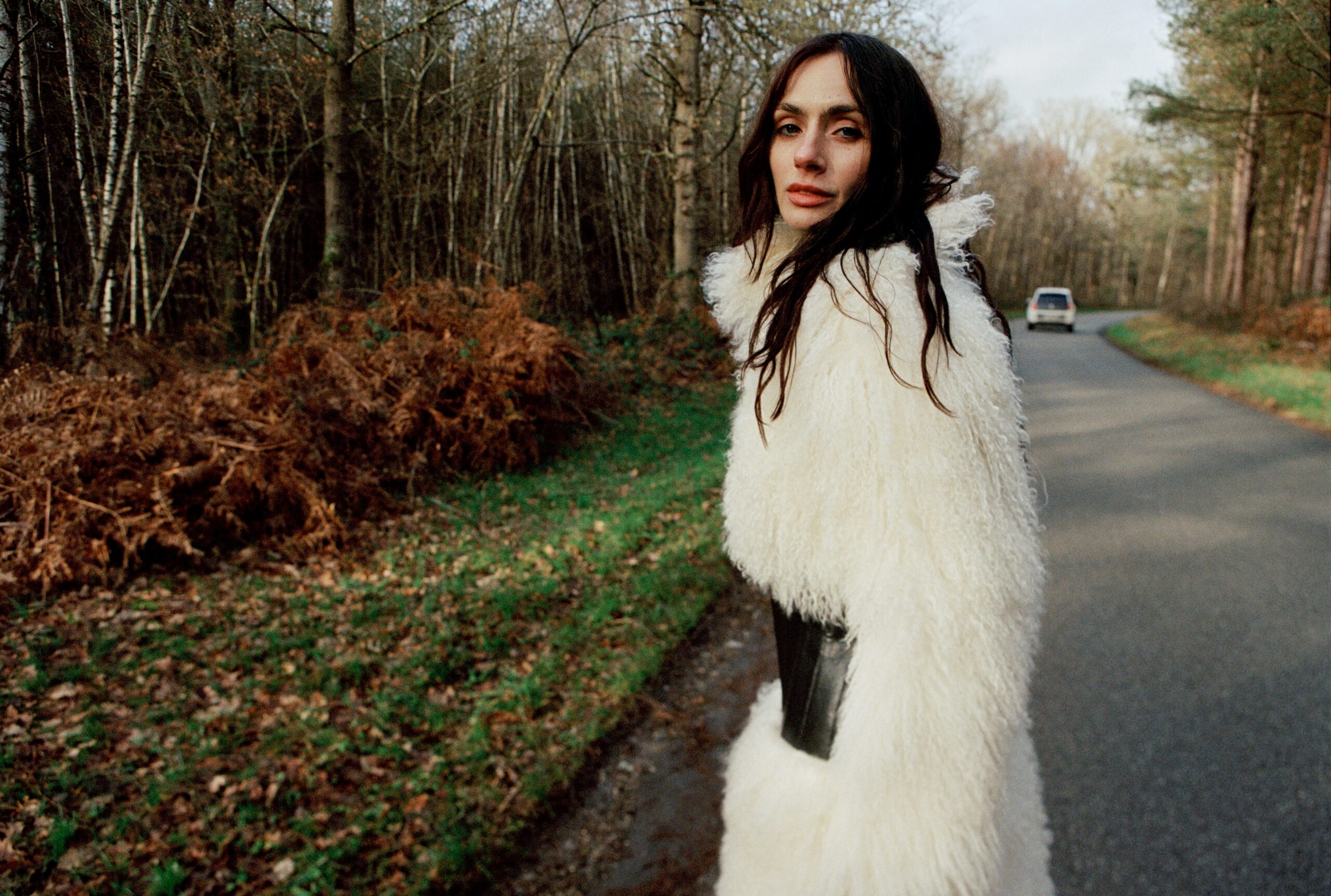
Zoë Bleu, photographed by Harry Carr.
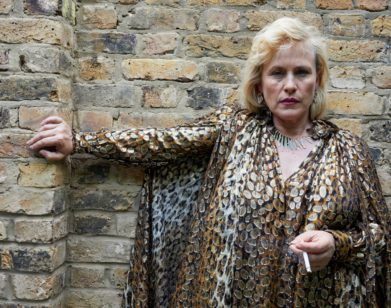
Every generation gets its own Dracula. Directors keep chopping up Bram Stoker’s immortal vision and serving it back with a different pathological emphasis: horror, excess, seduction. In Luc Besson’s latest take, which is out in the US today, the focus shifts decisively to love—the type that leading lady Zoë Bleu describes as eternal, feverish, and charmingly naive, transcending the human realm. Her role as Elisabeta, the object of the Count’s obsession, places her at the emotional center of this latest iteration. It happens to be a perfect fit for the nascent actress, who has long gravitated toward a style of fashion and creation untethered to any single era. Before the film’s release, she got on the phone with actress and collaborator Patricia Arquette—who also happens to be her aunt. In conversation, the two dove deep into the power of a modern love story, Bleu’s first encounters with stardom, and how they both stay grounded on a hectic set.
———
PATRICIA ARQUETTE: Hi, honey.
ZOE BLEU: Hi.
ARQUETTE: How are you?
BLEU: I’m good. How are you?
ARQUETTE: Good.
BLEU: You look beautiful.
ARQUETTE: You too. I’m so excited to talk to you today about your incredible work in Dracula.
BLEU: It’s so surreal. I’m so happy to be talking to you.
ARQUETTE: This movie is a classic, of course. We’ve all grown up reading and watching different versions of Dracula. How did you feel about landing this kind of iconic role?
BLEU: It felt like a dream come true. It felt surreal. I was actually in your apartment when I got the news. At the time, I was asking for a new beginning, and to take my craft and myself more seriously. And then to be given an opportunity where someone else takes you seriously, it was like, “Okay, I’ve arrived, and now I’m being asked to really show up.” And not only do I have to show up as Zoe, but this is an iconic role, as you said. I wanted to do the role justice, and also pay homage to all the women that have played it before. Thinking about Winona [Ryder], I was like, “Okay, I’ve got a lot of work to do.”
ARQUETTE: It felt like that role really made sense for you. Since you were a teenager, you were so interested in fashion, and you were dressing up in these mixtures of vintage pieces and then pieces you were creating.
BLEU: Always dressed like a princess.
ARQUETTE: Yeah. And you’ve done many different things. You’ve designed gowns, you’ve started your own line, you were in a Gucci campaign, and you’ve been to all these shows. How did you feel about landing your first giant role in a period piece, where you got to dress in all of these clothes from this world?
BLEU: So grateful. I felt like the perfect storm: Fantasy, love, romance, period costumes—not only from one specific decade, but over a span of 400 years. There were different kinds of styles aesthetically that I love and reference in my own work. I just felt so inspired the entire time. We had an amazing costume team, and I learned so much from watching them. Not only about being an actress, but about how they worked as a team. I had my little experience being on Gonzo Girl with you. But this couldn’t have been a better fit for me, really.
ARQUETTE: Yeah. I was blown away by your performance. By many different aspects of it, but one of them was that you play two characters. There’s a bit of a shared memory that connects them, but Mina comes from a very different world. Do you want to talk about that a little bit?
BLEU: Yeah. Mina is a woman who feels like she’s walking in a house of smoke and mirrors, and every time she looks at her reflection, something’s a bit skewed. There’s a fog around her inner life. She’s a woman who has forgotten her true essence, her power. And a lot of women in the world feel this way. It’s very easy to feel like that when the world has historically been run by men, and women have been oppressed. But it felt interesting to explore these different rooms within Mina, where a certain sound, or a smell, or the fire, the way the fire danced would bring memories back to her.
ARQUETTE: Well, I also want to talk about all of your art–acting, music, poetry, dance, drawing. You’ve been a multi-disciplined artist for a long, long time. Do you use those different disciplines when you’re acting?
BLEU: Well, during the making of Dracula, I was writing poetry as my characters the entire time in the makeup chair. Especially at the beginning, I felt a bit nervous and I was overwhelmed by the experience of being on a big set, and the pressure of it all. I figured out with my teacher that what helps me get back into my body and be present with the character was to start writing poetry as my character, so I could start to build this inner world; building memory, building sensation, building a snow globe inside of me and letting it snow, so that when I walked on set, that was already alive in me. I was also sketching in my head. If I didn’t have a piece of paper, I would just imagine what different gowns Elisabeta or Mina would wear, and see myself as the character putting on these dresses. I ended up designing a collection inspired by both the characters, and the merging of those characters with myself. And then I wrote a few songs. One I just recorded recently, actually, which was like a love poem that I wrote as Elisabeta. It’s nice to be able to plug in and be like, “Okay, I’m an actress, but this is also really nutritious for all the other things I love to do.”
ARQUETTE: Yeah. I’ve always thought vampires were interesting, because if you distill it down, there’s like an insatiability. Trying to fill yourself up with other people, it’s almost an endless hunger. This particular Dracula has a very different twist on it, and obviously that was intended.
BLEU: Less selfish.
ARQUETTE: I mean, I guess it’s selfish to its own end, but what it wants is this particular person to love. It’s like that uber romantic notion that I think I grew up with, this idea of this everlasting love.
BLEU: Do you still believe that kind of love is possible?
ARQUETTE: I mean, I believe I’ve already had it in my life, especially when I was younger. But I don’t know if that’s the kind of love that really lasts forever. In some kind of a way it does, but maybe because it’s otherworldly. It doesn’t really survive in this world.
BLEU: Yeah, it can’t exist.
ARQUETTE: Maybe that’s that part of it that people resonate with a lot. I think we all also, as girls, grow up with that kind of like, “There’s this prince, and he loves you.”
BLEU: Yeah. “Gotta love me, and only me, forever.”
ARQUETTE: Exactly. “Through every century, and through any place, and every room, you will only see me.” There’s something also weirdly naive about Dracula, the story in itself. But love is such a powerful drug, and such a powerful motivator.
BLEU: I think it’s my favorite.
ARQUETTE: It used to be my favorite.
BLEU: Yeah, I don’t feel it anymore as much.
ARQUETTE: What was it like to be on that set? Because like you were saying, this was a huge movie. What do you do when every cell of your body wants to scream, “I can’t do this.”? How do you push through on a big set like that, with a big director?
BLEU: I mean, I feel totally fine talking about how it was a challenge. Maybe some more established actors would say that it doesn’t bother them. I don’t even have that much experience, but it’s gnarly. For me at least, I’m open energetically and I’m vulnerable, in a way. We probably had 200 people on set, and everyone was a bit stressed. Luc [Besson]’s very meticulous about time, which was really good training for me. Everyone was running to make the mark, and there were many moments where I felt like, “Oh my god, this is a lot.” I honestly kept having to imagine Glinda the Good Witch in The Wizard of Oz. I had to breathe, and imagine a bubble around me made of light. I made a playlist that I could always come back to. I had an Elisabeta playlist, I had a Mina playlist. I had a playlist for me and Dracula
ARQUETTE: Oh, wow.
BLEU: Yeah. It always brought me back. Music always was the thing that would calm my nerves. Even just in my normal life, music helps.
ARQUETTE: I think a lot of actors feel the same. I think I read that Diane Keaton used music a lot. And David Lynch, when we were working together, he would have music that he was thinking of using in the score playing in one ear sometimes. How was it for you to shoot this period kind of movie in Paris?
BLEU: Well, it was always my dream, as you know, to live in Paris. It was kind of both of our dreams, and we both ended up moving there. But there’s this one scene where we’re running in the middle of the road next to the Louvre, and they shut down the entire road with a cross section in this very iconic part of Paris. I remember myself maybe a few years ago standing in that exact place, and it just felt so surreal to be like, “Wow, look how magical life is. If you believe in your dreams enough, things do happen.” I mean, what was it like for you when you landed your first big role in a film? How did you feel?
ARQUETTE: I just felt terrified to show up. I felt like a fraud and like I didn’t know enough. I just didn’t know enough about the technical things. And I was working with people that were coming with a higher caliber of experience and maybe even talent. But also, very early on I worked with Tony Scott, and he really taught me how to listen to my instincts and take chances and make suggestions. I think that experience really informed all of my acting.
BLEU: What film was this?
ARQUETTE: True Romance.
BLEU: Oh, right.
ARQUETTE: Before that, I was working with a lot of people who were like, “Don’t do this, do this.” They wanted me to be the girl puppet to put in a certain position and move around or something.
BLEU: You’re no puppet, girl.
ARQUETTE: Yeah.
BLEU: When you’re on set and there’s a lot going on, and suddenly you’ve got to be on set crying, what helps you stay in your body and stay in the story?
ARQUETTE: I feel like, specifically if it’s a crying scene or something heavy, a lot of times the AD is your best support system in that space. Sometimes, if it’s really loud and people have forgotten what the tone is, I’ll just start saying, “Shh.” And then people just start getting quieter. I’ve occasionally, rarely, used music to listen to, but I’ll write things.
BLEU: You’re such a great writer.
ARQUETTE: You’re such a great writer. I’m excited for you. You’re going to put out a book of poetry?
BLEU: I am. It’s called Growing My Own Gods. It’s a book of my love poems from the last almost 12 years.
ARQUETTE: Wow. Nice.
BLEU: I actually put a few of the Dracula poems in there. I’m excited that it’ll be coming out this year
ARQUETTE: Nice. I was thinking about how you make a movie, then suddenly you’re done with it. Months go by in your life and you let that go, little by little. The process, the character, showing up on set. It fades away from the immediacy of your life, and then it comes back around again when it’s released. Then there’s this different kind of thing where you see the way it was edited, and the music, and the color, and all the other actors’ choices.
BLEU: I think that’s the best part, having the opportunity to watch everyone else’s performances.
ARQUETTE: Yeah. That’s also part of the weird thing of being an actor. You usually walk away like, “I don’t know what’s next.” It’s a weird, liminal place.
BLEU: Yeah, I’m definitely in that space. It’s almost like the ghosts of the movie are walking with me at the moment, because it’s not time to say goodbye fully. I thought you leave set and you say goodbye, but when it’s all completed and ready to be shown to the world, it goes from a spirit to a body.
ARQUETTE: I mean, when it came out in Paris, you became a big phenomena on TikTok. Thousands of young people started discovering you.
BLEU: Yeah, it’s amazing. It’s a mindfuck, really. Someone stopped me on the street recently in New York City, and I’ve never been stopped in the street before. And they were like, “Oh my god, I’m so sorry, I never do this, but are you Zoe Bleu? I saw Dracula.” She just started weeping and was like, “I’m so embarrassed, but I just wanted to say thank you, because I stopped believing in love. But I watched the movie, and it made me want to believe in love again.” She grabbed my hands and looked me in the eye with tears, and was like, “Thank you.” Watching how the film has impacted people is the most incredible thing ever. If I can make one woman believe in love again… like, wow. And we need love in this world more than ever. We need love and lightness, and we need magic.
ARQUETTE: I think there’s something interesting about this Dracula’s character too, that he holds her in such high regard. It’s like it’s only her in the world.
BLEU: I never in my life met a man like that.
ARQUETTE: That idea of chivalry or commitment is interesting, because you don’t necessarily think of that when you think of vampires.
BLEU: I think that’s actually what’s affected women the most who love this movie. They’re more like, “I want to be the only woman in the room.” And every woman should feel like that. Is chivalry dead? Can we please bring it back a bit? The “I only have eyes for you” feeling. Does that exist anymore?
ARQUETTE: I don’t know. I don’t know if it’s some ancient calling we have within us, or if we are conditioned to believe in that.
BLEU: Has it ever existed? Is it a myth?
ARQUETTE: It’s a big mystery.
ARQUETTE: Okay. Zo, what have I not asked you that you want to talk about?
BLEU: I think this has been great. I’m blessed that I get to talk to you about this movie.
ARQUETTE: Me too. You’re such a great artist, Zoe. You’ve always lived your life as an artist, unapologetically. A lot of people don’t do that, or don’t have that inner strength to move through life in that way, even if they want to.
BLEU: You’re such an inspiration for me. I love you.