


ARCHIVES
“White Music Is In Incredible Decline”: David Bowie, by Glenn O’Brien


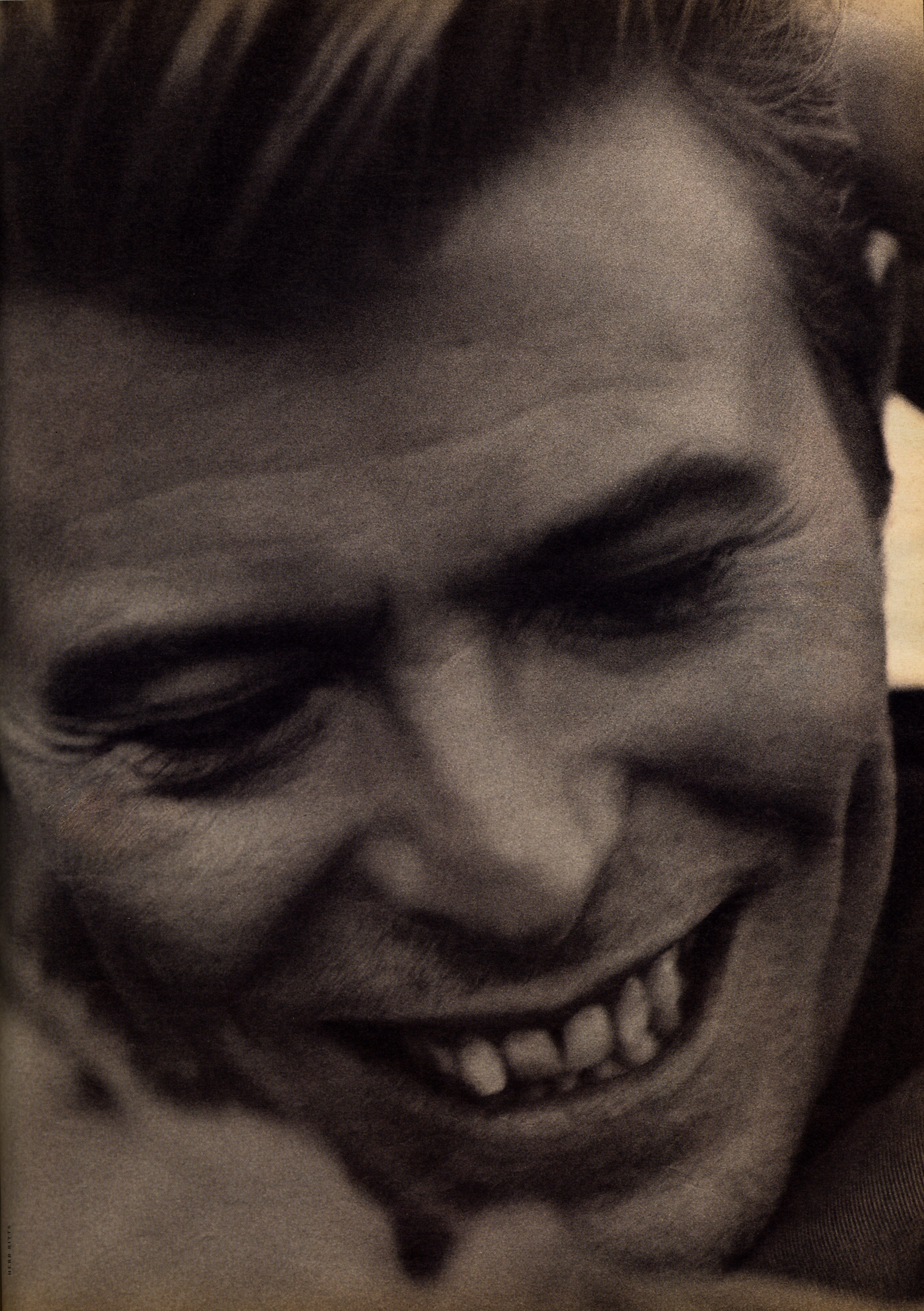
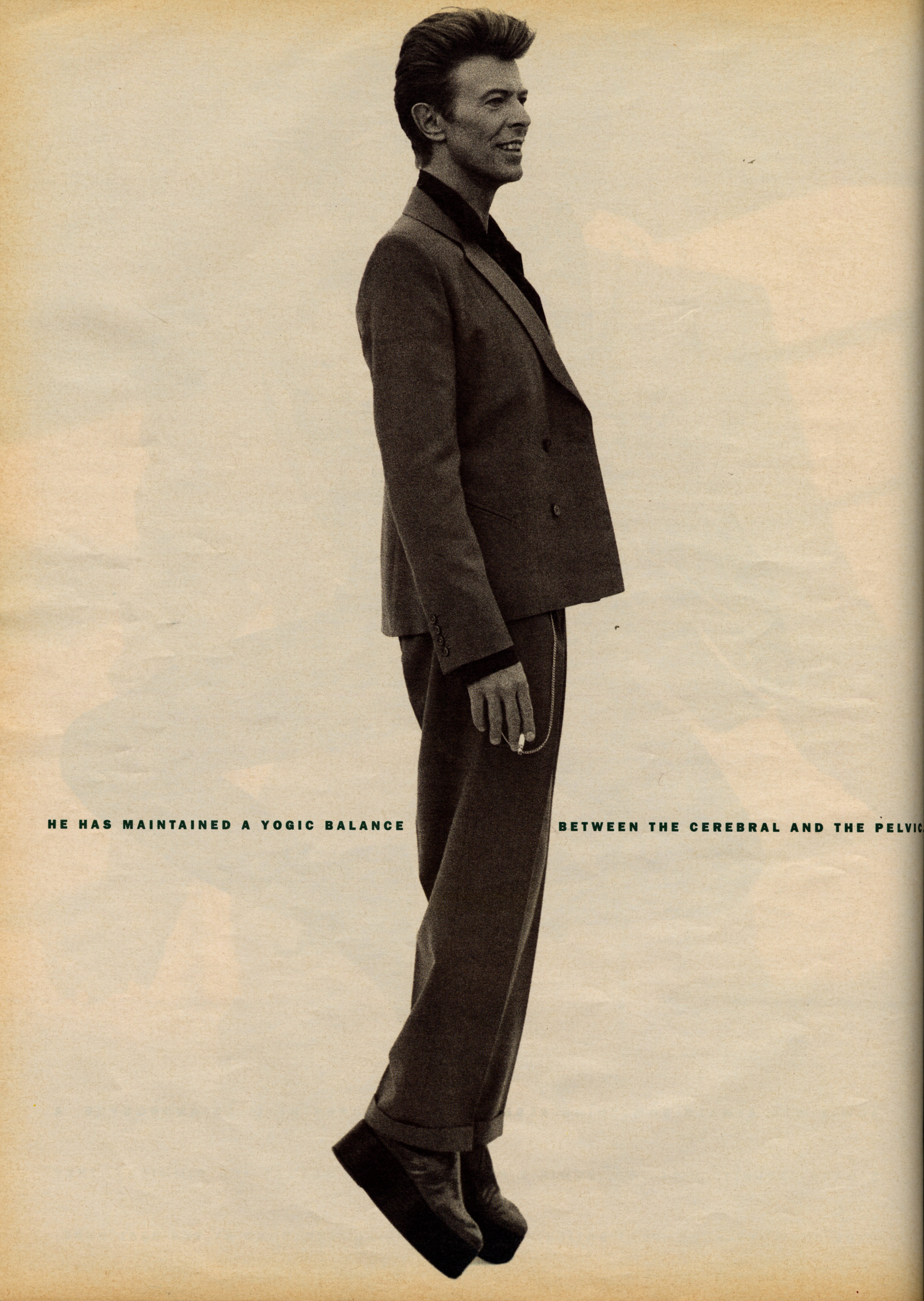
David Bowie, photographed by Herb Ritts for Interview in May 1990.
50 years after the release of Station to Station—the album that captured David Bowie in a state of transit, suspended between European modernism and American soul—his refusal to settle still defines the work. Originally published in May 1990, writer Glenn O’Brien’s conversation with the Interview cover star finds the artist at another inflection point. Nearly two decades after Bowie first appeared at Andy Warhol’s “place of business”—then largely unknown in the United States—to perform his song “Andy Warhol,” he was once again on the verge of a new beginning. On the eve of his “putting the songs to bed” tour, Bowie speaks candidly about repetition, collaboration, and the risks of becoming too easily understood. To mark the anniversary of Station to Station, below is the original 1990 Interview feature with David Bowie, as told to Glenn O’Brien.—OLAMIDE OYENUSI
———
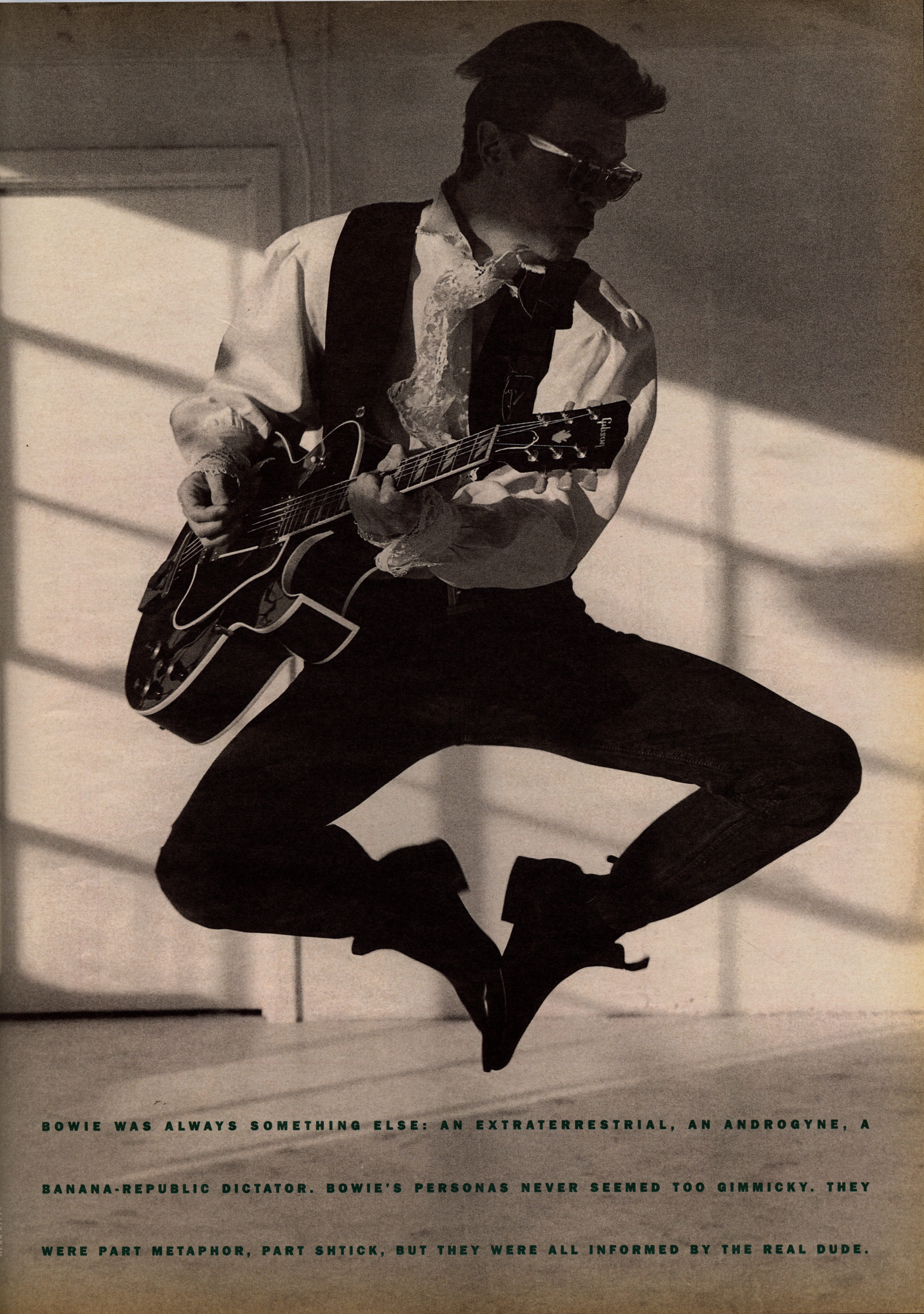
The first time I met David Bowie was about eighteen years ago. It was shortly before the release of his first album in America, and he had come up to Andy Warhol’s place of business to perform his composition “Andy Warhol.” Andy had never heard of him—which was no insult; hardly anyone in the United States had heard of him then, Andy was a little embarrassed to be serenaded, but he acquiesced and listened attentively while Bowie sang and mimed the song. Bowie had long blond hair and wore Mary Jane shoes and one blue sock and one red. The next time I saw him was less than a year later, in England. I caught him performing with his band, the Spiders From Mars, and he really rocked the house. This time he had short blond hair, or maybe red, and was well into an alien fashion mode that would soon sweep the world. Soon he was huge and changing his look and stage persona with remarkable frequency. He was always something else: an extraterrestrial, an androgyne, an aristocrat, a banana-republic dictator. Bowie’s personas never seemed too gimmicky. They were part metaphor, part shtick, part put-on, part character, but they were all informed by the real dude.
Over the years Bowie has proved himself to be a preeminent artist in what’s loosely known as rock ‘n’ roll. He’s made some of the most significant music of our time, usually pushing the envelope of the pop arts in the process. At best his songs are both fine-art gems and mass rhythmic social movements. He has always maintained a yogic balance between the cerebral and the pelvic, and that has kept him loose, outside the pack, and on the nose cone of our time, Superficially, Bowie, might be seen as a chameleon picking up the arriving trend and riding it. But I think he has always been genuinely ahead of the times. Some might attribute that to marketing genius, but it would seem to have more to do with a brilliantly low threshold of boredom and a healthy capacity for self-indulgence. He’s a guy who always does what he likes.
Over the years this has included pursuing many musical and theatrical directions, acting in films such as The Man Who Fell to Earth; Merry Christmas, Mr. Lawrence; Absolute Beginners; and The Last Temptation of Christ and producing artists such as Lou Reed and Iggy Pop. A year or so ago, after a sort of vacation from the front lines, Bowie put together a new band. This time it was to be a real collaborative band, not a backup band. Tin Machine consists of Bowie, guitarist Reeves Gabrels, and the brothers Hunt and Tony Sales on drums and bass. It is a hard-edged, tough-minded band, tough enough to pull off the Bowie-as-a-band-member stuff. They’re now working on a second album.
At the moment Tin Machine’s singer and rhythm guitarist, David Bowie, is touring the world as a headliner, backed by a band led by guitarist Adrian Belew. This is Bowie’s “putting the songs to bed” tour. He says that after this tour you’ll never hear these golden hits again. Another publicity stunt? Can this be the end of Major Tom? I asked David Bowie about these and other things when I talked to him at his rehearsal space in New York just before the tour kicked off. He was wearing worn black jeans and a red turtleneck—very much the regular guy. Which he is—maybe in a way that only the best artists and average Joes can be. Thinking about all the versions of Bowie I’ve seen, all those costumes and personalities, I’m sure that indeed there always was a regular guy behind them. I mean, isn’t art just a way of making the world safe for sincerity?
———
GLENN O’BRIEN: Tell us about your tour.
DAVID BOWIE: It’s the “putting the songs to bed tour. I’m going to be doing between twenty-five and thirty-five songs, closely associated with me, and then not do them any-more, because I’m moving on. Bye-bye, Major Tom, forever…
O’BRIEN: Are you signing a contract on this? Are you sure?
BOWIE: Yes, absolutely. This is it. And I’m relieved. Knowing that I won’t ever have those songs to rely on again spurs me to keep doing new things, which is good for an artist.
O’BRIEN: You did retire from the stage once before.
BOWIE: I think ’73 was the only time I retired. But all I said was that it was the last performance of Ziggy and the Spiders. And indeed it was. I didn’t say that I was going to stop performing altogether.
O’BRIEN: Did you get this idea by seeing some venerable group doing their old hits?
BOWIE: I’d like to say that was how I got the idea. But I think it was the excitement I found being generated by Tin Machine that made me realize that I wanted to put myself in a group context, which I’ve never done.
O’BRIEN: Even when you started out, you were never really an equal member in a group.
BOWIE: No, I never felt that need. I never felt that matey. It was very much my own show, but I’ve changed considerably over the years, and now I do enjoy relaxing my responsibilities artistically and trying to feel a bit more open to other people’s ideas in terms of what we can do. Using the royal we…
O’BRIEN: I remember when I saw you playing with Iggy Pop you really seemed to be having a good time just being one of the boys in the band.
BOWIE: I did enjoy that. I enjoyed not having to say, “O.K., we’ll do it this way” or “Let’s stay in that hotel.” Of course, there are times when I find it difficult to keep my mouth shut, and I want to throw in more than my two cents’ worth.
O’BRIEN: Are you doing something with dance on this “putting the songs to bed” tour?
BOWIE: I’m working with Edouard Lock, from a Canadian dance company. La La La Human Steps is absolutely fantastic-they’re one of the most expressive and aggressive dance troupes that I’ve ever seen. Their chief dancer, Louise Lecavalier, is doing prerecorded pieces with me. Whatever I do tends to have some kind of theatrical device attached to it, but this one is a lot simpler than anything l’ve done before. We’re experimenting with a series of video-interactive devices that we can work with onstage, with prerecorded pieces of footage which are shown and projected in a substantially new way.
O’BRIEN: I thought you were going to be with dancers onstage.
BOWIE: There will be dance within the program, but it will be footage treated and slow-mo’ed, and used more as atmosphere. It will feature Louise, just one person.
O’BRIEN: Will you have a video of this show?
BOWIE: We’re intending to film it for posterity; I should hope so. I’ve always regretted not having filmed things like the “Diamond Dogs” show. We never filmed the “Station to Station” show. Or the “soul” show with Dave Sanborn and those guys. I have absolutely no footage of those things. It’s terrible. Rod Srewart has footage from 1908-well, from quite a long way back. I’ve got the “Ziggy Stardust” thing, and that’s about it. That’s all I’ve got. It’s infuriating.
O’BRIEN: Do you pay attention to what’s going on now with pop music?
BOWIE: I have an incredibly hard time with it at the moment. It’s all so dispirited and sexless. There’s this strange atmosphere now that’s come over sex that I’m particularly angry about. Sex is suddenly once again the unmentionable word, and one wonders if that’s going to lead to more right-wing thinking and to a kind of fucking depressing grayness to the quality of life. It’s a return to everything that we despised in the early ’60s. I do like the Pixies. I think they’re great. I think Sonic Youth are wonderful. I must say I still like The Cure. It’s marvelous that they’ve actually got a huge audience over here now. There are a number of bands that are good to listen to, but it really doesn’t seem that there is access for new people anymore. I just named the three bands that probably will get access, but for other new bands there is no radio they can use, and MTV won’t play anything unless it makes money for MTV. With all the media that we have now it’s less possible to put over good music than it was when we didn’t have all those facilities, which is ludicrous.
O’BRIEN: It seems to me that the real leadership artistically has totally gone over to the black artists. They are almost the only ones that are really changing the forms.
BOWIE: I agree. Absolutely. I think that white music is in an incredible decline at the moment. And now that rock is a fully fledged career opportunity, I don’t think we’ll ever see the likes of what we once knew ever again.
O’BRIEN: Now there’s a Rock and Roll Hall of Fame.
BOWIE: I think that’s awful. Well, I guess what you have to do is just go against the flow and not be demoralized by it. One has to keep buoyant. I don’t listen to the radio anymore, and I never watch the TV things, the MTV stuff. When I do, it draws me into that dangerous position of wondering why I’m still doing what I’m doing; I think, God, am I part of all this? The best way is to just completely eradicate it from your mind and draw back into yourself and say, “Well, what I want to do is have fun.”
O’BRIEN: Is that how you always changed directions?
BOWIE: By turning away from things?
O’BRIEN: Yes.
BOWIE: Yes. Repeatedly. From cities, from experiences, from art, from everything. There just comes a point where things become mundane, and it’s repetitive.
O’BRIEN: I think a lot of people thought you were just trying to come up with a new gimmick.
BOWIE: I’m the last person in the world who should say this, but it was never, ever a marketing or merchandising device. But every time I did it, it was the worst thing I could possibly have done for everybody around me. It didn’t work out that way in the end. But to any management I had, it was always “What on earth is he doing?” When I had the “Diamond Dogs” show, I scrapped it when I got to Los Angeles and came back with the “soul” show. It was very petulant, a lot of it. I needed to do that because I always had a hard time sorting out exactly who I was. I needed to buffer myself with some kind of premeditated identity just to get out there onstage. It was necessary for me to develop some kind of character, but it also happened that I got bored with the characters very quickly if they didn’t quite fit. And then it seemed like a logical thing to develop a new one…
O’BRIEN: So do you feel that you’re totally over requiring a character?
BOWIE: Yes, I have been for a number of years. I don’t think that I need characters anymore. I’m not sure that means I’m cocksure about who I am, any more than I ever was, but at least I have an understanding that I know myself better. It doesn’t mean that I know what I am, but I know who I am, if that makes any sense. That sounds like rambling shit, but I’m far more aware of my limitations, strengths, and weaknesses than I ever was. I still feel that it’s fair to both myself and to my audience that the shows have a different personality every time that I tour. I don’t want to see an artist duplicate his presentation every time I see it. There are a few artists who can carry a show sheerly on their real persona repeatedly, but there comes a point where you want some new information, as much as you love them. That’s true with anybody-the Stones or whoever. There is a point where you think, Yeah, I know that jump, I know that lick.
O’BRIEN: Do you still identify with the songs that you’re putting to bed now?
BOWIE: Oh, God, it’s so hard. One thing that has made it a more real experience is having Adrian Belew interpret the musical side in his own way. The premise was: Yes, we’ll do these songs, but let’s not be a slave to the original interpretations, because that’s no fun for any-body. We’re just a four-piece band, so let’s do them the way a four-piece band would do these things, even if it’s “Life on Mars,” with orchestra and everything. Let’s make it a four-piece-band version of it, so musically it is a honed-down, stripped-down kind of thing. which is fun.
O’BRIEN: So you’re playing too.
BOWIE: Yeah, I’m playing saxophone and guitar.
O’BRIEN: Have you seen Dylan in recent years?
BOWIE: No.
O’BRIEN: It’s amazing the way he alters the arrangements of his songs radically night after night.
BOWIE: I hope that you approve of that. I saw the most despicable reviews of his concert in L.A. They were so patronizing, as though they had an angle on the guy. The contempt and the dismissal that Dylan is given is unbelievable.
O’BRIEN: I think that what he does is great. His songs really hold up lyrically, but rather than just come out and do them the way that everybody remembers, to come out and jar people with something totally alien is just brilliant. It’s like Charlie Parker playing standards. It just makes you think about everything all over again.
BOWIE: I’ve heard a lot about the way Dylan’s speaking the songs now instead of singing them, which I think is absolutely right. He is the poet laureate of America. He should be reading his poems to music now, like Linton Kwesi Johnson.
O’BRIEN: I always wondered why you never got a little more involved in the art world. A lot of people who have been in pop have been able to cross over, and they’ve chosen to. I think you’re somebody that artists take seriously, but unlike Brian Eno or David Byrne, you’ve stayed out of the art world. I know you paint.
BOWIE: A bit. I did a portrait of Iggy a number of years ago that appeared on the back of Iggy’s book.
O’BRIEN: So what has kept you from —
BOWIE: From being arty?
O’BRIEN: Well…
BOWIE: Oh, yes, indeed. There’s a quality to art at the moment that I can’t come to terms with. It just doesn’t appeal to me. I find it far too comfortable and bourgeois and middle-class. I think it’s generally having a negative effect on David Byrne. He’s probably going through his most uninspired period at the moment. I can’t say I follow Brian Eno’s work too much, because I don’t know what he’s doing half the time. He’s probably doing video installations or something. I’m not sure that an art career would have any benefit for me; I’m not sure it’s what I want. I don’t think I want to be a designer-rock artist. It’s almost a social grace to get into the art world, and I’m very wary of it. Art was good in Berlin in the late ’70s—there was a lot more guts to art when the Neo-Expressionists were starting up; it was real slapdash; it had real heart to it-but it seems so cold and heartless in America. It’s a buyer’s market.
O’BRIEN: Obviously you don’t need the art world to have credibility as an intelligent person, and in a way you’re more free by staying out of it, because you’re not in a market that’s dominated by twenty or a hundred people. But the cool thing about the art world is the having-dinner part. There is a community in the art world, and one of the best things about it is the dinner talk. And I think people do trade ideas, or concerns, once in a while.
BOWIE: But it’s the same idea that they’re all passing around—or it has been over the last ten years, hasn’t it?
O’BRIEN: I don’t know. Who do you hang out with?
BOWIE: Oh, my God, who on earth do I hang out with? Let’s take the last few months. The last six months, who have I been hanging around with? Apart from my fiancée, and Coco, whom you probably remember from the dim recesses of the past-Coco Schwab is my best friend. And the band. Most of the time we’ve been in Australia recording, so I’ve been hanging out with surfers and the occasional sheep farmer. You meet sheep farmers in very trendy restaurants in Sydney. And there’s the Sydney Dance Company; they’re quite fun, actually. They did an awful tour over here, and they should not be judged by that tour, because they are much better. Before Australia I was in Indonesia, and I hung out with the village people in north Bali.
O’BRIEN: You don’t mean the Village People.
BOWIE: Ha. Where do you think those people got those crazy clothes ideas? But really, have you been to Bali? My God, do they dress. Every day of the week there’s a celebration.
O’BRIEN: Did you read in the papers that they were blasting rock ‘n’ roll at Noriega when he was in the Vatican Embassy? They were blasting “Modern Love” at him.
BOWIE: Yeah, I know.
O’BRIEN: What did you think of that?
BOWIE: Mixed feelings. I enjoyed it very much, but I really wished my songs hadn’t been pulled into that particular situation.
O’BRIEN: You were in good company, because your songs were played along with Jimi Hendrix’s.
BOWIE: That’s fine.
O’BRIEN: As a former Berliner, you must have been thrilled with the fall of the Wall.
BOWIE: The first thing it brought back into my mind was an evening I once spent in a punk club in Berlin on the anniversary of the Wall having been put up. There was a birthday cake of the Berlin Wall that went around the entire room. It was under green neon. The people all had Mohawks and things through their noses, and as midnight struck all these punks just started lunging into the cake, rooting pieces out of it. I wished I’d had a camera. I had never seen anything like it. It was an extraordinary image, seeing the Wall come down. And now they’re really bringing it down. I can’t believe that it has happened. Everybody in Berlin was fully convinced that it would be up another hundred years. It’s quite spectacular. And it might lead Britain into an area of socialism that is a lot truer than anything else it’s had before; it might take the emphasis off having Nanny out there all the time. It is all over. It is all over. What is to replace it, we shall see, won’t we?