


IN CONVERSATION
Tom Blyth Tells Tim Roth How He Made It From Nottingham to Hollywood


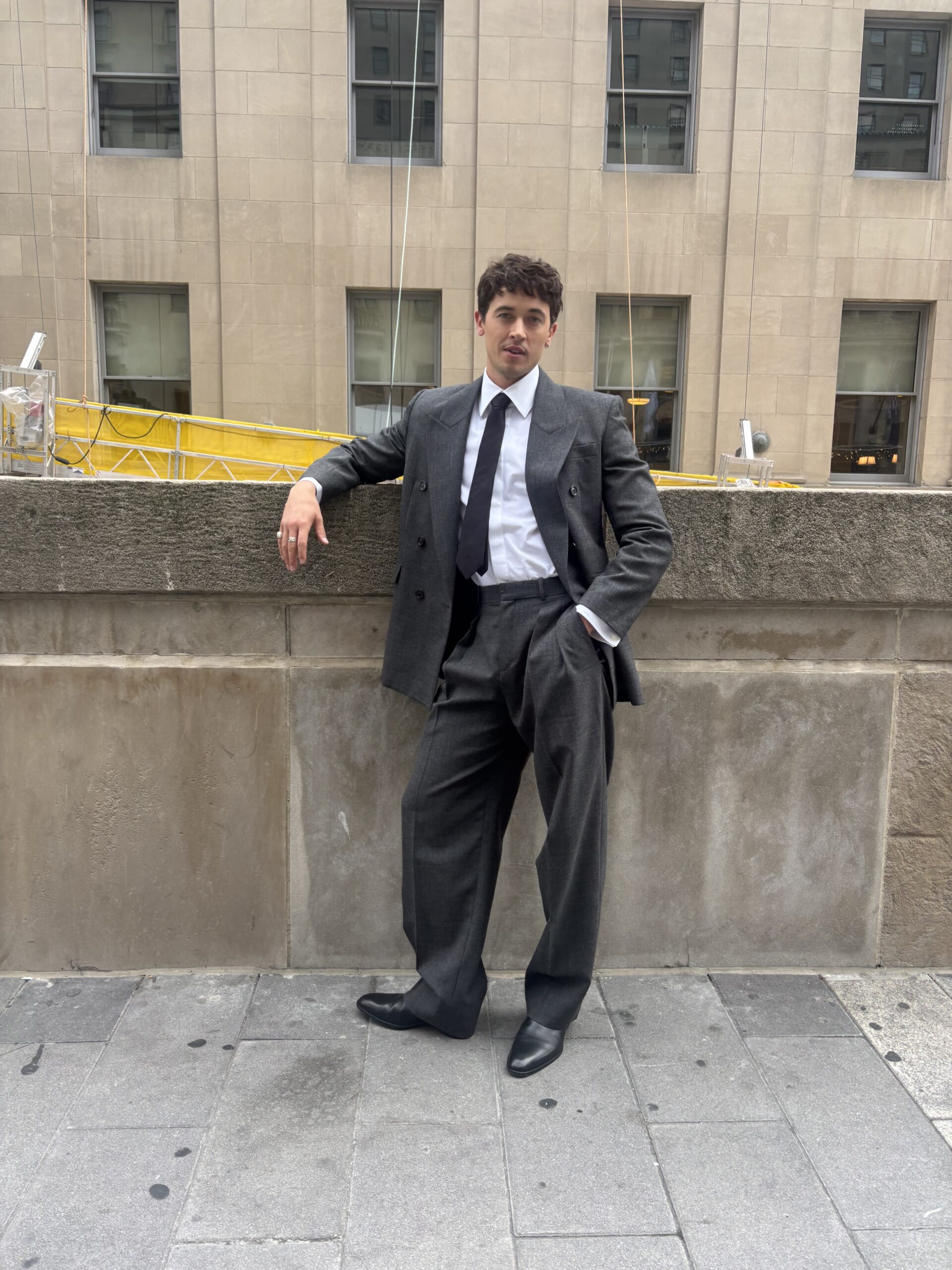
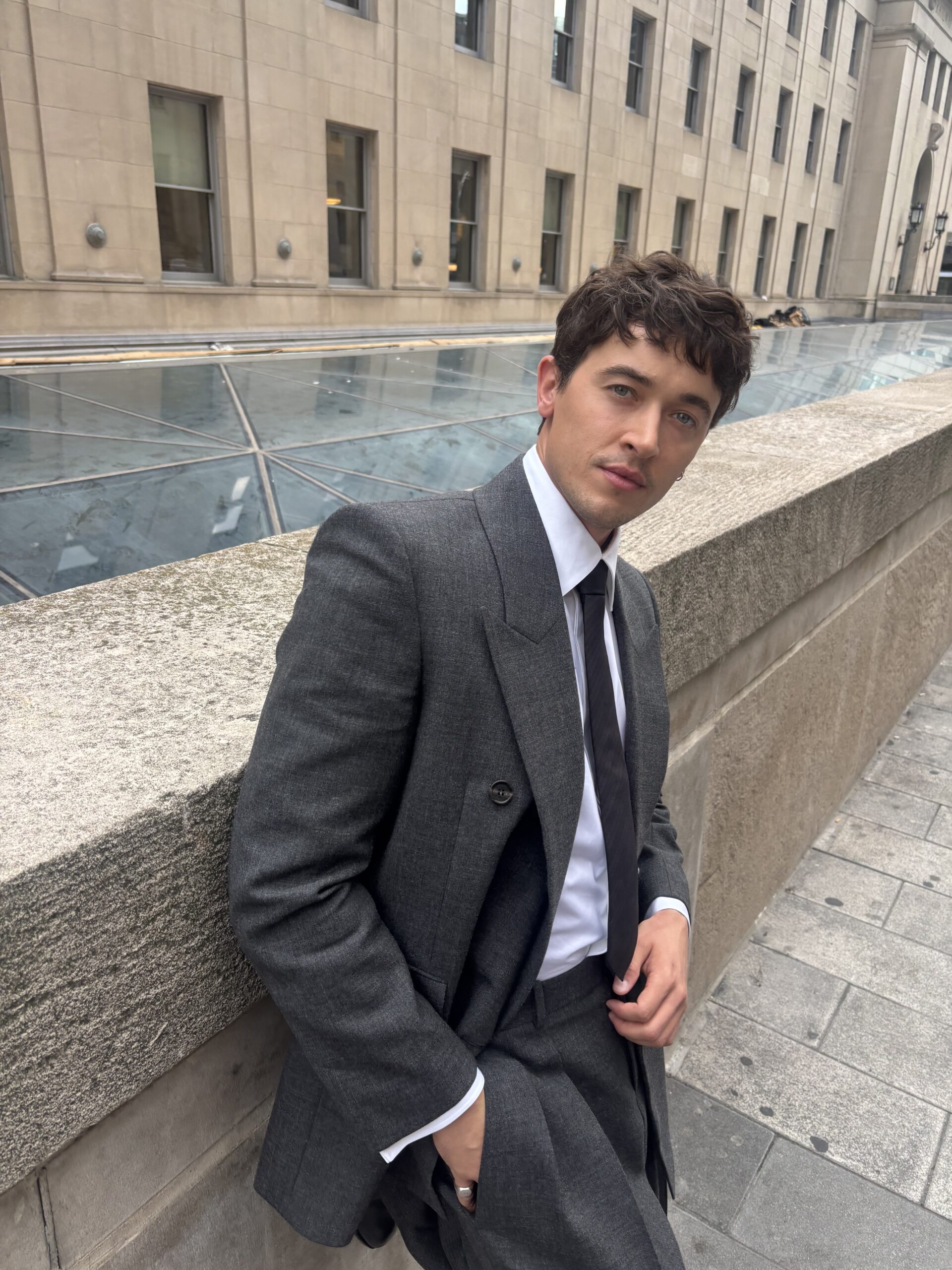
Tom Blyth, photographed by Myles Pettengill.
“Now more than ever,” Tom Blyth wants to make difficult films. After his blockbuster breakout in The Hunger Games: The Ballad of Songbirds & Snakes, the 30-year-old actor is going indie, starring opposite Russell Tovey in the psychosexual thriller Plainsclothes as a closeted undercover cop tasked with apprehending gay men by seducing would-be cruisers in a mall bathroom. The film, which originally premiered at Sundance and goes wide this weekend, marks the feature-length debut for director Carmen Emmi. Last week, Blyth got on Zoom to unpack the role and his career trajectory with his personal hero, the actor Tim Roth, who wasn’t shy about pitching Blyth on a two-hander with the great Claire Denis. Below, the Brits have a playful and wide-ranging conversation about the films that shaped them and the magic of movie theaters.
———
TIM ROTH: Fucking hell. Ignore all the notes. Ignore everything. [Laughs] I saw your film Plainclothes last night. It’s fucking brilliant and I sent it over to my son for him to watch it as well. Hunter, the one here in the States, he’s starting out as a director. I just said, “You’ve got to see this.” That’s a little indie movie, right?
TOM BLYTH: Man, it was literally a million dollars. Or less than a million, I think? Shot it in 18 or 19 work days overall.
ROTH: Where did you shoot it?
BLYTH: We shot it in Syracuse, New York, which is where Carmen [Emmi], the director, is from. Have you been up that way?
ROTH: I’ve just got back from New York, but I wasn’t anywhere like that. I was in Staten Island doing a film.
BLYTH: Well, mate, thank you for watching. That means the world.
ROTH: When I came to America, there was a thing called independent film thing that was just starting up and luckily it coincided with me landing. Quentin [Tarantino] was part of that, so I went to do his job. But that all seems to have gone away. Back then, everyone was looking for that kind of stuff. If this film had been made 20 years ago, actually, it would’ve been very interesting, because I don’t know what had been done on that kind of sexuality. Well, there were a few things, but they’re mainly heterosexual.
BLYTH: I guess the comparison for that time was Cruising, right? With Al Pacino. That’s the standout, but I can’t think of another one.
ROTH: Exactly. You could pop over to Europe and find more. But it was always under the surface, even with [Pier Paolo] Pasolini and people like that. It was never out in the open like your film was.
BLYTH: Wim Wenders, I guess, but you’re right. Another interesting thing is that this is set in the ’90s, right?
ROTH: Not a cell phone in sight.
BLYTH: Thank god.
ROTH: Thank fucking god.
BLYTH: I feel this about theater as well at the moment. I can’t stand watching plays or films where there’s people on their phones. I just can’t be bothered. I’m like, “We all walk around like that. Why would you want to watch the people watching their phones?”
ROTH: I remember I was about to do a film with Michel Franco, this great Mexican film director that I worked with. And when we were working on the script, there were scenes in it where someone’s talking on the phone, but they’re walking around with the phone in their hand and they’re talking. I’m like, “Why the fuck are you doing that?” And he said, “Well, that’s what people do.” And I tried to remove as much of it as possible. I mean, if you go anywhere in the world now, try taking a picture without a phone in it.
BLYTH: We kept joking that we were making a period piece because it felt like it. But that’s what’s cool because the film, like you said, maybe wouldn’t have been made back in the ’90s or ’80s. And yet it’s about that time–
ROTH: But it’s weirdly hard to make now. It shouldn’t be that hard to make it now.
BLYTH: Why do you think that is?
ROTH: It’s the nature of the film industry across the planet, in a sense. On the one hand, there are people—we bitch about the phone—who make a fucking movie on their phone because that’s all they’ve got. So there is that option sitting around, but–
BLYTH: It’s like it’s more accessible than ever to make a film, but harder than ever to put a film out.
ROTH: Getting one out into the system is insane. It’s also the lack of cinemas. My son goes to the cinema two or three times a week to watch old movies, to watch new movies, to do all of that stuff. So it’s still out there, but in a much less celebrated fashion, I suppose.
BLYTH: There’s that dream of being a British actor in L.A. that I always found very enticing. Honestly, all cards on the table, I was probably 15 watching Reservoir Dogs and Googling you and seeing that you’d moved to L.A. and thinking, “That’s what I need to do.” [Laughs] It’s funny how things work out.
ROTH: [Laughs] Oh, it is. I only come back to work now.
BLYTH: Do you still enjoy doing the indies as much as you used to, even though it seems like it’s harder to get them made?
ROTH: Yeah, definitely. I did a film up in Scotland called Tornado and it was an absolute blast. They did it on a minimum budget with a bunch of rabble-rouser trudging around the Highlands. And The Madness, which I just did on Staten Island, is a totally independent film by a first-time director. I love doing that stuff. What about you? How did you start?
BLYTH: I feel like I’ve been doing it forever, even though I’m still pretty green. I started out when I was 15. I was born and raised in Nottingham.
ROTH: Oh, fucking hell.
BLYTH: I’m a Midlands lad.
ROTH: Wanderers fan?
BLYTH: Not actually. Everton fan, because my dad was an Everton fan. I’ve been living in the States for too long, so I don’t follow anything. But now that I’m back in the UK, I feel like I’m going to get back into it. But yeah, I went to a place called the TV Workshop, where a bunch of British actors come through, then I moved down to London and did the whole National Youth Theatre thing. And then I went to Juilliard in New York when I was 21.
ROTH: Why there?
BLYTH: I needed to get out of my own way. And going to the States, for some reason, gave me way more confidence in my own ability to just fucking throw it out there and have fun with it. I probably harp on this too much, but I think there’s a UK thing where we’re very judgmental as a people.
ROTH: You think? [Laughs]
BLYTH: It’s not great for acting, or expressiveness in general, because I think you’ve got to be unapologetic in many ways about going out on a limb and being ugly and messy and dangerous. And I don’t think being in the UK was good for that, so going to the States really helped me just break out of that self-judgement. I came out of drama school at 25 and it took a few years to start getting jobs. When I was 27, I got a TV show in the States, a western called Billy the Kid. And then shortly after that I got the Hunger Games reboot, which was obviously a big commercial project, but I’ve always wanted to do the indie thing.
ROTH: It’s all right if it goes hand in hand. It’s like the one opens the doors for the other things you want.
BLYTH: Totally. That’s the mindset that I’ve clung onto the whole time: “How can I do this for as long as I can and keep it interesting?”And for me, it’s just variety, doing stuff that I’ve never done before, testing myself. I want it to be challenging always.
ROTH: I mean, I’ve done terrible films, but you don’t know until you get there. And sometimes, those are the most enjoyable sets.
BLYTH: I’ve done a couple of duds as well. And you know what? You can’t have regrets, can you?
ROTH: No.
BLYTH: Do you believe in fate and manifest destiny and that sort of thing?
ROTH: I don’t have any titles for it. But I always say that if you get turned down, hopefully there’s good reason for it.
BLYTH: Yeah. It always seems to work out if you don’t cling too tightly, I think.
ROTH: On Plainclothes, did you have a dialect coach?
BLYTH: I was with a guy called Sam who helped me out and—
ROTH: It’s fucking amazing, by the way. It’s a really good job.
BLYTH: We were really trying to go for the Syracuse dialect, but it’s quite hard to nail down a Syracuse sound. It’s like almost you don’t want to go New York, Brooklyn, because that sounds like—
ROTH: Has it got a soft R or a hard R? Hard Rs are harder for us Brits.
BLYTH: It’s definitely a harder R because it’s more of a Midwestern sound.
ROTH: Yeah, yeah. The New York one is easier.
BLYTH: Way easier. So we basically tried to do something that sounded like Syracuse but not lean into it in a caricature way, which is always the trick, right?
ROTH: But I’ll tell you what’s good about it. It’s smooth as fucking silk.
BLYTH: Good.
ROTH: With a lot of the indie movies, they can’t afford dialect coaches.
BLYTH: I only had three sessions with my guy because that was what they could afford. Have you got people you go to every time?
ROTH: Oh, yeah. I’ve got one in London and she’s a genius, so whenever I’m over there and I need something regional, she can do it. But she can do the American thing easily, too.
BLYTH: What about movement? Because obviously you did Planet of the Apes as well.
ROTH: Oh, yeah. Well, I did films to embarrass my children. I did the Hulk movie and I did the Planet of the Apes movie. “Your dad’s a fucking monkey”—that was going on. I went to an ape movement class and I thought it was fascinating. So when it came along, I just got right into it. I also had a fantastic stunt double on it, who we used as my double in the Hulk movie too. He’s an incredible guy.
BLYTH: Oh, nice. I’ve found that if the script is good, you can almost hear the voice in your head when you first start reading it.
ROTH: Yes, and you get a sense of where that sound is.
BLYTH: Yeah. And then obviously, if you’ve got a coach, you fine-tune it and get closer to what it actually is.
ROTH: What’s good about your film also is the dialogue is there, but the silence is there too. That’s fucking rare. You have to fight for the silence.
BLYTH: I mean, it’s the same with auditions as well. I’m sure you’ve not auditioned in quite a while, but—
ROTH: I don’t audition. I stopped very early. I was so shit at it that I thought I’d lose jobs by auditioning, so I just put my foot down. I’ve got enough work out there. They can go and see if they like my acting. If they don’t, then they can move on.
BLYTH: That’s the benefit, right? The more you do, the more your work is auditioning for you. I’ve been lucky that the auditions have been less and less, which is nice.
ROTH: I was just so bad at it. [Laughs] I was losing so much work.
BLYTH: I respect that. Also, you’d worked with great filmmakers so early on that your name was probably associated with greatness already.
ROTH: I was doing all right. [Laughs]
BLYTH: What I have gotten a bit more confident with is knowing within 20 pages whether or not the script is for me and just having the balls to say, “No, maybe it’s for someone else.” It could be a huge film or TV show, but it’s not my thing.
ROTH: Yeah. There’s always one coming, yeah. Have you done anything in your own dialect that suits you?
BLYTH: It’s not so much my dialect—well, I don’t really know what my dialect is anymore. It’s such a hybrid North-South American-British. But actually, last year for the first time, I did a film called Wasteman, which is going to TIFF in a few weeks. It’s a prison drama. So it’s me and my friend David Jonsson, a two-hander. I play this cocky nutter who just comes in and basically fucks with his cellmate’s life and makes it really hard for him to go on parole. And that was probably the most fun I’ve ever had in a job so far.
ROTH: Why?
BLYTH: I mean, the dialect really set me free. I’m not going to lie. It wasn’t my voice, but it was a South London dialect. I found a lot of playfulness in it. But also the character is just a proper bounce-off-the-walls, high-energy coyote kind of animal character. I got to really play, while David was anchoring and being the watchful presence. And then I did a film with Claire Denis at the beginning of this year where she said, “I want you to go Nottingham with it.”
ROTH: Oh, wow. That’s good.
BLYTH: One of Claire’s best friends is a musician from Nottingham, so when we met in Paris to talk about doing this film together, she loved that I was from Nottingham. I thought it was going to be an American accent and she basically said, “No, I want you to do a Nottingham accent.” Which was bizarrely one of the hardest accents I’ve done. I was like, “Shit, what does that even sound like now?” But that was a lot of fun.
ROTH: We’ve got to get Claire Denis to find something for me and you to work on together, all right?
BLYTH: What a dream.
ROTH: Get on the blower and sort that out. [Laughs]
BLYTH: I’d jump at the chance. She’d love you and you’d love her.
ROTH: Oh, I love all that shit. I love it.
BLYTH: She’s no-nonsense. She knows what she wants and she gets what she wants. You might be scheduled to film 12 hours and it’s a night shoot, but after eight, if she feels like there’s something missing, she’ll go, “No, we’ll do it tomorrow.” Talk about someone who just owns the set.
ROTH: Does she have a good crew with her?
BLYTH: She worked with people she’s worked with before who respect her process and enable it. But speaking of directors, you’ve worked with literally all the best ones. [Laughs] Are there directors who you would still die to work with?
ROTH: Oh, fucking hell. I hate that because they always go straight out of my mind. Generally, it’s the ones that are tucked away somewhere writing their first fucking script. And there are actors that I still haven’t worked with. I never worked with Cate Blanchett. And there are ones that I’ve worked with before who I’d love to work with again: Samantha Morton, anything with her, and Joanne Whalley. Naomi Watts, same there. But no, I mean, again, as soon as we hang up, I’ll have a list for you.
BLYTH: I know.
ROTH: Oh, I wanted to ask you, the woman who played your mom in Plainclothes—she is bloody good.
BLYTH: Maria Dizzia.
ROTH: She is so good.
BLYTH: I mean, I love that the film—no spoilers—ends on her and that look she gives.
ROTH: And you know what? As an audience, you needed that.
BLYTH: It’s the catharsis, isn’t it? I mean, when I read it on the page, I wasn’t sure what the genre was, but we’ve been described as… What was it? A “romantic thriller.” Because it’s so anxiety-driven, it’s so tightly wound.
ROTH: I was worried about that because when I started watching it I was like, “Oh, please don’t be a shaky-camera whisper-acting movie, please.” And it wasn’t.
BLYTH: It’s so brave for a first-time filmmaker to do that, to really lean into that stylistic—
ROTH: That was his first film?
BLYTH: That was his first film. His name is Carmen Emmi.
ROTH: That is fucking insane. He’s got a lot to live up to after that one.
BLYTH: No pressure, mate.
ROTH: Have you ever shot on film?
BLYTH: No, I haven’t.
ROTH: You’ve got to do that.
BLYTH: I really want to. And there’s a film that I just got attached to that isn’t getting itself together yet, but hopefully will next year, and that will be on film. And to me, that was a big draw. Because I was like, “If they can get the money together to shoot on film, that’d be a fun time.”
ROTH: That one I did up in Scotland, they shot that on film, and it was so nice being back with that.
BLYTH: Have you found the experience or the culture around film has changed since you’ve seen the change from film to digital?
ROTH: Well, I suppose at the beginning, there was a sadness with a lot of the crew members because they sensed that it was over. But what it did was it enabled the budgets to go lower and a lot more poverty-stricken filmmakers to mark their work. On the other hand, it signaled a sad removal. And the one thing that we all knew was coming was that we’d start to lose cinemas because of streaming. And what was fascinating for me always was when you go and see a film in a crowded room full of strangers—
BLYTH: The best thing.
ROTH: There’s something about that group activity that is sadly missing. I mean, it’s still around, but in a much less significant way, sadly.
BLYTH: My core memories as a kid were going to the cinema. I mean, my mom and dad separated when I was really young. I’d see my dad once a month, and he worked really hard. So basically all he had the energy to do was take us to the cinema. We’d spend the whole weekend seeing films. He lived up in Leeds and we’d just go and see two, three, sometimes four films a weekend.
ROTH: Brilliant.
BLYTH: The smell of popcorn in a movie theater is still my favorite smell.
ROTH: I remember my dad taking me to see proper films. Again, it was in Brixton, that same cinema, and it was The Sting, which was a film with Paul Newman and Robert Redford. It was about scam guys and stuff. And then he took me back and made me sausages, because he lived up the road from us as well. So we had the same separation thing, but it was probably a good separation, to be honest.
BLYTH: The first film that I remember seeing in the cinema was Monsters, Inc., the first Monsters.
ROTH: Oh! I love Monsters, Inc. I liked Up as well.
BLYTH: Do you feel that your career is what you had imagined it’d be?
ROTH: I think it is. Weirdly, I wanted anarchy. And I’ve got it. I mean, it’s absolute chaos. I never know what’s coming. It’s fascinating to me, still. There’s a couple of films I’ve been trying to make for a long time. Really, really hard to get off the ground. And you work with Hunter Schafer, right?
BLYTH: Yeah. I love Hunter.
ROTH: She’s fucking incredible, right? So me and her have got a film that we are hoping to shoot next year. There was a problem because of her doing a series and stuff so our timing fell apart, but hopefully we can do this one in Venice this coming year. I only met her on Zoom but I was blown away. I think she’s extraordinary.
BLYTH: She’s one of my favorite people. She’s just such a great actor. She’s just the best.
ROTH: As soon as I met her, we were chatting and I was like, “Oh god, I want to work with her, man.”
BLYTH: Yeah, yeah.
ROTH: Who would you want to work with? I’ll throw it back at you.
BLYTH: Oh, you fucker. [Laughs]
ROTH: There we go. It’s hard, right?
BLYTH: I mean, Steve McQueen, in terms of directors who are still around now.
ROTH: Oh yeah, definitely. Edgar Wright I’d like to work with.
BLYTH: Edgar Wright, yeah. The Coen Brothers and Paul Thomas Anderson are two of my North Stars.
ROTH: Yeah. Brady Corbet would be good to work with. We did a film together called Funny Games with Michael Haneke and Brady was in that. He should go on your list, I think.
BLYTH: Oh, yeah.
ROTH: Are you working now, or are you on a break?
BLYTH: I just reached a little break. I had a really busy two years, which has been a blessing. But I do feel a little burnt out. I mean, I’ve been in a very fortunate position to have lots on my plate for the first time in my life. I’m reluctant to turn my back on it even for a month because I’m like—
ROTH: Do you travel for your own pleasure when you’re on a break?
BLYTH: I haven’t for a while, but I’m planning on it. We travel so much, you forget to do it just for yourself.
ROTH: Yeah. Find a nice little hotel in the back street and do your thing.
BLYTH: What about you? Are you working on something right now?
ROTH: What am I doing? I’m coming to Wales to do a bit of Madness, which is fun. And we’ve got Peaky Blinders coming out, the movie.
BLYTH: Oh, that’s cool. How was that?
ROTH: It was absolutely insane and I absolutely loved it. I mean, I’ve been doing the ADR for it and I’ve only seen glimpses of what they were doing. The sets were extraordinary, and the costumes and the makeup and the actors. I would sit on set and just watch what they’re up to. But otherwise, usually unemployment is vacation at home, so it’s all good.
BLYTH: Mate, thank you for doing this. You’re one of my heroes. I appreciate you spending time with me.
ROTH: Yeah, definitely. And get on to Claire, sort that out. [Laughs]
BLYTH: Yeah, yeah, yeah, yeah, yeah.
ROTH: Fucking superb.