


NOW PLAYING
Faces of Death — a Film About Censorship — Is Being Censored


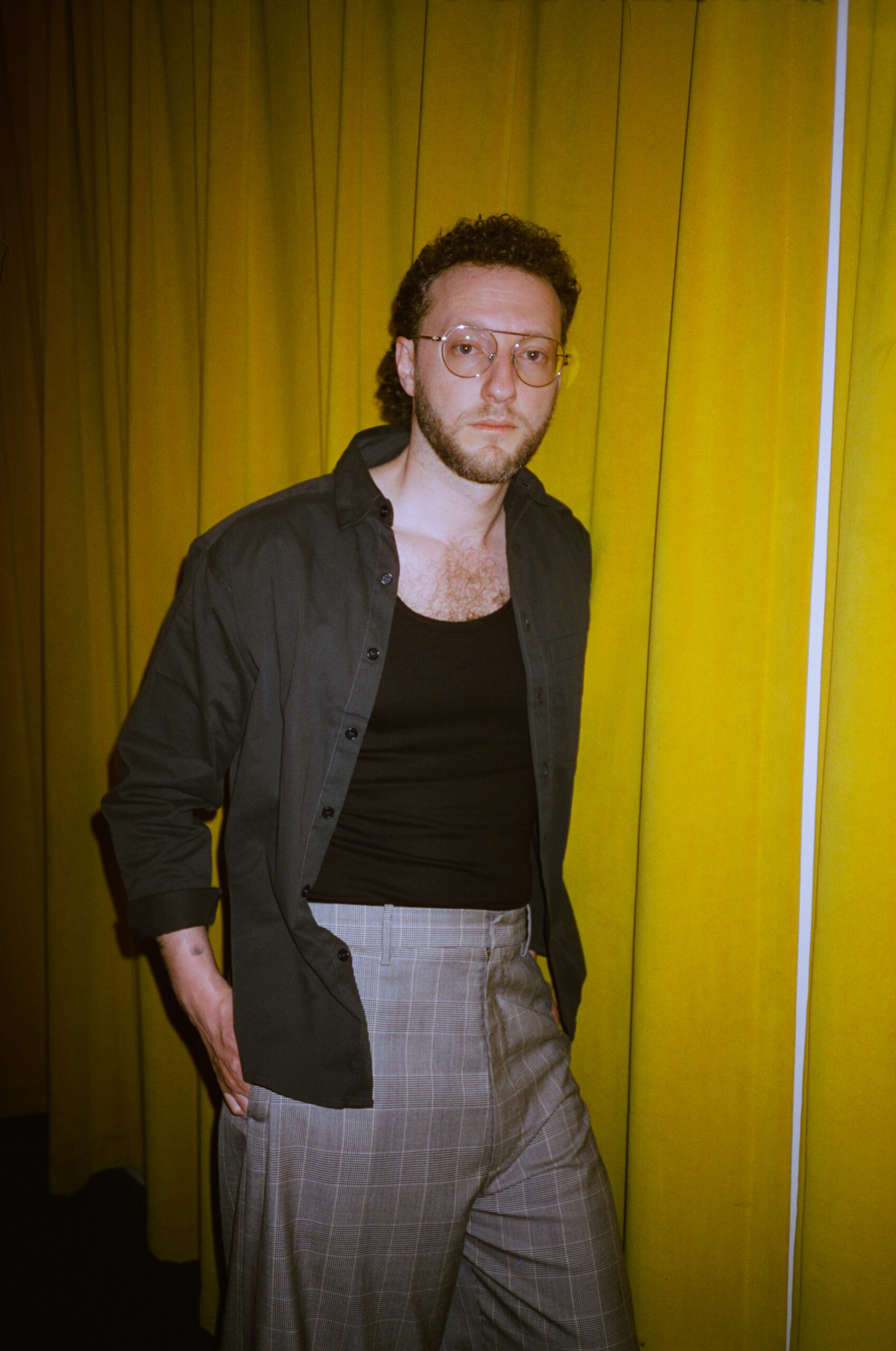
Daniel Goldhaber, photographed by Jason Lester.
Daniel Goldhaber and Isa Mazzei’s latest film, a meditation on modern censorship, has itself been repeatedly censored. It’s been a long road for the collaborators, who finished their new slasher, Faces of Death, two years ago, only to have it mysteriously pulled from SXSW just three days before its premiere. IFC eventually stepped in to shepherd it toward release, but the setbacks didn’t stop there: disputes with MPPC over whether the original content could be shown, posters flagged and pulled, trailers buried behind YouTube bans. It’s a bleakly comic run of obstacles, though when I met Goldhaber for coffee last week, he seemed more amused by the irony than anything.
After a prolonged limbo, Faces of Death has finally surfaced. Starring Barbie Ferreira, Dacre Montgomery, and Josie Totah, the film reimagines the infamous 1978 VHS snuff tape by the same name for a world governed by algorithms. What was once passed hand-to-hand in the basements of defiant teenagers is now ambiently available online, always within reach. The film, out in theaters this Friday, continues the duo’s taste for provocation, following the success and backlash of How To Blow Up a Pipeline. In conversation, Goldhaber and I dive into the attention economy, content moderation as a political choice, and assassinating our tech overlords.
———
EMILY SANDSTROM: Well, congratulations. How are you feeling?
DANIEL GOLDHABER: I’m feeling good. I mean, it’s been such a long road. It’s been seven years.
SANDSTROM: Tell me where this all began?
GOLDHABER: We got an email from our agent at CAA in 2019, saying, “Legendary has the remake rights to Faces of Death. Are you interested?” And Isa, who I made Cam with, and I wanted to continue working together. We’d sold a couple of other things on a small-scale level, but Faces was our first proper studio job.
SANDSTROM: Had you seen the movie before you were approached?
GOLDHABER: No, we hadn’t. We went back and watched it and realized we’d definitely seen clips of it online. There’s a brilliant exec at Legendary, John Silk, who had the idea alongside us that Faces of Death is now online, but really, it’s kind of everywhere. Thinking of it as exploitable IP is a pretty galaxy-brained, insane thing for a corporation to do. That’s something we tried to fold into the movie itself: essentially, a private equity mindset. Legendary saying, “There’s value to extract from this fake snuff film compilation from 1978 because of its name recognition.” From the beginning, we felt a successful version of the movie would leave the audience wondering if it should exist at all. It felt like thumbing our nose at the studio a bit, which ultimately caught up with us and made the film harder to release.
SANDSTROM: Yeah, tell me about the delays.
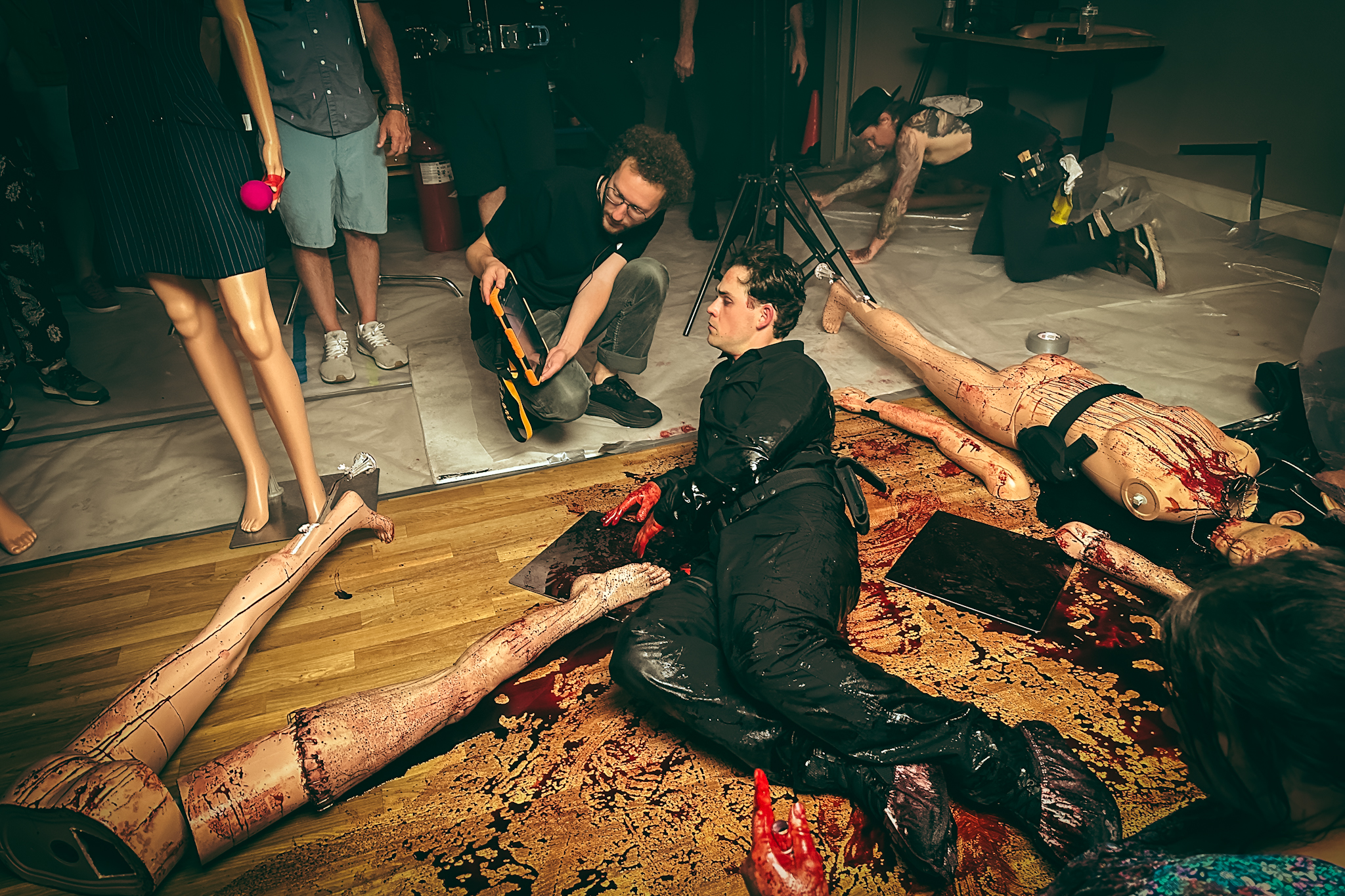
Photo by Isa Mazzei.
GOLDHABER: There’s only so much I can get into. It took about a year to get the studio to prove the casting in the movie. Then we shot the film and then edited the movie, but it was a challenging process because the strikes happened. We were two-thirds of the way through our production, and Isa was pulled off set, and so I had to do the last third without her, and also without the ability to write anything. Then we finally finished the film, and we were supposed to premiere at SXSW in 2024. And for reasons that I can’t get into, the film was pulled from the festival three days before the lineup was announced. Then it took two years for us to find a distributor. We had to fight very hard.
SANDSTROM: You’re making me feel conspiratorial.
GOLDHABER: I would say it was a problem of censorship and of corporate interference. I’ll leave it at that.
SANDSTROM: What happened next?
GOLDHABER: Eventually it was seen at IFC, and they were very passionate about it, but it took them some time. They fought really hard to be able to release this movie. And then finally we dropped our first teaser, and it immediately got banned from YouTube.
SANDSTROM: I saw you post about that, yeah.
GOLDHABER: Yeah, that wasn’t the marketing. It was annoying. It’s not trafficking on YouTube because they essentially put the movie behind a 17+ screen wall, which means it won’t embed on websites, for all of our marketing materials. We had our own censorship battles with the MPAA too. But the point is that we’ve had trouble marketing the movie, and our materials have gotten banned and taken down.
SANDSTROM: How do you feel about that?
GOLDHABER: On one hand, I think it’s an exciting narrative for the movie, since the movie’s about censorship. We also got into a censorship issue with the MPAA about the hammerhead scene, when Margo’s moderating. They forced us to cut a section where you see the scalp get peeled back and flopped out from the moderation sequence.
SANDSTROM: Yes, my hand was covering my eyes for that.
GOLDHABER: But like 15 minutes later in the movie, Charli [XCX] shows her phone that has the exact moment that they had forced us to cut from the moderation feed. I think ultimately what the MPAA did not care for is the fact that we’re placing the hypocrisy of moderation around violent imagery at the forefront. That’s what they forced us to cut down. But the actual material itself they had no problem with 10 minutes later in the film.
SANDSTROM: Super interesting.
Courtesy of Independent Film Company and Shudder.
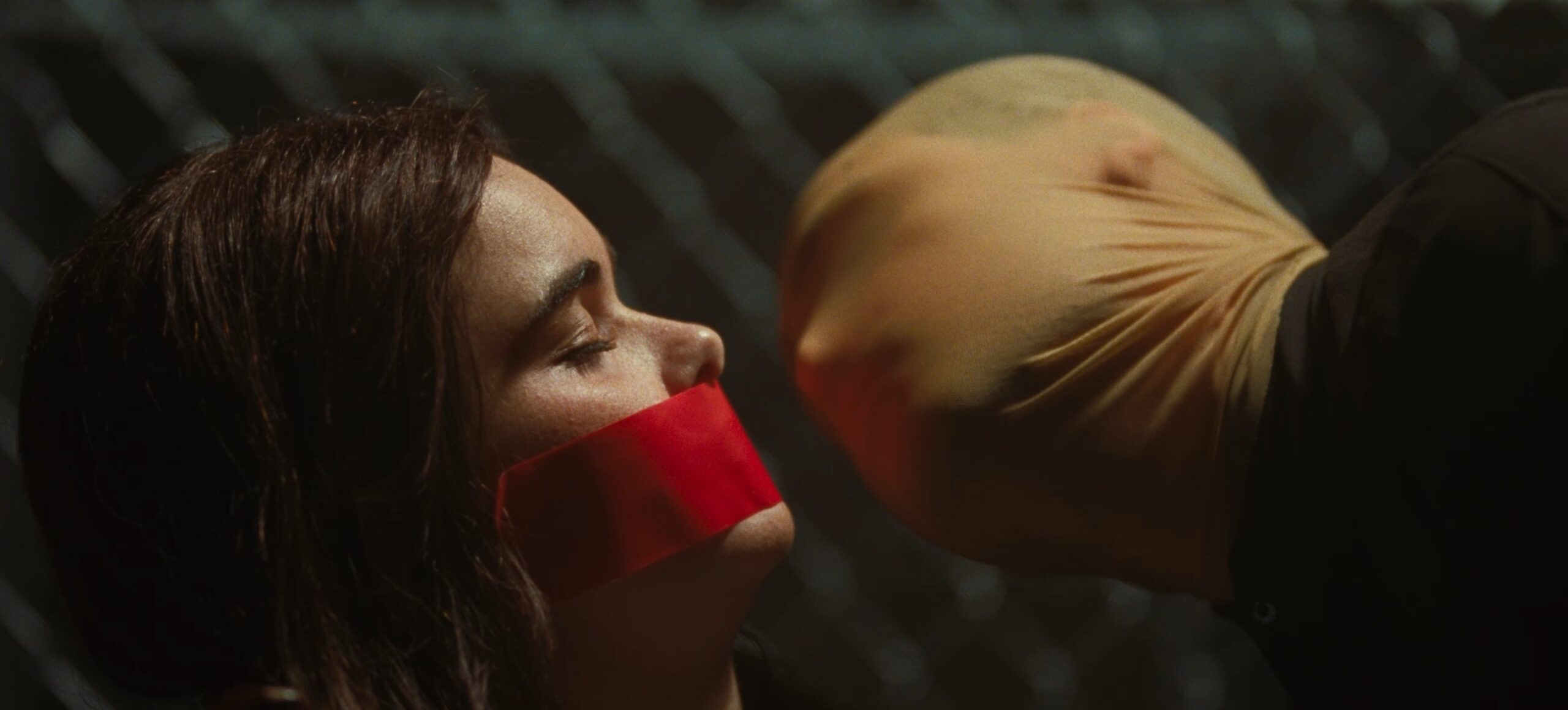
GOLDHABER: It’s the same thing with the posters they had banned. You have multiple posters out in theaters right now with heroines head to toe in blood. MPAA has no problem with that. But you have a poster that has an out-of-focus, bloody face in the background with a censored icon over it, then all of a sudden they’re taking issue.
SANDSTROM: It sounds like you’ve been on a journey. You also worked briefly as a content moderator yourself, right?
GOLDHABER: Yes, over a summer for a startup that my friends had.
SANDSTROM: What was that like?
GOLDHABER: It was really disturbing. Aside from the child pornography, it was all stuff that I had encountered on the internet at one point or another. Usually if you run into fucked up footage on the internet, you go looking for it. But to suddenly see it blasted at you, you start really thinking about who’s on the other side. Why are they posting this? The first two or three times I was monitoring the feed, I was really horrified. You get off work after doing it for four to six hours and you feel nauseous. I have friends now that work in moderation, and one of them saw Faces of Death and said that the most realistic aspect of the film is Margot’s dead-eyed stare. That’s an idea that we’re trying to communicate in the movie, how we all adjust so quickly. But the biggest inspiration I took away from working as a content moderator was simply thinking, this is a cool job for somebody to have who then runs into some sort of a mystery.
SANDSTROM: Right.
GOLDHABER: But there’s nothing that Margot sees when she’s moderating, outside of the pornography, that isn’t familiar to what we all see on our content feeds all the time. Moderation is, by and large, a smokescreen job. It can very quickly and easily become a vehicle by which these companies also enact censorship. You can even just literally see in the [Sam] Altman-[Mark] Zuckerberg case, Zuckerberg being like, “Don’t worry. We’ve got our team on taking down anybody trying to dox or target people working for DOGE,” which is kind of not really the point of these platforms. You should have every right to discuss the identities of people working for the government.
SANDSTROM: Right, it’s a political decision not to.
GOLDHABER: Yeah, it’s a political decision, and yet these human-run moderation divisions are also the exact people enacted to monitor undesirable speech on the apps, which the movie also talks about.
SANDSTROM: Do you feel detached from the film at all since it’s taken such a long time to come out?

Courtesy of Independent Film Company and Shudder.
GOLDHABER: It’s complicated. I thought I would maybe feel a little more detached than I do, but what the movie has to say is something that I still feel really passionate about. There’s also a lot of technical things about this movie that I’m extremely proud of. There are sequences in this film that I think are the best sequences I’ve ever made. And I got to shoot on 35-millimeter, and we’re exhibiting prints, and I’m getting a 2000-screen wide release. This is all awesome and I’m lucky to be able to make movies on this scale, but I also think that I have always believed in trying to make films that push forward the cultural conversation from a formal standpoint, from an aesthetic standpoint, from a thematic standpoint. I’m always trying to do something that’s new on every level. And now more than ever, there is a tremendous amount of resistance from the establishment towards any idea that is socially confrontational.
SANDSTROM: Do you feel like you’re meeting a lot of filmmakers that are willing to go against the grain in the same way? Or do you think there’s so much anxiety that people just want to get anything made at this point?
GOLDHABER: Most filmmakers I know are having difficulty getting the projects that they feel most excited about. Even when those are projects that have a strong commercial motor, there just are so few buyers. Distributing movies is really challenging. We want to get young people in the movie theaters. Ultimately, it needs to be young people, not just making the movies but running the studios, running the distribution companies, running the financing. You’d see a much stronger command of how to actually connect with young people.
SANDSTROM: Let’s talk about the film’s marketing.
GOLDHABER: I think the marketing has been really reflective of what the movie is. When marketing is at its best, it drives a participatory atmosphere in the target audience and in the culture. Being able to do that means being able to craft a narrative and an aesthetic, but it also is about understanding how to actually reach that audience. The core audience of this movie is people who saw this VHS tape when they were 15 in their best friend’s basement and were traumatized by it, and they’re a horror fan and want to revisit that experience 30, or 40 years later, right? It’s also a young audience. It is people who grew up seeing Barbie [Ferreira] and Dacre [Montgomery] and Josie [Totah] on their TV’s, that are now really excited to see them in a fucked up horror movie.
SANDSTROM: What were you thinking about when you were writing Margo [Barbie Ferreria] and Arthur [Dacre Montgomery]?
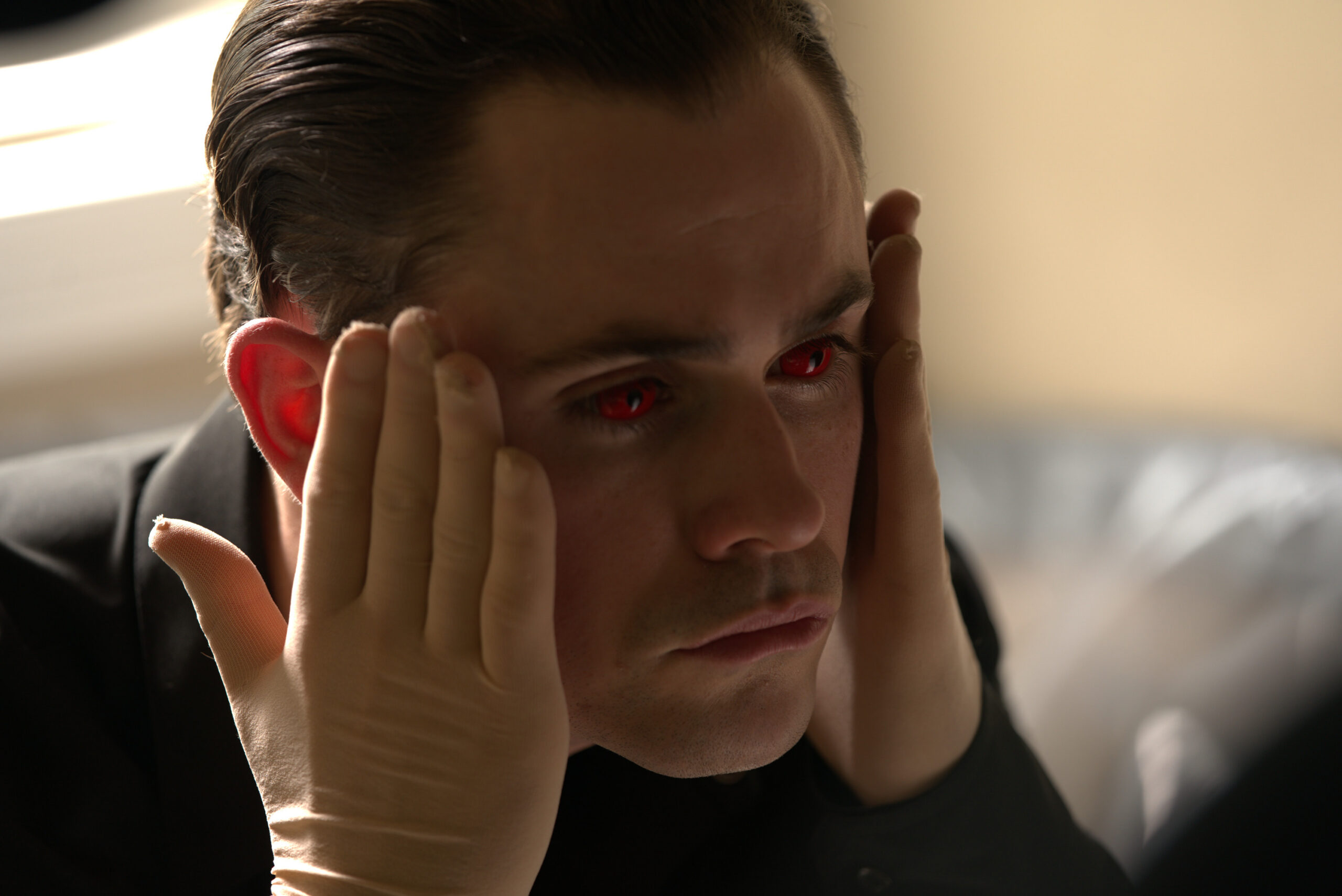
GOLDHABER: Margot and Arthur for us were always seen as two sides of the same coin: Somebody who’s fallen victim to the temptations of the internet and somebody who wants to exploit them. For Margo, it was really important to feel like there was a person in this role who was an authentic human being. She feels like just a young queer person with a shitty job living in New Orleans. And Barbie was so game that she just always wanted to look like shit. She was like, “This girl isn’t cool, she doesn’t go out.” She really wanted to live that role and inhabit it to the fullest.
SANDSTROM: Right.
GOLDHABER: When you look at the circumstances of a lot of places in America–the social alienation, the economic disenfranchisement combined with like our gun laws, these explosive acts of violence become almost inevitable. And when it comes to Arthur, you have something that springs from a very similar source. I really want people to be looking at his surroundings. This house that he lives in, his neighborhood. He claims his parents have recently died, and everything he owns is something that he ordered from the internet. He wants attention for what reason? Because this is somebody who’s actually never been able to connect with anybody in his life.
Courtesy of Independent Film Company and Shudder.
SANDSTROM: So you’re really looking at him as a product of his geography.
GOLDHABER: Exactly. Faces of Death was also a meditation on how the American suburbs mediates the intersection of violence and alienation.
SANDSTROM: Some of those shots of the suburbs are just jarring at the end. They’re very difficult and uncanny.
GOLDHABER: Right. Then there’s also, he’s got a Hitler painting up in his house.
SANDSTROM: Right. And he looks a little… He looks a little …
GOLDHABER: He looks a little fasc.
SANDSTROM: Yeah. He looks a little fasc.
GOLDHABER: And that was all on purpose.
SANDSTROM: Do you find conversations about the attention economy generally interesting?
GOLDHABER: I do. I mean, it’s the number one thing that’s motivating Arthur, right? A huge swath of our company has decided that we place a premium on the value of people’s attention. That’s one of the last scarce resources capitalism can still exploit to create corporate value. And one of the greatest ways to get lots of attention very quickly is by committing an act of mass violence. So we have set the economic principle that committing an act of mass violence means that you have increased value as a person.
SANDSTROM: What did you think about the recent Meta case?
GOLDHABER: It’s a travesty that they were fined six million dollars. I think that’s insane.
SANDSTROM: Tell me more.
Photo by Adam Hendricks.
GOLDHABER: I mean, it’s great that there was a little bit of a legal precedent established to say that these algorithms are damaging, but the problem is that went hand in hand with a six million dollar fine. On some level, the message is being sent that this is acceptable. The number of people that that behavior reaches, it should be a fine in the tens or hundreds of billions. A six million dollar fine is barely a rounding error. It’s an insignificant amount of money.
SANDSTROM: Yeah. I would at the least love to see some money used to go back into schools.
GOLDHABER: These people should be in prison.
SANDSTROM: You feel that way?
GOLDHABER: [Laughs] 100%. I do believe in the carceral system for the people that run social media companies. We pretend that the algorithm is just some machine thing that has a mind of its own that we have no control over. The algorithm is fed incentives. We tell it what to do. We tell it what matters. We tell it how it makes money. These are human inputs that make these decisions. You could decide that the most important thing is not keeping people on their phones 24/7. When you look at all the science on how devastating social media is—for brains, for culture, and even people’s ability to pursue life, liberty, and happiness—it’s hard not to see it as one of the greatest disruptions and destructions of human life in history.
SANDSTROM: What’s next for you?
GOLDHABER: What I’m most passionate about is showing people what they haven’t seen before—how so much media and systemic design is built to obfuscate the ways our world is slowly eating away at us, disempowering us, driving us apart, and destroying the environment. We’re made to feel powerless. I’m interested in exposing those systems. Not in a didactic way, but in an emotional, immersive, cinematic, and deeply human way that gives people a sense that there’s something they can do about it. I also have a film with Regency on the horizon. It’s a lovers-on-the-run story, but with a fresh take.