


IN CONVERSATION
Jennette McCurdy Tells Sofia Coppola How She Reinvented The Age Gap Novel


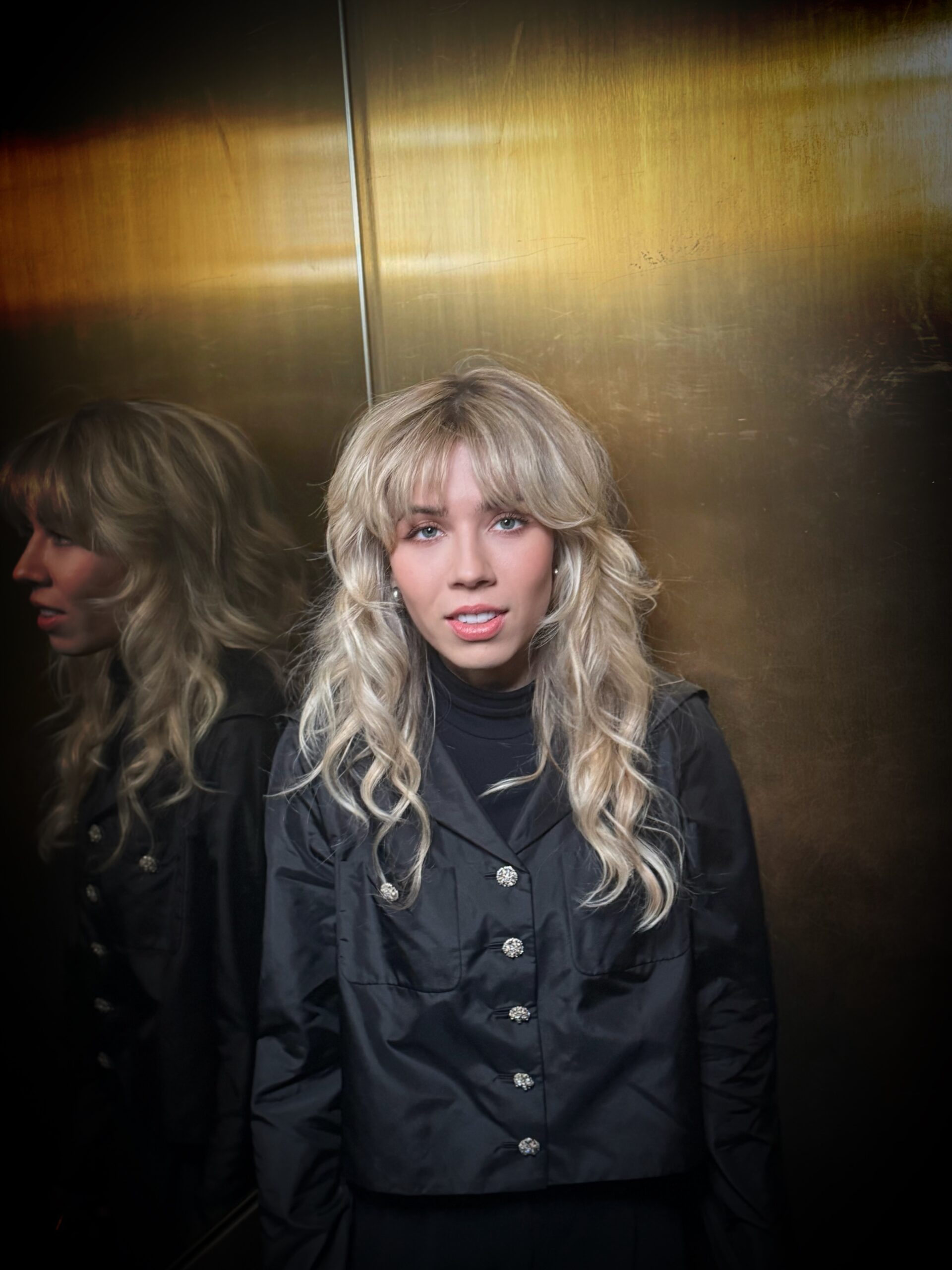
Photo courtesy of Jennette McCurdy.
Jennette McCurdy, the iCarly actor turned best-selling memoirist, is still processing her formative years. Four years ago, her explosive debut I’m Glad My Mom Died gave readers a no-holds-barred glimpse into the dark underbelly of teen stardom, made more traumatic by McCurdy’s abusive stage mother. As she began writing her follow-up, she found herself parsing through other unsavory aspects of her past, leading to her fiction debut Half His Age, out this month with Penguin Random House. The novel, drawing partly from a relationship McCurdy experienced at the age of 18 with a man more than a decade older than her, follows the ever-impulsive and oh-so-naive Waldo, who enters into an all-consuming tryst with her creative writing teacher, Mr. Korgy. It’s a story we’ve heard before—the tortured age-gap romance—but McCurdy is flipping the trope on its head while returning power (and perspective) to her protagonist. Enter Sofia Coppola, who knows a thing or two about representing girlhood in her work. After discovering McCurdy’s books through her own daughter, Romy Mars, the Academy-award winning director wanted to hear from the author herself. With Coppola in New York and McCurdy on a nationwide book tour, the two hopped on a Zoom call last week to reflect on writing rituals, the Lolita effect, and the real-life man who inspired the novel’s villain.—ARY RUSSELL
———
SOFIA COPPOLA: Hi, Jennette. I’m so glad to see you and talk to you.
JENNETTE MCCURDY: Sofia, I’m so honored. I’ve been looking forward to this from the moment it was set. I couldn’t be more excited.
COPPOLA: My daughter sent me a picture of your book and that’s how I found out that you had a new book out.
MCCURDY: People have been asking what the jump was for memoir to fiction. I’ve written a lot more fiction in my life and started out writing screenplays, so it might be surprising to the outside world, but it wasn’t surprising for me.
COPPOLA: Oh, wow. But you’ve never written a novel before, right? This is your first?
MCCURDY: This is my first published novel. I was working on a different novel, and then Half His Age was just… I couldn’t stop thinking about it. It’s told from the point of view of this 17-year-old girl, Waldo, and her voice was so in my head. So I just said, “I’m going to put this other novel aside for a week,” assuming that I would exhaust myself on it and—
COPPOLA: Get it out of your system.
MCCURDY: Yeah, exactly. Then, instead, 30 days later I had a first draft.
COPPOLA: No way.
MCCURDY: And now it’s two years and almost 20 drafts later and this is the one that’s come out.
COPPOLA: Oh, I love when that happens. I can totally relate because I was working on a script that I’m supposed to be doing and then this other thing just kept nagging at me and I was like, “I’m not going to do that. That’s stupid.” But then I couldn’t help it and before I knew it, I was wrapped in. I mean, you can’t ignore that when you’re being drawn to something.
MCCURDY: That’s exactly it.
COPPOLA: My friend Tamara Jenkins, who’s a filmmaker, we always talk about how this process is so hard, writing and then making something and why do we do this? And then I just remember one time being nagged by an idea and I’m like, “Oh, that’s why we do it, because we have to.”
MCCURDY: It’s so well-said. But do you ever look back on something after you’ve finished writing it? And then you can analyze it in a different way where you can say, “Oh, maybe this is why that came out then.”
COPPOLA: Yeah, totally. I want to ask you that because I never go into things knowing what I’m doing. But in this case, was that character familiar? Was this a story that you always were interested in telling?
MCCURDY: I’d had the seed of the idea, really just a little bit of the protagonist’s voice. And then when I was 24 on a bullet train in Japan, I remember just knowing it was going to be a novel. That’s the piece that was weird to me, because I had never written a novel. I had only written things in many other formats, so I have no idea why I knew it was going to be a novel, but I knew that.
COPPOLA: And why is her name Waldo, just the name just came to you?
MCCURDY: She was always Waldo, but then I tried to change it at one point. I was like, “Maybe that’s too weird.” But I’m a really physical writer, where I can try my hardest to take a note but if it doesn’t feel right, my body freezes.
COPPOLA: That’s lucky.
MCCURDY: You think?
COPPOLA: Yeah, because it’s your intuition guiding you, it sounds like. It’s only you that listens to it.
MCCURDY: For a long time, I really felt frustrated by it like, “I wish I could feel things less intensely.” I’m only starting to really feel grateful for it.
COPPOLA: To me, it sounds like a superpower and gift.
MCCURDY: I’ll take it. And I know this is territory that’s been explored before, but I really hadn’t felt that so much from the point of view of a 17-year-old. It’s not at all focused on the taboo itself. It’s really more focused on—
COPPOLA: The experience.
MCCURDY: Exactly—the interiority and the psychological examination of the young woman experiencing it and all the contributing factors that led her to enter into that kind of relationship in the first place.
COPPOLA: I grew up with Lolita being this important book so I think it’s so interesting to be in the head of the girl and her experience. It’s such a heightened moment because you’re just discovering yourself and receiving that kind of attention, and to look at it without being judgmental of the situation…
MCCURDY: I try to avoid judgment. I try to avoid being moralistic or finger-waggy. There’s no surer way to turn off an audience. It’s something I so respect and admire about your work—how it’s just so rooted in observation, with no judgment at all. It ends up having more meaning because we’re drawing from our own experiences and applying ourselves to what we’re seeing. It leads to much more interesting conversations.
COPPOLA: Oh, I’m so glad. Yeah, I try to let people decide on their own and put it all out there in a some seer way. But of course, the gossipy side of me is just curious how growing up working with older men, being around that environment and seeing that, if that has any relation to this or not.
MCCURDY: It goes back to what we were talking about, how you look back on something after you’ve written it and you go, “Why did this one come out?” So a couple drafts in, I was looking back over it and going, “Why did this happen?” And it’s because I had a lot of unprocessed anger around experiences from my past, and writing is a way of finding closure and processing emotions that I haven’t fully.
COPPOLA: That’s why I was so impressed by your memoir because it was so personal and honest, but so well-written and funny and touching. Just the fact that you could take something so horrific, something that would break someone, and turn it into art—it must have been a cathartic experience. But I wonder, was the guy character based on anyone in particular?
MCCURDY: He’s an amalgamation of various people from my own past. His name’s Mr. Korgy. He really took on a life of his own. Because the book’s all told through Waldo’s point of view, I would feel so much anger toward him and feel like I wanted to defend Waldo. Ultimately I’d try to put myself in his point of view and build out his world and try to feel what it’s like to be Mr. Korgy, this man with so many regrets and his failed dreams and his sad life. It was tough, but it had to be done because nobody thinks they’re a bad guy. And it feels like the only way to write truthfully is to really put yourself in the shoes of each character and give them a point of view that is grounded.
COPPOLA: I felt like that when I worked on Priscilla. She’s young and with this guy and I was trying to understand while talking to Priscilla [Presley] her point of view, how she saw it. I really tried to be in her point of view as opposed to my point of view as an adult with daughters. Did you read Megan Nolan’s book Acts of Desperation?
MCCURDY: Somebody literally recommended this to me yesterday.
COPPOLA: I really like that book because it’s like a car wreck of a younger girl into this guy that’s a disaster, but it’s so relatable. It’s so universal. And if my daughter or a young person’s talking about a guy treating them in a hot and cold way, you’re just like, “Oh, don’t waste your time.” But when you’re younger you’re like, “I’m going to make him love me.” I was listening to a podcast about Lolita. It’s called Lolita Diaries, have you heard of it?
MCCURDY: I haven’t, no.
COPPOLA: I love that movie, the [Stanley] Kubrick film. It’s so well-made. And I remember being into the book when I was 15. I thought she was so powerful, that she had the upper hand. Looking at it now, it’s so different, but I had no idea at the time how dark it really was. The movie has so much style that it treats it differently.
MCCURDY: Also, to read Lolita at 15…
COPPOLA: Yeah. [Laughs] Did you go to school? Were you homeschooled?
MCCURDY: I was homeschooled my whole life. I’ve never gone to a public school.
COPPOLA: Oh, wow.
MCCURDY: Did you go to–
COPPOLA: I went to regular school. [Coppola gets a FaceTime from her daughter, Romy Mars] My daughter’s calling. I’m telling her I’m on with you, she’ll be excited.
MCCURDY: Tell her I say hi.
COPPOLA: That’s Romy.
MCCURDY: Hi, Romy. I can’t hear you.
COPPOLA: She says she’s a big fan.
MCCURDY: Oh, thank you so much.
ROMY MARS: Just tell her I love her book, tell her I love her.
COPPOLA: I have to go because we’re doing an interview. I’ll call you back.
MCCURDY: Oh, thank you. That’s so nice.
COPPOLA: So you’re on a book tour. Are you doing talks in theaters?
MCCURDY: Yeah.
COPPOLA: With a moderator or just talking with the book?
MCCURDY: Some really cool people are moderating. Gillian Flynn is moderating tomorrow.
COPPOLA: Oh, wow.
MCCURDY: Lena Dunham moderated in Town Hall.
COPPOLA: That’s so cool. I’m curious about any favorite books or ones that inspired you or?
MCCURDY: I love Ottessa Moshfegh a lot also. I loved Three Women by Lisa Taddeo.
COPPOLA: Oh, yeah. That was rough.
MCCURDY: Yeah.
COPPOLA: But it sounds like this book isn’t really inspired by another book. It just came to you.
MCCURDY: Yeah. I mean, there’s a lot in the age gap story, but I really don’t think of this as that kind of story. And that’s what I was trying to say: can there be this noisy area of an age gap relationship while we’re actually staying close to Waldo’s point of view and not concerning ourselves with the taboo?
COPPOLA: It’s so interesting that you really stay with her because it seems so hard to do without looking at it from the outside. Because I remember someone told me that [Vladimir] Nabokov, when he wrote Lolita, he was writing to be shocking of how wrong it was, but that people took it the wrong way because he was in the point of view of the character. When I did Marie Antoinette, I was trying to show that she was out of touch with reality. But just because you’re in the point of view of a character doesn’t mean that the person making it is condoning it.
MCCURDY: In the first episode of Girls, Lena Dunham’s character says, “I’m the voice of a generation.” And people were saying, “Oh, how conceited. How can you think that about yourself?” And I was just laughing and saying, “How can people be misreading what the point is?” But who do you feel like gets your work? Who are the people who see it as intended?
COPPOLA: Oh, I feel understood. I found my people. But when I was younger, maybe it took a little while. But young people get what I’m trying to say now.
MCCURDY: Totally.
COPPOLA: Wait, I don’t want to pry, but did you have a relationship with an older guy when you were young?
MCCURDY: I did, actually. My first relationship, I was 18 and he was in his 30s.
COPPOLA: That was your first experience?
MCCURDY: That was my first experience. And yeah, as a Mormon virgin, I literally did not know what cum was. [Laughs] So naive.
COPPOLA: Oh, wow.
MCCURDY: So sheltered, and then just thrust into the deep end.
COPPOLA: With an adult. Did that inform some of the stories?
MCCURDY: It was definitely the seed, and also that thing where I mentioned having unprocessed anger. I’m 33 and it’s so strange to me. “How could I have not processed that?” But I think I was processing other things.
COPPOLA: Do you have a ritual around writing?
MCCURDY: Yeah, I have for almost 10 years now. I had it way before the memoir came out, when I was just writing into a void and nobody would read anything.
COPPOLA: Wow.
MCCURDY: It was lonely for a while, but I do think it was really important that nobody cared because that really helped me to be–
COPPOLA: Free.
MCCURDY: Yeah, exactly. I write six days a week. It’s always the first thing I do when I wake up. I make coffee and change and then just start writing. I don’t feel like I can move on with my day until I’ve written. Do you feel that?
COPPOLA: No, I’ve actually just started this week writing in the morning. Before I had kids, I would just stay up all night writing. I like to write at night because it feels like there’s no distraction. It didn’t feel like work to me. It felt like private time where I could just do whatever I wanted. But I just recently started doing the morning pages from The Artist’s Way.
MCCURDY: Of course.
COPPOLA: I remember that was really popular in the 90s and I don’t know how I ended up with a copy of that. Do you ever do that?
MCCURDY: I’ve done the book three times.
COPPOLA: Oh, really? I’ve only done the first chapter. Do you have a first person that you trust the most to read that won’t try to make it into their version, that gets what you’re trying to do?
MCCURDY: Yeah. My partner, we’ve been together nine years. He writes as well, but for screenplays and television more so. We’re each other’s first readers.
COPPOLA: Oh, that’s so important.
MCCURDY: I find it so helpful because he has a really different point of view than I do, but we have enough crossover and we care about similar themes and he knows my voice. He can see it and go, “Oh, this is the potential of what it could be,” instead of noting whatever it is that’s on the page at the time.
COPPOLA: And where does your story take place? Is it in the past?
MCCURDY: It’s modern day, but it’s in Anchorage, Alaska.
COPPOLA: Did you go there to research?
MCCURDY: Well, my significant other is from Anchorage, so I’ve probably spent more than six months there altogether.
COPPOLA: Oh, wow.
MCCURDY: It’s both as beautiful as it looks and then so much sadder than it looks. They’ve got these big wide streets and everything’s 25 years outdated. The mall’s 90% closed down. There’s three stores still open.
COPPOLA: So it has an isolating bleakness?
MCCURDY: But it’s so cinematic, more so for its ugliness than the parts that are beautiful.
COPPOLA: Stark.
MCCURDY: Yeah, and vacant.
COPPOLA: I can’t wait to read it. It’s so fun to talk to you. Congratulations.
MCCURDY: Thank you, Sofia.