



TWISTED
In Permanence, Sophie Mackintosh Turns Adultery Into a Perfect Illusion


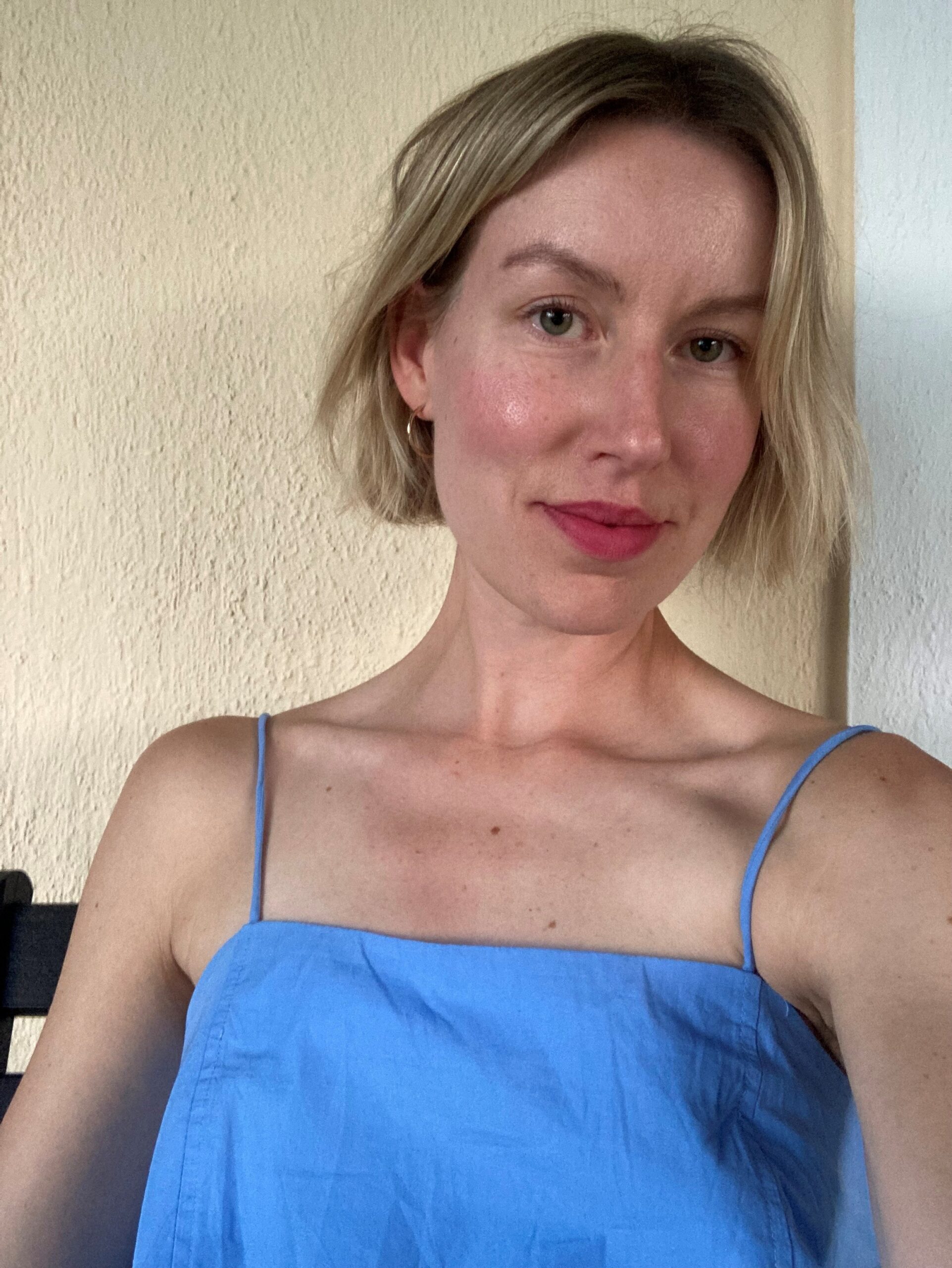
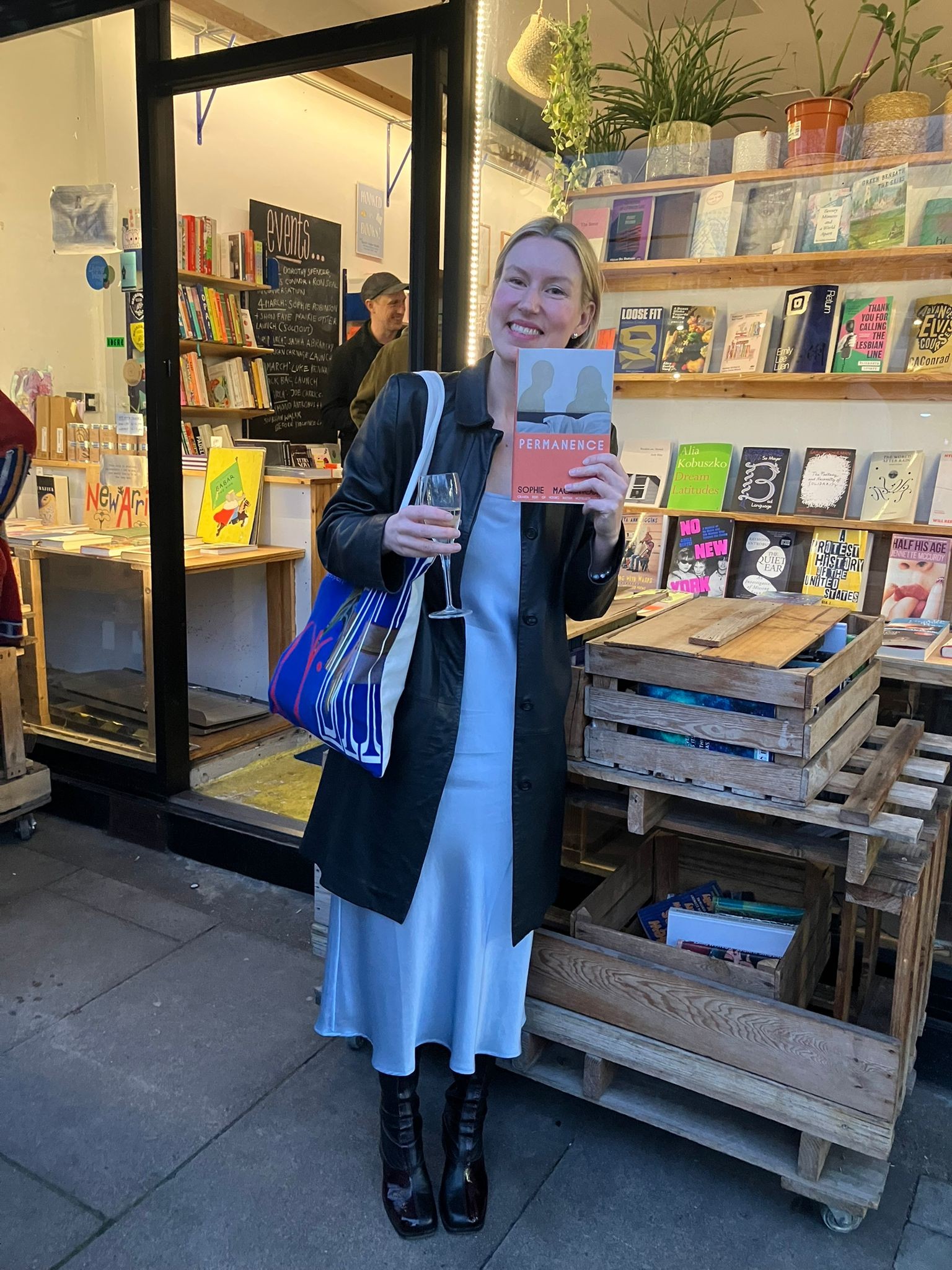
All photo courtesy of Sophie Mackintosh.
Sophie Mackintosh’s new novel Permanence presents an alternate world in which a pair of lovers wake up beside each other in a perfect apartment. Outside, it’s perfect weather in a perfect city full of perfect restaurants and perfect gardens where perfect people having affairs can be together without secrecy or consequence. The dream curdles, as all dreams must. But the story is wonderfully uncynical in its depiction of the minutiae and complexity of the truly grand romance at its core. Mackintosh’s books are miracles of insight about love, deception, delusion, and fantasy. The realities we create because we need them. When I called Sophie from New York she was a world away, visiting family in Melbourne, Australia. Between her 7am and my 5pm we talked about whether desire requires unavailability (no), obsessive devotion (hot), and monogamy and dystopia (not the same thing). Is love forever? Not in this life. But maybe in another.
———
SOPHIE MACKINTOSH: Hi.
ELVIA WILK: Hi, how’s it going?
MACKINTOSH: Good. How are you?
WILK: I’m good. I’m glad we’re having this conversation. This is a great excuse to talk.
MACKINTOSH: Yeah. Thank you so much for doing this. It’s actually the first interview I’ve done for Permanence, so I’m sorry if I’m nervous.
WILK: I love that I’m the first. I’m sure everyone will want to talk to you about it. What was happening in your life when you wrote this very romantic book? You don’t have to say whether you were in love with a person, but it feels like you were in love with the book while you were writing it.
MACKINTOSH: Writing it was a strange experience because it took me a long time. There was a big gap between the first draft and the last draft, and both were really intense processes. Then there was a whole bit in the middle where my life was sort of imploding. I was writing it post-pandemic, and my life had changed quite a lot and everything was reshuffling. I was finding a new place to live, and I was dating and falling in love, and I was having many thoughts about how it felt to be in love and the kind of love that I was looking for. But yeah, I was very much in love with the book. I was happy that it was finally coming together after this idea orbiting my mind for so long. I was feeling almost like a monk or something, but in a very pure way. It’s hard to find words to talk about this book without overusing the word devotion.
WILK: That was my experience reading the book. It’s about two people entirely devoted to each other, and I felt devoted to their love story too. I really cared about them. There are a few peripheral characters, but mainly it’s just Clara and Francis. How did you pare it down so far?
MACKINTOSH: The kernel of the novel arrived as a clean idea of the two worlds. At first I struggled with the simplicity of the idea. There was a point in writing where I was like, “Actually there’s not enough for it to be a love story. It needs to be grander, or it needs to say something bigger somehow.” There’s a subplot that was discarded about a conspiracy and a secret society… There were a lot of strange threads that just didn’t quite cohere. I was trying to cram more things into the simple premise because it didn’t feel like enough.
WILK: I mean, it’s deceptively simple. The pared-down structure is really elegant, and it’s what allows you to do develop their complicated relationship. It has a symmetrical structure, flipping back and forth between the character’s perspectives. The seeming cleanness of that is what allows the slow degradation to become so effective. The premise that there’s another world for lovers to go to where they can finally be together, but then this alternate reality is potentially a nightmare. Is that because what makes an affair hot is the secrecy—or that without charge of impossibility there’s no way to create erotic friction? Do you think desire requires unavailability?
MACKINTOSH: I actually don’t think that. In this central relationship between the two people, the unavailability isn’t necessarily what stokes their relationship. Actually they might have had a really happy relationship if they’d got together under dramatically different circumstances. And what drives them apart, I guess, are the same hurts that we inflict on each other in any relationship, but which are obviously so magnified in a relationship with this level of stakes and with this level of artificiality. It’s only when they have room to really think about what the relationship has cost them, the damage that has been caused that can’t be undone, that it comes apart. Suddenly they’ve been given everything, but it feels like it’s too little too late. So it’s not a cautionary tale of how once someone is available, they lose their shine.
There’s also that quality of love that comes from being with someone every day. That idea of a domestic eroticism was important to me, because I think that can be so beautiful in a long-term relationship, where getting to know someone and whatever they do that’s boring or even gross can just be totally enrapturing.
WILK: I think about that a lot. Early in my relationship with my husband, we talked about whether the “having” or the “getting” was more exciting.
MACKINTOSH: I love that idea of having and getting. And there’s always something you’re trying to get, I think. Or is there ever a point where we’ve got everything that we want?
WILK: If so, that’s not ideal. You’d have to leave. It’s a paradox.
MACKINTOSH: Yeah.
WILK: I guess thinking about domesticity, I wanted to ask you about this magic apartment in the city of impermanence where they wake up one morning, on the other side of the membrane between the worlds. There’s an eerie sense that cause and effect are kind of scrambled in that apartment and in the city overall. Like sometimes the place is manifesting their desires or their crises or their fears—things will start cracking and the weather will dim, and this idyllic world becomes a sinister reflection of their relationship status.
MACKINTOSH: The mechanics are fully fluid, but I was thinking of the city of impermanence as this kind of testing space and rehearsal space, something that is putting them through the paces. Almost like, “Okay, see, this is what you’ve wanted. Can you put up with this? Do you still want to be together?” And often throughout the book, the answer is yes. It’s a shame when it starts crumbling around them, but it’s not necessarily stopping them.
WILK: Not a deal breaker.
MACKINTOSH: Yeah, it’s not a deal breaker. But when the harm they’ve inflicted on each other manifests in the city, maybe they can’t outrun it. It’s hard to separate the way they feel about the city and the way they feel about each other. Obviously it’s a metaphor for their relationship, but I think the situation is slightly more complicated and more enmeshed than the city just being a receptacle or a reflection of their mental state. One of the times the city is at its best is when they’re not feeling so good about the relationship. I’m trying to figure out a way to speak without spoilers…
WILK: No spoilers. One thing that I was just thinking about is how hard it is to write a love story that’s both universal and specific. I mean, the pain and the wonder of being in love is that it’s the most special thing and the most normal thing at the same time. How do you write a love story that doesn’t just become fluff?
MACKINTOSH: Yeah, maybe it needs a kind of edge of unhappiness. I’m interested in ordinary love, but I think there’s something about writing a story of an affair that feels like the high drama I need to keep me invested. There’s betrayal and there’s heightened emotion, as well as those quieter moments. Even if someone is reading it who’s never entertained the idea of adultery, everyone can relate to that heightened feeling, that yearning, that wanting someone who is not so available or receptive. Beyond a certain point, loving someone in that way stops being a love story between two people and becomes more about one person projecting onto the other, or one person’s relationship with themselves, or one person’s idea of love that isn’t an actual love. And now I’m sounding really cynical.
WILK: I didn’t really think about this as an “affair book” until I finished it. The magical scenario kept me from thinking of it in those terms. Were you reading a lot of affair books when you wrote it?
MACKINTOSH: Well, when I started writing it, I said that I was interested in writing a love—well, an affair story that was also a love story, one that was not about moralizing, one that had no lesson in it, one that was grand and about the beauty of the affair, that site of enclosed love. I was reading Annie Ernaux’s Simple Passion, and also Getting Lost, the diary she wrote to accompany it, and being struck by how the diaries are so repetitive. There’s so much visible pain in those pages. And I remember feeling drawn to affair books a lot afterwards. I read The End of the Affair by Graham Greene after I handed in one of the final drafts to my editors. Have you read it?
WILK: I haven’t!
MACKINTOSH: It’s so crazy. It went in a very religious direction that I wasn’t expecting. It went from being an adultery book into a Catholic book about faith.
WILK: I do think you got as close to writing a non-moralizing book about an affair as humanly possible. At one point I realized, oh, if this guy Francis were in a different book, he might just seem like a bad man. He’s married and cheating on his wife. He won’t leave his family but insists he’s not being duplicitous with Clara because he’s being honest about not wanting to leave them… I typically would not like this man at all. But I sympathized with him. How did you write him in a way that didn’t make me hate or dismiss him?
MACKINTOSH: I think just attempting to have compassion for both of them. I didn’t want it to be that he’s terrible and Clara is at his whims. I mean, she is dictated by the fact that he won’t leave his family, but also—it’s hard to leave a family. They’re both characters under huge amounts of pressure, who have lives that they’re trying to fit the other person into. For Clara, it’s easier in a way, because she’s going through a lot of pain in the relationship, but she doesn’t have to try to undo the structures that Francis is within. You can possess that complexity, you can actually love two people and it can be distressing. There’s no right or wrong way to go. I really didn’t want people to read him and be like, “This is just a bad man.” They’re both very in love with each other. Clara might have to propel things, but when someone loves you with that strong of a feeling, how do you turn that down? They’re caught up in something that they can’t understand or easily break free from.
WILK: It’s interesting because their relationship is set up along traditional vectors of power, where the man has a family and maybe more security in his life, more of a social context, and the woman is more of a free agent and more precarious. But what you do is create and show many more vectors of power that are less about the macrostructure and more about what actually happens between people, which is that the power flips a lot.
MACKINTOSH: Yeah, she has freedom and he has less freedom, but the way they feel about each other fluctuates. There are points where Francis thinks, “Oh, possibly I love her more than she loves me right now.” And as a person used to being the person in power, where does that leave him? In the city of impermanence, they have to attend to these little movements and these shifts that we’re not always aware of. You never really know what the other person’s thinking or how much percent they love you today compared to yesterday—in any relationship, not just romantic. The way we feel about each other is rarely unconditional. It’s always contingent on things that are out of our control or that we don’t even think about.
WILK: In that sense, I’m curious about how you thought about the monogamous couples in the city of impermanence. I feel like it would’ve been unbelievably complicated to write a polyamorous city of impermanence. But I don’t think everyone there is having a monogamy-style affair. Maybe people there start having affairs with each other… you could just spiral out.
MACKINTOSH: I wouldn’t say they’re all in monogamous relationships there, but it would’ve been too messy to be like, “Well, this is one relationship, an example of how it works, and this is another relationship, an example of how it’s working.” But people have different ways of relating to the city. Clara and Francis meet another couple, Aiden and Lily, who seem quite happy to be in the city. They reconcile themselves—they have a family in one place and then they get to be together in this city and they’re fine with that. And then you have other couples who don’t want to go back to the real world at all, the devotees who just only want to be with each other and go to great pains to not leave the city.
WILK: I know people have called your other books fairytales or fables or speculative fiction. What is your current feeling on genre labels after having written a bunch of books that could be called speculative?
MACKINTOSH: I’m fine with it. I know we have to categorize books. I’ve always thought of my books as existing in parallel universes. My second book Blue Ticket was the one that feels most like it could be a dystopia, but I didn’t really see it as a dystopia. It’s a parallel world. And thinking to myself about this idea of parallel worlds as opposed to future worlds, I found the idea very freeing that it doesn’t have to adhere to tropes of the future, but it can just have more fantastical elements. Permanence is the novel where I’ve leaned into this idea most. I think totally divorcing it from the idea of the future and making it more of a magical realism speculative thing gave me a lot more freedom in writing. I think it sets readers free a little bit as well.
In some ways, I was a bit like, “Is my imagination so puny that the idea of a dream-paradise- afterlife is a parallel universe for lovers?” I just want to walk around a beautiful city and be in a hotel room and have little drinks and go for really great meals and walk around art galleries.
WILK: I also want that, yeah, unfortunately.
MACKINTOSH: Going back to your first question, the process of being in love with the book and writing it was great. It was a confident experience. I got to think: What would I love to be doing all the time? How do I create a world for these two which is just a world of bliss, at least at the beginning? It’s fun. It’s like playing with them.
WILK: It’s so generous.
MACKINTOSH: And then just smashing it all to pieces.
WILK: But they do have a pretty good situation for a while. I’m still happy for them. And I’m glad I got to experience that.