


Kristen Stewart


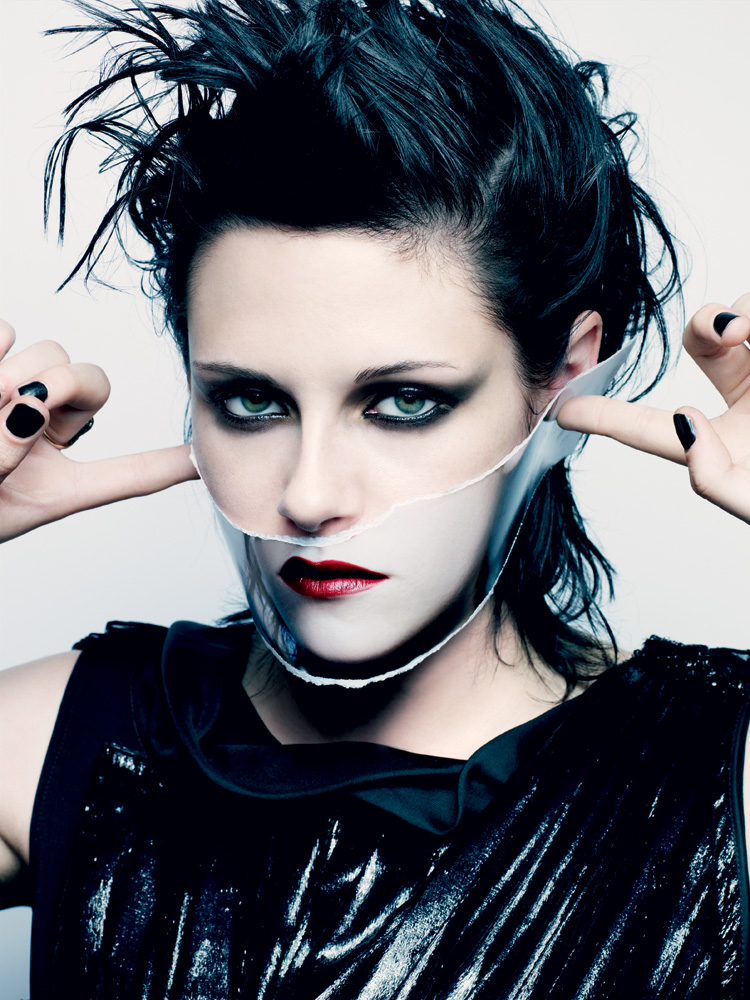
The first decade of the 21st century, which is about to draw to a close, is in serious danger of being remembered as the time when fame was measured in pokes, tweets, and the ability to parlay a death-defying (and sometimes not so death-defying) degree of persona recklessness into a reality-television deal. But just as the door was about to slam shut on the double aughts, in walks—or, more appropriately, saunters—Kristen Stewart.
At 19, Stewart has already earned a place in the annals of pop-culture history. This is due to her starring role in Twilight, which—in case you’ve somehow managed to elude word of its all-encompassing death grip on young America—is a film based on the first in a series of very popular books about vampires, werewolves, and teenage life in the town of Forks, Washington. Stewart’s character, Bella Swan, is a newcomer to Forks who is forced to cope with the dueling pressures of starting life at a new school and the fact that her prospective boyfriend, the rakish Edward Cullen (played by the rakish Robert Pattinson), is a 104-year-old undead bloodsucker.
Given Twilight’s preoccupation with the timeless themes of misunderstood youth, troubled young love, and the intervening forces of darkness, the film’s success isn’t all that surprising. (To date, it has grossed more than $380 million worldwide.) Nor is the fact that more Twilights are in the offing: A second installment, New Moon, hits theaters in November, and a third, Eclipse, is due out next year. But the growing size and complexity of the Twilight machine has had some unavoidable implications:
In the last 12 months, Stewart has become a tabloid regular and a blog-stalked cynosure. The fact that her Twilight character is romantically linked to Pattinson’s in the film has also fueled nonstop speculation that they are involved in real life. BUYING A HOUSE? and GETTING MARRIED? were just a couple of the early autumn headlines. Between filming Twilight sequels, Stewart did a turn as Joan Jett in Floria Sigismondi’s new rock-band biopic The Runaways; even her hair for the film—which was chopped and dyed to mimic Jett’s late-’70s shag—inspired reams of media critique.

You always have to realize that the story needs to make sense to the 11-year-olds who read the book and aren’t necessarily going to be viewing a scene as foreplay. . . and it’s pretty deep, heady foreplay.Kristen Stewart
Stewart grew up in Los Angeles in a Hollywood family of sorts—her mother is a script supervisor, and her father is a stage manager—and as a kid announced her interest in working in front of the camera. Her second film, David Fincher’s 2002 thriller, Panic Room, in which she played Jodie Foster’s too-quick, too-wise, too-over-it daughter, proved an early indicator of her ability to play young, smart, but not precocious. Her performance in more left-of-center projects such as Sean Penn’s Into the Wild (2007) and this year’s Adventureland has only reinforced that notion. But if there’s a thread that runs through her relatively small body of work, it’s one that’s closely connected to the idea that you don’t have to be old to have soul. With Stewart, you don’t get 19-going-on-35. What you do get is a visceral window into what it means to be young and struggling to make sense of your own life and the world around you—and all the alternating waves of darkness and confusion and brightness and possibility that come with that. In many ways, it’s the unwritten nature of Stewart’s own story now, with its surreal subplots and recent twists and turns, that makes her compelling to watch. It’s true that she might very well be a rebel anodyne to many of her bleached and sprayed-on contemporaries. Or, like Bella Swan, she might just be someone who comes from somewhere, found her way into something exceptional, and is on her way to someplace else. Either way, she’s got a solid arc.
In celebration of Interview’s 40th anniversary, we askedactor, director, writer, and photographer Dennis Hopper—whose connection to the magazine reaches across all fourdecades—to handle the interviewing duties for this cover story. He graciously obliged. He spoke to Stewart, who was shooting Eclipse in Vancouver, from the set of his cable series, Crash, in Albuquerque, New Mexico.
DENNIS HOPPER: Before we start, I have a little six-year-old daughter here who’s going crazy right now because you’re on the phone. Could I just put her on for a second to say hello?
KRISTEN STEWART: Yeah, sure.
HOPPER: Okay, her name is Galen. [hands phone]
GALEN HOPPER: Hi!
STEWART: Hi! How are you?
GALEN: Good.
STEWART: It’s really nice to meet you, Galen. [pause] Hello?
GALEN: Hi!
HOPPER: [takes phone] She’s so excited.
STEWART: Wow, that made me so nervous!
HOPPER: It made you nervous?
STEWART: Yeah. I’m just sort of intimidated by kids. I didn’t know what to say.
HOPPER: Well, thank you for doing that. So how are you doing?
STEWART: I’m pretty good. I’m not very good at interviews, but this is a trip. Why in god’s name did you want to do this? You have no idea how cool this is for me.
HOPPER: Well, you’re a really good actress. And my daughter is your biggest fan, so I thought, What the hell? [laughs] I usually don’t do this, either. But you must be going through a lot right now, the way Twilight is hitting. You must have no peace at all.
STEWART: The sad thing is that I feel so boring because Twilight is literally how every conversation I have these days begins—whether it’s someone I’m meeting for the first time or someone I just haven’t seen in a while. The first thing I want to say to them is, “It’s insane! And, as a person, I can’t do anything!” But then I think to myself, God damn it, shut the fuck up.
HOPPER: [both laugh] You know, you’re giving really wonderful performances. Since you didn’t know you’d be making sequels when you were making the first Twilight, has it been difficult for you to get back into character for these new ones?
STEWART: I’ve actually always been interested in following a character more long term, but the only place to really do that as an actor is on a TV series. But the Twilight series is cool because you know what’s ahead of you—all of the books have been written. And I get breaks in between. It’s sort of a depressing thing to lose a character just when you’ve been able to get to know her. Usually, at the end of a film it’s like I’ve finally gotten to know this person completely, and then we’re done. That actually happened on the set of Twilight, and then it happened again on New Moon. Each time my character Bella became a different person, and I got to know that person and take her to the next level.
HOPPER: Have you been able to enjoy it? Or do you feel more pressure doing these sequels?
STEWART: I do feel more of a pressurized strain than what is typical for me. Usually, what drives you is your own personal responsibility to the script and the character and the people you are working with. But in this case, I have a responsibility not only to that but to everyone who has personal involvement in the books—and now that spans the world. It’s an insane concept. There are certain things in Twilight . . . As much as I’m proud of that movie and I do like it, I feel like maybe I brought too much of myself to the character. I feel like I really know Bella now. But most readers feel like they know Bella because it’s a first-person narrative. She’s like a little vessel and everyone experiences the story through her. All of these girls who are fans personally feel like they encapsulate that character. So it’s like, “How the hell am I going to do that for all of them? It’s impossible!” But I’ve decided, if you’re just unabashedly honest all of the time, you have nothing to be ashamed of.
HOPPER: These Twilight books have some dark material.
STEWART: But the movies aren’t that dark, as much as we’d all have loved to have made those films. But as pretty as it is to watch and as nice as it is to have watched these two characters find solace in each other, everything around them is absolute chaos. I mean, you have to question their motivations—to watch two people so unhealthily devoted to each other . . . I stand behind everything that they do. I have to justify it in my mind, or else I couldn’t play the character. But they are definitely not the most pragmatic characters. The weirdest fucking themes run through this story—like dominance and masochism. I mean, you always have to realize that the story needs to make sense to the 11-year-olds who read the book and aren’t necessarily going to be viewing a scene as foreplay. But then there is the other segment of the audience—a large percentage—who does see the scene as foreplay. And it’s pretty deep, heady foreplay. [laughs] So it’s fun to play it both ways. I mean, I don’t know what it feels like to make out with my vampire boyfriend because it isn’t something that anybody has ever felt. But it’s funny to think that a lot of the audience is 10 years old and will maybe one day grow up to realize there are a lot of involved thoughts in Twilight that they didn’t see before.
HOPPER: Well, you’re getting a lot of attention.
STEWART: Yeah, it’s weird. There’s an idea about who I am that’s eternally projected onto me, and then I almost feel like I have to fulfill that role. Even when things come out of my mouth, I want to be sure I’m saying exactly what I mean. All I’m thinking of is the fact that everything that I say is going to be criticized—not criticized, just evaluated and analyzed. And it’s always something that matters so much to me that doesn’t come out right. But in terms of how my life has changed, I never really went out a whole lot before. I’m sort of an in-my-head kind of person. I wish I could take more walks . . .
HOPPER: You can’t take walks?
STEWART: I’d like to take more walks after work, instead of having to come back to my hotel room and not leave. So it can be boring. I’ve been working as an actress since I was very young, and I know a lot of people who are actors who don’t have to deal with having a persona . . . You know, if you look up the word persona, it isn’t even real. The whole meaning of the word is that it’s made up, and it’s like I didn’t even get to make up my own. It can be annoying. But I have a really strong feeling that this is going to go away, that this is the most intense it’s going to get—and could get—and that it’s fleeting. So in a few years, I will hopefully become more like the people I want to become like.
HOPPER: Does it bother you to see yourself in the tabloids?
STEWART: There’s nothing you can do about it, to be honest. I don’t leave my hotel room—literally, I don’t. I don’t talk to anybody about my personal life, and maybe that perpetuates it, too. But it’s really important to own what you want to own and keep it to yourself. That said, the only way for me not to have somebody know where I went the night before is if I didn’t go out at all. So that’s what I’m trading. It depends what mood I’m in. Some nights, I think, “You know what? I don’t care. I’m just going to do what I want to do.” Then the next day I think, “Ugh.Now everyone thinks I’m going out to get the attention.” But it’s like, no, I actually, for a second, thought that maybe I could be like a normal person.
HOPPER: I was looking at all the films you’ve done, and you’ve worked with some extraordinarily talented people: Patricia Clarkson—god, she’s a great actress—and Jodie Foster. Just really wonderful people. And your performances are very different. You started when you were nine years old. You wanted to act, right? It wasn’t like you were forced into it because your parents were in the industry?
STEWART: No. Not at all.
HOPPER: Because Dean Stockwell is one of my best friends, and he has horror stories about acting when he was a kid. But you wanted to do this, right?
STEWART: It’s a weird thing to expect a child that young to say what they want to do, like act. I’m not sure it was a natural inclination for me either, but it was something that I fell into. To be honest, I had fun at first. It was the first thing I ever thrived at. My parents are crew. They were both baffled that I wanted to act. But they support anything that me and my brothers want to do. It was something I thought was fun because I grew up on sets. And then a few years later, I grew up and acting became very different to me. I think I was about 13.
The only way for me not to have somebody know where I went the night before is if I didn’t go out at all. So that’s what I’m trading . . . Some nights, I think, “You know what? I don’t care. I’m just going to do what I want to do.”Kristen Stewart
HOPPER: Did you study with anyone? Or did you just pick it up through association?
STEWART: No, I just walked into it.
HOPPER: You learned it there. That’s the best place to learn. I saw Panic Room again last night.
STEWART: Really? I haven’t seen that in so long. That was the second movie I ever made. Thank god Jodie Foster did that movie because I wasn’t thinking about anything on that set. I was literally just hanging out with her and being myself. I can’t think about watching that—it would kill me. It would be like watching a home movie.
HOPPER: But you’re so good in it. Did you go to school while you were working as a kid?
STEWART: I went to public school up until junior high. I know it’s a little late and I’m a little old, but I just finished high school—with honors. The other day I was doing a graduation scene on Eclipse, and I had just finished high school myself the week before, so I told the crew, “Hey, just so you know, I’m actually graduating right now, and I’m not going to have another ceremony.” So I took a mock picture with an extra. I literally asked the actor to come back and shake my hand and hand me the diploma while I was dressed in a cap and gown.
Fanning, and he knows her as well, so it was cool. I actually hadn’t seen him in a couple of years. So it was sort of a trip because I’m different and he’s not. You know what I’m saying?
This is an excerpt of the October cover story. To read the full Kristen Stewart interview pick up a copy of Interview.