


BACKSTAGE
Christopher Abbott Only Cries Onstage


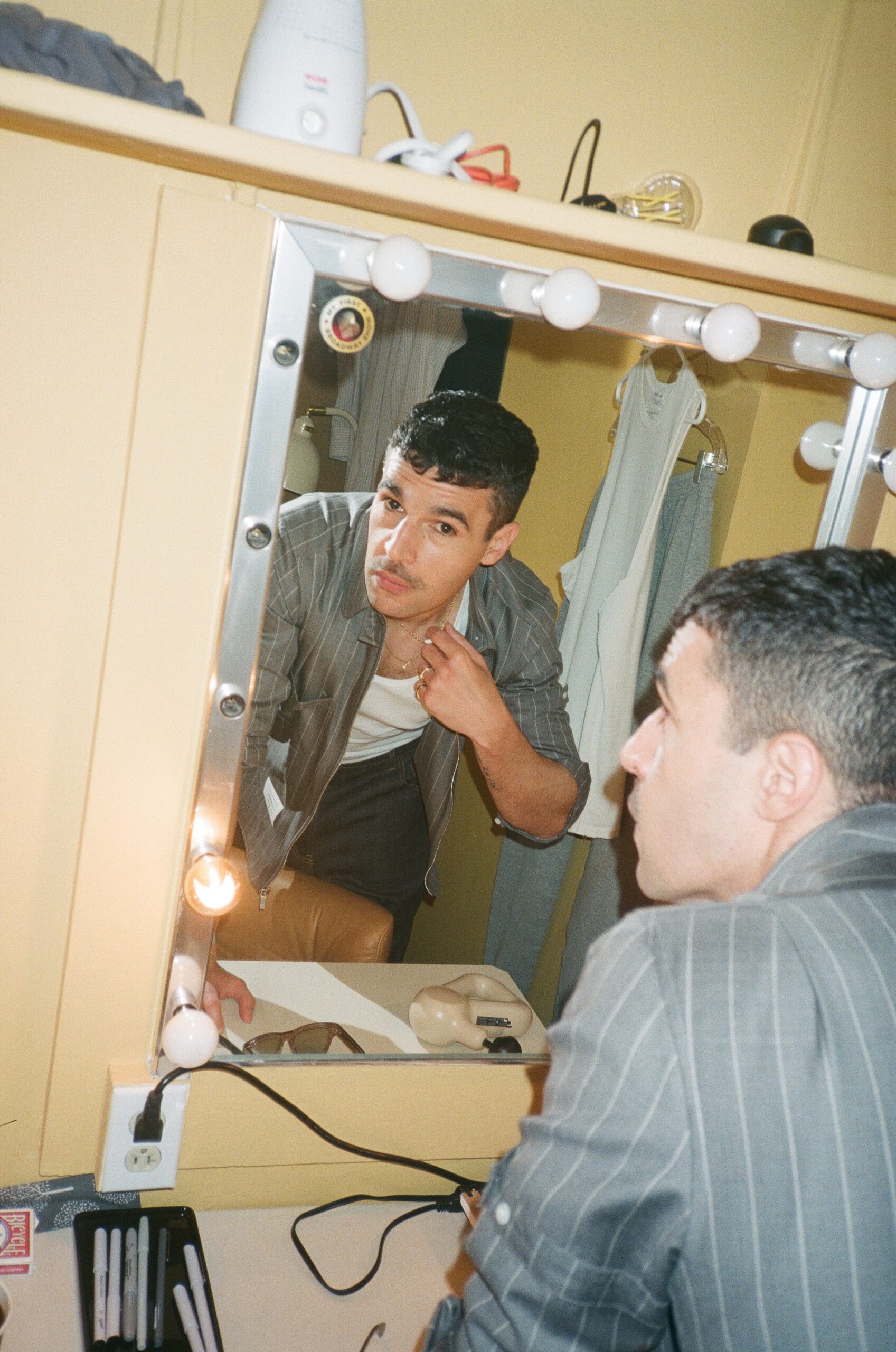
Christopher Abbott considers himself a theater person. Ever since his first professional acting gig in 2008, he has sustained his stage presence alongside a career in film and TV. He’s currently playing Biff Loman in Joe Mantello’s revival of Death of a Salesman on Broadway, alongside Laurie Metcalf and Nathan Lane, a performance that’s earned him his first Tony nomination. Abbott, who has a knack for playing New York tough guys and articulating their misguided machismo with tenderness, plays Biff not as the hapless fool you might expect, but as a man with a dangerous edge that threatens to boil over at any moment. We sat down with him to talk about Knicks fever, finding his way into this role, and what Willy Loman is teaching him about impending fatherhood.
———
THURSDAY, MAY 21, 2026, 11AM, NEW YORK
———
GEORGIE MCKEON: Hi Chris, how are you?
CHRISTOPHER ABBOTT: Good, it’s a rainy day, but off to a good start.
MCKEON: Are you excited for the Knicks game tonight?
ABBOTT: I am. I’m going to have to juggle doing this play and trying to watch in between. What time does it start? Hold on a second.
MCKEON: I think it starts at 8.
ABBOTT: That’s not bad. So I’ll be able to at least catch the end of the game. This is very important.
MCKEON: I heard you took Laurie Metcalf to a game.
ABBOTT: We did. Ben [Ahlers] and I took her.
MCKEON: What was that like?
ABBOTT: She loves it. A few weeks before that game that we took her to, she coincidentally was at a game that I was at. She texted me because she saw me there. I didn’t even know she liked the Knicks and liked basketball. As soon as I found that out, we took the opportunity to all go together.
MCKEON: That’s so sweet. Does the cast hang out much outside of the play?
ABBOTT: Our hang time is usually around the play. A natural tradition has started where maybe 45 minutes before the show, Laurie, Ben and I gather in Nathan’s room and just talk a bunch of shit. Nathan is on stage for most of the play, but in between our scenes, while we’re in the alcoves stage left or stage right, we have time for a little chit-chat before we have to head out and do some dramatic scenes.
MCKEON: So you guys are in a headspace where you can talk and acknowledge the real world outside of the play, even while you’re in the middle of a performance?
ABBOTT: The nice thing is that these are all pros. We’ve done a lot of shows already and so many rehearsals, so I think we’re naturally locked in at this point. We’re not having, like, water balloon fights back there, but it’s good and healthy to be able to hang out and talk. I’ve made the mistake in the past of getting too “into the zone” before a scene and that can make you get too in your head.
MCKEON: Every play, in its own way, is going to be emotionally intense. But this play is especially so. Even with the way it’s staged, it’s very vulnerable. You really just have each other up there to lean on. How did you build that trust?

ABBOTT: I think even how you described it is a big part of it. We have very few anchors on stage. Most scenes, there’s just a bench, a couple chairs, maybe there’s a table. There aren’t many objects, besides a football or a cigarette in some scenes, to distract yourself with. A lot of behavior can be found in objects, and there’s a naturalism that comes with that. With the staging of this play, it makes it a little bit more difficult. There’s nothing to hide behind. But if you really work at it, it forces you to really lean on the other person.
MCKEON: You’ve mentioned how special it is that everyone in this play is first and foremost a “theater person,” yourself included. Why is that?
ABBOTT: I’ll start by saying that I’m really happy that this play is doing well. I’m very happy that audiences are coming and are being moved by it. And I appreciate that it’s all these theater actors making that success happen. That’s not to say that I’m against movie stars being in plays. I think everyone should have a shot at it. I just mean that I’m happy that these actors, who are considered theater actors, can still make a play a success.
MCKEON: And you consider yourself to be a theater actor, primarily?
ABBOTT: Yeah. I do films and TV too, obviously, but ever since I started acting, I’ve been in plays pretty consistently, a lot of them Off-Broadway, some of them Off-Off Broadway. So yeah, it’s always been with me.
MCKEON: What is it about a live show that you enjoy?
ABBOTT: The easy comp for me is a band making a record in the studio versus going on tour and playing live. Doing films and TV feels a little bit more like making a record in the studio and doing theater feels like you’re on tour. If I’m talking to my therapist, I feel a greater sense of control from doing it live. As an actor, I struggle with that sometimes. Being on set requires a lot of cooks in a kitchen. With theater, there are still cooks, but once you’re up there on stage, you’re on your own, so there’s a sense of control there that I don’t get from film or TV.
MCKEON: Is there an element of wanting to continue to perfect your performance every night?
ABBOTT: No, that’s not a goal because I don’t think there’s an answer for what a perfect performance is. It’s an ever-evolving thing. For me, it really feels like you do every show once. You can discover something one night, but that won’t necessarily carry over into the next night. Maybe your scene partner does something different and so you can’t use that thing that you found, but maybe it’ll come back around in three weeks and work again. This all ties into why I like doing live, because I like making quick, instinctive decisions in front of an audience. There’s a lack of safety net that I find thrilling.
MCKEON: The live music analogy makes sense when you say that you think of every show as the show, not as one night in a run of shows. That’s really what concerts are, every night is different.
ABBOTT: Yeah, and my music friends will talk to me about it, too. A guitar player or drummer might make a mistake and the audience will never know, but the band knows that something’s off. I love that those two things can be happening at once. In theater, you have the interplay between the actors, and then there’s the interplay with the audience.
MCKEON: What’s the best concert you’ve been to?
ABBOTT: Radiohead.
MCKEON: Specific show?
ABBOTT: That’s hard. I’ve seen them a lot. Gun to my head, they’re probably one of my favorite bands. All their concerts are pretty inspiring to me, Thom Yorke specifically.
MCKEON: Are you a musician as well or am I inventing that?
ABBOTT: No. I play instruments and I have some close friends who are real musicians and play music for a living. I’ve always secretly wanted to do that, but no, I play stuff just for myself.
MCKEON: It’s never too late.
ABBOTT: I know. I can’t age out of that.
MCKEON: Just to rewind a little bit, what was your first encounter with Death of a Salesman?
ABBOTT: Well, I’ve never seen a live production. Laurie [Metcalf] has a similar thing, where there are some plays that you avoid seeing just in case you might do it one day. But my introduction to it was a scene study class back when I was in school. I worked on that first scene between Biff and Happy in class.
MCKEON: I understand that you didn’t have to audition for this part, because the director, Joe Mantello, was familiar with your work. When you were offered the role, were you intimidated?
ABBOTT: I wouldn’t say intimidated. If anything, I leaned more towards excitement. I guess it could be intimidating when you think about it, but for me that’s actually exciting because there’s something to work on and decipher. A lot of the joy of working on this part is finding the traps, seeing how you can avoid them, and doing something unique.

MCKEON: What did you see as the “traps” in playing this character?
ABBOTT: The big one was for Biff to feel bad for himself. Upon first reading, the part can seem very reflective and inward. I think that can get in the way of being active on stage and with your scene partner. So that was the biggest trap that I wanted to avoid, a “woe is me” kind of tone. The great thing about a play like this is that it is so specifically written and nuanced. There are a lot of clues and details in the writing that you can really draw from. But there’s also a danger to this. If you skirt over it too quickly, there are details you can miss. I remember at one point during rehearsals, there was a line I felt like I hadn’t even heard before. In one of the flashbacks, Laurie’s character quickly says about Biff when he’s younger, “He’s too rough with the girls.” So, you’re playing detective and you go, “Alright, what is that? What does that mean?” Maybe this means that this younger, golden-boy image of Biff is Willy’s projection. For me, the heartbreaking thing about Biff is his realization and his acceptance that he’s not that special.
MCKEON: The way that you’re describing your approach sounds similar to Tony, the character you played in Where We’re Born, someone macho but fragile. You said about that role and that play that “These are people that I grew up with.” You’re from Chickahominy in Connecticut, right?
ABBOTT: Yes, I was born in a neighborhood in Greenwich, Connecticut, called Chickahominy.
MCKEON: Right. I also grew up in Greenwich, which is one of the reasons I was so excited to talk to you.
ABBOTT: Oh, where did you grow up?
MCKEON: I grew up on the border of Greenwich and Stamford, near the ShopRite.
ABBOTT: Oh yeah, absolutely. I know exactly where that is. So you know the assumptions about that area. Greenwich is widely considered a very rich-people town, but there are pockets within it that aren’t like that.
MCKEON: Exactly. I feel like growing up in a not rich part of a very rich town really warps your sense of what’s normal when it comes to wealth and makes you really class-conscious. Did that inform your approach to this play?
ABBOTT: Well with the play Where We’re Born–which was written by a dear friend of mine, Lucy Thurber– that was a part of this group of plays called the Hill Town Plays. There’s a nickname for these towns in Western Mass called the Hill Towns, where you would have one rich town and then a poor town right next to it. Greenwich and Stamford are mostly rich, but not entirely. So there’s something that happens when affluence is a quarter of a mile away, whether it’s a chip on your shoulder or something else. You live so close to it but it also feels very far away, you know what I mean?
MCKEON: Yes! Have you been surprised by the audience’s reactions to the play?
ABBOTT: I’m really relieved that audiences have been moved and continue to be moved by this play. So many stars have to align for any play to work, and that’s not lost on me. If we did this play two years ago or last year or next year, would it have worked the same? We don’t know. There’s a world in which people could think of this play as dated, but its themes still ring true.
MCKEON: I was struck by how timely it felt. In the first conversation between Happy and Biff, Happy says, “Sometimes I just sit in my apartment and I think about the rent I’m paying.” That could have been added this year as a laugh line.
ABBOTT: There can’t be a more appropriate line for this play being done in New York. That line always gets a laugh, because that’s the audience’s experience, too. You’re like, “Holy shit, that’s still happening.” And that’s what makes it timeless.
MCKEON: The play deals with another timeless theme, the relationship between parents and their children, fathers and sons. So, I have to ask, has your impending fatherhood impacted how you are thinking about this play?
ABBOTT: I think so. I think so. I joked that I’m learning that I will do my best to not be a Willy Loman. But yeah, there’s a generational theme to this play and there’s something else that’s interesting that I’ve noticed: it’s a play that makes men, specifically, cry. It makes everyone emotional, but when I’ve gone outside of the theater after the play, you see grown men weeping and tearing up. I think that is really cool.
MCKEON: Before you became an actor, were you a man who cried?
ABBOTT: Short answer, no. Even now, in some ways, I’m not a crier. That’s a thing that I’ve thought about many times, like, “Well, why can I be emotionally available in a play and then maybe not as much in my day-to-day life?” That’s for my therapist. But as a young kid, I was sensitive, I know that. Then growing up and becoming a man, there was the classic thing, whether it’s nature or nurture, of learning to bury that kind of stuff. That’s just a thing that a lot of men deal with, but it doesn’t mean that the emotional intelligence isn’t there. It just means that showing vulnerability is not the go-to.
MCKEON: You’ve said that with every performance, you’re constantly learning. What are the lessons that you’re taking away from this one?
ABBOTT: It’s been a reminder to really do the work and that the feat is to not show the work. When you’re on stage, if you can make it seem like you’re not acting at the audience and you’re just doing your best to live the play, the audience will follow you on that experience, you know what I mean? But it’s just a reminder that it takes a lot of work to do that. It takes a lot of work to make it seem seamless and effortless.
MCKEON: From where I was sitting, I think you accomplished that.
ABBOTT: Oh, thank you.
MCKEON: Of course. Well, thanks so much for chatting with me.
ABBOTT: Thanks for your time.