


PHENOM
Kane Parsons Can’t Escape the Backrooms


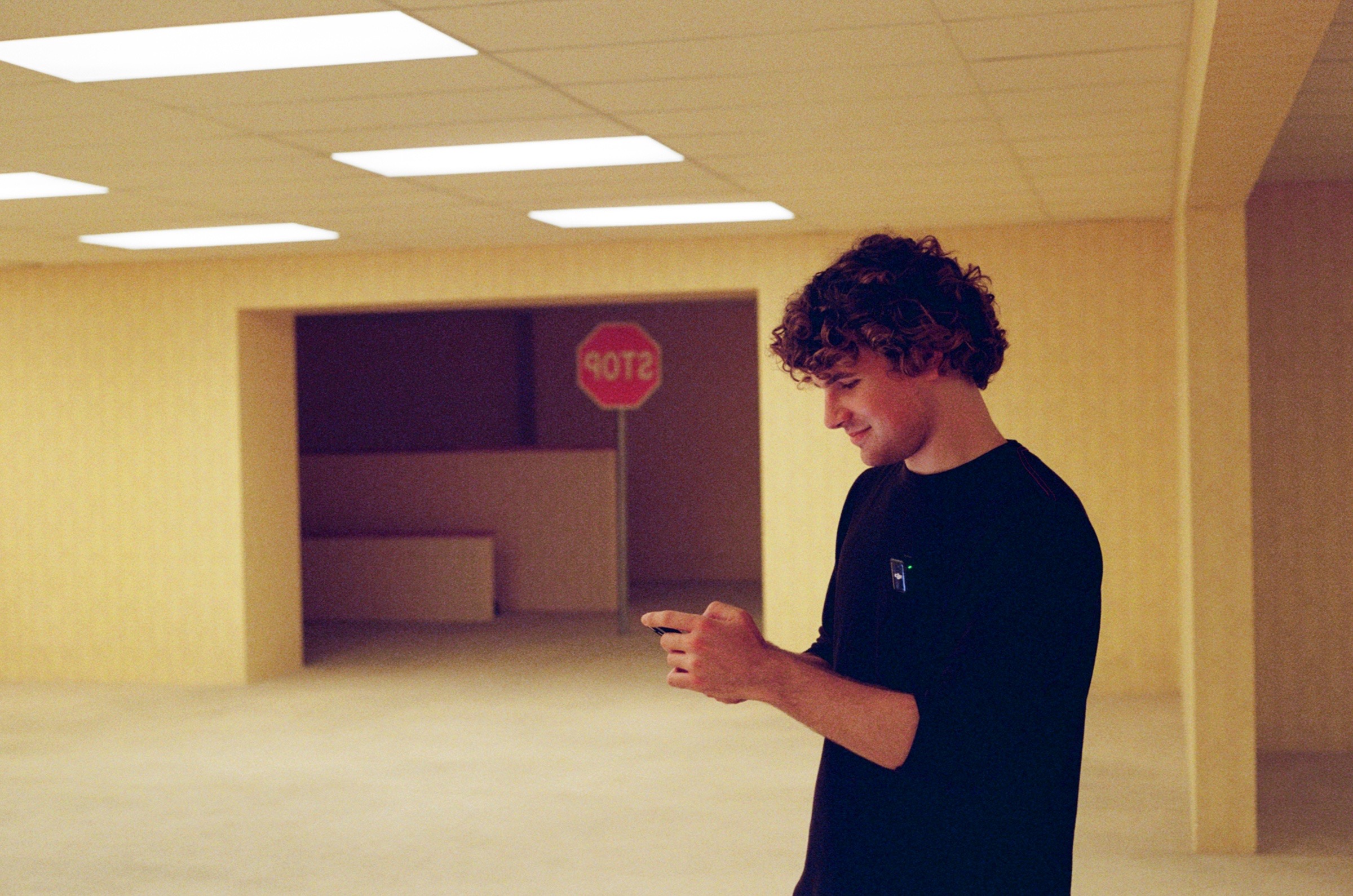
Kane Parsons, photographed by Isaiah Nichols.
Four years ago, Kane Parsons was designing horror videos in Blender from his bedroom. This weekend, he delivered A24 its biggest opening weekend ever. Backrooms, Parsons’s feature debut, raked in a staggering $81 million at the box office as of Sunday, transforming the self-taught YouTuber into one of Hollywood’s most unusual success stories. Parsons first built a following with his Backrooms mini web-series, a found footage universe of endless hallways, waiting rooms, offices, and other fluorescent purgatories. His online presence caught the studio’s attention, and eventually A24 handed him a script by Will Soodik, a $10 million budget, and a cast that included Renate Reinsve and Chiwetel Ejiofor. The resulting film was shot on a 30,000 square foot set, (which, ironically, the cast and crew got lost in themselves). The questions were inevitable. How much creative control does a 20-year-old first-time director actually get? What do you do with a 30,000-square-foot set when filming wraps? And after delivering one of the biggest horror openings in recent memory, how do you stop thinking about it altogether? We caught up with Parsons on all that, plus his friendship with Osgood Perkins, a potential Backrooms video game, and what still scares him..
SATURDAY 12 PM, MAY 23, 2026, LA
———
EMILY SANDSTROM: I want to know what personally really freaks you out. What are your favorite horror movies?
KANE PARSONS: What freaks me out has almost no overlap with horror films, or with fiction. I don’t consume enough stuff to have a list of strong favorites, particularly in the horror genre. It’s a bit of a cop-out, but it’s the truth. If I had to pick a genre, it would probably be a thriller. I hate saying science fiction because I prefer more grounded techno-thriller-esque stuff.
SANDSTROM: Do you consider yourself a film person?
PARSONS: I wasn’t someone who fell in love with film as a kid. I don’t feel like I’m consciously drawing on the legacy of the art form too much. I mean, everything obviously trickles down. There are always derivative properties of art in life, but my direct influences are more ambient from being online over the years. I’m biased towards longer-form narrative.
SANDSTROM: Do liminal spaces scare you personally or is that more of a point of fascination?
PARSONS: They don’t really get under my skin at all. I mean, if I’m sifting through piles of stuff that people have put together online, I might see one that does. But it’s really just a point of fascination for me because so many of these photos feel authorless. Maybe they’re taken from real estate listings or pulled off of old hard drives from decades ago. It’s really easy to project onto these visuals. For me, it very much scratches the same itch as fixating on a childhood memory that is detached contextually from everything else. So you don’t know what the context was, and it’s just a blip of a visual. I’ve got a lot of those floating around, and usually they’ll bubble up in the form of dreams. I think often people have the experience of feeling curious about the tonality of a dream again in the minutes or hours after they wake up. It feels like they’re coming from the same distant place as those photos.

Photo by Asterios Moutsokapas.
SANDSTROM: Have you had many dreams about going back to places and new rooms unfolding?
PARSONS: Most of my dreams are pretty architecturally centered, or fixated on spatial memory. In my waking life, I’m very focused on buildings and spatial relationships. When I did the first short film for Backrooms, part of the creative direction was pursuing that feeling of having a dream in your childhood home, but you wake up and register that the place you just were was entirely different from the real world version. It’s like the semantic information of that place all got shuffled and applied to something else incorrectly, but you believed it and felt it all the same. It’s your house, but extrapolated—these places don’t exist and sometimes they do weird things. Emotionally, that’s where a lot of the design choices stem from.
SANDSTROM: Even just hearing that makes me feel so icky. I want to ask about the set design. It was 30,000 square feet, is that right?
PARSONS: Yes, 30,000.
SANDSTROM: Were there conversations about doing it with AI as opposed to building a physical set? How did that decision come about?
PARSONS: As soon as we started considering our resources, I was strongly pushing for a physical set. I would never lean in a generative AI direction, and I’m personally in opposition to the use of it in the creative workforce, outside of automating menial tasks. I always maintained that I want to go as practical as possible, and we did. So the vast majority of what you see in the film is built sets. Anytime a character is physically walking on the floor, it’s a real floor. Anytime they’re physically touching a wall, that’s a real wall. And most of the time, if you were on the set, you could stand in the middle of it, do a 360-degree turn, and not see any blue screen and not see anything that breaks the facade of actually being there. So by and large, what you see in the film is what it felt like to be there. The only places where we do run into VFX would be the stuff that is obviously impossible to build, some of the massive spaces and whatnot. We technically built all the areas that the characters would traverse through, but since they wouldn’t all fit on the independent stages, we would obviously do an extension and then splice over to the next stage and jam them back together. I do love VFX, so I don’t consider it a weakness to leverage them to a certain extent. And then, in the found footage sections, a decent bit of that was done in Blender.

Photo by Asterios Moutsokapas.
SANDSTROM: Do you think you could sketch the set from memory now?
PARSONS: Oh yeah. I could traverse it with my eyes closed because I modeled the whole thing in Blender ahead of time. We worked on it for a couple months before any of it was actually built. I care about the specifics of it a lot. I could probably get a few things wrong because I wouldn’t have exact measurements, but the shape of it, definitely.
SANDSTROM: What do they do with a set that big when you’re done? Do they burn it down?
PARSONS: I don’t actually know. I wish I knew exactly what happened. The last day we were shooting a version of the opening scene that we ended up cutting. That was one day that we started cannibalizing parts from other sets and reshaping one of our main stages and adding extra walls. So it took on a new form and a new layout. By the last day, most of the sets were butchered and a lot of the walls were gone and it was in disarray. I said a little goodbye to all the sets at the end when everyone else had left. But I don’t know what came of everything else. I assume most of it was down within two days or so.I know the ceiling tiles made their way into the Oddfellows office and they wallpapered the editing suite with it. It very much felt like they took all the pieces and moved with us. I’m sure the rest got recycled for other projects, the flats and everything.
SANDSTROM: I read that you’ve developed this mentor-mentee relationship with Osgood Perkins. What’s the best piece of advice he’s given you?
PARSONS: He’s been a great ally and a great friend. There’s a very productive stubbornness that he has creatively. He’ll say no firmly to certain asks. He was very helpful in bringing an assertive nature to things. We were able to hold off on a lot of creative distillation or alterations from the original source material, and find the right tone to avoid becoming a tropey horror film. He’s obviously a director-first person, and everyone else needs to get out of the room. It’s not an uncommon sentiment, but I very much appreciate it and I think I’ve picked up a level of stubbornness.

Photo by Asterios Moutsokapas.
SANDSTROM: On the note of stubbornness, when you had a look at the script, did you have anything that you were really trying to push back on, or did it feel pretty streamlined?
PARSONS: The script is the place where I consistently had the least creative control. My creative control definitely grew over time while working on this project, and now that it’s all said and done, I think what they’ll allow for the next project has jumped significantly. I say they, being the powers that be—whoever they may be.
SANDSTROM: Right. Capital T, “They.”
PARSONS: I was able to assert certain elements of what needed to be held up in the original script. If I could go back in time, I would have liked spending more time developing it, but there was a narrow window where we either made the film or we didn’t. There were things originally in the script that—even if they’re just random peripheral art direction details—they would have been inconsistent with the world that people have come to expect. There was a need to bring everything in line with this universe. I spent a lot of nights barely sleeping, really trying to go hard and get these things sorted before we went to camera.
SANDSTROM: When you watch it back now, are there any parts where you flinch and you’re like, “Oh, I wish this wasn’t that“?
PARSONS: I had those moments in post for a while, but I’m happy to say I don’t have that anymore. Maybe one or two micro places with some dialogue. But never deliveries. I love the cast. Personally, I think there’s almost too much elegance in the script in a few places. But I don’t have anything where I want to look away from the screen at any point. Candidly, I was dreading there might be.
SANDSTROM: Also, the sound design is wild. What did you have in mind for that?

Photo by Asterios Moutsokapas.
PARSONS: The sound and score are always one of my favorite parts of the creative process. I score all the stuff on YouTube. When talking about the art direction for the soundscape, it was the easiest part to say, “Well, it needs to sound like the series. It needs to be identical to that.” There’s a richness because so much of the YouTube series is found footage, so you go mono with a lot of the audio. Whereas here we’re getting a more windy, fleshed out, rich sound. But the tonality has always been to create something fairly aged, and fairly of the ’90s, early 2000s. Even though this takes place in 1990, there’s a bit of a transposition there, almost like the future calling back into the past. It feels like something echoing down a corridor with these very gentle but massive drones and wails. We want to make sure we’re subverting the expectations and the flow of things as much as possible. There’s only maybe one spot on the film where it actually repeats itself melodically. Everything else is constantly evolving material.
SANDSTROM: Nice. What has the reaction been from the online community that you started this with?
PARSONS: Certain people have seen it and their reactions have been consistently positive. I’ve seen that it’s working for people who aren’t familiar and people who are familiar just the same. I’m of the mind that it’s supposed to scratch a specific itch, and if people have the itch, it seems to be working. If people don’t have the itch, that’s fine. Movies are always personalized experiences. I don’t try to be a generalist.
SANDSTROM: Do you feel like you’re pioneering a genre?
PARSONS: No, and I don’t want to think about it in that way. The moment it starts to feel too grand of a thing, it’ll become too socially motivated in a way that I’d find distracting or emotionally difficult. I want the work that I do to be a way of processing things in my own life. That’s what art is, and I like to keep it insulated in that manner. But if people want to treat it as a symptom of something larger, then I’m very excited to see what they say. I don’t want to make those assertions myself.

Photo by Asterios Moutsokapas.
SANDSTROM: Did you think about doing it as a video game at some point?
PARSONS: I’ve never ruled out the option of a video game in that world, but there’s so many Backrooms games out there. If we could do a proper, well-funded game, that could be pretty cool. But generally speaking, I like to be able to curate the direct path that I want. I want the train of thought to follow a very specific arc. Not that you can’t do that in a game, but it’s not my wheelhouse and I don’t want to experiment with that too much yet.
SANDSTROM: What happens after you make a huge movie? What are you going to do this summer? How are you going to unwind?
PARSONS: Next week, I’m going back home. I’m going to watch the film with my friends and family in my hometown theater and see it like a normal person. I’ll buy a ticket for it, see it once, and then go about the rest of the summer as though all this stuff is not happening. I need it to take a backseat, otherwise I won’t be able to ever focus on what the next project needs to be. I’m just going to take a couple weeks where I truly don’t think about it and try to let my brain recover from the absolute crunch period. There hasn’t been a day of downtime in a year and a half. But I’ve got a lot on the horizon that I want to start working on.
SANDSTROM: I was going to ask you if you could tease what’s next, unless it’s terrifying to jump into already.
PARSONS: I can’t say what’s immediately next because what needs to come first is this moment of very deep thought and consideration. But I have a few things. There will be something next, and I’d like to think it’ll be the best possible choice.
SANDSTROM: Cool.
PARSONS: I feel positive about it.