



IN CONVERSATION
Lewis Pullman Is Stepping Out of His Father’s Shadow


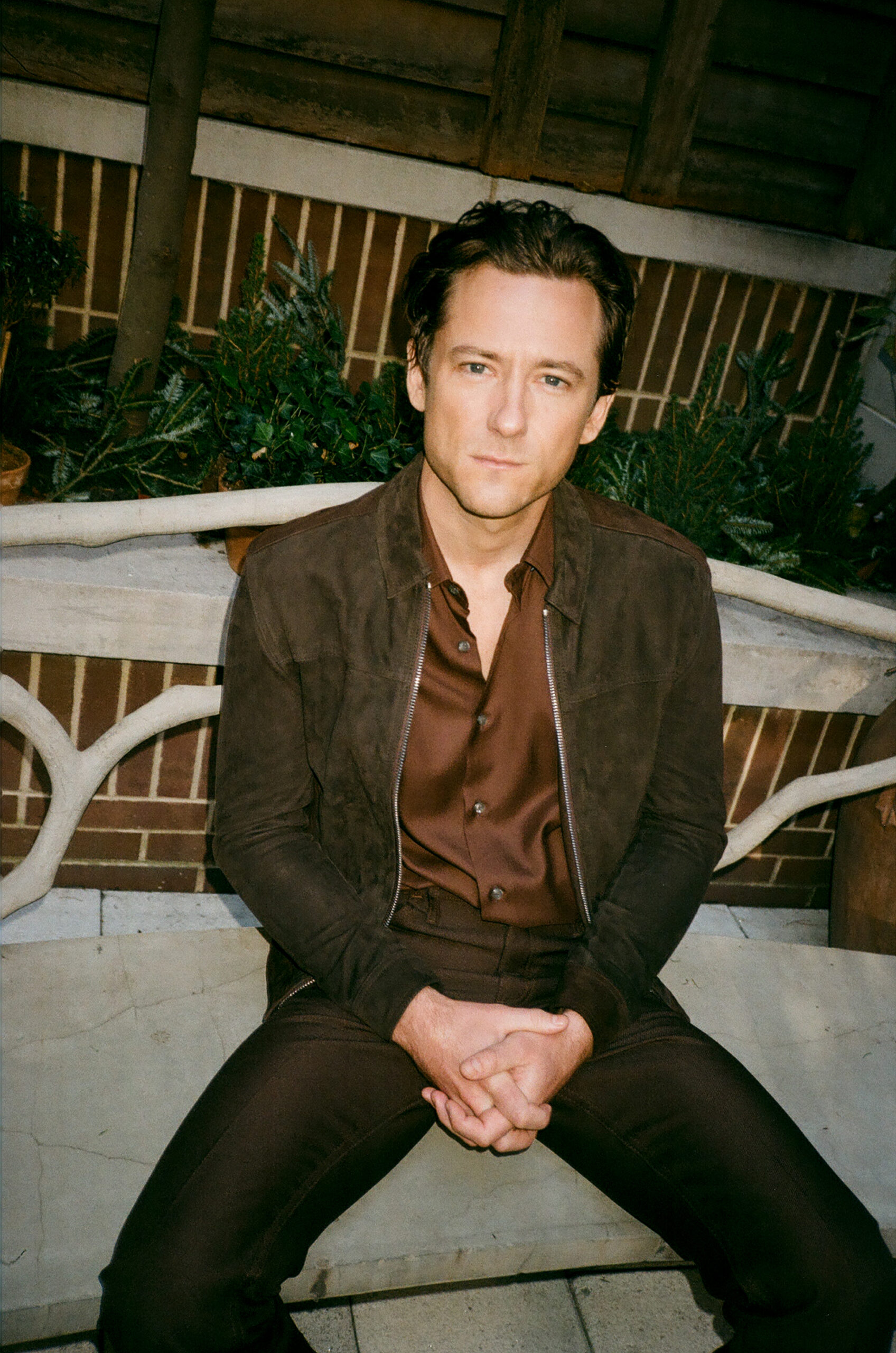
Lewis Pullman, photographed by Matt Weinberger.
Despite growing up the son of the man who delivered one of the all-time great cinematic speeches in Independence Day, Lewis Pullman’s career has been fueled less by the forces of nepotism than by those of discernment and dedication. The 32-year-old actor, whose dad is Spaceballs and Lost Highway star Bill Pullman, has enjoyed the kind of steady progression that indicates a performer’s staying power, having made supporting appearances in Bad Times at the El Royale and Top Gun: Maverick before earning an Emmy nomination in 2024 for his endearing turn in the hit miniseries Lessons in Chemistry. A sense of humility and a commitment to hard work, evidently, was part and parcel of the Pullman way. As he told his friend and fellow rising star Paul Walter Hauser last month, “Pops’ MO was always low expectations, low disappointment.” This year, however, Pullman is poised to become a household name, starring opposite Oscar contender Amanda Seyfried in director Mona Fastvold’s feverish The Testament of Ann Lee, an unconventional and ambitious musical documenting the 18th Century founding of the religious sect known as the Shakers. Before setting off on the awards season circuit, Pullman took a moment to field some very specific questions from Walter Hauser about growing up in Hollywood and choosing roles wisely.
———
LEWIS PULLMAN: Hi, Paul.
PAUL WALTER HAUSER: Good to see you, bud.
PULLMAN: Good to see you, buddy. Thank you for doing this. I’m so lucky.
HAUSER: I think we met at an award show. I was going up a staircase and you were coming down and I saw you and I think we both got mutually excited and we were like, “Hey, we should work together. We like each other.”
PULLMAN: I remember that moment crystal clear. I couldn’t believe you knew who I was. I was elated.
HAUSER: You put your name in my phone as Lewis Pullman with a bunch of exclamation points, and I have ignored my OCD to not change it to a proper entry.
PULLMAN: I must stand out somehow in the contact list.
HAUSER: We both have to. It’s so hard for white men in America. [Laughs] Hopefully, that joke will read in a magazine.
PULLMAN: For the record, the delivery was full of self-deprecation and awareness.
HAUSER: Yes. So I was thinking about you and just going back to the origins. There were two movies on constant rotation in my home as a child: Newsies and While You Were Sleeping. I still adore them to this day, and I always looked at your dad as being a relatable, pure guy in cinema. There is something cozy about him where I feel a certain warmth and purity or honesty in him. Does that catch at all for you?
PULLMAN: That resonates, absolutely. Obviously I wasn’t allowed to watch The Serpent and the Rainbow and things like that, so there was a limited repertoire. But then once I got interested, I did a whole deep dive and I spent a month watching all this stuff. And I do think that he has a natural warmth and comfort, and that’s a strength that he used and utilized whether he was aware of it or not, but then he actively subverted that. You can watch him make those decisions where that wasn’t really feeding him anymore.
HAUSER: I feel like you have almost taken that under advisement, whether conscious or unconsciously. When I look at the roles I’ve seen you in, there’s a pretty good variety of studio films, indie films, prestige television, a couple hot new directors, and then an absolute G like Joe Kaczynski. How intentional has that variety in your work been?
PULLMAN: I mean, you know better than anybody how, especially in the beginning, you just eat whatever’s on your plate and you enjoy it. I was just talking to my dad about this last night because him and my mom and my brother and sister came to the premiere of The Testament of Ann Lee and I was saying, “Pop and I, we were never big manifesters. Pop’s MO was always low expectations, low disappointment.”
HAUSER: There’s a lot of wisdom in that. Speaking of pops, when did you know that he was a famous figure in the world? When did it actually sink in when you were grown up?
PULLMAN: I think one thing that me and all my siblings got a pretty good radar for was ulterior motives. Even as a kid, you could pick up on like, “Why does somebody want this from my dad? Why do people expect this from him and where is that coming from?” We rarely went out to restaurants growing up. It was always my mom making dinner. But whenever we did, there’d be somebody coming up. And I was always like, “Well, what’s the big deal? I mean, he’s the best dad ever, but they don’t know that.” And then once I dabbled in acting and started understanding the magnitude of his talent, that was when I was like, “Okay, there should be a lot more people asking for him to do this Independence Day speech.”
HAUSER: You’ve described your mom as a clean-your-plate disciplinarian in one of your interviews. If you got the acting prowess and smarts and charm from your dad, what’s something you got from your mother that people don’t fully see?
PULLMAN: I love that question, Paul. God, you’re a sweetheart. So much, though. Her listening skills are like nobody I’ve ever met because she listens with her whole body. And she is such a good reminder of taking care of yourself, of being your own superhero, because nobody’s going to come save the day. She’s a maintainer. She’s a controlled burn lady. Even amongst the chaos, she is strong.
HAUSER: Having that in a parent is a really big deal, especially if you want to do something like what we do for a living.
PULLMAN: Yes, completely. It’s really true.
HAUSER: I’m curious, is there a film you auditioned for or a TV series that you wish you got, but you didn’t book?
PULLMAN: Yeah, there’s plenty. And I had to get over the hump of when the thing comes out, avoiding it and resenting it. Once I got over that, I could watch them. And then I was able to really understand, “Oh my god, that was never mine. That was always that person’s.” And understanding that manifest destiny really clarified things for me. It actually allows me a lot more freedom in my auditions now because I can be like, “Well, this is how I want to do it and how I would do it.”
HAUSER: 100%.
PULLMAN: I’m actually having a hard time thinking of one because I end up being like, “Well, look what I did instead!”
HAUSER: That’s a healthy outlook. I was trying to dig up dirt because I find it interesting. [Laughs]
PULLMAN: It is.
HAUSER: The fact that Tom Selleck was almost in Star Wars, I find that stuff so fascinating.
PULLMAN: Here’s a little dirt, but it’s clean dirt. You know that show The Good Doctor?
HAUSER: Yes.
PULLMAN: So that was early on when I started acting and I was not getting a lot of roles because the audition process to me was so otherworldly, so different from everything that I knew acting to be. It felt like a whole new skill that I had to learn from scratch. But then I got all this traction on The Good Doctor. I was doing all these chemistry reads and they were like, “This is yours, buddy.” And I was like, “Holy shit, I’m about to have a huge TV show.” And then, last minute, Freddie Highmore came back and got that role and he’s done such incredible stuff with it that I never could have ever done. It would’ve lasted two episodes. [Laughs] It would never have been renewed. I was so ill-equipped.
HAUSER: Oh, wow. I did not know that.
PULLMAN: But then I think, “Okay, well, I wouldn’t have done Bad Times at the El Royale, I wouldn’t have done Top Gun. I wouldn’t have done Thunderbolts.”
HAUSER: It would’ve taken over your whole career.
PULLMAN: Yeah.
HAUSER: As those shows often do. But some shit just falls in your lap, as you know. People sometimes give us too much credit and they don’t realize that we woke up one day to an email or phone call that changed our lives. I mean, sometimes that happens. But anyway, you and I have actually worked with a ton of the same people.
PULLMAN: Really?
HAUSER: All of whom I’ve remained friends with, guys like Pete Davidson, Austin Abrams, Jake Lacy, Jon Hamm, Sebastian Stan, Tom Pelphrey. I love all these guys, so I know what draws me to them. For you, what is a quality or multiple qualities you love in a co-star?
PULLMAN: I love somebody who both makes you feel so relaxed that you could almost fall asleep and somebody who pushes you, like there’s a knife in your back and they’re going forward with you like, “We’re doing this hand in hand, buddy.” So, a little bit of pressurization, and then also just a big heart. I think all those people you just mentioned have that. Tom Pelphrey, he is another one. The gas pedal is right to the floorboard and there’s nothing left. He does not leave anything.
HAUSER: He’s a real one. I think he’s going to end up being talked about like Cillian Murphy, where there’s so much humility at the beginning of the career that you almost go unnoticed, and then you get an Oppenheimer and everybody’s like, “Well, sorry we didn’t notice you when you were murdering it for 20 years.”
PULLMAN: It’s so, so true.
HAUSER: He’s a killer. What’s a department on a set that you’re most in awe of outside of acting, writing, directing?
PULLMAN: Probably set design. I love walking onto a set for the first time and just wandering around and getting there early if I haven’t seen it yet. Doing, for example, Spaceballs 2, I could not believe what Ra [Vincent] had done. He was just genius, his whole team. There is stuff in his sets that no one will ever see and no one will ever know about. So that is something I could imagine having done in another life. And my brother actually makes all sorts of things, from puppets to props and masks for theater companies and different directors around L.A., for music videos and shorts and documentaries. And I always will take pictures of shit that I see on set and send to him.
HAUSER: You come from a very creative family, evidently, but I just learned for the first time today that you drum for a band called Atta Boy, joined by the talents of your buddies Eden and Freddy and Dashel. I listened to some of the songs on Spotify. My favorite one was “Saccharine.” I loved it. It was anthemic and yet it was calming and reminded me a little bit of how I feel listening to my buddy Andy’s band, Manchester Orchestra, how I’m provoked but put at ease at the same time.
PULLMAN: I love that.
HAUSER: Is there something you get from making music that you maybe don’t fully get or satiate with the acting process?
PULLMAN: Yes, absolutely. I think I get immediacy. I know immediately whether it’s working or not. It’s not something I find out at the end of the day or at the end of the take or a year later, after it’s been edited and is done. And I think it’s sort of the easiest way to quiet the mind because, especially with an instrument like drums, you’re a metronome with a soul, essentially, and you have one job. And to be a conduit of that—there’s nothing like it.
HAUSER: That’s awesome. You were nominated for a Primetime Emmy Award for your work in the show Lessons in Chemistry. What was it like when you learned you were nominated in a category alongside legends like John Hawkes and Robert Downey Jr.?
PULLMAN: I couldn’t really wrap my head around it. I still can’t. You make all sorts of excuses for how something like that even happens. It’s taken me a while to be like, “I’m really proud of that show,” and it does mean a lot when somebody comes up to me and has a story about watching that with their husband or wife or their mom or dad and what it meant to them.
HAUSER: I love that. And, last but not least, in a world that is absolutely taken over by the PR machine, what is the name of one or two people you can offer up to us that do not get the credit they deserve for what they have done in your life, personal or professional?
PULLMAN: Oh, man, that’s a great question. Nobody’s asked that question in the history of mankind. I’m going to go from the gut here and say Laurel Parmet, who I just did The Starling Girl with. That was one of the best experiences making a movie I’ve ever had, and it was because of her. She’s an incredible storyteller. And the climate for making a movie right now is hard. But in my mind, she should be able to make whatever she wants because she does it like nobody else, and she does it how it ought to be done—with great, intense, personal care and a huge beating heart. And the other would be my mom. My mom is the person behind the scenes that makes everything run smoothly and rarely gets the accolades. She is the engine, and I try to remind her every day, but she’s a behind-the-scenes mover and shaker with just more and more empathy and love than anyone I’ve ever met.
HAUSER: What a great way to end. But as I used to say when I did standup comedy, I’ll leave you with this: “Look at me. I’m the king of New York. Suddenly, I’m respectable, staring right at you, lousy with stature. Making the headlines out of a hunch, protecting the weak and paying for lunch. When I’m at bat, proud men crumble, proud yet humble. I’m the king.”
PULLMAN: Dude, wait. You didn’t get up on the table, man. You have to do it again.
HAUSER: I can’t tap dance on a table like your father did. But maybe I’ll break dance.
PULLMAN: That’s what you can do.
HAUSER: Love you, buddy. Proud of you.
PULLMAN: I love you so much, Paul. Brother, I can’t thank you enough for doing this. You don’t know what it means to me. I’m the luckiest boy. Thank you for your incredible, genuinely remarkable questions. I’m sure you’ve had some bad ones, so that was a joy.
HAUSER: Oh yeah, a lot of bad ones. But dude, give my love to your family. Thank you, brother.
PULLMAN: We’ll talk to you soon.