


IN CONVERSATION
Gina Gershon Tells Laurie Anderson How She Survived the Hollywood Hothouse


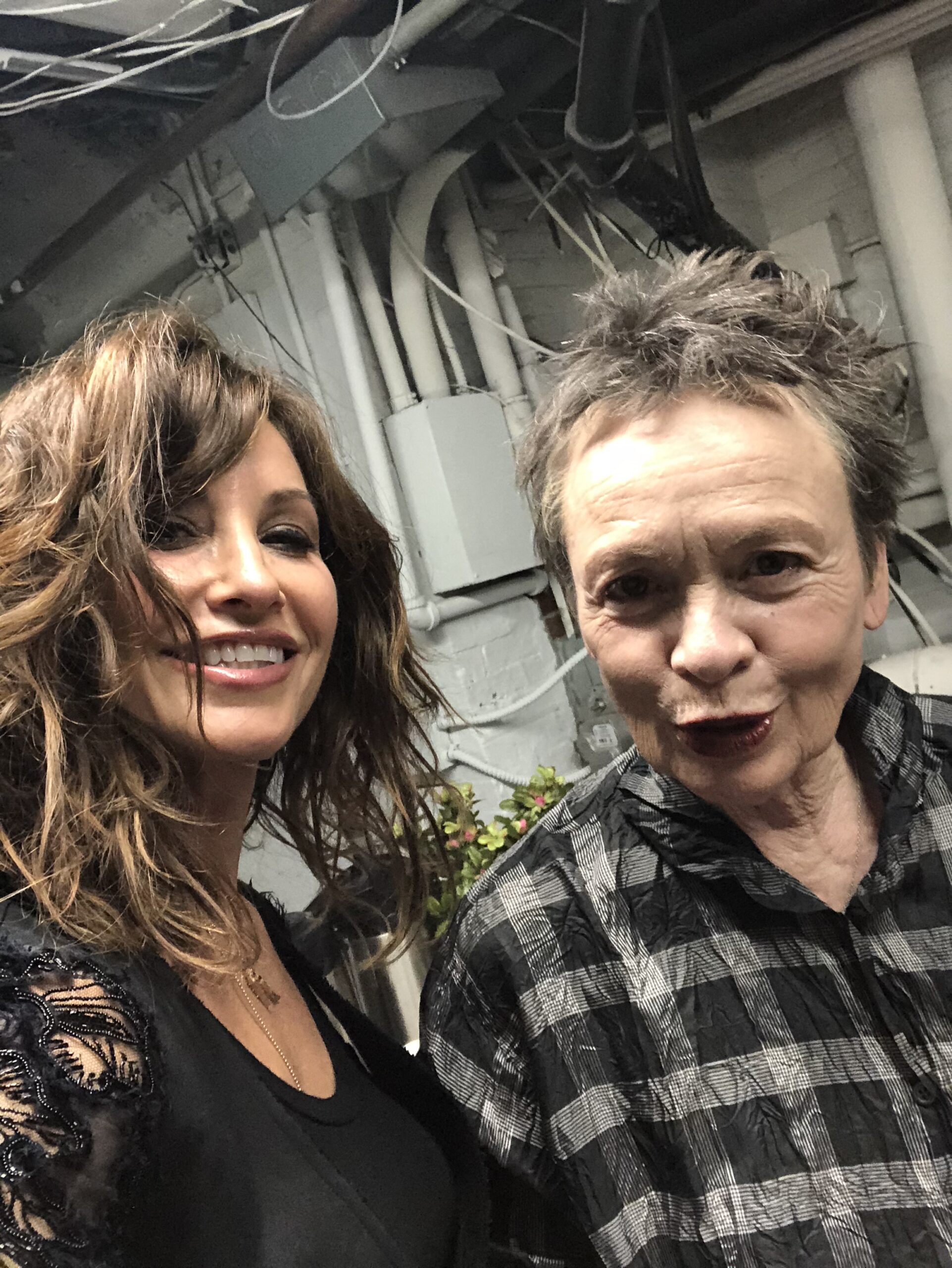
Photo courtesy of Gina Gershon.
Magnetic and self-assured, Gina Gershon made a name for herself in Hollywood as a risk-taker, often taking on queer roles in cult classics like Bound and Showgirls. Needless to say, her willingness to step into the bold and unconventional meant that she often found herself in some pretty surreal or sticky situations. After 40 years in the industry, the Los Angeles native compiled dozens of them in her new book AlphaPussy, a chronicle of coming-of-age blunders and cringe-worthy celebrity encounters that only made her stronger. “It’s not a self-help book,” she insists. “This is just how I navigated, in my way.” But that’s not to say there isn’t a bounty of insights to be found in its pages. Alphapussy, in fact, leaves the reader with a potent feeling of empowerment and autonomy. Take it from the genre-defiant artist and composer Laurie Anderson. “We have a lot of stories that have never really been told,” she told Gershon on a Zoom call last month. “But we have a million books and plays and operas about how men feel about their fathers.” In conversation, the two longtime friends talked matriarchy, Medusa, and surviving in La La Land.—ARY RUSSELL
———
GINA GERSHON: Thank you for doing this, Laurie. This is a normal conversation. This is a professional conversation. [Laughs]
LAURIE ANDERSON: Well, you’re really helping people with this book. I especially appreciated that you said there was only one piece of advice that you’d like to offer. “Learn about your parents.” I was thinking about that because I had a quite wonderful dream last week where I was talking to my mother and we were both 40 years old.
GERSHON: Wow.
ANDERSON: I was thinking, “Oh, wouldn’t it be nice to have coffee? I would really get along with her.” But no, I thought she had a lot of problems.
GERSHON: Wouldn’t that be great to be able to sit and talk to her about it? You’d understand and forgive so much.
ANDERSON: Well, you’re a very generous person to say that.
GERSHON: Not good for her. I mean, good for you.
ANDERSON: Nothing’s good for her anymore. She’s dead. But I loved the way you were describing how your mother’s completely oblivious to the fact that she’s pregnant and you said, “It’s just me floating around quietly, creating myself in the dark.” That’s a lovely phrase. How did you catapult yourself back into that little person you were?
GERSHON: I’m a storyteller. I don’t consider myself a writer so much. But I realized I don’t want to write a tell-all book about Showgirls, or about show biz. They’re interesting stories, but it’s not really me. It felt icky. So I said, “I don’t want to do that.” Then over time, I got into the exercise of writing stories down on paper, because I’ll forget them at some point. Once I started the process, all of a sudden I’d be sitting there and an image would come into my head of the bowling alley.
ANDERSON: Oh yeah.
GERSHON: This is where my acting training would come in, all that sense memory work.
ANDERSON: Tell me about sense memory work.
GERSHON: So let’s say you need to come up with a certain emotion, or you’re trying to figure out a certain part in a scene that’s difficult. Then maybe something from your past shows up and you lay there and you start watching it like a movie. So many times when something would float up to my consciousness and I didn’t know why, I would go on the mat until I finally saw the scene, until I remembered it. Sometimes stories would come up and I’d be like, “Oh my god, I remember that.” But thematically it didn’t quite fit, so then I wouldn’t use it. I had to be somewhat disciplined because a part of me wanted to go out on these super weird tangents. Of course, I’ve had nice memories too, but they didn’t belong in this book.
ANDERSON: I bet a lot of other things would come back if you look from a different point of view.
GERSHON: I wouldn’t have gotten these stories from my mom until she was basically on her deathbed, because she was so vulnerable and we had time. She wasn’t going anywhere. Her deathbed lasted three years.
ANDERSON: I remember that.
GERSHON: Instead of being defensive, she had softened.
ANDERSON: There’s really something amazing about being with your mother when she dies. It’s pretty iconic, especially for women.
GERSHON: Definitely, and it’s more intense for women. Men, they’re there, but women and their mothers, there’s nothing like that relationship. The father and son thing is pretty intense. But you notice when the mother’s dying, it’s usually the women who are there.
ANDERSON: Men are too lazy and they also feel it’s a little too sexual. It’s a little too invasive. They don’t want to know those kinds of things about their mother. They don’t want to change her diapers.
GERSHON: Nor should they, and the mother doesn’t want them to do that either. My mom didn’t want me to do all that stuff.
ANDERSON: Right.
GERSHON: But it’s interesting—they gave birth to us, but in the end, I was helping birth her death.
ANDERSON: This is why I have a lot of hope for women writing things—operas, books. We have a lot of stories that have never really been told. And we have a million books and plays and operas about how men feel about their fathers.
GERSHON: It’s true.
ANDERSON: We’re just starting to catch up.
GERSHON: I remember going to school and studying mythology. I said, “All these hero journeys, they’re all men’s stories.”
ANDERSON: Hello!
GERSHON: I don’t know if it was Joseph Campbell, but it was someone who said, “Well, the woman is already whole, so they don’t have to go through this.” It’s like, “What the fuck are you talking about?”
ANDERSON: Oh, bullshit. They’re back doing their laundry.
GERSHON: What I’m noticing in the last few years is they’re taking Antigone, Medea, Medusa, all these myths about how women were so horrible, but they’re telling the women’s side of the story, and how they really were victims just trying to survive.
ANDERSON: This could be our era, our evolution. It doesn’t seem so at the moment, but you never know.
GERSHON: The patriarchal system hasn’t worked. It’s got to go back to the matriarchal system, which seemed to have worked for billions of years.
ANDERSON: But also, what works about this book is it comes from your story. And while you’re referring to your AlphaPussy theory, it’s very organic.
GERSHON: I’ve been very clear when I talk to people in interviews, “Listen, this is not a how-to book, it’s not a self-help book. These are my experiences.” I’m not trying to advise anyone. This is just how I navigated, in my way.
ANDERSON: That’s the book’s power.
GERSHON: You can’t really teach anyone anything, anyway. Everyone has their own experience. It’s been interesting doing interviews with this [book] because everyone really comes at it like, “Oh, so what did you get out of it?” And the answers are so different.
ANDERSON: What surprised you the most?
GERSHON: Nothing has surprised me, but it’s all more of a reflection on who they are and their own experience. Some people like this story, some people like that story. Someone was telling me about the poker story, how they found it so satisfying.
ANDERSON: Yeah, that one’s satisfying. I was really happy to read about some of your teachers, how appreciative you were of [Robert] Altman and your time in Vermont. That must’ve been amazing with David Mamet, too. Who else was there?
GERSHON: Bill Macy was up in Vermont. Mamet, I didn’t talk to a lot. He was a little intimidating, but he gave me some of the best advice I got out of college, which was to learn to direct yourself.
ANDERSON: That’s amazing.
GERSHON: I was like, “Oh, you’re so cynical. That’s crazy.” He’s like, “If you are lucky in your life, you’ll have maybe three directors who actually direct you.”
ANDERSON: When you were writing this, you’re following one particular thread of this attitude of yours—there you are punching [Bob] Dylan, there you are confronting directors.
GERSHON: I didn’t start out writing about it like, “Oh, how do you manipulate? How do you survive?”
ANDERSON: Right.
GERSHON: I was inspired by younger actresses who were very good, but maybe they’re in their thirties and they would sometimes tell me, “The director on the set is doing this.” And it was really tripping them up. And I said, “Well, you’ve got to tell them to stop.”
ANDERSON: People aren’t able to hear that because honesty and truthfulness are not something that we’re trained to do. We’re trained to be devious.
GERSHON: No, but as you get older, if I had known all the stuff I’m talking about now, I might have been able to deal with these situations. I was trying to figure it out in real time instead of being able to recognize it.
ANDERSON: Yeah. I like the sections where things weren’t working out. I like to see when things get fucked up. Who are you then? How open are you? How truthful are you? The only time I learn anything is when everything is really fucked up and I fall apart and I feel like shit. But it’s one of the few times in my life when I’m actually open to understanding things a little better. Pay attention to your own suffering, and you’ll find out a lot of things.
GERSHON: Definitely. I’ve changed a lot because, when I was going through all these things, I was going on total animal instinct because I didn’t want to get attacked. Now looking back on it, hopefully I’ve gained some compassion and empathy and wisdom.
ANDERSON: You definitely feel somebody changing in this book, and watching this little punk learn lots of other things in other ways is an amazing story.
GERSHON: I’ve learned a lot watching you when you’re directing music. Sometimes I’m like, “Oh my god, people are doing these things wrong.” But you’re so uber calm and so gentle and people do what you’re saying. I’ve watched you several times and it’s really amazing.
ANDERSON: Well, one thing that is definitely true is that I see the potential in things rather than what you think is fucked up. That’s one of the things that some performers miss when they get nervous about an audience. You forget, they’re totally on your side, but it’s not just altruistic. New Yorkers want you to make something great and to succeed. It’s a magnet city for people who want to make things. And this book really shows that feeling. You’re in the film world, the music world, the theater world, and it’s a really kaleidoscopic picture of all of these things, plus all of these characters who pop up. It’s not just a self-portrait, but these great little mini-sketches of all these characters. I mean, who gets to see Bob Dylan boxing?
GERSHON: And people don’t just want you to be great. They want to see something authentic and real.
ANDERSON: Yes.
GERSHON: And that’s why Wally [Wallace] Shawn is so great, because he’s so authentic. Even if you’re seeing a show and something goes wrong, the audience loves it because they’re seeing something real and authentic. When I was younger, I was too much of a perfectionist and I was missing a lot of stuff that I could have explored. I wanted to be as great as I could be. But you know what? There’s no humility in perfection. ‘Cause where are you going to learn?
ANDERSON: There’s two things I saw recently, and one was full of high production value and stars and it was not working at all. It was pretentious. I used to do shows where every slide had to be in that exact spot with that exact sound and that exact light. And then John Zorn said, “Hey, you want to play? You want to do some improv?” And I was like, “What do you mean? This sounds like a very bad idea.” But it was so freeing. It was alive. It had air in it. It had decision-making. You talk about this in the book, too, the whole Larry David thing.
GERSHON: [Laughs] I was just making shit up. I’d never gotten to improv that much. The thing with Curb [Your Enthusiasm], with Larry, he was like “You come in and you flirt.” That’s all you get. But you have to whip something up and it’s so freeing and so fun.
ANDERSON: Well, you have to have chops to do this stuff.
GERSHON: I think doing music definitely helped me with improv.
ANDERSON: Yeah, it was nice to see how you weave in what you were learning as a musician and as an actor. That was really cool.
GERSHON: It’s kind of all the same, just different sides of the coin, different sides of the prism.
ANDERSON: Yeah.
GERSHON: Well, Laurie, we’ve been talking for over an hour. So I think you better go and—
ANDERSON: Step into the night. Well, this has been fun for me. I’ll see you soon, okay?
GERSHON: It’s always fun to talk to you. Thank you for doing this, Laurie.
ANDERSON: Oh, it’s my privilege. Thank you.