


NEW MUSEUM
Artist Sarah Lucas Unleashes Her Bunny on the Bowery


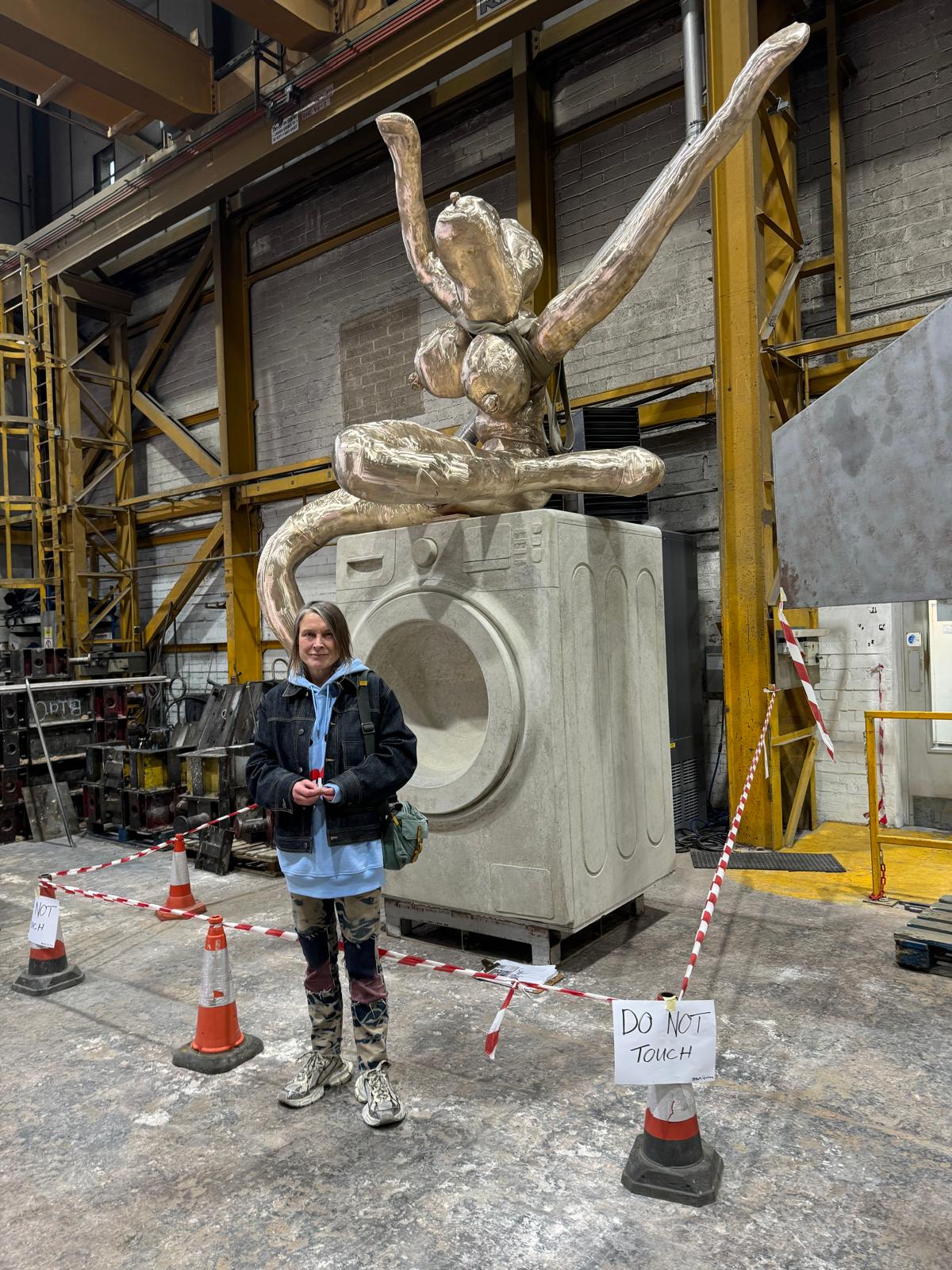
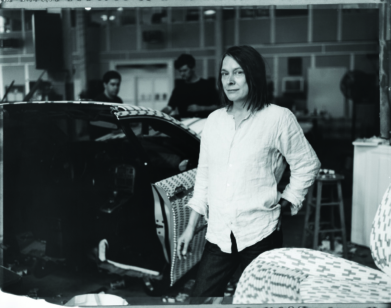
Sarah Lucas. Photo courtesy of Sadie Coles HQ, London.
For the next two years, a leggy, booby, fleshy creature will hold court on the Bowery, flailing her arms and kicking her yellow high-heeled feet atop a giant washing machine. VENUS VICTORIA by artist Sarah Lucas, the inaugural sculpture commissioned for the expanded New Museum’s sidewalk plaza, already has admirers stopping in their tracks to gawk. Who can blame them? Half woman and half abstracted rabbit, she’s a radical alternative to the anatomically correct female nude that centuries of male artists loved to carve and plop in public spaces; her jubilation the product of internal pleasure regardless of external reality.
Lucas was a key member of the hard-partying Young British Artists set that shot through the stuffy London art world in the 1990s with their stagings of personal and provocative work. At 62 years old, she’s less angry about the world being patriarchal, she tells Interview on a video call from her Suffolk farmhouse. She’s aware of that fact and would prefer her art “brighten things up” for people trying to live another day. VENUS VICTORIA is both feminine and phallic, inspired by the motifs of familiar domesticity and intentionally accessible to anyone passing by, not just contemporary art nerds. And while the lovely lady made of glossy bronze isn’t alive, as far as we know, Lucas swears that as a child she saw her babydoll’s limbs move in the night. So if you catch Venus shifting her weight or giving you a flirty wave at midnight, drop us a line.
———
FRIDAY 12:30 PM, MAY 15, 2026, SUFFOLK
———
GRETA RAINBOW: The first thing I have to ask you is, who is Venus Victoria? What are her desires? What are her secrets?
SARAH LUCAS: Oh, well don’t pry.
RAINBOW: You’re right, I’m so sorry.
LUCAS: I made a few different sculptures using the bunny figure, though not exactly the same one. I adjust things like the tits. Their attitudes change. But something about her consistently reminds me of a friend of mine, Cheri, who’s very girly and buxom and sexy. Quite often when I make one of these bunnies, it reminds me of somebody, but I don’t usually set out for it to be somebody. It’s really hard if you do. You’re almost never happy with it. This sculpture has a general femininity and a general exuberance.
RAINBOW: What do you start with if you don’t start with a reference?
LUCAS: Ha, good question. I just start, really. Things happen different ways around. After a while, I get a bit bored, or I start to think, “Why am I always making such skinny bunnies? I think I’ll make a fat one.” It usually doesn’t go how you expect. It gets difficult somewhere. I get fed up with them and chuck them somewhere else in the room, and it might be that one morning I come in and see it differently because of the bashed up way it happens to be sitting on the chair—not things that are deliberate. You get down a tunnel because you’re worrying too much. And then, when you let it go and you’re thinking about something else, it strikes you a new way.
RAINBOW: Maybe the bunnies come to life at night.
LUCAS: I used to think that when I was a kid. I used to wake up quite often at night, and I would think I could see the arm moving on a doll. I’d go and tell my mum and dad.
RAINBOW: Your space looks so nice. I wish I was there sipping wine with you.
LUCAS: Yeah? I’m with a glass of champagne. It was my partner’s birthday two days ago, but I was in New York and yesterday we were too tired and he was too busy. So we just cracked it open a moment ago.

Sarah Lucas, VENUS VICTORIA, 2026. Installation view: New Museum, New York. Courtesy New Museum. Photo: Thomas Barrett.
RAINBOW: Thanks for taking a break from celebrating. What are your thoughts on New York these days? I think people really associate you with England. What do you think about having your work in this prominent spot in Manhattan?
LUCAS: I was kind of dreading going to New York—not anything to do with the event or the New Museum, but just America. I was thinking, “Blimey, what am I going into here?” This sculpture has been made for quite a while. It’s overdue, due to the building taking forever to be finished as all building projects seem to do. It was almost made in a different time. The new New Museum seems unfathomably huge. You get this feeling in the art world these days that it’s becoming so hard to get any public money and things like that. So to be in a situation that wasn’t feeling like that at all, for a moment at least, was tremendous. I’m quite on a pendulum—not just about art, but in general. I’m an up and downy sort of person, especially in terms of an outlook on the world. God knows this year has been such a bastard. There was even a catastrophe involved in this sculpture because it got damaged. It was one of the great litany of things in my own life that have just piled on this year. It cheered me up to see it up. I don’t do many outdoor sculptures and that’s the first bunny sculpture I’ve scaled up.
RAINBOW: Are you scared for her to be on the street for a couple of years, all alone?
LUCAS: I suppose she’s not alone on the street. I have had other things outdoors, one of which was that horse and cart thing that I made, a Shire horse [titled Perceval]. Quite an unlikely sculpture for me. It was in a field here where I live in Suffolk for at least a couple of years. At one point, somebody scratched a drawing of a knob and bollocks onto its nose. And I thought that was quite funny.
RAINBOW: They should have gotten co-artistic credit.
LUCAS: The good thing about these things made to be outside is that they generally are robust, to some extent—touch wood—and can be put right. Unless the damage or the graffiti or whatever it might be was so interesting it was worth keeping.
RAINBOW: Venus Victoria feels substantial, especially the concrete washer she’s on, which I’m quite jealous of because I don’t have one in my Brooklyn apartment.
LUCAS: You don’t have a concrete washer or you don’t have a washer?
RAINBOW: Sadly neither. Why does she have one? Why is she on top of it?
LUCAS: She’s one in a series I was making at the time that can more or less sit on anything at all. I thought it was quite nice that it doesn’t have to be the same thing every bloody time. I have used washing machines as pedestals before. I hadn’t made a concrete one.
RAINBOW: What do you like about that material?
LUCAS: I like its reality, its basic building block of reality. Concrete is a mainstay of mine, I suppose. When I was at college and I didn’t know what to do at a certain moment, I made a little concrete cube. It was only about 10 inches square, and I just thought, “Okay, well, that is point A.” Somehow I’ve kept that mentality. It looks really good, I think. I could have thought, “Let’s make something that looks like a washing machine, paint that too.” But it looks great with buildings on the street, don’t you think? I’m very pleased.

Sarah Lucas, VENUS VICTORIA, 2026. Installation view: New Museum, New York. Courtesy New Museum. Photo: Thomas Barrett.
RAINBOW: Yeah. It’s like it’s emerging from the sidewalk.
LUCAS: It’s like a drawing, actually, of a washing machine embossed on a concrete block. On a more meaning level—and this is maybe the closest I get to thinking about Andy Warhol—something about her attitude was really very pop. The materials are pop. It’s not too complicated as a sculpture because I’ve got this feeling about public art: a lot of the people seeing it are not necessarily overly interested in art and it’s not particularly in their life. There’s a lot of people passing by who are not going into museums, and I was quite keen to communicate with everybody, really. A washer is relatable. I like things to be relatable. I also thought about post-WWII America and its tremendous production of motorcars, and its revolution of the kitchen for women in terms of appliances and all that…This thing of women being liberated from the drudge, and now perhaps even liberated from their liberation and the performance of liberation.
RAINBOW: So there’s not a certain kind of person that you think about when you’re making the sculpture and someone you hope will connect with it?
LUCAS: I didn’t grow up in a background that had any real notions about art—only in a sort of craft sense—and certainly no idea whatsoever that there’s any contemporary art going on. I was very aware of people’s—and my own, maybe—critical attitudes to art. I remember it being on the news when I was a kid, Carl Andre’s bricks coming to the Tate, and there was a total uproar in Britain. It struck me that people’s real outrage is a form of their appreciation, in a way. That’s the way they do it, even though they never realize it. I’ve always got that in mind. The variety of attitudes are not always seemingly so positive, but actually I take it as a kind of positive.
RAINBOW: Right. It’s like, “Thank you for thinking about it.”
LUCAS: Is that really pompous? I never think of myself as pompous.
RAINBOW: No, no, you’re not pompous. Not at all.
LUCAS: You’ve embarrassed me now.
RAINBOW: Oh no. Well, here’s another question. I can’t tell if Venus Victoria is happy to be doing the washing or if she’s happy to not be. I don’t know if the UK has what we call trad wives but…
JULIAN SIMMONS: [Opens the door and enters the room holding a bottle of champagne, which he holds up to the web cam] That’s the Mumm.
RAINBOW: I’ll take a glass, thank you.
SIMMONS: You know, there is a theory about women sitting on washing machines: that they do it for pleasure. Because of, you know, how it feels.
LUCAS: [Laughs] Oh god.
RAINBOW: Okay, this is what I was fishing for.
LUCAS: Thanks, Julian. [Julian Simmons leaves] My feeling about Venus Victoria is that she’s just having a great time. That would be one of my aspirations, not for women in particular but for everybody, if possible. The thing is, I was an angry young woman. Being angry and disgruntled was a part of my even becoming aware of women’s issues, because I grew up not questioning how patriarchal everything is. Not that I’ve ever grown up, but I was probably in my mid-20s when I really grasped that. I was considered to be this real punk, feminist type of person. I’m not sure how true that is.
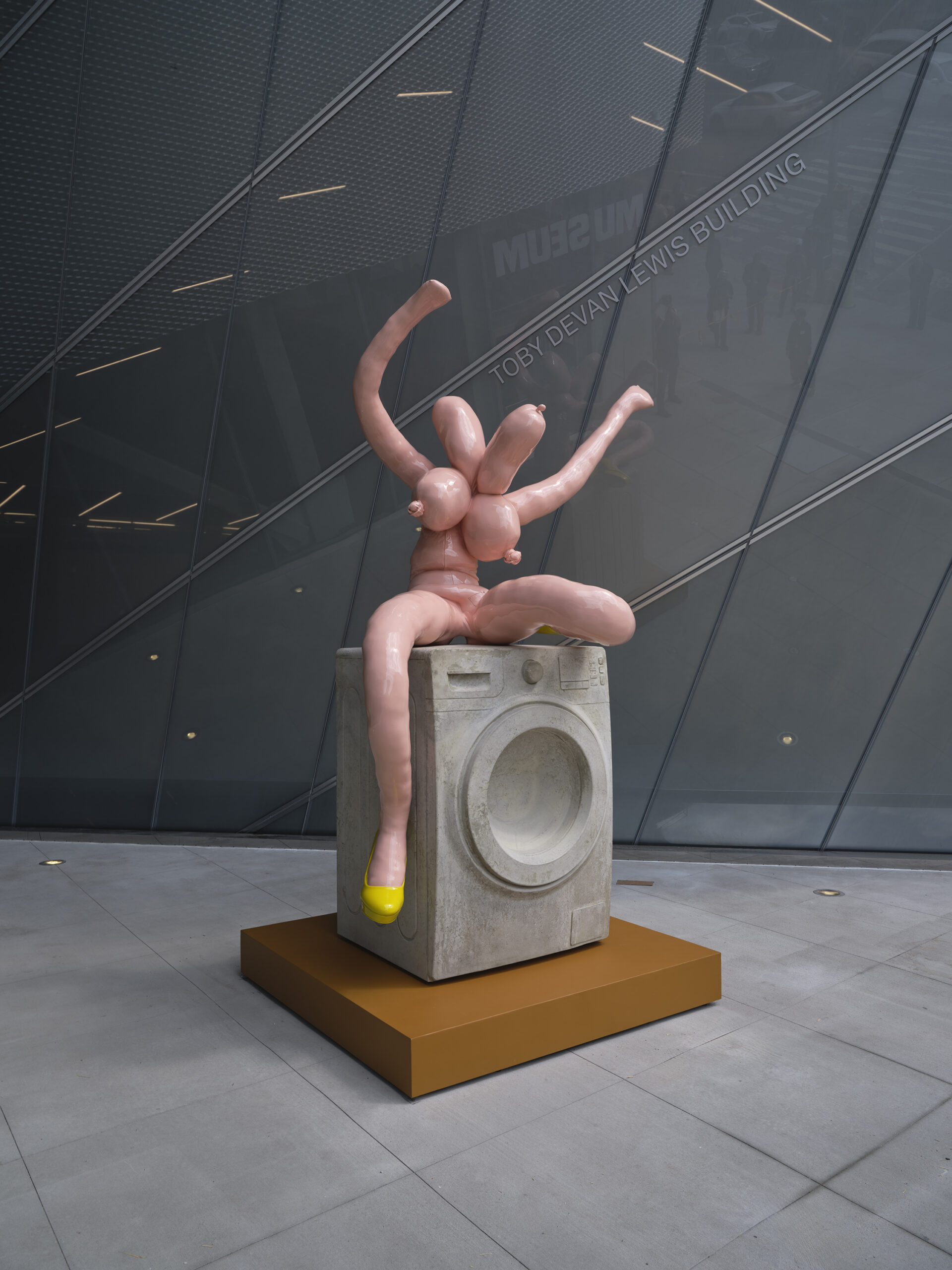
Sarah Lucas, VENUS VICTORIA, 2026. Installation view: New Museum, New York. Courtesy New Museum. Photo: Thomas Barrett.
Since about 2015, when I was thinking about making the show [I SCREAM DADDIO for the British Pavilion] in the Venice Biennale, I thought, “What do people want from me now, and what do I want?” I didn’t want to be recycling who I was at one time. This is when I really started using color. I wanted to be brightening things up for people because the times have become increasingly worse and worse, rather than becoming more and more angry and bleak. I make these sculptures and each one is just what it is. It’s amazing how much art does communicate. Women in particular feel some response to it. What that response is, I don’t really know, but I think it’s a felt thing. I think it is to do with recognizing the attitudes that the different sculptures strike, with having empathy for another thing, even if it’s not technically living.
RAINBOW: The bunnies are indeed unreal, and are so shiny and smooth. Obviously I’m young, but I’ve been really fixated on aging…
LUCAS: It gets worse, you know.
RAINBOW: I’ve been wondering, do I fear it? And what do I have to fear? Maybe the thing I fear is not being able to do what I love to do, which is write, because I won’t be seen and I won’t be desired. How do you feel about aging, and how has the experience of aging affected your practice?
LUCAS: It’s not that I never thought about it when I was younger—because I think I’ve probably always thought about it—but the younger you are, the older other people seem. As you get older, it doesn’t seem like that, and I was quite surprised. My most raucous decade was probably in my 30s, and even my 40s were pretty raucous. In the mid-50s, it starts to catch up with you. I’m speaking as somebody who smoked all my life and drank a lot all my life. But even if it wasn’t those things, you do deteriorate. I used to imagine, when I was younger, that there are answers in age. You think, “If people get to 80 or 90, they probably think they’ve had a good inning,” but I don’t think they do. It’s as unfathomable as ever. One of the worst things is not having as much energy. There’s not much you can do about that.
RAINBOW: There’s a lot of quotes about how you were the wildest of all the Young British Artists. Do you think that’s accurate?
LUCAS: I don’t know. I don’t compare myself with anyone else in particular, but I did have a period of seeming tougher—which I think was more of an aspiration of mine than a reality, because I don’t think I was very tough in the first place. And then I started to think, “I don’t even like being tough. Why would you want to be tough?” It suddenly struck me that to be gentle is a bit more of a luxury.
RAINBOW: Do you think Venus Victoria is tough?
LUCAS: I don’t think she’s tough, but I don’t think she’s a complete pushover either. I think she’s pretty confident. What would you say?
RAINBOW: I think she has that energy you mentioned.
LUCAS: Energy can be quite a good shield. It’s almost as if it protects you. Confidence in your convictions—of calling out trouble in the street, for instance—often seems to shield people. Trouble seems to slide away from them because of it.
RAINBOW: Yeah. Is it a karmic thing?
LUCAS: Or it’s a good example of what karma might mean. You’re a karma type?
RAINBOW: I do believe in the friendly universe theory.
Sarah Lucas, VENUS VICTORIA, 2026. Installation view: New Museum, New York. Courtesy New Museum. Photo: Thomas Barrett.
LUCAS: The friendly what?
RAINBOW: Friendly universe. It’s the belief that the universe wants you to be happy and wants things to go well.
LUCAS: When I said I think of myself as a person on a pendulum, I definitely think things work better when you’re feeling better. Oh, that’s my fridge that keeps making that fart noise, if you can hear it.
RAINBOW: I can’t hear it.
LUCAS: My fridge is quite perceptive. I think it can read my mind sometimes or hear what I’m saying. I do have a weird relationship with domestic objects, which is another reason I probably like things like washing machines. They sort of come alive for me. I don’t know if that’s universal. The way ordinary objects lie around, they’re expressing other things. For instance, I’ve got a load of mugs for coffee and tea, a random collection that has been here a long time. And they rearrange themselves. Or they get rearranged unconsciously, but in a way that means they’re forming relations to each other. That’s very amusing to me. They’re speaking to me, and it might be just color, or it might be an image. Sometimes, in certain moods, you can walk around and the whole house is like that; all the furniture, it’s like it’s saying something to you that they haven’t said to you before that way.
RAINBOW: Objects become extensions of yourself.
LUCAS: I think that’s quite inspiring, though “inspiring” is a bit of a fancy word for something that can happen on a much more mundane level. I’m using a lot of domestic stuff—furniture and tights, or whatever it might be—and you get a feeling for the material, living alongside it. I am in a relationship with the domestic items around me. Not necessarily domestic things, but just things around me.
RAINBOW: Right. You happen to be a woman living in a house. It’s just your experience.
LUCAS: Spot on.
RAINBOW: I think that’s a great place to stop. Is there anything else we haven’t talked about?
LUCAS: I don’t have an agenda. I always liked that phrase: agenda. [Laughs]
RAINBOW: You have the best laugh.
LUCAS: I’ll see you in the outside world somewhere then, one of these days, Greta? Amazing name, by the way. Is it real?
RAINBOW: Yeah, it’s my family’s surname. It’s my dad’s name. He’s English, actually. Sometimes it feels a bit much, but it’s just what it is…
LUCAS: Because it’s been raining on and off all day, we had a rainbow at the back stair. I thought, “Well, that’s interesting.”
RAINBOW: I was drinking wine with you there after all.