

Film

KT Auleta: It Takes a Village

Alex Gartenfeld  02/27/2009 04:45 PM

Trailer for Runaround


Runaround
is the first and only story that photographer KT Auleta has written; she wrote it around six years ago, but when her day job took off, she shelved the story. This year, Auleta reduced the screenplay from feature length to twenty minutes, and shot in September 2008. She took a cast and crew to her hometown in upstate New York; there she began to set the story of a young, compulsive girl named Jay, her dysfunctional relationships and her (equally dysfunctional) sidekicks. Last week the film screened at Anthology Film Archives to a full house of friends, family, and colleagues; it will screen again to broader audiences in April before hitting the festival circuit.


AG:  It was nice to recognize some of the people from the film. Jake had been in Ryan's photographs. But I didn't recognize the lead, Jay.

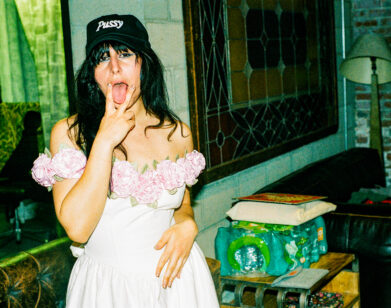
KTA: The acress is Isabelle McNally. I found her through a casting agency, Development NYC—Douglas Perrett's agency. She was one of the main people that I loved right away. She's only 19, but I had shot her for Self-Service for a project called "Sons and Daughters." The shoot was about famous people's children.

AG: Who is her parent?

KTA:  Her father Keith owns Pastis.

AG:  That's funny. In the context of the film I can imagine a john taking Jay to Pastis, but not going there with her dad.

KTA: She's got a great look. And I knew what I wanted out of this character.  I knew this character had to be really strong and independent, timeless looking. A timeless beauty really.  Well, all the characters had that. It was loosely set in the early 90s. I didn't want to hit you over the head with some kind of period piece. I wanted it to feel that way, so I needed people who felt timeless and didn't look "Downtown Cool," or too urban.

AG:  It was a very American story. The clothing was a little 90s, but not too much.  

KTA: Avena Gallagher did the costume stuff and she did a great job. Some of it was propping-the girls propped the room themselves. We went out and got a bunch of stuff. Our production manager, onsite production manager, who was also in the film as Spencer, this guy Ben Werth. He's an old friend of mine from high school.  When I started becoming serious about the project the first person I reached out to was him because his family is still very much in that town-he still spends a lot of time there in the summer. He had the relationships in town—those were real parties they were at in the film.

AG:  What's the town?

KTA: In my hometown of Oswego, New York. It's about six hours northwest of here.  It's near Syracuse, but it's on Lake Ontario.


AG: Is it an old steel town?

KTA: It was an old shipping town, there was some industry there.  The Oswego river was an entry way into the Great Lakes. It was an important spot at the turn of the century.

AG: So it's a little depressed.

KTA: Right now, absolutely. It's always been a working class town and there's a small state college there. So there's always been this dichotomy—just these people that are from somewhere else. It's far enough away from a big city where three generations stay there and never leave.  

AG: So you went to a house party—

KTA: We just set it up and had a party. We rented a house where the crew stayed.  All my experience doing photo shoots on a dime really came into play.  I was like, "Let's find a perfect house, we'll trick out the bedrooms, and have that be the girl's bedroom." It had a roof we could set a scene on, too.

AG: On the roof there's an amazing scene with the bees. I wondered how you planted them.
 
KTA: No, the bees where there. We wrote it into the script.  I think it was a great metaphor for the danger the girls were facing and their vulnerability.

AG: There's that great mirror, where they're on the roof with the bees there, and then one of the girls gets "stung" by the cigarette butt.

KTA: Totally, but that was already written into the script before and it just kind of fit in.  A bit of the film was improvised; we didn't figure out the whole conversation they were supposed to have. We shot in just four days—some of them were twenty-hour days, but it was a really fast shoot. It's something I learned from being a photographer, working on budget. Come in, bomb it all. What really worked, is that everyone really got into character. The girls were staying all together at my dad's house and I was staying one room and they were staying in another room.  Every morning we got up and my dad made us breakfast, kind of how it was when I was that age. It put everyone into that mood and harkened back to those days.

AG: Did the actor know each other before?

KTA: No. It was a quick bonding experience. Crazy stuff went on, at the party, and on the way home.

AG:  Were there local kids at the party?

KTA: Yeah.

AG: What was their dynamic with the cameras?

KTA: We set it up being like "Hey guys, we're shooting this film." Benji, who is from my town, has stayed closely in contact with people there. It was shot at his camp, in the back of his family's camp. His mom made it all this food. We got a keg and invited anyone to come who wanted to come and they basically partied, while we were filming.

AG: With Mom watching?

KTA: She's just awesome. Char and her husband Mike Werth, they're just amazing human beings. Just having everyone come out and have people be like, "Yeah, this is our story." This is everyone's story, and everyone can relate. 

AG: It must have been interesting for the parents watching the filming, because they are so absent in the film. The film is almost like the Peanuts, with the parents honking off screen.

KTA: Right. It doesn't have the same biographical resonance. There is certainly stuff that I bring in autobiographically. It all started when I found this book, [Emily White's Fast Girls:] Teenage Tribes and the Mythology of the Slut. I read it and I had such a strong reaction.  It was clearly the story of a studious girl who thought "How free and amazing to be this free sexual being?" I wanted to show that of course people make mistakes when they're reaching out and experimenting with your sexuality. But the freer you are, the more society frowns upon you. I don't think that was the main story, but I think that was the underlying story beyond the simple love story.

AG: How much of this comes from your experience in Oswego, or your experience of girls who behaved that way?

KTA: I'm coming from that group of girls. That type of girl who makes decisions that aren't socially accepted in a small town.

AG: So much of the experience of Runaround is watching through a feminine perspective. The trailer begins with the girls on the bikes in the field—Jay, Jean Marie, and Kim the three main female leads, on a silent road.

KTA: Well, I think about gender all the time in a kind of a passive way. Would my relationship be different with a female model than a man? Absolutely. Do I get more out of a male model, a straight male model, as woman-absolutely. These things that are just there.  They're not better or worse, but of course there is more to say-for instance, these are girls, they're not woman.  There is more to say about woman, but I am ready to move to a male character. A very male character, someone who doesn't attach himself to society or woman and he is very independent. That idea of freedom, I was talking to somebody who was asgking why someone I think is so free can't be a woman. I've been thinking about that a lot.

AG: On a photo set the "women" are generally girls.

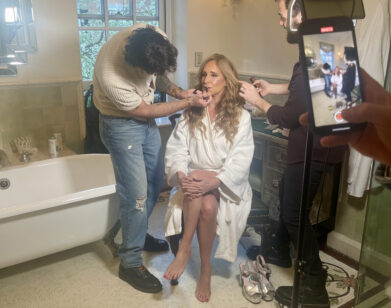
KTA: I'm most interested in helping them become women. I really enjoy the aspect of helping them create a character. I was talking to a stylist on a recent shoot and we noticed that the girl was getting peppier and stronger in just two days. She had started quiet and meek, and we were empowering her with the character she was meant to play. He was like, "It's so funny, you're going to meet this girl in a year and never think it's the same girl." They take on the strength of the characters that we've given them during this fantasy of this shoot. They gain intelligence and strength and perspective from artificial characters.

AG:  Did you connect to the early 90s for some of the look of the film because it was your experience?

KTA: I think partially it was my experience and it was also a time before hyper-communication.  This kind of hectic amount of communication that happens now. I think there was a purity to that time, especially where I was from. We didn't really have MTV and there wasn't even a mall in town. 

AG: If these girls watched MTV or were on the Internet, they might be less inclined to go to a third-rate rock club.

KTA: Yeah, they're not savvy about aesthetics or culture.

AG: You begin with the racetrack scene, which is such a strong metaphor, and alludes to the title of the film and the cyclical destructive behaviors in the film.

KTA: Absolutely, it's about running in circles. It's also an old fashion term for a slut "to run around," and it's giving "Someone the run around."

AG: Did you have a racetrack in Oswego? 

KTA:  Yep.

AG: Did you go there? 

KTA: It was in the consciousness, and I used to go there after the race for the parties. People would come in for the races and set up camps all around the racetrack and there would be bonfires everywhere and people partying.

AG: It's like a carnival almost.

KTA: Yeah, people come mostly from Canada, but also from all over, to see these cars go round and round in a circle. One of the mayors was a racecar driver.  It was both culture and sub-culture. And these fast racecars and everything seems hot and cool, but in the next scene the girls are on their little squeaky bikes.

AG: Cuts them down to size.

KTA: Yeah, totally.

Tags: Oswego, Avena Gallagher, Jake Boyle, Isabelle McNally, Anthology Film Archives, KT AUleta

Email
Add a Comment
View All Comments

Add a Comment

Be the first to add a comment.
Art in America