


Luigi Colani


You could call Luigi Colani one of the most influential and underrated designersof the 20th and 21st centuries. And he would probably agree—most likely with an exclamation point, which is how he punctuates most of his sentences. It’s fitting, given that Colani is a man of extremes. For more than 50 years, he has created breathtakingly beautiful, biomorphically streamlined cars and planes that have broken speed records. He has also been a leader in the detail-centric field of ergonomic design, having received particular attention in 1986 for his design of the Canon T90—the first camera conceived expressly for the shape of the human hand and eye. In no time, the T90 was knocked off by virtually every other camera maker.
Born in Berlin in 1928, Colani grew up obsessed with the interplay of design and motion. As an adult, he became a wildly prolific designer, and his biomorphic vision extends beyond motorcycles, automobiles, and aircraft, all the way to chopsticks, headphones, chairs, and china. (His 1971 Drop teapot for Rosenthal—the shape of a raindrop in free fall—is a stunner.) Pretty much anything Colani could think about putting his hands on was fair game.
But Colani considers himself more a theorist than a designer. Now age 81, living in Germany and China, and perpetually dressed in a signature white sweater and white pants that have been his look for decades, he’s cultivated a philosophy where forms are derived from the sensual (even sexual) shapes of nature—especially his favorites, fish and birds. Colani’s stealth aesthetic might have been viewed as a bit out-there or space-age back in the 1970s, when his ideas seemed better suited to a concept car or a Star Wars set than an assembly line at General Motors. But now, with the world suddenly waking up to notions of fuel economy, -Colani’s stentorian position on streamlining and fuel seems more relevant than ever.
And as architects and designers as diverse as Karim Rashid, Zaha Hadid, and Santiago Calatrava have all ridden the sinuous curves of biomorphism to stardom, Colani’s fantastic visions look less like futurist fantasies and more like premonitions of design to come.
DAVID COLMAN: Obviously, people who are in design know who you are, but I don’t think people outside of the design world necessarily do.
LUIGI COLANI: In 2007, I was named World Champion of Car Design, World Champion of General Design in London, in Pasadena, in Paris—even in China.
COLMAN: But you’ve been incredibly influential and don’t get enough credit.
COLANI: I’m copied all over the world. [laughs] You see, shit is not copied.
COLMAN: Very true, nobody copies shit. What was the first thing you saw where you thought, I want to design that someday!
COLANI: That’s a funny story. I was 3 years old, and we had a very rich neighbor in Berlin who drove a Mercedes sports car. I remember standing behind this car, admiring the trunk, how nicely shaped it was, for an hour. That shape has never left me—I could design it today!
COLMAN: Were you obsessed with cars even then?
COLANI: No. I was more into high-speed trains as a child. We lived near the railroad tracks—200 yards away—and there was an aerodynamic, high-speed train that went from Berlin to Dresden. It was this fascinating yellow and crimson machine, very streamlined. I would stand and watch as it went by.
COLMAN: In the early 1930s, streamlining was an amazing new force. Do you feel lucky that you were a child then to see it?
COLANI: I was very lucky to see all these airplanes and ships and cars. We lived near a very famous airfield outside of Berlin, where the first plane loops were done and prototypes were flown. I could see these fantastic streamlined airplanes from my window, going up and down. I was absolutely crazy for aircraft. COLMAN: What was it like being a teenager in Germany during World War II?
COLANI: I was 16 or 17 when the war ended—when we got bombed by the British and the Americans. It was not a very lucky time, but we lived on the outskirts of Berlin and weren’t hit at all.
COLMAN: How did being in Germany then affect your sense of the world?
COLANI: Everybody in Germany was for the -German cause. But then, after the war ended, when I heard the first Glenn Miller sound on the radio and these fantastic American music makers, I turned into a jazz fanatic. They called me Benny, after Benny Goodman. So, all of a sudden, the eyes of young Germans were opened to America—everything American was absolutely at the top of the list.
COLMAN: And after the war, you went to design school in Paris. How did you end up being so theoretical when it comes to your work?
COLANI: I consider myself a 3-D philosopher. I am not a designer at all. I studied aerodynamics, I studied philosophy, I studied sculpture. High technology on one side, and on the other side, art. First, I studied sculpture at the Academy of Arts in Berlin. Then, after two years, I left for France to study aerodynamics at the [École] Polytechnique, but I already knew so much about aerodynamics from watching trains and cars and planes. So I went to the Sorbonne to study analytic philosophy. And I learned to ask myself questions like: Why is something made the way it is? Why does a motorcar look like it does? Is it right or wrong? What is an airplane? Why is it shaped like that? Then, later, I became a diver and studied subaquatic life and the streamlining of sharks and manta rays. Any fish is superior to the shapes we humans have invented—and unchanged for 250 million years, imagine!
COLMAN: Well, you get a good design, you stick with it. What was the first thing you made that you were really proud of?
COLANI: In the late ’50s I bought an old Volkswagen Beetle, and I designed a sports car and made an open two-seater out of it. It was the first kit car in the world. I built a couple thousand of those in Germany, made some money, and started designing cars like a madman.
COLMAN: It looks like a dune buggy. You were working on lots of other things too at the time, right?
COLANI: Lots and lots—altogether I’ve designed between four and five thousand things. In the early 1970s, these letters started piling up on my table from companies in Japan, saying, “Please come. We need a man like you.” I didn’t want to go to Japan, so just to get rid of them, I named a fantastic amount of money that they’d have to pay. And they accepted! [laughs] I got there, and I saw how stupid the Japanese were, as far as design was concerned. Overnight I was the number one designer in Japan. I started designing cameras and suitcases and all the stuff that made Japan famous. I was chief designer at Canon.
COLMAN: The Canon T90 is still an archetype of camera design—the first ergonomic camera modeled to the shape of how the human hand holds something and how a camera fits to your eye. It might be your most famous design. I can’t believe how old it is, because I think of it as so modern.
COLANI: One of the best cameras in the world. It took two years of me telling them that a camera is a thing between the human hand and the human eye, so it had to have ergonomics on both sides! They got the message, and we did it, and overnight it was the camera of the world. Everyone—Nikon, Yashica, Sony—all copied Colani.
COLMAN: Now people use an LCD screen rather than a viewfinder on a camera. Have you thought about redesigning it?
COLANI: I am working with the German Zeiss company on the camera of tomorrow. It will only be a lens with a grip on it—that’s all. Not a stupid box like we have today.
COLMAN: What about Detroit? Did you ever work with American car companies?
COLANI: Bob Lutz, one of the GM bosses, called me to come there, and I went with my streamlined truck and a couple of high-speed cars to Detroit. Everybody was inspired by the drawings and the wind tunnels and the race cars—but no one wanted to work with me because I had a reputation for being an aerodynamic dictator! [laughs]
COLMAN: In the 1990s, Detroit tried to adapt your streamlined ideas with these soft-shape cars, but they really lost all sense of the visual beauty.
COLANI: 1973 was the first gasoline crisis in the world. That year, I designed the first aerodynamic truck, eating 40 percent less fuel. I put it on exhibit everywhere. It was 30 years ahead of its time. Nobody is building it today, and everybody still has problems with their boxy cars and trucks eating up fuel. Finally, I’ve been in contact with American companies like Kenworth to design streamlined trucks for them, and a man is driving one of my trucks around America to get people interested in them because gasoline is such a big problem. This stuff won’t be around forever. We need super-streamlined machinery. They don’t get the message, even today!
COLMAN: Do you think that the world is more receptive to your work than it used to be?
COLANI: No, no, no. You see, if you are 30 years ahead of your time, you will always have difficulty speaking with the bosses in the industry. They are too conservative.COLMAN: But design has come to be such a selling point. A decade ago, we didn’t have people like Karim Rashid, who has clearly gotten a lot of inspiration from you. And now his name on a product helps it sell.
COLANI: There are two designers in the world—Karim Rashid and Ross Lovegrove—who both consider themselves Colani fans. [laughs] I’m very proud of it. That’s fine.
COLMAN: I’d say there are more than two. Maybe they don’t want to cop to it, but plenty of people have drawn plenty of inspiration from you.
COLANI: The thing is, 75 percent of design today is absolutely outdated. It all has to be redesigned with the materials and knowledge that we now have. We know so much more than what we are doing. At the moment, I am designing two planes that are so advanced from other aircraft that you would be astonished. This is my success and my burden at the same time. It isn’t easy for me to have contact with the industry, because it is so outdated. Look at General Motors, look at -Mercedes, look at Chrysler, look at Porsche, look at BMW . . . They are all building cars from yesterday! Nobody has an idea how the car of tomorrow should look. I’ve built them already. I have the prototypes in my exhibition, but they won’t do it.
COLMAN: Why do you think that is?
COLANI: I have been very outspoken. The world is super-stupid. You have by far the best designers in America! And you do the most stupid cars in the world! They put billions into their stupid designs for General Motors, Chrysler, Buick, or who knows what. The designers in America must be frustrated. I am not frustrated, because I am not a designer—I am a philosopher, and all philosophers have said for ages that the world around them is stupid. Da Vinci said it, so did everyone up to Karl Marx. They all said, “The world is stupid—they always go the wrong way.” I’ve just built a small electrical car that I am unveiling in Hanover. This will shatter the whole world because it’s very light, very streamlined, very cheap, and very beautiful. We are putting it on exhibit with these wind-power generators that I’m designing here in China. We designed the propellers, we designed the hub . . . We are building those in China in big numbers.
COLMAN: It makes sense that you would do great wind-power generators. You have got some major propeller ideas.
COLANI: [laughs] I am like the inventor of the propeller, because it was outdated and it was going away 70 years ago when the jet engine came in. But the jet is too thirsty, too loud, and not fuel efficient at all. You can fly with propellers very fast and more economically.
COLMAN: Your designs have a really refined, striking aesthetic. Do you find it disappointing, the marginalized role that beauty plays in the world of design?
COLANI: Look at nature—look at birds, look at fish. Things that look good, work good. People don’t get the message of ergonomics.
COLMAN: The word ergonomics is funny because people think of it having to do with safety and health, and not with aesthetics or beauty.
COLANI: It has a lot to do with beauty, with efficiency—the human being is in the middle of it all. Your hands, your eyes, your nose, your legs, your feet, your ass . . . It’s the things that are designed to cover your body that are all wrong.
COLMAN: One thing I wanted to talk about was how sexual your work is.
COLANI: Well, sex is life. You know, if you don’t do it anymore, you can take a spoon and go into the woods and dig yourself a hole and be finished! [laughs] Eroticism is the driving force behind everything in the world.
COLMAN: Is that a big part of your philosophy?
COLANI: It is absolutely the central theme—that life is erotic, period. The female body is one of the most extraordinary designs ever done in this universe.
COLMAN: I happen to think the male body has certain charms, but that’s my own preference.
COLANI: Male bodies can look very nice, but the female body beats them all.
COLMAN: Is there a country today that is willing to accept and celebrate design?
COLANI: Well, 30 years ago it was Japan. Now it’s China. China came from a communist dictatorship of the ugliest kind to become a country which today has a smiling population. Things are getting better and better every day—you can feel it, you can touch it over here!COLMAN: Did you ever live in America?
COLANI: I lived there for three months here and six months there, but never for a lengthy period. I always wanted to stay in America, but I never was asked by any industry to come and work. They always said they admired my work, but nobody ever asked me.
COLMAN: Why not?
COLANI: America is very conservative. It is not a very modern country. If you look at the population, they are very serious, very nice, very good people. I love the Americans. But they are too serious to be modern. But it’s not too late. With the last election, America has proven that it’s a very young country at heart. We have big hopes in the world that we can again love America for what it is.
COLMAN: Are there artists you feel a kinship with?
COLANI: Today the guy I admire the most is Syd Mead. He’s a conceptualist—he did Blade Runner [1982], Aliens [1986], and so on . . . He’s designing things that are not yet there for the next 50 years.
COLMAN: What about architects? What do you think of Santiago Calatrava? He seems very -influenced by you.
COLANI: He is not an architect—he’s an artist. He is doing some extraordinary things. And he is a Spaniard, so he’s overdoing his architecture. There’s too much shape, and he wastes material at an astonishing rate, but he is one of the best at the moment.
COLMAN: What about Frank Gehry?
COLANI: [laughs] I will kick his ass.
COLMAN: [laughs] Very nice.
COLANI: He is a guy whose mouth is bigger than his brain. [laughs] I don’t like the things he does, because if you look at the interior of his designs, like the Bilbao thing, it looks crazy outside, and if you go inside, you bump into every steel corner. An architect has to build the building from the inside out, not the outside in!
COLMAN: Have you followed the rebuilding of ground zero, where the World Trade Center was?
COLANI: If I had been president, I would have come out and declared: “Nothing there, ever! This place stays as it is. We make a big place there where people can pray about the errors we have made that those two towers had to fall.” I’m a very peaceful man. In the ’80s, I was the chief designer at Thyssen, one of the biggest companies in Germany. But when they asked me to design armored vehicles, tanks, and submarines, I quit overnight.
COLMAN: Okay, one last question: Why the white sweater and pants?
COLANI: Well, I work every day with material that is white—plaster or Styrofoam—so I always have white things on. I can just brush off my chest and legs, and I am clean again.
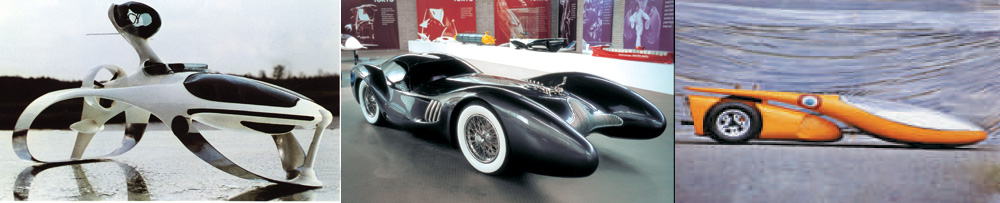
Photos: Colani’s Hydrofoil, 1978. center | His interpretation of the German Horch roadster, 2004. right | A life-size model of a two-part hybrid car, with an engine from a Lamborghini Miura and a cockpit-like passenger cabin, 1978. All images courtesy of Bangert Verlag.
David Colman lives in New York and writes aboutfashion, design, and art