


MET GALA
Meet the Man Who Gave Bad Bunny Jowls


Vogue Magazine/YouTube
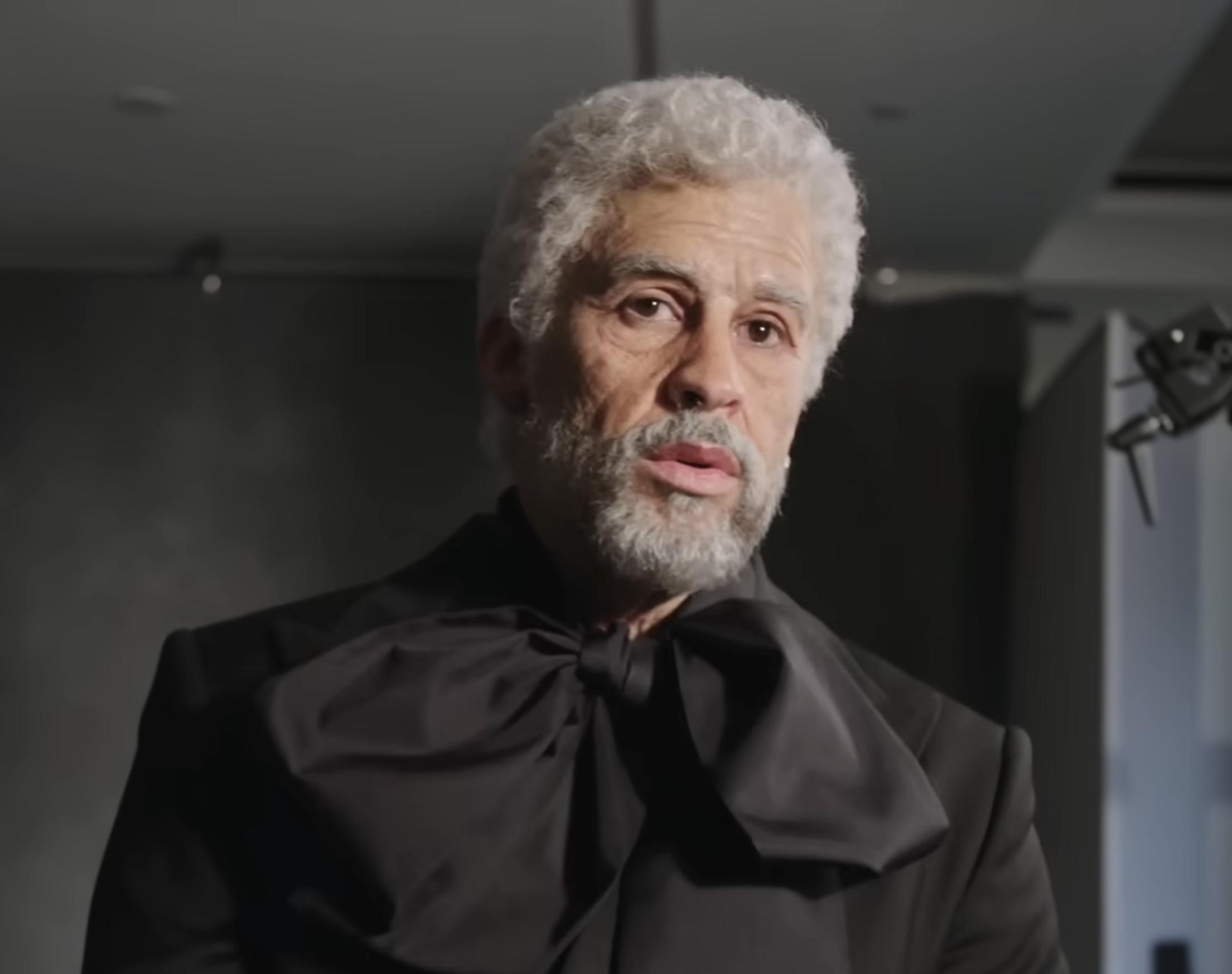
Mike Marino is a renaissance man—literally. The Prosthetic Renaissance founder and art history buff sees the practical makeup effects he does for movies, TV, and red carpets as existing on a continuum with the work of the Old Masters, arguing they’d also be creating with latex, rubber, and 3D modeling if they were alive today. Perhaps that explains why Marino’s prosthetics have become increasingly in-demand in recent years with both Hollywood and celebrities looking to shapeshift for one night. His work has appeared on The Batman, True Detective, The Weeknd’s Dawn FM album cover, and any number of Heidi Klum’s iconic Halloween costumes over the years. Most recently, he paired up with the supermodel again on her statuesque 2026 Met Gala costume, and also helped Bad Bunny get a glimpse into his silver-fox future. We caught up with the prosthetics maestro post Met Gala to find out more about entombing Klum in marble and what is was like putting jowls on Benito.
———
THURSDAY, 12:02 PM, MAY 7, 2026 NEW YORK CITY
———
MIKE MARINO: Hi, there. How’s it going?
EMILY KIRKPATRICK: Good, good. How are you?
MARINO: Oh, crazy. Absolutely crazy.
KIRKPATRICK: It’s been a wild week.
MARINO: I can’t complain. Not only Met Gala madness, doing two people, but then coming back and jumping right back into Batman.
KIRKPATRICK: Oh, man. It never ends. Let’s start with that. Tell me about the process of how these two Met Gala looks came together.
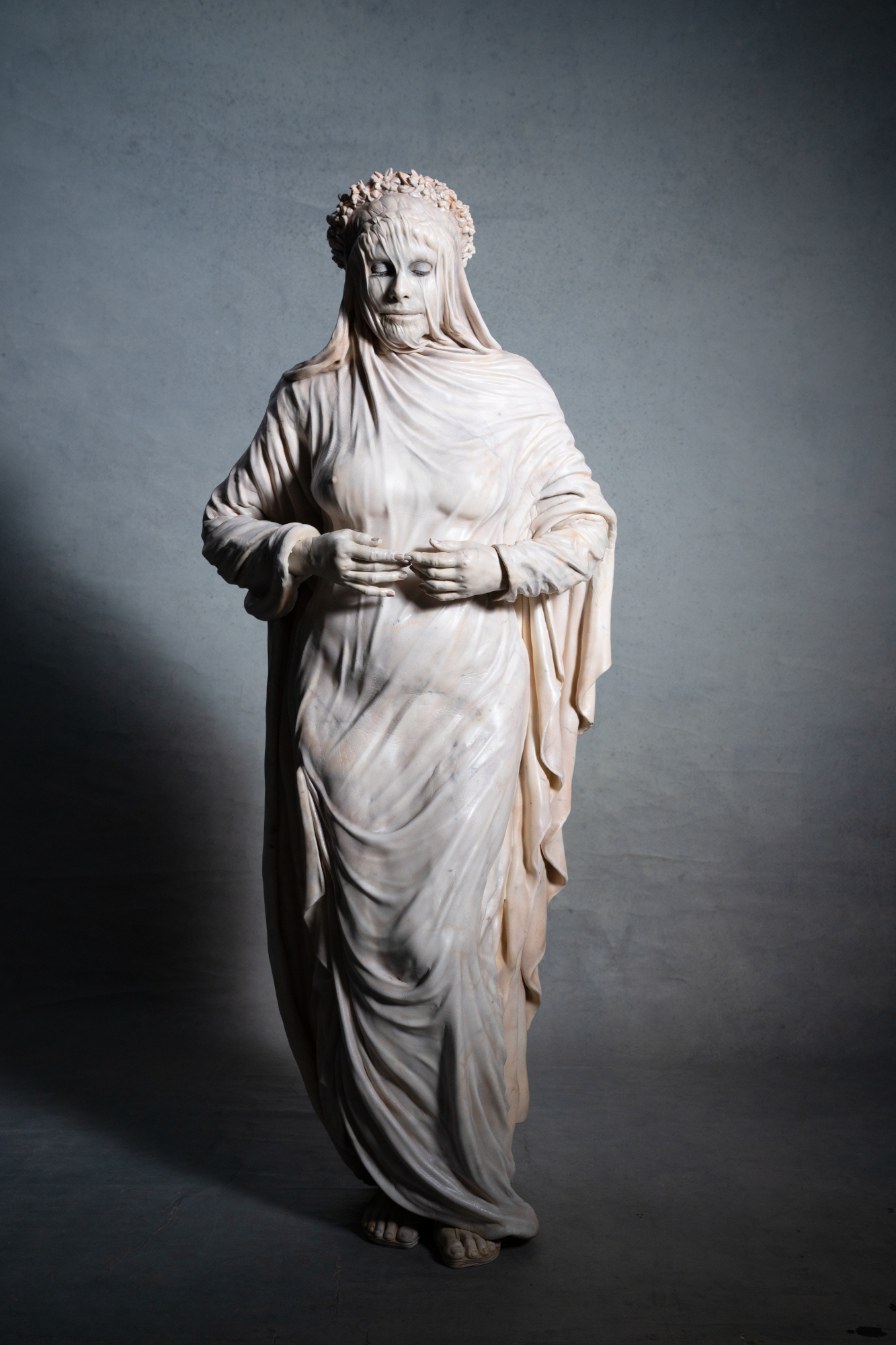
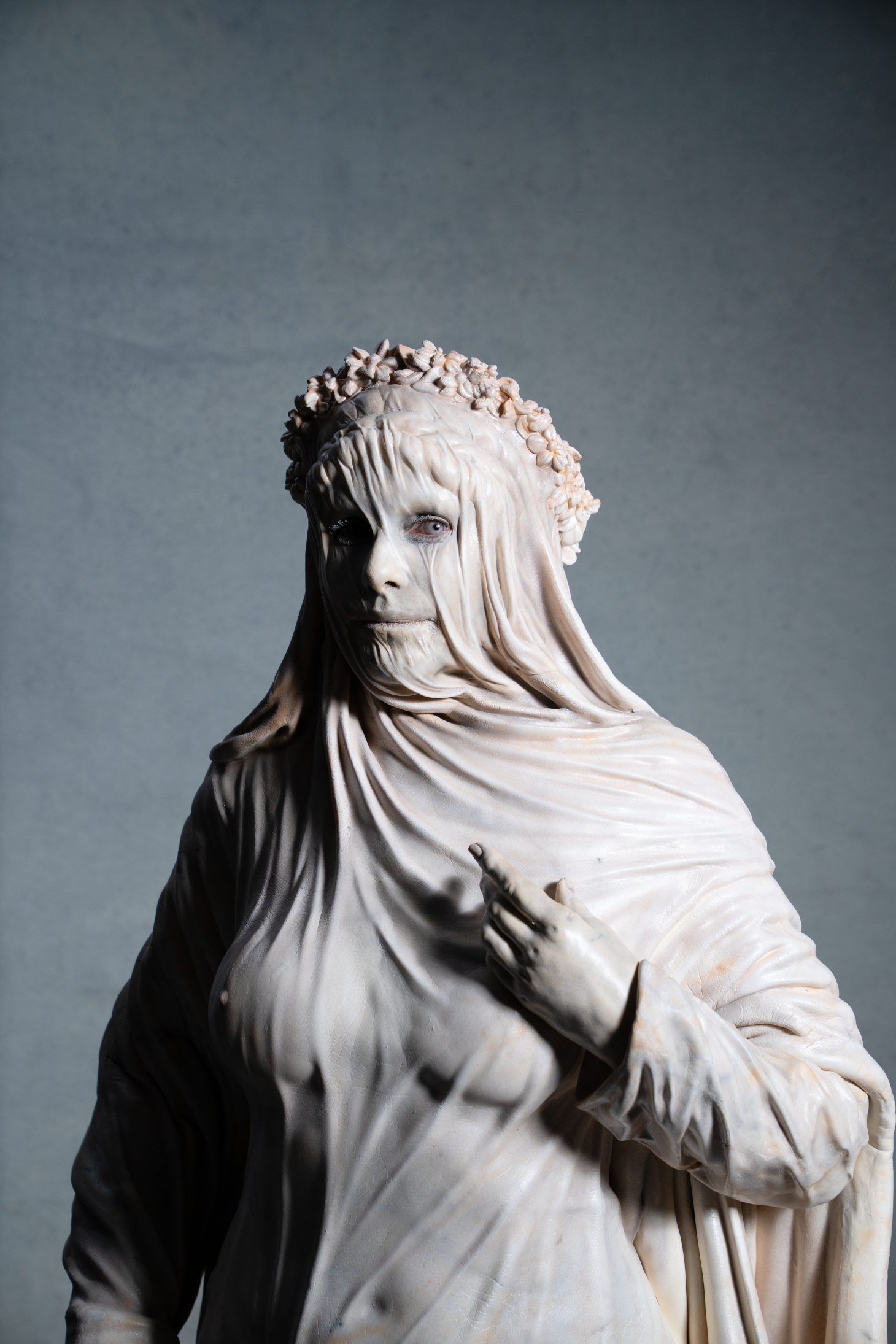
MARINO: Well, I’ve been working with Heidi [Klum] for many years, maybe almost 15 years. Mostly Halloween stuff. We’ve tried to do something for the Met Gala, but timing didn’t really work out. And then this year came about, and she reached out to me and said, “Hey, let’s do something really cool. I’m not sure what to do.” And I was thinking maybe we could do something that’s in the gallery, or something inspired by the Metropolitan Museum of Art. We discussed, is it a painting? Is it a statue? And I was like, “I think people will probably do more paintings. We should do a sculpture, maybe something in marble.” And then I said, “It would be really cool if we did like ‘The Veiled Christ’ by Giuseppe Sanmartino or Raffaele Monti’s ‘The Veiled Vestal.’” I sent a photo and she goes, “Oh, my god, I have this thing by Raffaele Monti.” It was a bust she had. She pulled it out and I said, “Yeah, exactly.” And she goes, “Done, done, done. Let’s do that.” So, that’s how that all came to be.

Courtesy of Prosthetic Renaissance
KIRKPATRICK: Cool.
MARINO: And as far as Bad Bunny, they reached out to me with a rough design. I don’t know if it was AI or Photoshop or something, but it had my name on it already. It had “Makeup by Mike Marino.” So, I was like, “Wait a minute.” I guess they made a wishlist—a wish design. So, I said, “Cool, let’s make it happen.” There just had to be some way to time it so that we could do both of them and make them both look good, which we did. I set up two separate teams to prepare because they weren’t being done in the same place. There was a 30-minute drive in between them. So, as soon as I finished Heidi, I went right over there and I was ready to do him. It was a perfect time setup.
KIRKPATRICK: That’s great because I feel like, in New York, a 30-minute drive can easily turn into an hour drive.
MARINO: Yeah. I had some angels following me around.
KIRKPATRICK: No joke. How long in advance were you given to prepare for each of them?
MARINO: It’s usually a couple months for both. It was a little bit shorter of a timeframe with Heidi. Usually, we have a lot more time to figure it out because it’s so complicated. And this one was so crazy complicated to figure out technically. But the good thing is that we cut some time out because we already had her body. We could immediately start sculpting and all that because a lot of the length in the process is taking a body scan, taking body casts, all that stuff.. But we already had a 25% head start, so we could cut some time out of the build. But still, doesn’t make it easy.
And Benito, we didn’t have him. So, we went down to Miami where he was at the time, and then we scanned him there and took photos and measurements and all the things we needed.
KIRKPATRICK: So, for something like Heidi’s costume, is that just a full body suit that’s being put on, and then you’re doing additional prosthetics on top of that?
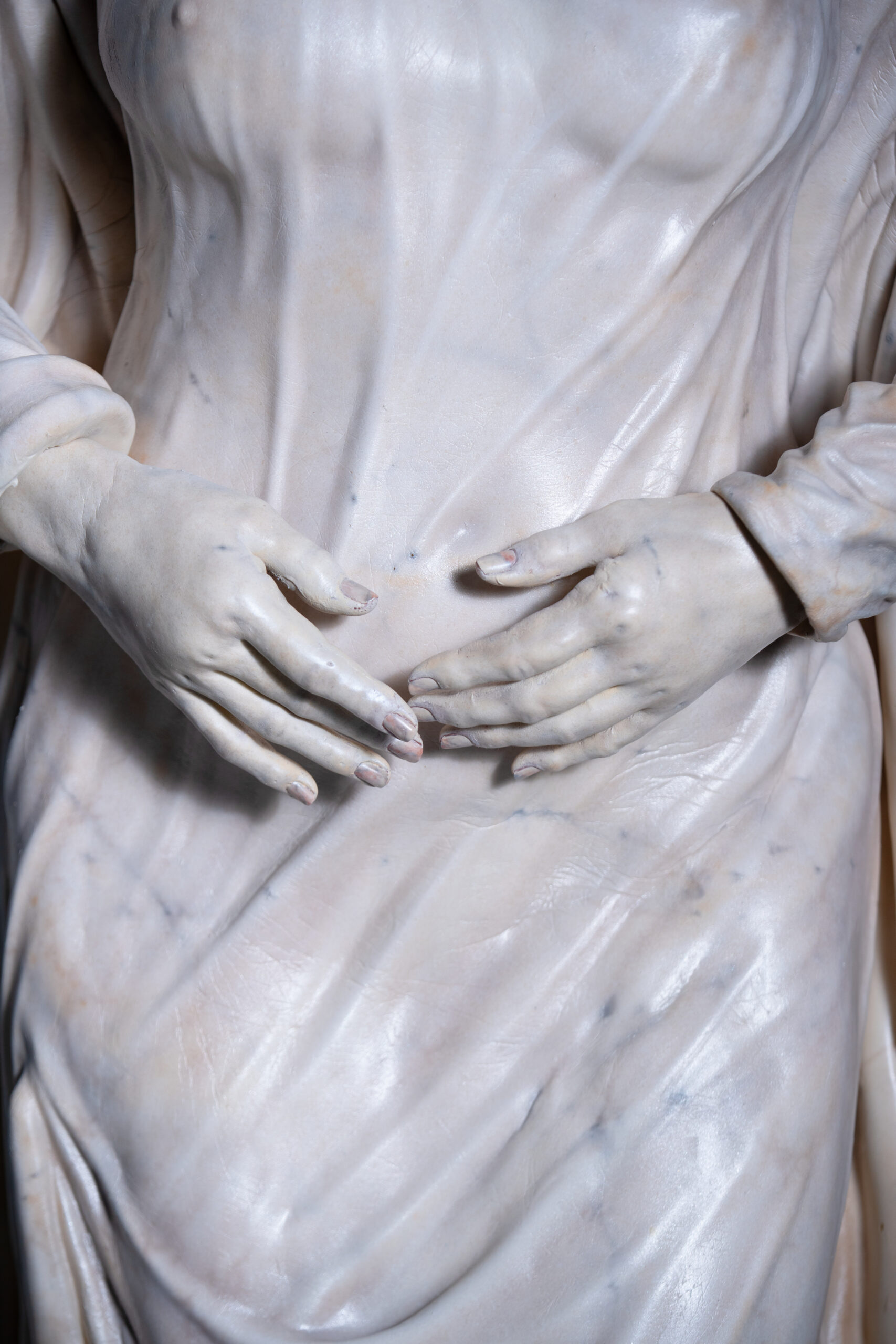
MARINO: Yeah, I try to think about the how. A lot of it is engineering. How these work is it’s like a puzzle and the pieces overlap onto each other and you have to design it that way. So, we made this suit where she kind of slips in. It’s custom fit to her body on the inside and there’s a corset inside that just holds the suit on. The zippers are hidden within the folds, and then there’s an arm that’s separated that buttons on the inside because one arm is designed to go up so she can bend her arm. Then the face goes on and overlaps onto that full body suit so that it blends directly into that. Then the hands get glued on and blended into her own hands so she could still text and stuff. When you have a glove on, you can’t communicate and she’s there alone. So, that thing had a cell phone pocket.
KIRKPATRICK: Oh, my god, that’s amazing.
MARINO: Yeah, it’s pretty funny.
KIRKPATRICK: I love the practical considerations, like beyond the fit and the look of it. She’s going to be in it all night. She wants to text, she wants to move.
MARINO: Yeah. And how do you go to the bathroom?
KIRKPATRICK: Right.
MARINO: We figured out all the ways, like if she has to pee or something.
KIRKPATRICK: Okay. So, that is built-in?
MARINO: Yeah. You can have somebody help you unzip this and then you can just go. We always figure out a way. If you got to pee, you got to pee.
Courtesy of Prosthetic Renaissance
KIRKPATRICK: Absolutely. Nobody’s suffering for the art. And the costume itself seemed very malleable. Was that rubber?
MARINO: Yeah. Once it was sculpted and molded, we cast out the whole suit and the prosthetics out of a really super soft foam latex, which was injected into the molds. And then you could vary the softness of all that. So, we really wanted to make it as pliable as we could so that she could have mobility and bend it and all that. There are limitations, but still, it’s all about keeping how these things are engineered in mind. I’m like, “How is it going to move?” She’s got to walk up steps and all that stuff.
KIRKPATRICK: Definitely. And with Bad Bunny, is there a similar engineering involved or is it like a little more straightforward?
MARINO: Yeah, that’s a little easier as far as design because his face and hands are just in makeup and his body, he’s wearing clothes. But it’s still challenging because where do I end the neck? Where do I end the hands? But it has its own challenges, too, because realistic makeup is super hard to pull off. And I wasn’t making him an 100-year-old person where his, like, cheekbones are hanging out and the eyebags are spilling over his cheek bones. None of those crazy things—which I would love to do—but I think it was more of a distinguished, handsome, older man look.
KIRKPATRICK: Definitely. It’s already difficult to achieve the realism, but when it’s high-def cameras on a well-lit red carpet, I imagine that ups the difficulty.
MARINO: Absolutely. You can’t hide anything. It makes you have mini heart attacks every day while you’re doing that stuff.
KIRKPATRICK: I’m sure. And then also once you send them out there and they’re on their own, things could go wrong.
MARINO: Totally. Wigs could fall off, you could have something get unglued and no one’s there to touch it up. It’s kind of a nightmare. You’re just praying the whole time.
KIRKPATRICK: How durable are these pieces? What can they withstand?
MARINO: They can withstand quite a bit. It’s pretty versatile. It’s just that they have to take care of it. I’ve had actors go crazy and ruin it in five minutes, but these two are great. They were really, really aware of what they were wearing.
KIRKPATRICK: Are these pieces that could be reusable?
MARINO: No. Once they go, once they are worn, they’re trash. Maybe Heidi’s suit can be reworn since it zips up and all that, but the face makeup, no. But you have molds of it, so it’s like you can recast it, repaint it, but it’s not something that you could take off and then put back on.
KIRKPATRICK: It just occurred to me, what do you guys do with Heidi’s old Halloween costumes? Do you keep those? Does she keep those?
MARINO: She keeps them. She likes to keep it.
KIRKPATRICK: I love her love of Halloween. I think everyone does.
Courtesy of Prosthetic Renaissance
MARINO: Oh, she loves dressing up. She knows that artists make it, and she loves artists. She’s got art all over her house. She’s a big supporter of the arts and she has fun with it. It’s not really a job for her. She was made to look beautiful in fashion stuff her whole life. So, she’s just having fun with all this stuff. She’s really a patron of the arts, which is rare.
KIRKPATRICK: Exceedingly rare these days!
MARINO: She’s amazing. And Bad Bunny was great. He’d never worn makeup like that.
KIRKPATRICK: Oh, really?
MARINO: It was all new to him, but he was super patient and he knew what the process was. We explained what it would be like and he was so cool.
KIRKPATRICK: I’m guessing this whole process is probably very expensive, right?
MARINO: Well, I mean, similar to any fashion designer. They have seamstresses, they have special fabrics they need, and all that. Same with me, I’m just doing it in rubber.
KIRKPATRICK: Right, and to fabricate something custom that can never be worn again. It’s very couture in that way.
MARINO: Yeah. It’s 100% couture.This is the ultimate, strangest couture in the world. I’m a one-of-a-kind couture fashion designer. No one knows how to do it because each process is so impossibly difficult to pull off technically that you could ruin something in seconds. It’s not like you could cut a new piece of fabric or something. It’s this big domino effect. If one domino goes out, the fucking thing doesn’t go anymore. It’s a quest of luck and engineering and planning to even get this thing out of the mold and in rubber and then paint it. And then on the day the added difficulty of, like, does it even fit?
KIRKPATRICK: Have you ever had that problem?
MARINO: Rubber has a tendency to shrink. So, it’s a matter of planning ahead of time for shrinkage and it’s a really, really tricky process.
The other thing is, usually, on a movie or whatever, we have a test. We have a day where we test the makeup and we go, like, “Oh, we’re going to learn some things about it and fix them for the next round.” But these are the tests. There’s no test. It’s like shit—
KIRKPATRICK: You’re learning live.
Courtesy of Prosthetic Renaissance
MARINO: Yeah. You’re like, “I hope this works. Fuck.”
KIRKPATRICK: Is there anything an observer at home might not realize about what’s going on with these Met looks?
MARINO: Well, I’m a huge art history fan. So, I wanted to do this because it’s kind of representing your modern art inside a place that has the most ancient art and the history of artists right there. It’s Heidi Klum standing next to masterpieces. It’s a little nerve-wracking, but it’s like we’re doing what those older generations were doing. They’d probably be doing what I’m doing now.
KIRKPATRICK: Right. You’re the next generation of it. It just occurred to me, I feel like Heidi was the only celebrity who referenced a sculpture. I think it was overwhelmingly paintings.
MARINO: That’s why I thought it would be cool to do a sculpture because it’s more difficult in a sense. Plus, our thing is a sculpture, it’s a painting, and it’s movement. It’s a real renaissance of art. We’re painting on a three-dimensional sculpture and then it’s a performance art [piece]. So, it’s its own unique art. It just gets grouped into entertainment because of movies, but this is sort of an avant-garde art that not many people are doing.
KIRKPATRICK: That’s a really great point I hadn’t thought of before. And on a night where it’s about “fashion is art,” that couldn’t be more embodied.
MARINO: Yeah. People always have opinions like, “Oh, this isn’t costume,” or “This isn’t a dress,” or whatever. And it’s like, “You just suck.” The artists are the ones who dictate what art is, not the critic.
KIRKPATRICK: Definitely. And I feel like art has always been about transcending traditional boundaries.
MARINO: Yeah, that’s right. If people have opinions about it, it’s controversial, and that’s what you want. It provokes you, it makes you think.
KIRKPATRICK: It elicits a reaction. And if it’s not eliciting a reaction, it’s not very good art.
MARINO: Exactly.
KIRKPATRICK: Well, thank you so much for chatting with me. This was great. I might have to hit you up again around Halloween.
MARINO: Yeah, absolutely. Any time, Emily.

Courtesy of Prosthetic Renaissance