


DEBUT
Artists Jennie Jieun Lee and Matt Dillon on Doubt, Discipline, and Diaspora


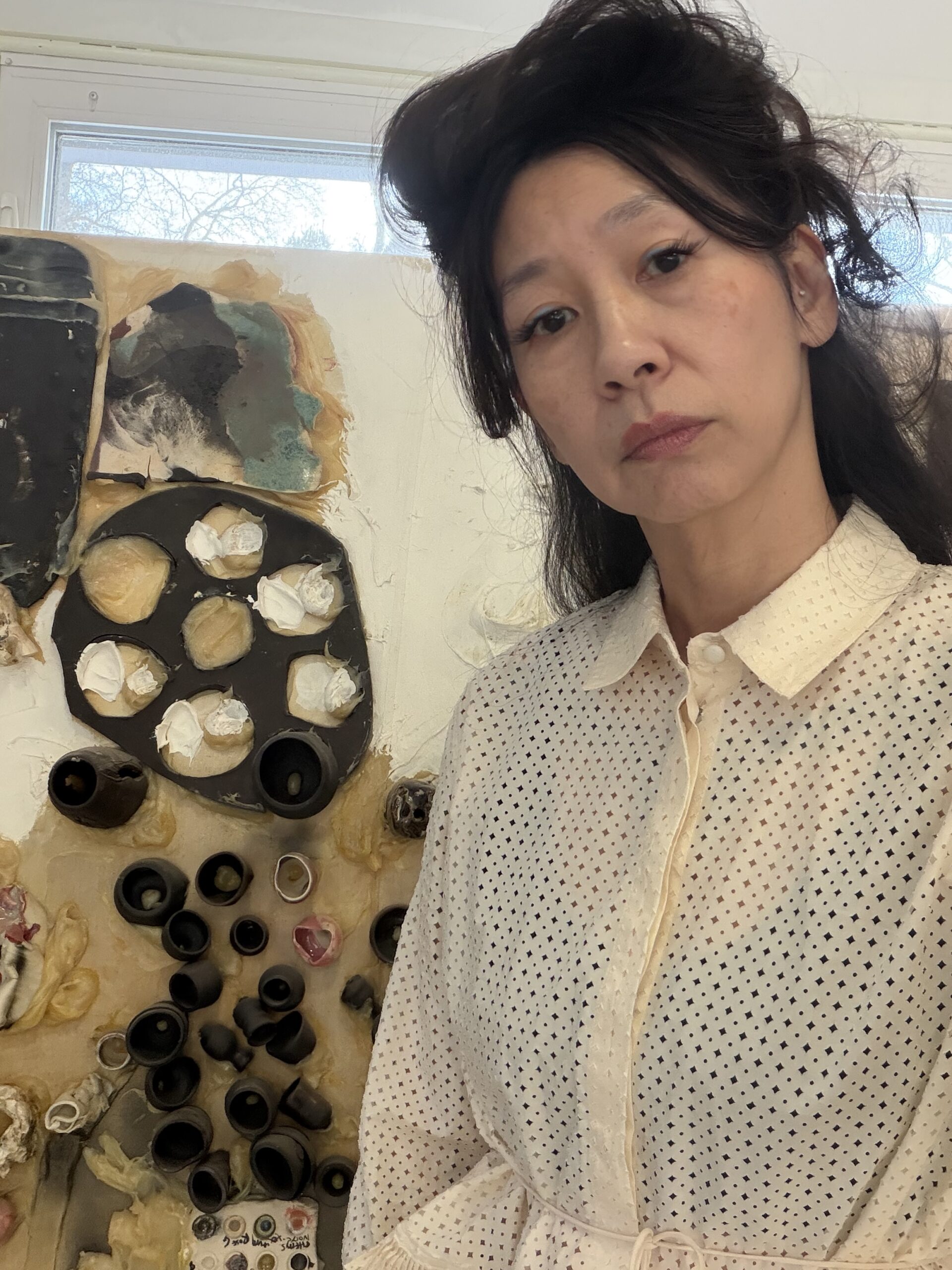
Photos courtesy of Jennie Jieun Lee and Matt Dillon.
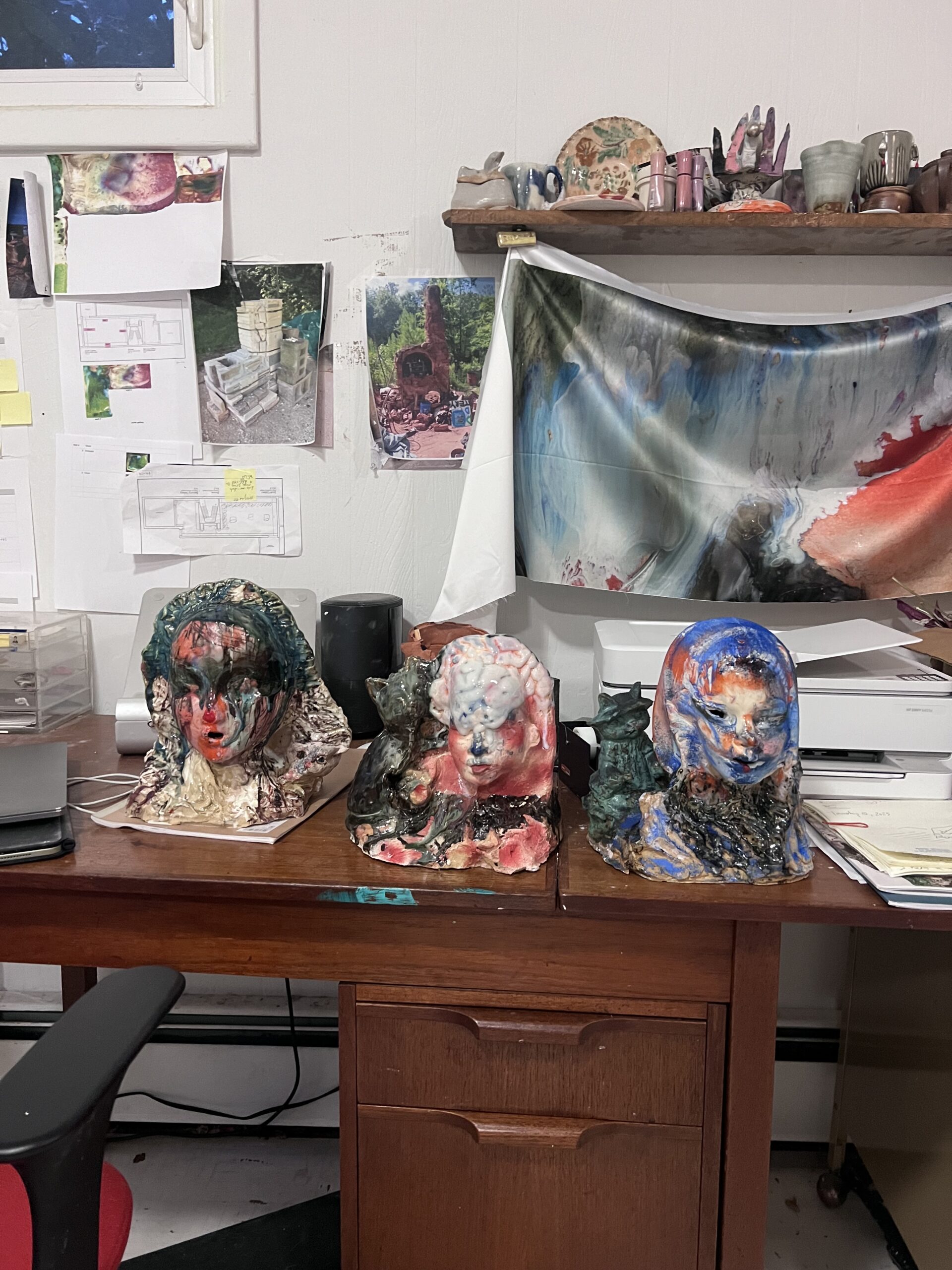
For Jennie Jieun Lee, it starts with the face. The Korean born artist’s fixation almost registers as a compulsion. “When we first moved to Manhattan, I used to draw on the walls,” she recalls. “It was always this fat face with eyeshadow going up.” Faces are where history, emotion, and projection collide in Lee’s ceramic practice. Consider the masks and heads that first brought her attention to Marie, her interactive tribute to Marie Laveau, the 19th-century voodoo priestess and community organizer whose legacy has been warped by myth and racism. The sculpture will make a reappearance in her museum debut, Luteal Elements and Grooves, which opens next week at the The Aldrich Contemporary Art Museum. Those early pieces also happened to spark the beginning of Lee’s longtime friendship with Matt Dillon, who became her very first collector. Dillon, the actor-cum-visual artist, demonstrates a similar preoccupation with faces, shaped in part by a lifetime of studying them in his screen work. In conversation, he recalls the words of director William Friedkin: “The greatest location is the human face.” Before the show opened, the pair got on Zoom to exchange ideas about discipline, doubt, and delayed arrivals.
———
MATT DILLON: Wow, it’s great to see your studio back there.
JENNIE JIEUN LEE: I know. It’s pretty empty because everything for the show has been picked up. So right now it’s just the dregs.
DILLON: But look at that, all those racks. I guess when you’re working in ceramic, which is really sculpture in a way, you need all that space.
LEE: Oh yeah, this space and more. We’ve been using the outside, too.
DILLON: I think I was one of your first collectors, but your work has developed and grown so much since then. They’re also larger works now. And congratulations on the show.
LEE: Thank you. Yeah, you bought that mask and were one of the first people to ever buy my work. Our dear friend Adam Roth brought you to the show, and that’s when I realized that you were into art. Before that I just knew of you as an actor.
DILLON: Yeah. I come from an artistic family, so I was always predisposed to it, but I didn’t have a serious studio until about 10 years ago. But I would work, and a lot of times I would keep sketchbooks and things like that. I would do it for maybe a year at a time, and then I’d put it down. Then I would return to it and be like, “Oh, I’m going to go back in and buy all these art supplies.”
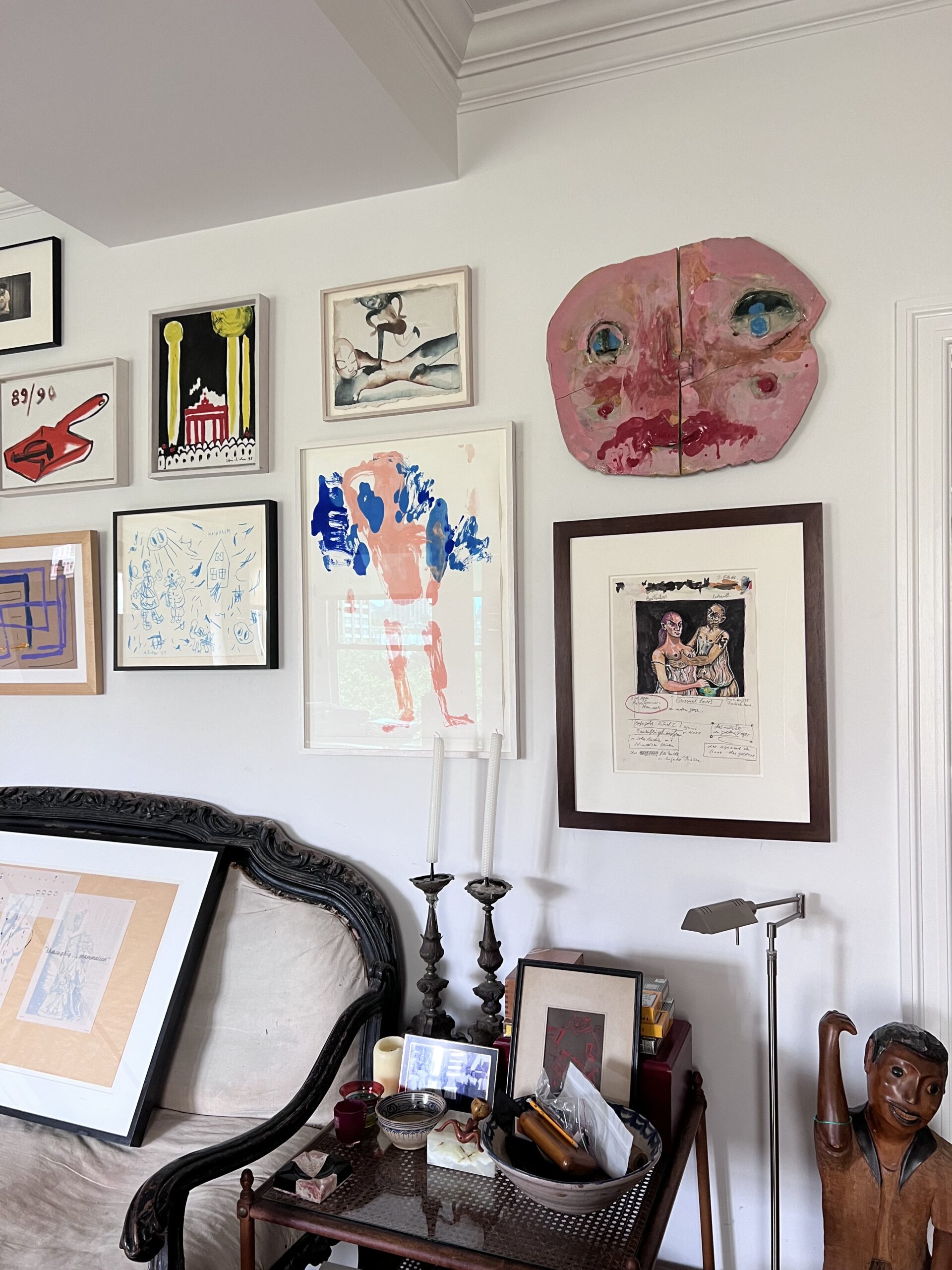
Jennie Jieun Lee’s mask in Matt Dillon’s collection.
LEE: Was it too much pressure? All of a sudden you’re all serious versus just a sketchbook?
DILLON: I don’t know what it was. I remember once I was at my friend’s house and her kid’s kitchen table, and the kid’s art supplies were there, like crayons and stuff. I just was like, “I really miss this.”
LEE: It’s funny that you say that. My mom was an art teacher in Korea, and then we moved to New Jersey. For her to make money, she took her skills and taught the neighborhood kids arts and crafts class after school in our attic. She knew that making art is a long game. And it was such a long process for me. I mean, I went to undergrad, got out of school and then didn’t make art for 11 years. Then I started making and it all blew up. I had stuffed it away for so long and I thought I wasn’t doing anything, but it was really kind of like the research and development stage. Maybe that was the same for you while you were acting. You’re doing all this other stuff, but it’s feeding your creativity, and then it comes out in your paintings. Especially in the last 10 years, I’ve visited you in your studio and seen how prolific you are.
DILLON: Thank you. I was also friends with a lot of conceptual artists. Patrick Painter, and I was hanging out with Mike Kelley a lot. I guess as a filmmaker and as an actor, there’s always this thing with preparation and you have this structure, and it’s also very collaborative. It is like construction sometimes. In that way, it’s a little bit different.
LEE: Yes, it’s less spontaneous. It’s almost like making ceramics. There’s so much planning. I mean, you could start spontaneously, but for you to get to the final piece, it takes a month, because it has to dry and you have to fire it twice. It’s kind of like making a movie, whereas something like painting is so immediate.
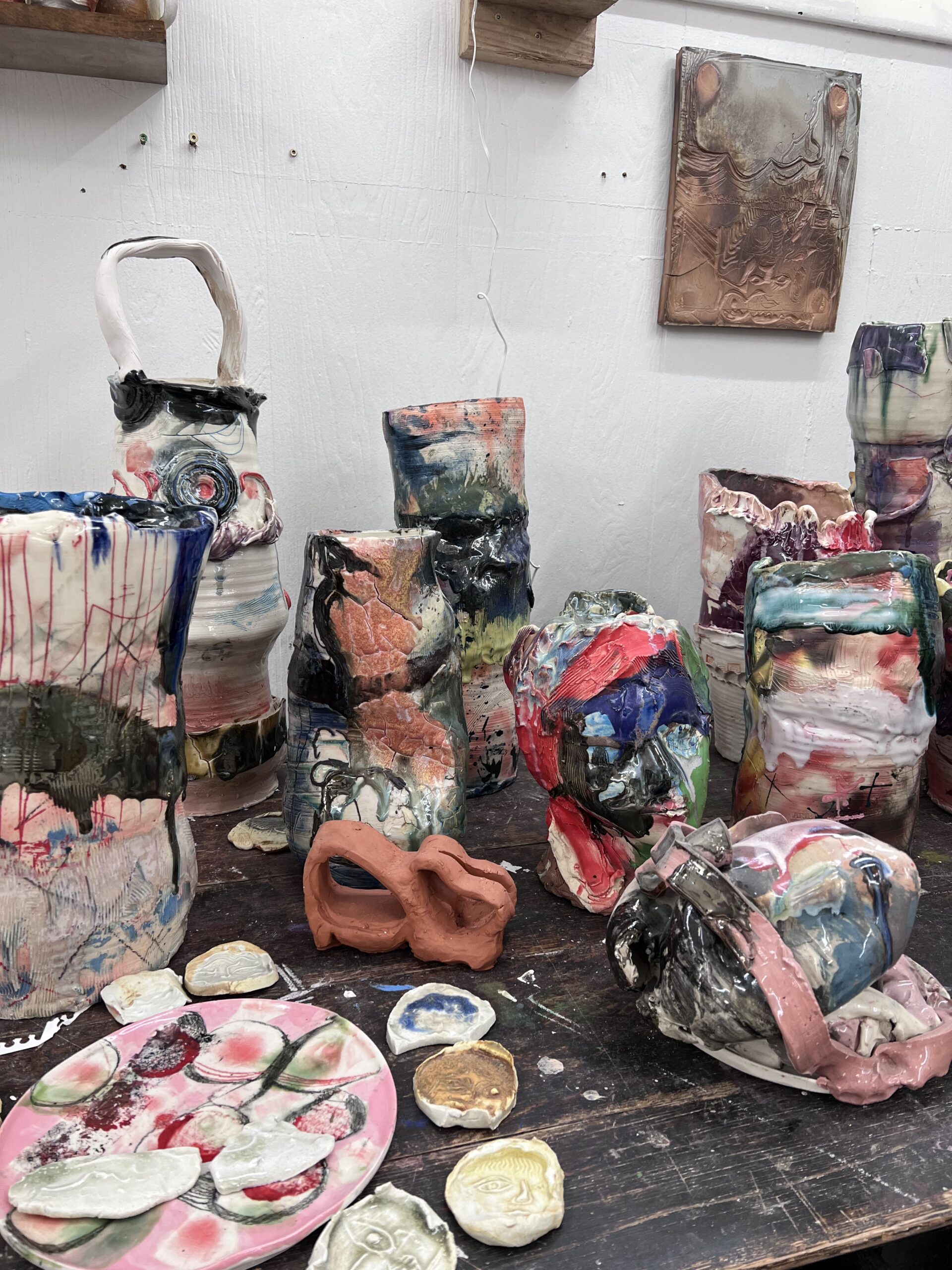
DILLON: Absolutely. I love that painting is so direct. But it’s mostly solitary. It’s interesting that you talked about masks–you went right to the human element, and I guess there was a part of me that immediately responded to that.
LEE: You do own many masks. Also, I went to your new studio recently, the first thing you did was put up a mask.
DILLON: I like them.
LEE: I mean, I would say the things that sell the most are definitely heads and masks. I think people like to try and see themselves through something.
DILLON: There’s one that’s going to be at the Aldrich Museum, right? I’m trying to remember the name. It was a woman who was a voodoo–
LEE: Yes. It’s titled Marie. It’s named after Marie Laveau, the famous voodoo priestess from the 1800s who was a free Black woman of color and an entrepreneur. People would go and visit her and she would aid them with romance, finance, and also swaying politics. She sat with men on death row, praying with them. So when she died, this mausoleum was set up for her, in St. Louis cemetery No. 1. It’s in the Treme district.
DILLON: Is it one of those above ground cemeteries?
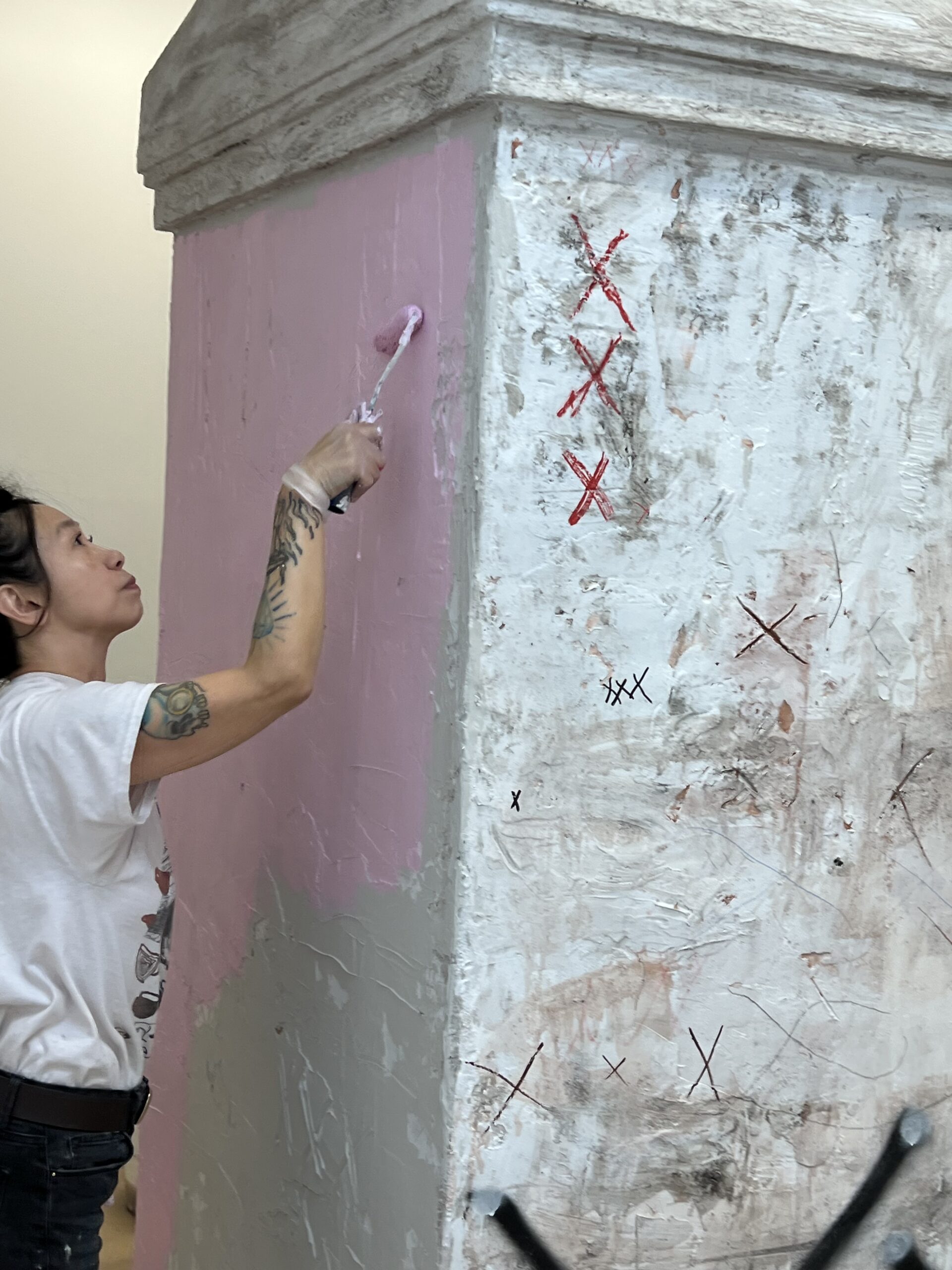

Marie at Martos Gallery.
LEE: Yeah, all of them are there. Nicolas Cage has a preemptive tomb for himself in the same cemetery, and it’s got a lot of lipstick marks. The archdiocese keeps wiping them off and he gets mad. But anyway, at Marie Laveau’s tomb, people go there and they mark an X and leave an offering. Then they turn three times, or some people knock three times. Supposedly, if your wish comes true, you come back and you circle the X. But in 2006, somebody vandalized it and painted it all pink. Now the Archdiocese won’t let people visit without a guide, which I understand. But it just moved me so deeply that it is no longer marked as I originally saw it. So I wanted to recreate that memory and honor her. Because of racism, she’s been poorly portrayed in the press and in books since 1881, as they often did with Black women back then.
DILLON: But the structure still exists, right?
LEE: Yes they restored it, but I think it’s just all white. If you want to go visit it now, you have to pay a visiting guide, and I’m not entirely sure that they let you mark up the tomb anymore. So it’s kind of a vestige of the past.
DILLON: And you’ve kind of recreated it, right? Is it ceramic?
LEE: It’s actually wood with a lot of joint compound, and then I marked it up. When it was up at Martos Gallery in 2019, I invited visitors to mark it up and leave an offering.
DILLON: That’s great, so it had a kind of interactive element to it?
LEE: Yeah, and kids love it. Well, kids usually love being able to do something that they’re told not to do usually in a gallery or a museum.
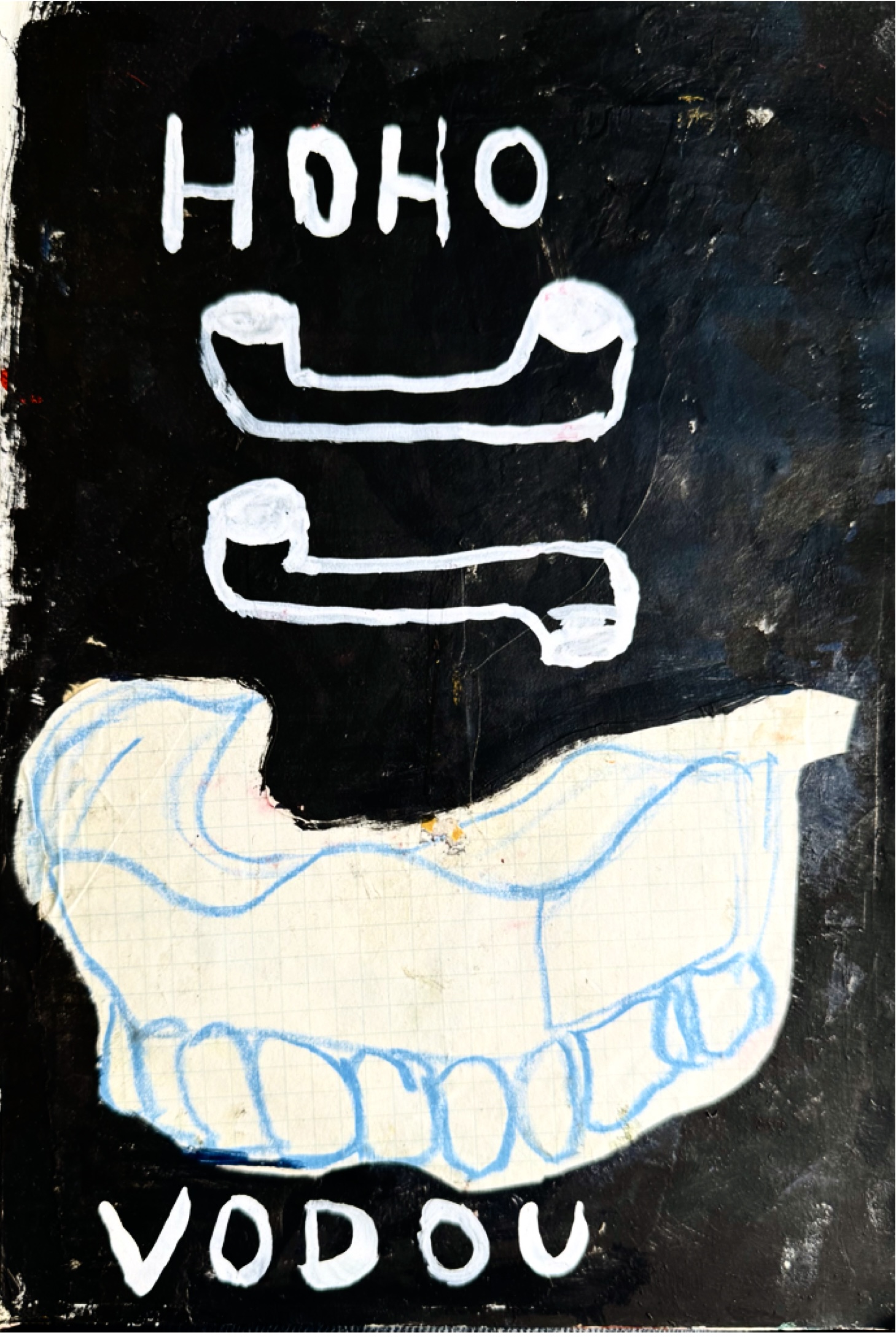
DILLON: You mentioned voodoo, and I did this film in Senegal once [The Fence]. When I was done filming, I became very interested in Dahomey and Benin, which has a very interesting history, although it’s somewhat dark. That’s where the voodoo came from, which ended up in New Orleans and in Brazil, and in Haiti, and a little bit in Cuba. There’s a really interesting cultural aspect to it, not just with painting and carving, but also musically. It was very inspiring to me. It reminded me of how when I made different films, I would bring stuff with me–anything I could fit in my luggage. I think there’s real power in these symbols. I’m spiritual, but I’m not a religious person. What are your thoughts about that? I mean, you did this piece dedicated to Marie.
LEE: Right. I was concerned about whether or not anybody from Marie Laveau’s lineage would take offense, but we found somebody related to her. It was like her great, great, great-granddaughter, and I sent her an image of the tomb and she thanked me. I don’t want to pretend that I do voodoo or anything like that. I believe in spirituality, but I’m more there to honor and to give a voice to somebody that has been portrayed in such a terrible way.
DILLON: When I was traveling throughout the world, I noticed there’s a real fear of voodoo.
LEE: There is. When I was reading about Marie Laveau and what her time here on earth was like, it was really about local activism and community building. This is all lore and word of mouth, but she was paying enslaved people that worked for politicians to get intel from them. And then she would use that intel in other ways to sway politics by passing that information along. So she was supporting her community, which is what you have to do when the world is so cruel.
DILLON: I think this really says a lot about your curiosity for the world. You’re not just focusing on something like, “Well, I came from here and this is my background, and I don’t deviate from that.” You’re truly curious. And it makes me think of the painter who I love, who is no longer with us, Martin Wong. He was free and he embraced what he was interested in and it was beautiful. And I can identify with it, because as you can see here behind me, I have all this music and mostly it’s all Cuban or the diaspora of African music. Of course, I love Irish music, which I grew up with as a child.
LEE: Well, after watching your film, City of Ghosts, I realized that you brought back the textures and energy from the film, which was shot in Cambodia. I was trying to do the same thing. I’m at a place where I’ve been working with ceramics now for such a long time and I do get burnt out. But I recently went to see Marty Supreme, and I was so inspired by it. I was just thinking about origin stories and backgrounds, and our parents and grandparents. I really wanted to write more, and partly because–this is something that my friend said that Mike Kelley did, he didn’t like what people were writing about his work, so he started writing about his own work.
DILLON: I understand that.

LEE: I’m actually going to take a writing workshop with the writer, Alex Auder, in February. That’s why I’m interested in your writing process, especially the collaborative aspects with Barry Gifford.
DILLON: That’s great. Well, it goes back to the whole idea of not being controlled, being free. I was thinking about Lars von Trier, who I really enjoyed working with. There is this Danish phrase he would say that means, “keep it messy” or “remember to draw outside the lines.” It’s something that has stayed with me when I’m in the process.
LEE: [Laughs] I don’t have any issue with that. I feel like I was born outside the lines.
DILLON: You were born outside the lines?
LEE: Yeah, and I don’t have an issue with being messy. That was actually my problem until I was able to channel it in the right way, or in a productive way. My boyfriend, Graham, doesn’t like this, but people have introduced me and my work as being “feral.” He sees that as very problematic, but I was just like, “I’ll just go with it. Maybe that’s kind of weird, like they’re othering me or something like that,” but really I think it’s because I’m so messy.
DILLON: Well, your shows have been really interesting. There’s obviously a voice there, so I can see that it’s you, but you’re still discovering stuff. There are no limitations. I’m excited to see what you’re going to be doing at the Aldrich Museum. I remember earlier shows of yours, where you did these heads and masks. But now I’m noticing that it’s a little bit of a departure from figuration, which I think is an interesting development.
LEE: I do have some figures though in the show, some new ones that I made in North Carolina this summer at a residency called Township10. We were using some incredible clay from North Carolina, from this company called Starworks, and it was so rich and just so easy to build with.

DILLON: You can’t help yourself, I’m sure.
LEE: I know. It’s almost like when I’m doodling, it’s always a face. It just goes straight to the face. Even when we first moved to Manhattan in 1976, I used to draw on the walls. We lived at 145 Fourth Avenue, right in Union Square, and I used to draw on the walls and it was this fat face with eyeshadow going up. But it’s always been faces. It started with me making my mom’s face, I think, in ceramics. Then when you saw those masks, they came after an 11-year artist block where I didn’t make work. Then I joined a ceramic studio in Greenpoint called Clay Space 1205, and the first thing I made was a slab with a face. I just kept doing it and kept doing it. They ended up in that group show that Eddie Martinez curated, called Bad Fog.
DILLON: I loved that. I think the actor part of me always liked the faces. I think about this thing that I always remember–and I got a kick out of it, because Billy Friedkin was complaining about something that he did in casting. Listen, I won’t go into all that, but I said to him, “What about that location you were working in?” And he said, “The greatest location is the human face.”
LEE: Wow, that’s amazing. I’m obsessed with him, even though I heard he can be quite cruel. He made that film Bug, and I just went to go see the play version of it. Have you seen it, with Michael Shannon?
DILLON: I haven’t seen it, but Michael’s a great actor. I’ve seen a lot of Friedkin’s earlier works.
LEE: Exorcist is one that will forever be etched in my brain.
DILLON: One thing I’d like to say is, earlier I was thinking about young artists making work now. I think my best advice is just to be open to discovering. I mean, I’m certainly a lot older than you, but as I develop, I think some things are dragged out, but you know what? I think the depth is there. I mean, to be a film director, it’s really hard to have a late period. But in the visual arts, you can do that, because it’s so direct. A friend of mine teaches at a great art school in Brussels, and he’s a really great drawer. And he said to me, he said, “Getting old is a drag, but my line gets better all the time.”
LEE: So true. I teach a lot of young people how to make ceramics, and also grad critique. But I don’t put any pressure on them. I just tell them to keep going, because when I was that age, I didn’t believe in myself. I was making hideous work and I thought it was the end of the world. I stopped making work for over a decade and then I started again. You just don’t know what’s cooking in there. You just have to be patient and you just have to stay alive. I think it’s very hard for many people–they feel like it’s the end and it’s not going to get better. But you just have to keep waiting until a miracle happens, because it does. That waiting time is so hard, that idle time. But things are happening internally. It might not feel like it, but they are. And that’s just coming from someone that experienced that.
DILLON: You’re right.
LEE: It’s all work, and work is hard. Art is hard, as my friend says. But it’s worth it if that’s what you want to do with your life. And it’s the only thing I can do with my life.