

Miranda July


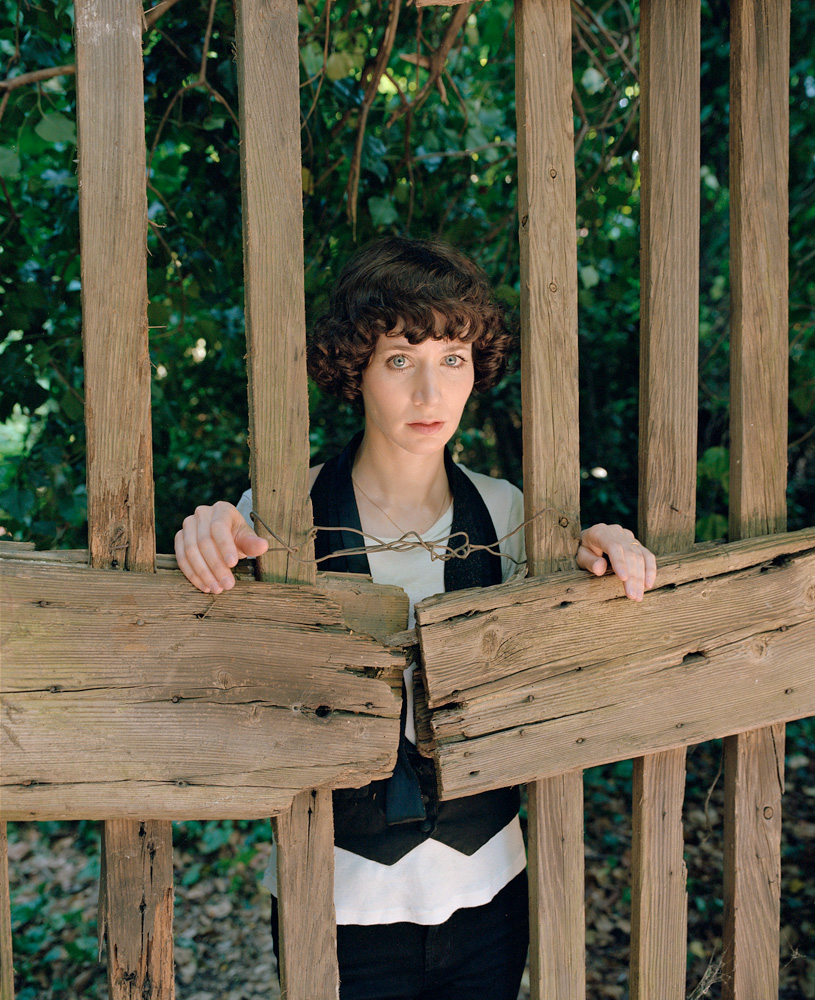
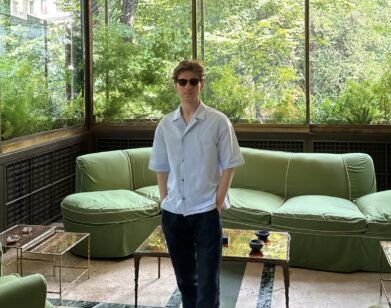
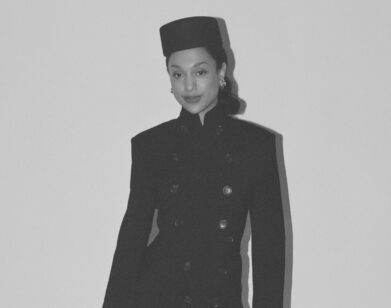
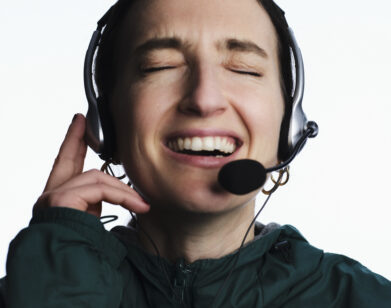
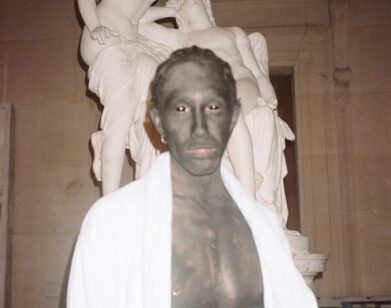
Notice the title of her 2005 film: Me and You and Everyone We Know. Or her first collection of short stories: No One Belongs Here More Than You. Clearly, Miranda July is trying to involve us in something. Her latest endeavor, “Eleven Heavy Things,” at this summer’s Daniel Birnbaum–curated Venice Biennale, is another choice step in bringing the audience into the art and also letting the art leave with the audience (here in photographic form). In a small side garden in the Arsenale section of the art festival, the 35-year-old artist erected 11 steel-lined cast fiberglass sculptures that were specifically designed to be climbed over, stood on, and posed under. Many of the pieces come with July’s loaded text messages such as What I look like when I’m lying (notice the cute toddler in our photos) or We don’t know each other. We’re just hugging for the picture. When we’re done I’ll walk away quickly. It’s almost over. Part of the idea was that the project would be completed only in the snapshots of visitors who traveled to Venice for the art and then brought the evidence of July’s work back home with them. In this way, the artist is something of a creative pollinator. July doesn’t want her art to be observed in silence, but rather she wants it to take on new life, to breathe alongside you, sometimes even accuse you of a few indecencies (notice the finger-in-the-hole sculpture). Right now, July is a busy woman. She’s currently working on her next film, and her first novel. But on one afternoon duringthe opening weekend of the Venice Biennale, Interview teamed up with her and invited a number of attendees to pose with the works for an exclusive art-meets-the-world collaboration. For “20 Questions,” curated by Matthew Higgs, friends and colleagues of the artist were invited to pose a single question to July. Here is what they asked, and how she answered.
1
Cindy Sherman: What is the scariest situation that you’ve ever put yourself in in front of an audience?
Miranda July: Nothing I can come up with these days is as scary as opening for punk bands in bars back before anyone knew who I was. Sometimes these audiences were so confounded, so unfamiliar with the idea of “performance” that they would get angry and yell at me while I performed. I remember searching the crowd for the eyes of one woman who looked like she might know what I was talking about. I would do it for her; that would get me through it.
2
Spike Jonze: Why are we here?
July: “We” meaning humans? Or just you and me? We humans are here because nothing can be perfect. There always have to be some living things that are unsatisfied, itchy, trying too hard. If it was all just animals and rocks and lettuce, the gods wouldn’t feel like they had enough to do.
3
Dave Eggers: As someone who works in different media, when you see or hear something you think you might work into an artwork of some kind, do you automatically know which medium it’s destined for?
July: Usually I do. I write down the idea in my notebook, and then I put a little letter in the corner of the page in a circle. S for story, N for novel, M for movie, A for art, P for performance, B for business. This makes me sound totally rigid. I am also lots of fun! Totally wild! Party!
4
Michel Gondry: Do you define a limit to how clearly the idea or concept is conveyed in your work, and do you consciously change where this limit is when you jump from art to film?
July: I’ve been thinking about this a lot -lately, as I move back and forth among a novel, a -movie script, and making sculptures. It seems like each medium has a different degree of -refinement, and the trick is to honor that. Fiction is the most refined; it’s like working with a watchmaker’s tiny tools. Then I switch over to a script, and it feels like I have big clumsy gloves on, but clumsy gloves are good for symbolic movement. And then art—that’s like no hands at all—is just letting mystery stay inarticulate. Which is its own kind of precision when it works.
5
Debra Singer: What did you do for your birthday this year?
July: It’s in February, and I was in the mountains, so I woke up and went sledding first thing. I remember flying off a high jump and smashing deep into the snow, arms and legs everywhere, thinking: If this is 35, it’s okay.
6
Daniel Birnbaum: What time is it on the sun?
July: Hot-o’clock.
7
Kate and Laura Mulleavy: What is the last word that you erased?
July: Hot-o’clock. I wasn’t sure that was the right way to write it.
8
Hans Ulrich Obrist: Can you tell me about your unrealized projects?
July: I actually don’t have a great surplus of ideas. Some evolve very slowly, over many years, but I sort of trust that all of the interesting ones will become something that I eventually end up doing. Maybe that’s naïve, though. Maybe, in truth, I will never end up having my own televised avant-garde performance/talk show that is a cross between Frederick Weisman, Mister Rogers, and American Bandstand.
9
Khaela Maricich: What is something that you have learned during the past 10 years?
July: I at least got a toehold on how to fight. The kind of fighting where I listen. I don’t agree, but I listen. And, like it or not, listening changes you.
Life is so ridiculously gorgeous, strange, heartbreaking, horrific, etc., that we are compelled to describe it to ourselves, but we can’t! We cannot do it! And so we make art.Miranda July
10
Harrell Fletcher: What makes something—a piece of art, a film, a book, a bowl of soup, a song, a walk—really good, in your subjective view? Maybe the question is, if you had a set of things that you considered good, like the list in the previous sentence, is there a quality that they share that makes you like them? Or is the goodness different in each case?
July: I think there are a few categories of cross-genre good, but here is my favorite: At first you hate it. And then suddenly you expand, you grow, and the book, the bowl of soup, the song, the walk, becomes a prized thing—the first example of your new, smarter self.
11
George Saunders: Why art? Why write stories, make movies? What is the purpose of making art, in your view?
July: I’m just gonna go for broke on this one and say that we do it because life is so ridiculously gorgeous, strange, heartbreaking, horrific, etc., that we are compelled to describe it to ourselves, but we can’t! We cannot do it! And so we make art.
12
Jarvis Cocker: You likened the election of Barack Obama to the U.S. getting its period for the first time. Could you elaborate?
July: I was trying to explain how it was both symbolic and very real. That we elected him was shocking to me, and it changed my sense of the future. I had a thrilling new feeling of responsibility. Really not dissimilar to how I felt when I got my period for the first time, but not private—as a nation! A national period. But I’m not sure this metaphor really holds up . . . Do we want to get knocked up, as a nation? Cramps? Tampax? Huh?
13
Chan Marshall: If you were sent to prison, what would be your crime?
July: I will take this literally: I was arrested once, when I was 18, for shoplifting. (Hi, Mom!) I was stealing a tube of Neosporin antibiotic ointment; I put it in my sock. When the security guard grabbed my arm, I was so terrified that I peed. I was wearing a dress, so it went right on to the floor in a puddle. That didn’t stop them, though. I was taken down to the station, fingerprinted, the whole deal. Afterwards I bought myself an orange Popsicle and sat on the curb, eating it and weeping.
14
Matthew Higgs: What question would you like to ask yourself?
July: Can I have a time-out?
15
Carrie Brownstein: What daily ritual that you perform makes you feel the safest, and why?
July: I eat an egg every morning, and when I’m done, I almost always have the thought: There. Now even if I’m captured and starved, I’ll be able to live off the protein of that egg for a while.
16
Monet Zulpo-Dane: You are making a time capsule that you will bury in your backyard and dig up on your 90th birthday. What are the five most important things you put in it?
July: 1. The feeling of a normal day at age 35. 2. A conversation between Mike [Mills] and me about what we should make for dinner. 3. My parents. 4. My teeth. 5. The time capsule you and I buried when we were 7.
17
Lorrie Moore: How is your Italian coming along —and I don’t mean that gondolier?
July: Molto male.
18
David Shrigley: What is your favorite term of abuse, or your favorite expletive/profane exclamation?
July: I throw “pud” around a fair amount, which I just looked up and discovered means penis. For expletives, “fucklord.” I got that from a friend. Sometimes I follow it up with “lord of fuck.”
19
Jonathan Lethem: If you were told that you had to live inside a work of art, which would you choose?
July: A painting by Mamma Andersson called Leftovers. You can look it up online. Three girls in a nice, messy apartment. They seem relaxed; one of them is naked.
20
Joanna Newsom: Please name something that other people seem to care about, but that doesn’t matter at all to you, as well as something that you care about very much that seems unimportant to most other folks.
July: Part one: Alcohol. Part two: Errata. I’ve collected them since I was a little girl, probably because my parents run a publishing company. An erratum is a correction inserted into a book after publication. It’s a nice thing to collect because you can’t go after them, you just come upon them. In 25 years I’ve only found about 12.
Cindy Sherman is a photographer and filmmakerbased in New York.
Spike Jonze is a writer, director, and producer in Los Angeles. His new film, Where the Wild Things Are, is out this fall.
Dave Eggers is a writer and publisher.
Michel Gondry just released his latest collection of music videos, Michel Gondry 2: More Videos, and is in preproduction on Columbia Pictures’ The Green Hornet.
Debra Singer is the director and chief curator of The Kitchen, New York.
Daniel Birnbaum, a Frankfurt, Germany–based writer and curator, is the director of the 53rd Venice Biennale.
Kate and Laura Mulleavy are the founders and designers of Rodarte, in Los Angeles.
Hans Ulrich Obrist isco-director of Serpentine Gallery, London.
Khaela Maricich, of the band The Blow, is an artist and performer living in New York.
Harrell Fletcher is the director of the Art and Social Practice program at Portland State University in Portland, Oregon.
George Saunders is a teacher and writer in Syracuse, New York.
Jarvis Cocker is a shortsighted songwriter from the North of England.
Chan Marshall, a.k.a. Cat Power, is a singer-songwriter currently based in Los Angeles.
Matthew Higgs is the director of White Columns, New York.
Carrie Brownstein, of the band Sleater-Kinney, is a musician, actor, and writer in Portland, Oregon.
Monet Zulpo-Dane works at Green For All in Oakland, California.
Lorrie Moore teaches at the University of Wisconsin–Madison. Her new novel, A Gate at the Stairs, is out next month. | David Shrigley is an artist living in Glasgow.
Jonathan Lethem is a writer in Brooklyn. His new novel, Chronic City, is out this fall.
Joanna Newsom is a harpist, pianist, and singer-songwriter living in California.