


James Nares


James Nares did not immediately rocket to the top of the New York painting scene. The Englishman turned New Yorker had to go through many phases to get there. He practically had to shoot himself in the foot. (Literally and metaphorically—you know the English and their hunting.) He was a No Wave musician, a filmmaker and performer, and a leading member of the living-dangerously clique of the ’70s and ’80s. But no matter what he was going through, he always worked at his art with elegance and grace, and he was always greatly admired (and collected) by fellow artists, many of them more successful than himself. Finally, over the last decade, the handsome, towering, snooker-playing, self-effacing painter has finally begun to achieve the recognition he deserves. His paintings can be found in many great collections and at the Paul Kasmin Gallery. And a retrospective of 30 years of filmmaking was held recently at the Anthology Film Archives in New York. I interviewed my old friend at his apartment in Chelsea, where he was picking away on an oud, and at my house in the country, where Nares is here and there on the walls.
GLENN O’BRIEN: What brought you to New York?
JAMES NARES: My friend Seth Tillett. I’d been at school with him, and he lived in New York. I ran into him on the street in London. All I did was read American art magazines. I felt like a real loner in London, being interested in all these artists that nobody else seemed to have heard of.
GO: Who were you interested in?
JN: I was interested in the Avalanche magazine people.
GO: Like Vito Acconci?
JN: I loved Vito. And really the whole spectrum of what was happening, from Gordon Matta-Clark on down. Seth told a story about going to the Broome Street Bar and turning around, and the guy next to him was Robert Rauschenberg, and they got into a big talk. That sealed the deal for me. The idea of being able to walk into a local bar and sit next to Rauschenberg was too much to resist.
GO: Had you been making art in London?
JN: Yeah. Ever since I was tiny. It was the thing I could do. They weren’t quite sure what to do with me. But I seemed to be well occupied and out of trouble when I was making art, so they encouraged that.
GO: What kind of work did you make as a youth?
JN: I painted the neighbors’ rhododendrons bright red with enamel. That was beautiful. I remember my mother came and said, “What are you doing, children?” “Painting.” “Oh, how wonderful.” That red-and-green thing has stuck with me ever since. I made a fountain out of my step-dad’s tuba. He never played the tuba. I don’t know why he had one, but I mounted it on a chimney stack and connected the garden hose and made this beautiful musical fountain. They were very long-suffering, my parents. I took old 16mm home movies, which I really regret now, and melted them onto a board with a blowtorch and made a kind of [Jackson] Pollock-spaghetti-melted film painting. It was quite beautiful. But it ruined those memories forever. They were like, “Well, that’s very nice, James. That’s beautiful.”
GO: What’s your oldest extant work?
JN: My mother has a horrible little woolen doll character. God, it’s ugly. It looks like a voodoo doll. I don’t know how I made it or why. I also have a great autobiography that I wrote when I was 5. It has a self-portrait on the cover, with little pictures inside. It starts off matter-of-fact and then it ends abruptly with a passage about my father dying. It suddenly becomes very tragic. “Then the fangs of death had crept into our household, and it was never quite the same.” That was the end of my autobiography at age 5.
GO: So what did you do after arriving in New York?
JN: I hooked up with Seth, and we moved in to this big loft on Jay Street in Tribeca, when it was a total ghost town. September of 1974. The first people whose door I went knocking on were Willoughby Sharp and Liza Bear, because I loved their magazine, Avalanche. Willoughby was very warm. He opened the house to me. I had seen him do a sort of performance lecture at the Royal College of Art, in London. He had come in and mussed around on the stage, pulling wires and setting things up, and that went on for an hour or so before anything happened. There was a bar attached to the lecture hall, and everyone kept getting more and more drunk. After a while, Willoughby turned on a slide projector and flashed through a whole carousel of slides very quickly. This critic I was sitting with and my self were the only ones who knew the artists, so with each artist that came up, we yelled out the name. It was almost like Name That Tune. Then Willoughby asked if there were any questions. It was over in about 60 seconds. The audience was appropriately appalled, and I loved it. So when I came here, I said to Willoughby, “I loved the thing you did there. I heard that you were on acid.” Willoughby said, “Well, of course I was on acid!” That was my first visitation. The neighborhood there was cool, and 1974 through ’76 were very definitive years for me. Richard Serra was very present in the neighborhood and in my mind. I think my early artwork and movies show that.
GO: Did you visit him?
JN: Yeah, I loved his studio on Greenwich Street. He’d just started making those oil-stick, oil-rubbing paintings, and everything was black. The telephone, I remember, was oil-sticked black. Everything was black. It was beautiful.
GO: Were you making work then?
JN: Yeah. The only thing that really survives from that period is my pendulum movies. I hung this enormous pendulum from the bridge on the street where I lived and made a movie just watching the pendulum swing. I also had cast these concrete balls and just left them in vacant lots or in the middle of the street. They looked beautiful. It seems like a long time ago. It also seems like a kind of golden age, those years. Because there was no money . . .
GO: You didn’t need money. People would go to Max’s Kansas City at cocktail hour and maybe order one drink and eat all this free food. Half the art world was surviving on it.
JN: Openings provided a lot of meals, too. There was a kind of liberation in that. Nothing to lose.
GO: Who did you meet early on?
JN: Lindzee Smith, Julia Heyward, Paula Longendyke-a funny, mixed crew. Boris Policeband, whom I loved, lived with us for a while and ate spaghetti every night and ate only at night. He was the first guy who watched more than one television at a time. He had about 10 TVs, which seemed really radical. There were no remotes. He ran around changing channels while he talked to you.
GO: Around ’74, there wasn’t a lot going on. I remember Patti Smith was doing stuff.
JN: Yeah, Patti Smith, Television, then Talking Heads.
GO: The first time I saw Talking Heads was at the Lower Manhattan Ocean Club, on Chambers Street. They were a trio.
JN: I saw them there, too. Was Lisa Stroud a great friend of David Byrne’s?
GO: She was his girlfriend.
JN: She dragged us all down there to see him. Diego Cortez was a great influence in my life and other people’s lives at that time. He was the first one to tie into the things that were happening in the larger world, and he introduced us to more of the music that was coming out of England and that whole attitude toward making art and making music, which we picked up on and applied to our films. I kind of took a left turn out of the art that I’d been making at that time, and went into this other thing. Picked up a guitar. James Chance said he was forming a band.
GO: Did you meet him through Diego?
JN: Possibly. We had this little garage on Jay Street, in the same building where we lived. Our landlords parked their big Cadillacs in the garage during the day, and after they left at night, we ran in and put up a movie screen and showed movies and did performances. I met James when he was playing there with a trio. It seems like a different city altogether. It was a ghost town-the whole of lower Manhattan, from 14th Street down, was just wreckage. Beautiful wreckage.
GO: Did you have any kind of gainful employment?
JN: I did odd jobs with a couple of friends. We had a construction outfit called the Three Aces. We pretended that we knew how to do things, and then figured out how to do them. Somehow we managed to work it out on the fly. We put up a few things—I doubt whether they are still standing. I had a friend who was a plumber. He dragged me off in the middle of the night to fix someone’s toilet in a little apartment, and the owner was a guy called Philip Glass, a musician. I fixed his toilet.
GO: Was your first band the Contortions?
JN: The first band was the Contortions. James Chance said he was forming a band, and would I play guitar? I said yes. I was always one of those people who wanted to do everything, and it was just too good of an opportunity. Everyone has a small percentage in them, at some point, where they want to be a rock ‘n’ roll player of some sort. Some do it and stick with it, and others just take a dip. I took a dip with the Contortions.
GO: Well, that was a pretty good dip.
JN: It was a good dip, yeah. It was a great band.
GO: So it was James and you and Pat Place?
JN: Even before that, it was James, myself, and Anne Deon, who was Alan Vega’s girlfriend, and the same drummer James had for a while. Then the drummer quit, and Anne Deon stepped in . . . We loved her, but she had difficulty keeping time. One day she was no longer there. Then Chiko Hige and Reck came in, the Japanese bass-and-drums combo—they were fantastic. Then Pat came in, and then Adele [Bertei]. I remember we were rehearsing in this old movie theater on Delancey Street where Lydia Lunch was living upstairs. I think Mars and those guys were all living in that rehearsal space. We were rehearsing there and Adele walked in, and James just took one look at her, and she looked so good that he said he wanted her in the band. That was an addition based on something very superficial that turned out to have depth. She was great. She sang one song with us, “Chain of Fools,” and she did it as good as Aretha Franklin. Adele is tiny, but she had the biggest voice. We played all the going clubs-Max’s, CBGB. I quit just before Brian Eno did No New York [1978]. It was funny, I had just quit the band and went to London, and then he came over to New York and made that record.
GO: You were also making movies.
JN: I’d always made these short Super-8 movies, and a couple of longer ones. But then Eric Mitchell was a great inspiration to me. Eric Mitchell and the whole attitude of learning your instrument by playing it that was around then. We applied that to filmmaking. We would act in one another’s films. I’d be doing sound on someone’s film one day, and camera on somebody else’s, and acting in another the next day. We exchanged roles with a great deal of freedom from one day to the next. We made films as quickly and cheaply as we could, and we made them about our own lives-or thinly disguised versions of our lives-and we showed them in our own cinema on St. Marks Place, the New Cinema. We showed our films on a video screen. We couldn’t afford to have prints made, so we had video dubs made from the original Super-8. It was maybe the first video movie theater. It was a terrible picture. Amy Taubin [the longtime film critic for The Village Voice] described it as “bent pink soup,” which it was. That was a great moment.
To have fun making art was something that the generation before mine was not supposed to do. That the joy of making it should be apparent.James Nares
GO: There was so much talent in those films. It’s funny, because you overlooked the flaws—or they even enhanced it. It was interesting to see your film Rome ’78 [1978] again. I remember thinking that it was an epic when I first saw it. Thirty years later, the thing I noticed about Rome ’78 was Eric seemingly watching himself in the monitor, admiring himself.
JN: [laughs] There wasn’t a monitor. He’s looking off camera, reading the script. Or maybe admiring himself in somebody else’s eyes. That’s kind of what one did. It was a funny time. It was very dark, and I loved flirting with danger . . . but it was also about having fun, which seemed radical-the idea of having fun. I said to Frank Stella the other day, at the gallery . . . I was admiring some new works of his, and I said, “God, this looks great! It looks like you really had fun making it.” And he just turned around and walked off, and I realized that’s a sort of generational distinction. To have fun making art was something that the generation before mine was not supposed to do. That the joy of making it should be apparent, I find it quite a redeeming quality.
GO: When did you get serious about painting?
JN: I had been a painter before I came to New York. But when I came to New York, I wasn’t interested in painting at all. Then around ’82, I guess, I realized that I couldn’t do everything. I wanted to make movies, I wanted to make music, I wanted to make art. I figured that I couldn’t be good at all of them and make a living at the same time and that I should probably focus on what I knew best. So in 1982, when painting was enjoying a kind of new life, I caught the bug.
GO: You’re like the last of the Action Painters.
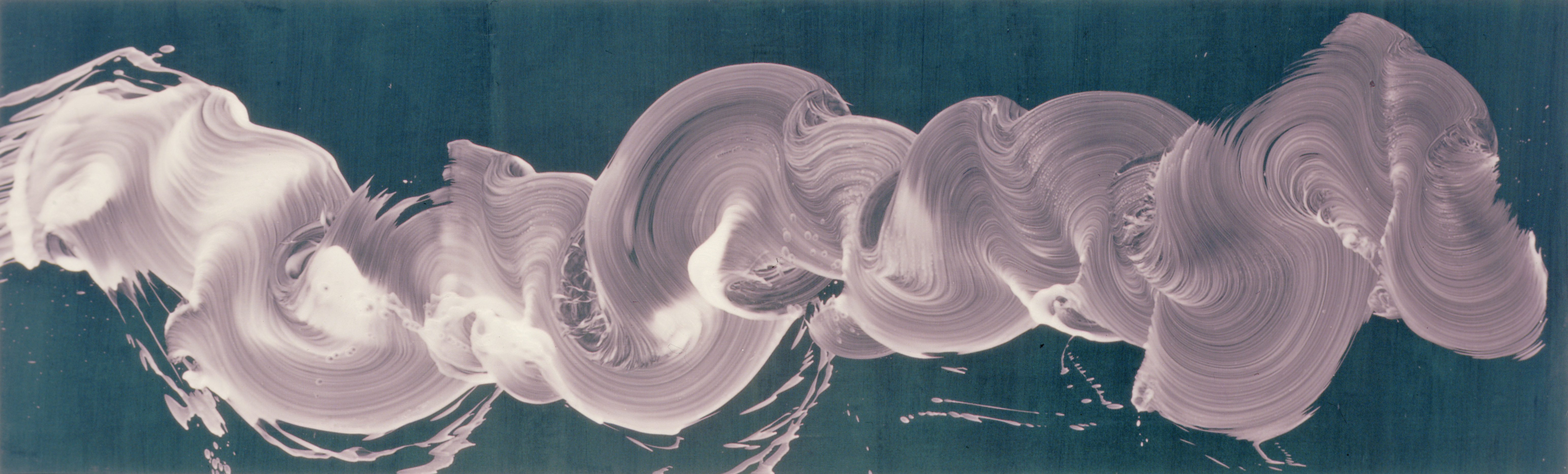
JN: Well, I wanted to find something in painting that I could identify as my own. And I kind of stripped it down for myself to the things that seemed most important. A lot of it had to do with reinventing the brush, the surface, and the paint. It’s those three things that I kind of came up with my own versions of, or my own mixtures of. They’re pretty simple, the ingredients to my paintings. I like to think of it as like making bread or something. A little change in the recipe and you get something completely different.
GO: You make your own brushes and you have invented a series of devices to make paintings with. Talk about how that evolved.
JN: Well, my devices were all born of necessity, because I’ve always had the problem—which a lot of painters have—of making a large version of something that works well small. Once I’d reduced the paintings and stripped away everything and was left with the brushstroke, I thought that to increase the size of the brushstroke would be a sort of simple mathematical enlargement thing. If you make it bigger, you simply make a bigger brushstroke. But when the size changes, the physics of the thing changes.
GO: I remember when you were in Bridgehampton, New York, in the barn in the cornfield, and you were trying to suspend yourself over the canvas.
JN: Yeah. All those things have been invention based on necessity. I couldn’t make a big painting using the paint that I’d use . . . I couldn’t do it vertically. It had to be horizontal because of the drip. And a big painting, I couldn’t reach the whole surface. So that was one of my many attempts at a solution, to reach the middle of a large painting without making it stand vertically. I remember forgetting to hook myself into the rig one time, and I launched myself at the canvas and just fell face-first into the painting.
They work only if they are anti-gravity, like they have sort of been blown onto the canvas like some sort of tiepolo figure up in the sky or something.James Nares
GO: Your painting rig evolved out of the necessity to be above the painting?
JN: I needed to be above the painting because the paint is so liquid that it will drip, and I never want any sign of gravity to show in the paintings. They work only if they are kind of antigravity, like they have sort of been blown onto the canvas like some sort of Tiepolo figure up in the sky or something. If there’s any orientation like a drip, it kills the effect. A lot of the early work was on paper, and with a piece of paper you have access to the rectangle at any point of entrance or exit. And you can move outside of the rectangle or come back in. There’s complete freedom of access to any part of the rectangle. But when I made it bigger, I couldn’t reach in the same way. Which is why I made this rig so I could paint as if I were working on a piece of paper.
GO: In your earlier brushstroke paintings, you were deliberately letting the residue of the failed figures accumulate on the white, so there was this very, very subtle, kind of ghostly underpainting.
JN: I liked to feel that the work that I put into the painting was somehow visible. I liked the patina of the history of the painting. But after a while it became unnecessary. And then I ended up taking that out, too. I found by taking any event out of the ground, I was left with an infinite space, because the painting is about the brushstroke really—it’s not about anything else.
GO: To me, the ones that are on the pure white or pure background are a lot more three-dimensional—they really are kind of gravity-defying. They’re really floating in space.
JN: I think I always wanted to fly. Flight has always been a preoccupation of mine. Like the little old painting in your guest room, Yaw, Pitch and Roll: That has a picture of Louis Blériot and one of his flying machines in the background. My grandmother once flew with Blériot.
GO: Really?
JN: Yeah, strapped to the wing in a big hat. Blériot was the first to fly the English Channel. She was there when he landed and he gave her a ride. She was 18, and she put on a big hat, and in a long white dress, she went up, strapped tight to the wing of a biplane. Maybe flight is in my genes.
GO: With your big brushstroke paintings-you’re in your rig making strokes and your assistant is there squeegeeing off the paint when you aren’t satisfied with the result, which is most of the time. How many strokes do you do before you have a keeper?
JN: It depends. I liken it to playing baseball and trying to hit a home run. Sometimes you get lucky and the first pop it goes out of the ballpark. Other times you go quite a few games before anything happens. I can do hundreds of attempts and not get a keeper. And I’ve got it on the first attempt.
GO: How long does it take you to decide if a stroke has got it or not?
JN: I kind of know it immediately. Sometimes I’ll keep it in spite of myself, because there’s something about it. Maybe I don’t like it, but there’s something about it that makes it difficult to erase—and quite often that’ll be a particularly good painting. I guess that’s because what I’m after is to surprise myself somehow, to kind of step out of the picture and let it surprise me. I guess that’s what all artists do, in a way. I do feel that I’ve reduced my painting work to this one thing, but there’s a kind of endless range of expression within that very simple structure that I’ve given myself. It’s like there’s an element of music, there’s an element of movie, there’s a beginning, a middle, and an end-there’s a little narrative there. It’s like writing telegrams or something.
GO: Do you feel a connection with the abstract expressionists?
JN: I think the connection is there—that’s very obvious-but what I do is sort of anti-that, in that it’s very repetitive. I’m doing the same thing over and over and over. Everything in my studio goes in circles. I move in circles, the paint goes on and the paint goes off, and it goes down and it comes off, and it’s very repetitive—like a lot of my short movies, which are taking a repetitive gesture and celebrating that.
GO: But are you going for an automatic thing? How conscious are you? You know, like Yogi Berra said, “You can’t think and hit . . . “
JN: It’s right there, right on that line between thinking and hitting. You’ve got to be aware of it, but not too aware. It’s a search for that perfect place right down the middle, where neither rules.
GO: So you started making brushes because you couldn’t buy brushes that worked?
JN: Yeah. And I found that brushes are like characters in a way: Each one does a different dance. I started gathering different brush-making materials and putting them together-synthetics, naturals . . .
GO: Did you know anything about brushes?
JN: No, I didn’t. I just figured it out. I did some reading. And I did some looking. And I took brushes apart and examined them, and then reconfigured them in different ways, and talked to people in the brush-making industry and the bristle-importing business, and I kind of put it all together with a lot of five-minute epoxy and fishing rods and anything that seemed like it might work as a brush. The first one I made looked like a space rocket, and it took me about two weeks to make. It was big, and it was clumpy, and I shaped it using a pair of thinning scissors that you give someone a haircut with. And a few days and several large blisters on my fingers later, I had a brush.
GO: Did it work?
JN: It kind of worked. But there were things about it that didn’t work. And that’s been the story ever since. I think 90 percent of the brushes I make don’t do the thing that I hope they will do and get shelved. But then quite often I find a use for them later. I usually make a brush with a particular thing in mind.
GO: A lot of them look great. It’s great just to see the variety and the crazy, almost Rube Goldberg-like inventive quality of the things that you’ve tried, like with feathers. . . .
JN: Anything from feathers to foam rubber.
GO: Is that always evolving, or have you sort of arrived at something that’s working for the paintings you do now?
JN: I’ve arrived at something that works for now. I do have this sort of holy grail of the ideal filament and combination of different filaments at different lengths and strengths and with different degrees of snap and taper and everything. But I need to persuade the guys at DuPont to make it for me, and I haven’t been able to yet. They’ve been very generous with me in giving me different things that I’ve asked for. But I haven’t got them to reconfigure their machines yet to actually extract a bristle to my kind of ultimate design. I’m working on it. The ones I’m using now are synthetic, which is good for the animals. It’s a DuPont filament-three different kinds of filament combined.
GO: And do they build them for you or do you make them?
JN: I make them. To make the ones I like most right now, I take household brushes and chop them up and glue them back together again and put my own handles on. And the brushes are like the characters in my drama or something. I bring them onto the stage, and I kind of know what they can do, and I turn them loose within the confines of the studio, like dancers.
GO: You bought the contents of a high-speed film laboratory from the University of Tennessee on eBay, right?
JN: It wasn’t eBay. It was something called GovDeals. I bid $250 on a whim for the entire contents of the University of Tennessee high-speed movie lab, thinking that somebody would bid a little higher than that, and the closer it got to the end of the auction, the more I realized that there was a possibility I might actually win the thing-which I did. So I got the whole for 250 bucks, and I dispatched Tom Jarmusch down there to pick it up in a truck. It was quite amusing. When he got there, the guys in the warehouse kept saying, “Say thank you to your friend for relieving us of this burden.” It kind of worked out good in the end, but I did get a lot of stuff that I just threw straight away. Tom came back with a truckload of wires and cameras and parts of cameras and lenses. . . . I got these amazing cameras that were encased in rubber-gun-sight cameras for filming the bullets coming out of the guns to calibrate them or something. They have these wonderful, big wide-angle lenses. I didn’t even know they were cameras when I first looked at them. I thought it was some piece of machinery. I got a couple of those, and I got a couple of these enormous cast-iron cameras, which go at 10,000 frames a second with a rotating prism instead of a gate, so the film just runs through, vroom, like this. It doesn’t go click-click-click-click-click. It just runs when the prism rotates. I’ve got many, many ideas for films from that.
GO: Are they shorts, or—
JN: Most of them are shorts, and a couple of them are longer ones. But they’re mostly in the 8- to 10-minute range. There are a couple of half-hour ones. That’s about as long as I can get without losing my attention. My attention abilities are curtailed somewhat. Whatever the hell I did with my life . . .
GO: There was a famous TV commercial where the model says, “Don’t hate me because I’m beautiful.” Do you find that maybe even now, in certain circles, it’s taboo to make work that is beautiful?
JN: Yeah. I feel that, in a way, I’m trying to make something beautiful and failing. I find beauty really compelling-it makes me want to kind of puke in some ways. Well, I find the power of beauty very unsettling. And I think my paintings have that. In as much as they’re beautiful, there’s something unsettling about them. And maybe it’s because I’m reaching for the kind of perfection of something . . . I’m reaching for the perfection of a movement or a moment . . . and that, you know, by its nature is reaching for beauty. But there’s something about a moth to the flame about it for me. There’s a kind of turbulence to the paintings, a kind of turbulent beauty.
GO: But I think what you’re doing is tough because there is this kind of-
JN: Prejudice.
GO: Yes, because it used to be assumed that it was okay to make a beautiful painting.
JN: Yes.
GO: It was just part of the job, but it was part of the attack on painting, and on the idea of the decorative. I mean, I think that if you look at all the artists whose work you can say is clearly beautiful-it’s not easy, it’s harder.
JN: It’s not easy to look at it?
GO: No, it’s not easy for them to be accepted.
JN: I think there’s some truth to that.
GO: I think that eventually it has to be accepted, but it’s easy to dismiss some paintings that aim for beauty by saying, “Oh, that’s decoration.”
JN: I hope that my paintings are a bit more than that. Amy Taubin said something very nice in that piece that she wrote: that each of the paintings is a kind of search for a still place in the turbulence of one’s life, and maybe there’s a kind of beauty in stillness. I’d like to think that there’s some sort of deeper beauty to the paintings than their lusciousness.
GO: Yeah, because your paintings are a lot about time—and about the beauty that’s always escaping. Like in nature, the flower hits that moment where from now on, it’s downhill all the way. So it’s kind of capturing the evanescent quality of beauty, that it’s just fleeting.
JN: Yes, that’s very nice, Glenn.
GO: But there are a lot of really great artists who I think have this ironic obstacle of beauty.
JN: Well, I spent many years trying to make sort of ugly things-
GO: You failed miserably at making ugly things, James.
JN: [laughs] I tried to make ugly music and I guess I failed. Even that was beautiful, too. You know, you just do what you do, and . . . I do think that in some respects, the surface beauty of my paintings is a lure, to grab you into maybe looking and thinking a little further, but it’s a sort of entrapment. I feel trapped by beauty, and maybe I try to use beauty as a trap in my own way. It’s sort of irresistible, beauty.