


RUSH OUT
At the Venice Biennale, Lavar Munroe Conjures the Legacy of John Beadle


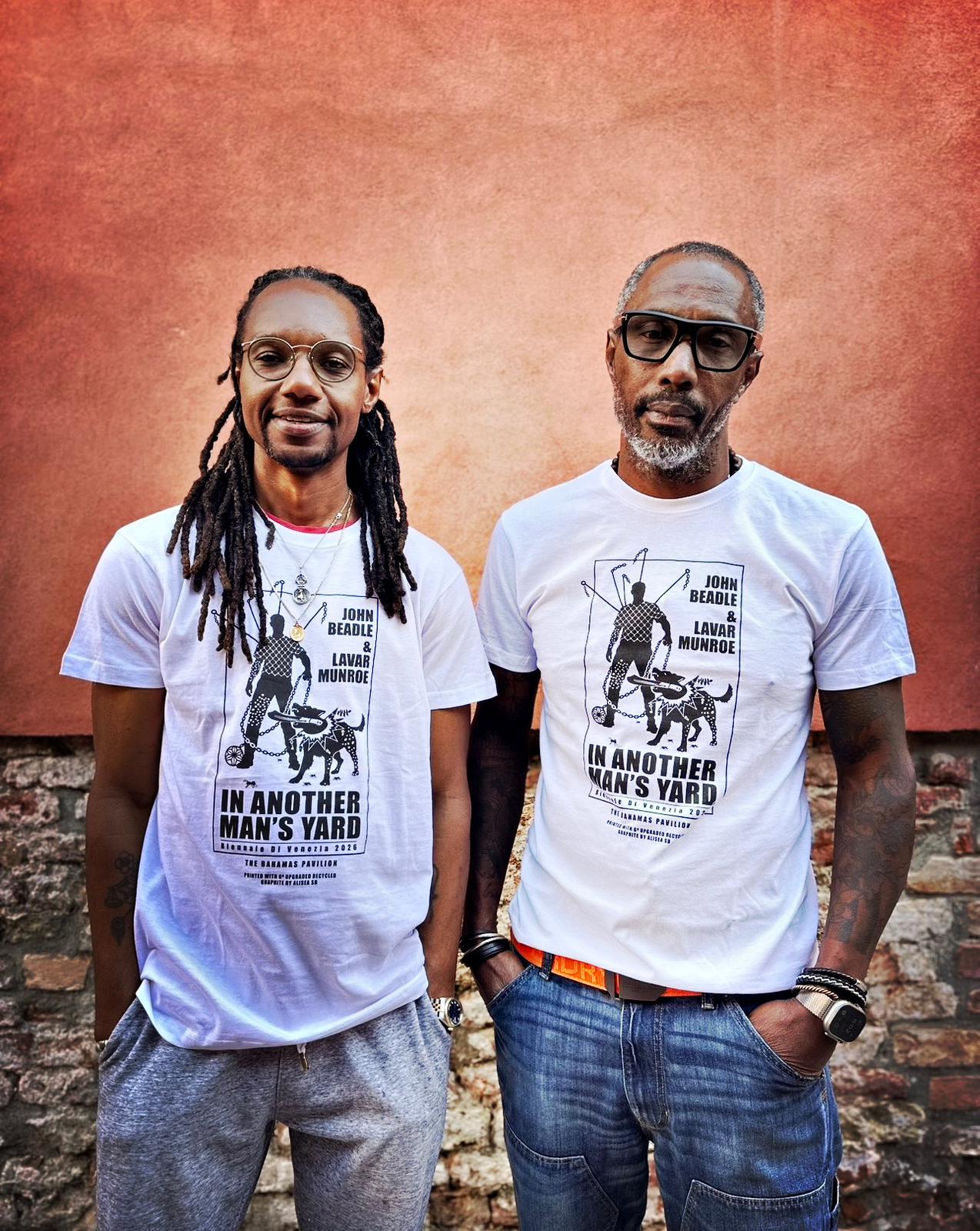
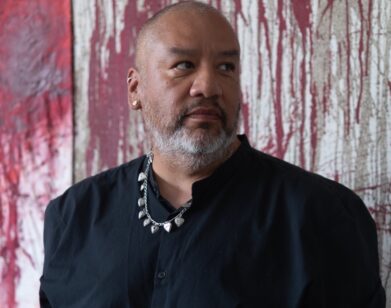
Lavar Munroe and John Cox. Photo courtesy of Lavar Munroe.
TUESDAY, 4:30 PM, APRIL 28, 2026 VENICE
Somewhere in a pile of old newspapers laying around his studio, Lavar Munroe found his old friend John Beadle again. Midway into creating a new body of work, the obituary of the late artist and fellow Bahamian (who passed away in 2024) surfaced from the stack, an interruption Munroe insists can’t have been by coincidence: “At that point I knew that there was a real connection between the spirit world, Beadle, and myself. Nobody can tell me otherwise,” he said last week. That news clipping was later folded into an 11-panel painting now anchoring the Bahamas Pavilion at the 61st Venice Biennale. Curated by Dr. Krista Thompson, In Another Man’s Yard marks the Caribbean nation’s return to the international arts stage after a 13-year hiatus, and stages an intergenerational dialogue between the two artists grounded in their shared engagement with Junkanoo, the historic Bahamian processional festival of performance, community, and costume-making.
Built on-site in Venice over a single month, the show transforms discarded materials into vessels of commemoration. Repurposed cardboard, salvaged Junkanoo costumes, sail material from Haitian sloops, and artifacts recovered from Beadle’s studio after his passing fill the two-story exhibition. Munroe’s monumental aforementioned 11-panel painting, No Matter How Dreary and Gray, We People of Flesh and Blood Would Rather Live Here, Than in Another Man’s Yard, imagines a Junkanoo procession for Beadle, every panel streaked with rain (drawn from the Bahamian spiritual tradition where rain during a Junkanoo Wake signals a bridge between the living and the dead). Elsewhere, However Long the Night, the Dawn Will Break channels Junkanoo’s “rush out,” the procession performed when a community member dies. The posthumous exhibition continuously weaves together materials tied to Beadle’s practice and life, including tiny cardboard bird sculptures found in his studio.
A week before the opening, Lavar Munroe got on Zoom with John Cox, executive director of arts and culture at Baha Mar, (the resort that helped fund the installation). Together, they reflected on Beadle’s lingering presence, and what it means to bring Bahamian art to the world stage.
———
JOHN COX: Hey, Lavar.
LAVAR MUNROE: Hey.
COX: We might as well jump right into it, hey?
MUNROE: Yeah.
COX: First of all, I know you’ve showed in Venice a couple of times before in different capacities, but what does it mean for you to be channeling the energy in this moment after we lost him?
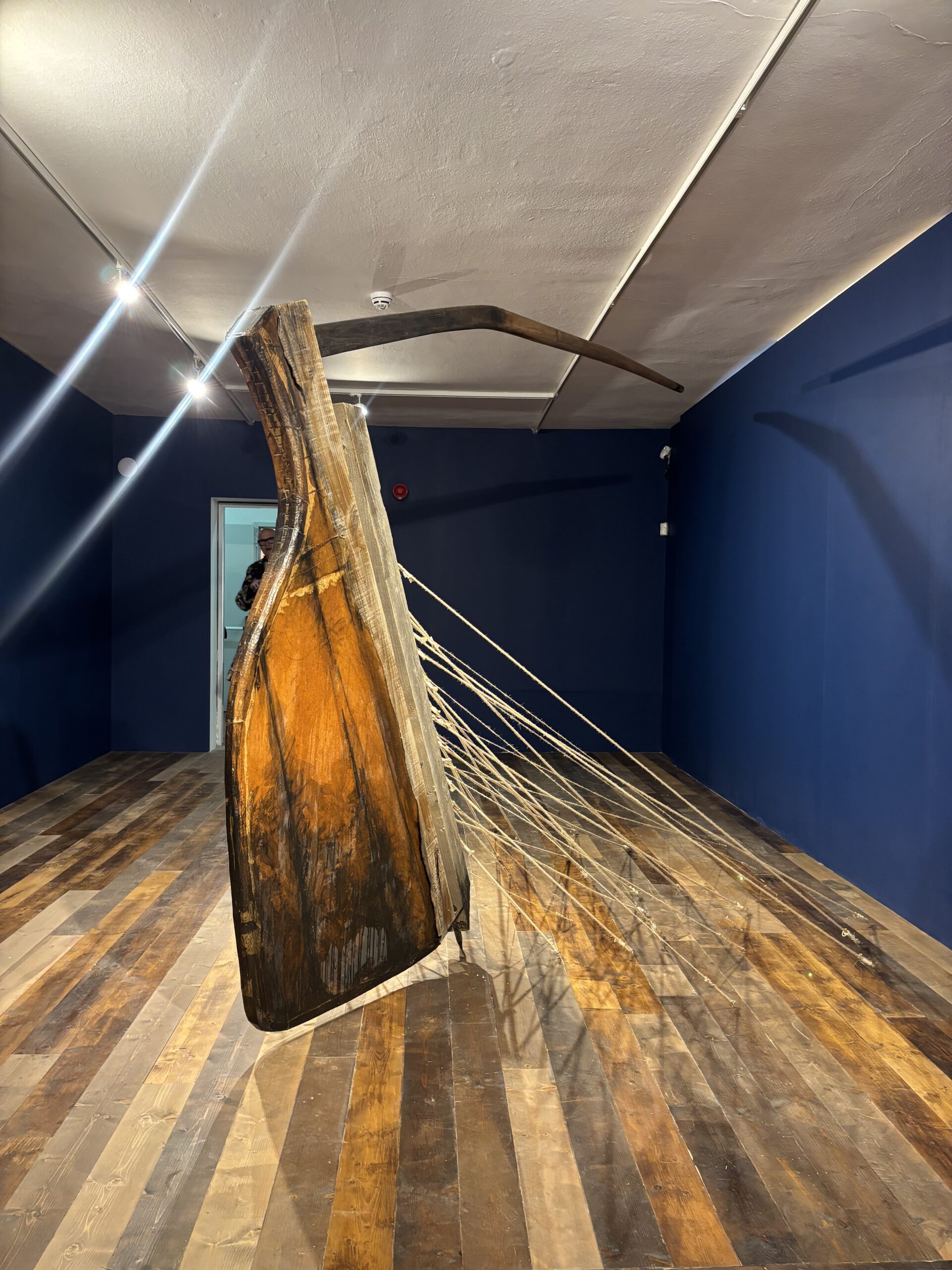
John Beadle, Live Load, 2010. Wood, cardboard, rope. © Estate of John Beadle; commissioned by International Curators Forum. (ICF) for Liverpool Biennial.
MUNROE: It means a lot. As you know, Beadle’s history and mine go way back. Starting off in 2010 at the Liverpool Biennial, where at the time I didn’t even know what a Biennale was, I was living with him and I learned from him. One of the pieces that’s currently in the show now was made in Venice. It’s called Live Load, where he used cardboard, wood, and string to make this rudder and oar type sculpture. That was the first time I saw cardboard used in a way where it defied what cardboard really is. I watched them transform this very mundane, disposable material into something that’s precious, but also that doesn’t look like the material that it came from. That was the beginning of my interest in cardboard.
COX: I’ve known both of you for quite a long time. I remember you in the context of the College of The Bahamas, being a very switched-on student there and I remember watching the work evolve. Is there a point at which you remember turning a corner and saying, “I could actually do this”?
MUNROE: Very early on, because I had examples like yourself. What y’all were doing at the time showed me that it was possible to be a full-time artist. It also showed me that art was beyond just painting. You both embraced materiality in a way that I’d never seen before. You using the woods and the stones and the bicycle tubes, and Beadle using the fishing hooks and the collage elements — it gave me the confidence to really use materials in the way I’m using them now. But once I saw that, my mind went international and I stopped thinking, “I’m going to be a local Bahamian artist.”
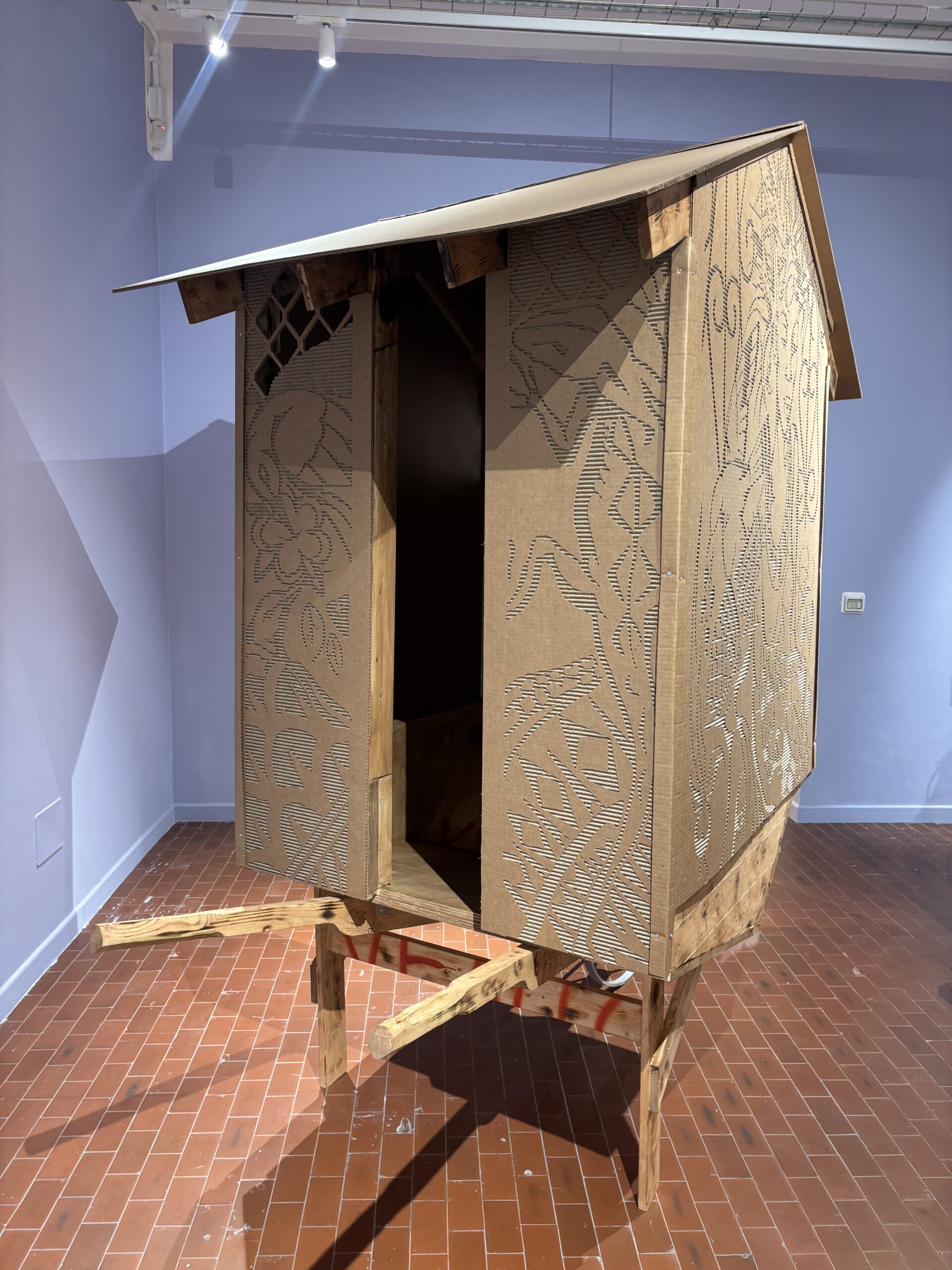
John Beadle, Mobile Housing Scheme, 2012. Wood, cardboard, metal. Dimensions variable. © Estate of John Beadle. Refabrication with the support of Tyler School of Art and Architecture, by Amanda Crain-Freeland and John Cox. Photo by Jackson Petite.
COX: Yeah. I think that that’s what we do, we imagine ourselves in a larger context. I did that series of work called, I Am Not Afraid To Fight A Perfect Stranger, which deals with the idea of asserting yourself and contributing to a bigger artistic human conversation, which I think you’ve been successful in. Also, Jackson Burnside made me feel about Junkanoo in a very different way. He made me feel that Junkanoo was not about the parade on Bay Street as much as it was about this kind of creative community. Like a rare, egoless, collaboration. Can you speak to that?
MUNROE: Yeah. I think he’s using Junkanoo as a jumping off point to speak about issues we’re dealing with today. But these conversations are still being had globally, not just in The Bahamas. I’m also pointing to those things, but I’m also using it to pay homage to Beadle. Within the Junkanoo community, when somebody dies we have something that’s called a Junkanoo Wake, which pretty much is the sending off of a spirit. It’s the community and the earthly realm coming together, telling the spirit of the dead that it’s okay to move on. And in the Pavilion, I’m using this Junkanoo Wake for the paintings to pay homage to Beadle by pointing to various things that are related to him. I’m pointing to the One Family Junkanoo group from which he’s associated, also the insects that are happening in the work. And there’s rain. When there’s rain happening during the Junkanoo Wake, there’s a connection being made. If they rush in for somebody and the rain comes down, that is the connection between the spirit world and the earthly realm. So, if you notice with the 11-panel piece, all the pieces have rain in it. I was also digging through the newspaper, which I usually have in my studio, and all of a sudden found Beadle’s obituary, the front page of The Nassau Guardian that spoke about his death. At that point, I knew that there was a real connection between the spirit world, Beadle, and myself. Nobody can tell me otherwise. Out of a big pile of newspaper this one thing popped up, and that paper also was included inside the 11-panel piece.

John Beadle. One Thousand Small Mercies, 2016. Wood, cardboard, metal, objects. 72 x 24 x 182 in. Courtesy National Art Gallery of The Bahamas. Photo by Blair Meadows.
COX: Even though you’re away from home in a lot of ways, you’re a part of this diaspora of Caribbean creatives that are all over the world. It feels like the energy and the inspiration of the work—no matter how far you’ve gone already—is still coming from home. Is that a thing for you?
MUNROE: It’s very true. I mean, I’m always home.
COX: You know the Mobile Housing Scheme that we’re reimagining in the space for John? I remember when I curated that show and he made the work, he was articulating the concept to me. He’s like, “John, whenever you go, you carry your home. Your culture moves with you.” Conceptually, the underpinning of Munroe feels like it’s embodied in that work. It’s a wheelbarrow, a space of grounded humility, of labor, identity, no pretense, and I’m carrying the space. I’m carrying my home with me. How do you feel about that?
MUNROE: It’s always been about the journey. My thesis in graduate school was about the monomyth, the hero’s journey. And borrowing from Joseph Campbell—I mean, you probably remember The Hero with a Thousand Faces. It’s about the various stages as human beings that we go through. His birth, his initiation, his rite of passage, him being in the belly of the beast, defeating the beast, then coming out of the beast, being victorious, and then he dies.
COX: Yeah, exactly.
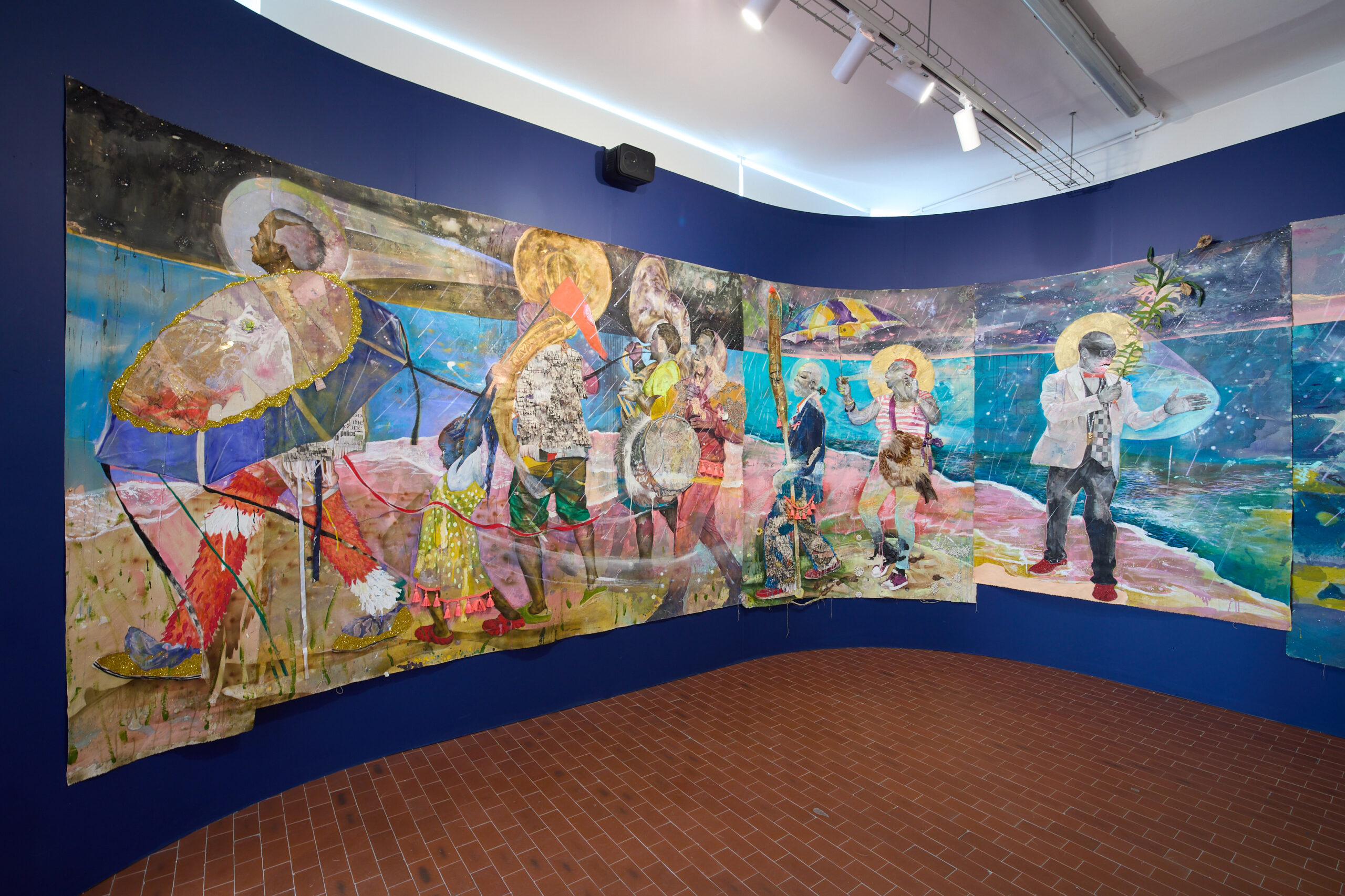
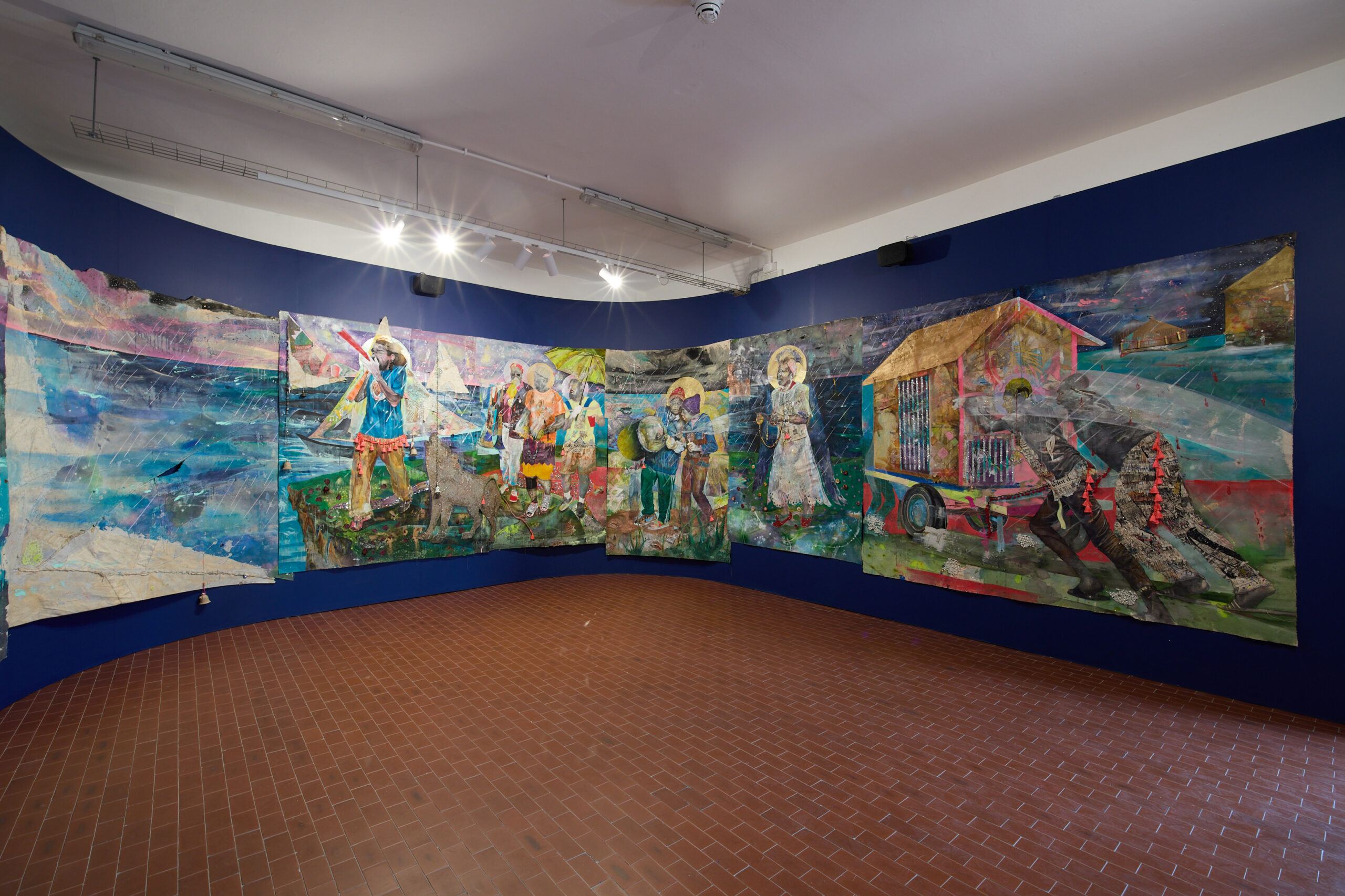
Lavar Munroe, No Matter How Dreary and Gray, We People of Flesh and Blood Would Rather Live Here, Than in Another Man’s Yard (Bridge Over Troubled Water), 2026. Acrylic, spray paint, latex house paint, airbrush, mixed media. Dimensions variable. Courtesy the artist, The Bahamas Pavilion, Larkin Durey, Monique Meloche. Photo Larkin Durey.
MUNROE: So, that narrative I take throughout the work, and using that narrative to point to multiple facets of life. It could be me traveling to Africa and back to The Bahamas, or witnessing the death of my father, or reading the newspaper and seeing there’s a Haitian sloop that had capsized, or there were Haitians that were apprehended. Any journey is kind of heroic.
COX: I’m a fan of Joseph Campbell, and I know that he was a fan of Carl Jung, and Carl Jung spoke about the nervous breakdown. Those of us who are privileged enough to have gone through a nervous breakdown actually have to reckon with our own selves in a deep way. That oftentimes you unravel, but then you unravel the space of new realization, which can be quite powerful. Have you experienced that?
MUNROE: I have had trials. I wouldn’t say a nervous breakdown, but I’ve had times where I had to work through things. I mean, divorce is one of those things that was very trying, and being in the court system and having to rebuild. I mean, the death of family members, the birth of children, the rearing of children. We all go through it.
COX: Yeah. That’s beautiful. I feel really honored that my company really loves you and the work that you do. At Baha Mar, Graeme Davis sought you out when you were in a show I curated a couple of years ago. He said, “Who’s this Lavar Munroe person? I think we should really think about getting his work.” And now we’re onto the third one, and probably going to do many more. How do you think we might be able to take what you do and actually create markets for you in The Bahamas, but also in the region?

John Beadle. In Another Man’s Yard, 2006. Metal, canvas, wood, fishing line. Dimensions variable. Courtesy National Art Gallery of The Bahamas. Photo by Jackson Petite.
MUNROE: I think it’s difficult, to be honest. I think outside of yourself, and maybe Dawn Davies on a smaller level, there aren’t many people who could even understand why the price is what it is. And I wouldn’t say it’s been difficult, because it hasn’t been my market for such a long time. I do realize that we are a very young country and there’s a lot to learn, and I embrace that.
COX: I think it’s about assigning value. I feel incredibly blessed to work for a company that can afford the work, but more importantly, has a value system that appreciates it. I think what happens a lot with people who have means is, you may for example have a painting that may be $18,000, and someone will go, “Oh my god, I’ll never pay for that.” But they will easily buy door handles for their bathroom for $10,000. So, it’s a different type of thing. But anyway, I would love to see reshaping expectations of the Bahamian space and the Caribbean space through this cultural awareness, artistic development, historical wherewithal, which I think is all wrapped into where you are. And you’re exposing it to an audience that may not even understand it now. They may understand it 30 years later, but the thing has to be positioned. I don’t know if that’s something that you are conscious of?
MUNROE: Yeah, I am conscious that there are examples being made. I look at this as an opportunity to make a blueprint for the other years to come. I’m showing that this is the level it needs to be at, and this is what it takes. It comes from the research, to the funding, to the curatorial choices, to the type of things that people are reading and how it connects to the bigger picture, but also to The Bahamas. So yes, I’m very aware of it. And that’s why the level at which it’s being done for me was always so important. It couldn’t be half-ass.
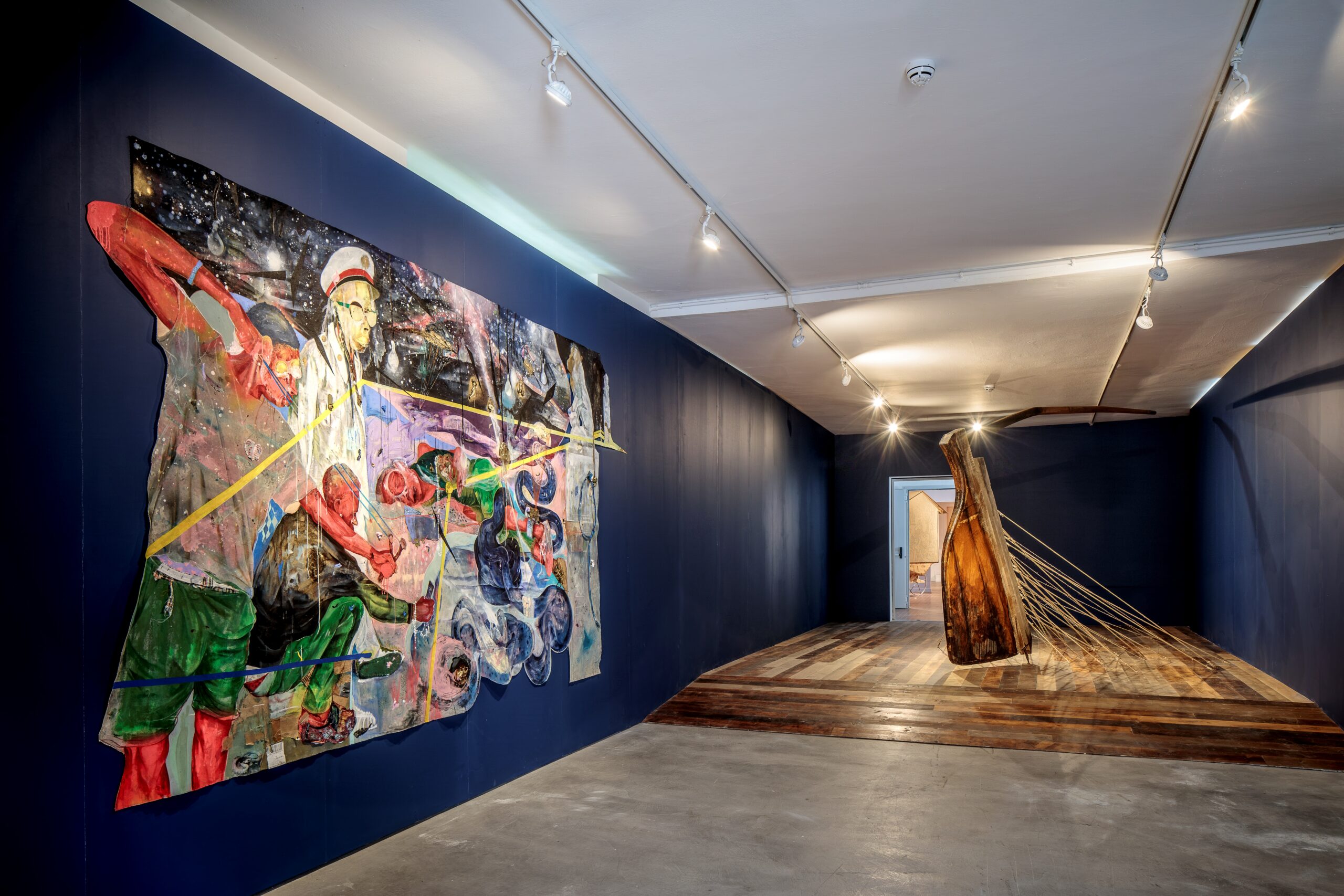
The Bahamas Pavilion, In Another Man’s Yard. John Beadle, Lavar Munroe, and the Spirit of (Posthumous) Collaboration. Works pictured by Lavar Munroe and John Beadle. Photo Francesco Allegretto.
COX: I mean, I have to go back to Baha Mar and applaud that they are underwriting a significant part of this because they recognize the value in it. They realize that there’s no immediate ROI on it, but they understand that this is an important nation building moment for us. What inspires me about you and Krista Thompson, our brilliant curator, and Amanda Coulson, our producer, is that I never feel a sense of desperation like, “We need to do something. We need to reach out to a level that is outside of where we are.” It’s rather that we are sharing the world that we already know.
MUNROE: Yeah, of course.
COX: Discovery is looking at Beadle truly being himself, uninhibited. Munroe and Beadle are ultimate Bahamians. Ultimate people of the Caribbean, and ultimate people of the human race. Which I think is such a wonderful thing, to assign that humanity to a place like The Bahamas where there is complexity, nuance, diversity, contradiction, conflict, and beauty.
MUNROE: Yeah. And as you can tell, there’s a sincereness. I’m just doing what I enjoy doing, same with Beadle. It never was a sign of desperation or ego or all of those things out the door.
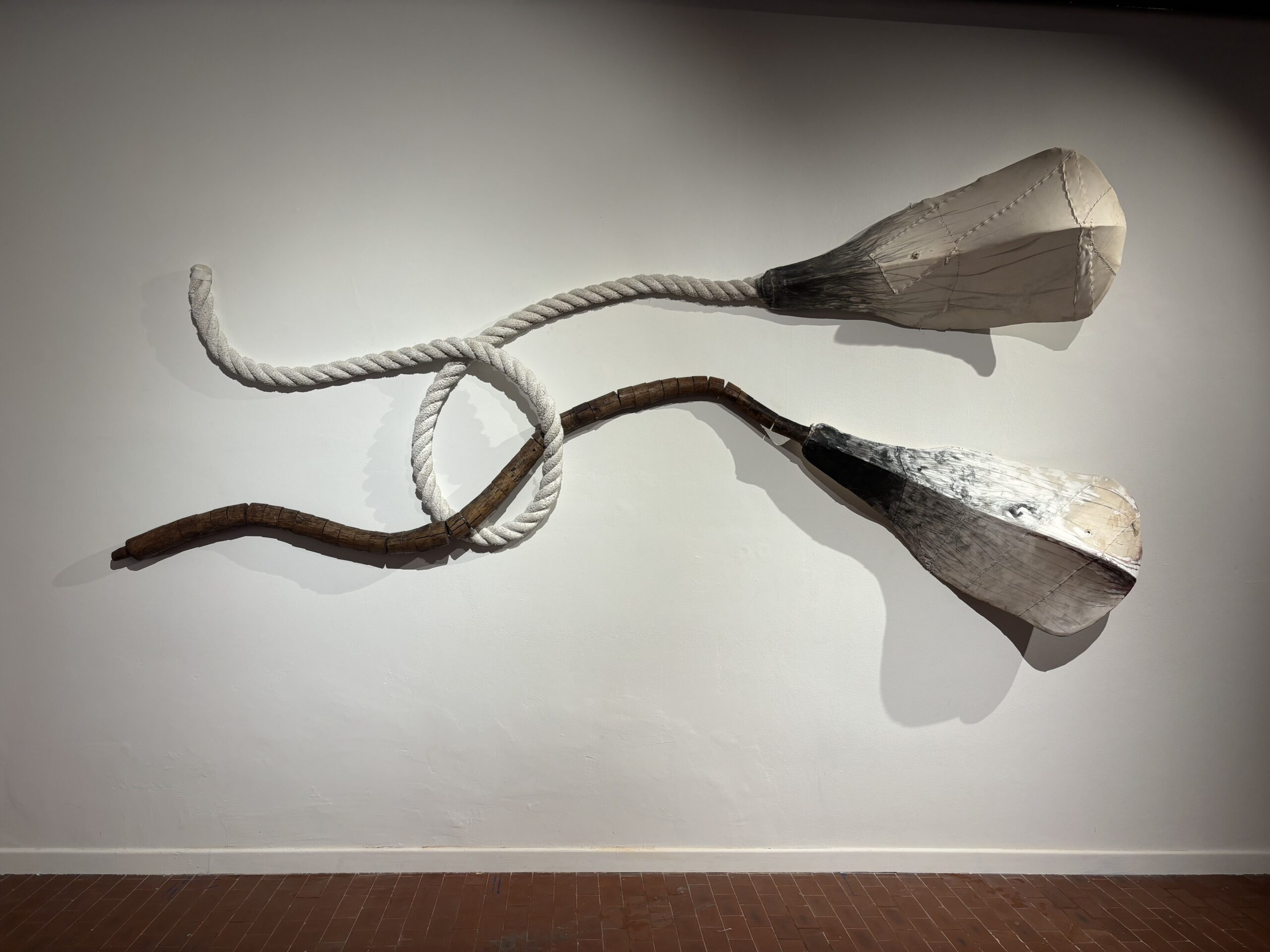
John Beadle. Moving in Place, I, 2000. Sail Canvas and Rope Shaft. 156 × 24 in. Moving in Place, II, 2000. Salvaged canvas sail and segmented tree trunk shaft. 93 × 23 in. © Estate of John Beadle.
COX: I wanted to ask you one more thing. It’s inspiring for me to see you work with Eddion [Whyms], who is the young artist assisting you. Do you have a word of advice for the next generation of creatives, who in 25 years are going to be like, “Hey, I’m doing the Venice Biennale”? What would you say to the next generation of creatives who are working at this global level that are from The Bahamas?
MUNROE: Just remain curious. Curiosity leads to research. Research leads to ambition. Ambition leads to work. Work leads to other things, but it’s a series of things that happen. Also, education first. But go outside of your comfort zone. Like for instance, Eddie, me getting him to get out of Venice to that thing the other night was like pulling teeth. “Oh, we need to call and let everybody know where we are.” No, let’s just go. Just go. So for me, again, it’s teaching them not only art, but teaching them how to be curious, teaching them how to move, teaching them how to ask questions. Don’t be afraid. You’re never lost. There’s always somebody who’s going to help you. Always, always, always. They can tell you’re not from around here. But again, this action and this curiosity comes with learning–learning cultures, learning life, learning art, learning how to articulate, learning how to speak a different language, learning to eat different things. So, with Eddion, I’m trying to teach him many things. And people did it for me, so the least I can do is do it for others, and especially my own.
COX: And then you also see the entire ecosystem of what it takes. You don’t work in a vacuum. We have Blue Curry. We have all these people who are in the mix doing and working. We have collaborators from Tyler University helping us reimagine some of these works, and the conversations bring us all together. This has been a wonderful conversation with you. I could talk with you for 10 more hours.
COX: A couple of times in that Pavilion, Lavar, I felt like I could burst into tears. Like, literally. I feel the energy and hear the conversations. I see so many of the silhouettes of you and him line up on the horizon in a perfect way. So I appreciate you for that, man. I really do.
MUNROE: Well, thank you. And I appreciate you, as I told you before, for being on board. For real. No joke. I sincerely appreciate it.