


Marianne Faithfull


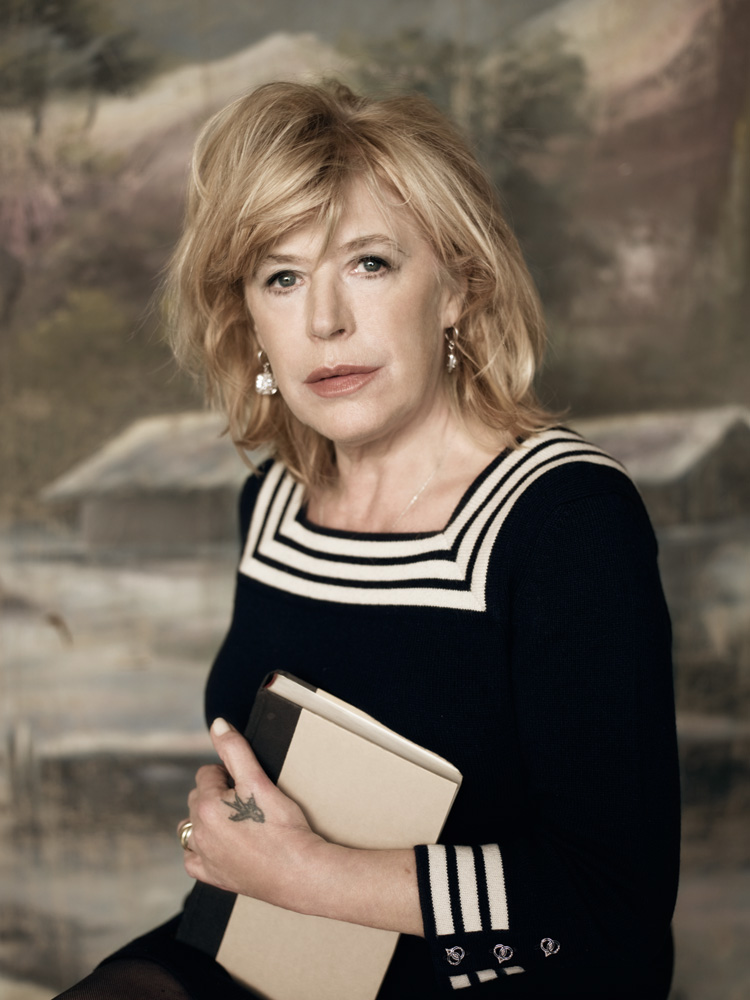
Talking to Marianne Faithfull over the day’s first coffee is a bit like waking up for cocktails. She’s alert and energetic, but chicly world weary. Her conversation is direct but subtle, wry but sincere. Faithfull has been there, done that, and been there again and done that too—rock stardom, Mick Jagger, addiction, homelessness, cancer, and motherhood are just some of the episodes of her richly patinated saga—and while her voice is famously broken, her humor is unbent. Her unapologetic decadence and hard-won wisdom is refreshing to hear, especially since her fans have had cause for concern in recent years: In September of 2006, Faithfull was diagnosed with breast cancer; the following year, she announced that she had been treated for hepatitis C; and she took an extended break in 2008, despite having just recorded one of the best albums of her career. That album, Easy Come, Easy Go (Decca), has just been released in the States. In putting it together, Faithfull, 62, and her longtime producer buddy Hal Willner, went hipster hog-wild, scrolling through their address books to enlist musicians such as Nick Cave, Antony Hegarty, Sean Lennon, Chan Marshall, Rufus Wainwright, and Keith Richards, whom Faithfull first met in the ’60s when she began her long, tumultuous relationship with Jagger. And they picked an eclectic group of covers, from such classics as Billie Holiday’s “Solitude” to “Children of Stone” by the contemporary neo-folkies Espers. Faithfull says that all together, the songs tell her life story—a story she has told in book form in her 1994 autobiography, Faithfull, and in her 2007 memoir, Memories, Dreams & Reflections, but one that was made for singing about, and she does so brilliantly in her inimitable cigarettes-and-whiskey rasp.
EVELYN McDONNELL: How did the idea for this record come about, of choosing these kinds of songs to record and working with Hal Willner and the other musicians?
MARIANNE FAITHFULL: Well, you know, Hal and I have worked together a lot before, and we’re very good friends. We always wanted to do another record in the studio, and I felt like part of my taking a break, really, was that I wanted to not write. So we started to look for songs. I started, and he started, and I found quite a few. Then he came over in October of 2007, and I played him the ones I found, and he played me lots of songs, and we went through them all, and we picked these. Have you got the 10 songs or the 18?
McDONNELL: I have the 12.
FAITHFULL: Oh, the 12, sorry, yeah. Well, we did a lot more than that. In Europe, I think, they’re releasing the 18 songs.
McDONNELL: We’re getting ripped off in America?
FAITHFULL: A bit . . . [both laugh] But maybe it’s better. Maybe they know their market. There’s a lot of money problems at the moment . . .
McDONNELL: Yes, indeed.
FAITHFULL: So I think it might be better. The 12, they’re lovely.
McDONNELL: Which ones did you find?
FAITHFULL: “Down from Dover” by Dolly Parton, “Sing Me Back Home,” which is the one with Keith [Richards] . . . I wanted to do “Ooh Baby Baby” [by The Miracles] as well. I’m not sure what else you got.
McDONNELL: You can also tell me the ones that are on the European version.
FAITHFULL: Yes, well, there’s a lovely version of “Many Miles of Freedom” by Traffic. And “Black Coffee.” It was recorded by Ella [Fitzgerald], of course, but everybody’s recorded “Black Coffee.” I love Ella, but she’s too technically perfect. I only like a few virtuoso voices, but I do like Ella Fitzgerald and Sarah Vaughan. And the rest of the time I like slightly more quirky voices. Ella’s version overwhelmed me, so I listened to the Bobby Darin version. I like the Bobby Darin because I think it’s not such a perfect voice, but it’s very good. And the other songs . . . There’s a wonderful version of me and Jarvis Cocker -doing “Somewhere.”
McDONNELL: Oh, that’s not on the American CD version of the record either.
FAITHFULL: Well, they’re going to have to release the whole thing eventually. I’m sure they will.
McDONNELL: Right. And they’ll get the money from people twice. [both laugh] What were you looking for when you were picking songs?
FAITHFULL: Hal and I took a huge risk in picking the songs, which I think we liked doing.
McDONNELL: The risk being that the songs that you picked were these eclectic . . .
FAITHFULL: Well, also that we didn’t pick any one kind of music. There’s country, jazz, blues, rock ’n’ roll, and folk on this record. You don’t really realize that maybe with the 12 songs, but there are an awful lot of things on there.
McDONNELL: And songs by more contemporary artists like The Decemberists and Neko Case . . .
FAITHFULL: I like The Decemberists one because it sounds like a folk tale, you know? Those kinds of strange love affairs in a folk tale. And the Neko Case one is just great. I can really understand what it’s about. But another song you haven’t got is “The Phoenix,” which is a Judee Sill song.
McDONNELL: No, I do have that one.
FAITHFULL: Oh, good, because she’s a very interesting songwriter.
McDONNELL: I don’t really know her work.
FAITHFULL: Well, she was a singer-songwriter—a folk singer, really—in the ’60s. And she was a heroin addict, and she died. But she wrote some lovely songs. I don’t know if I could have written “The Phoenix.” That’s Sean Lennon playing 12-string guitar, and then singing, too.
McDONNELL: Do you think any of these people will be performing with you live?
FAITHFULL: I don’t know. I mean, it’s not absolutely essential, but it would be very nice. I’d find it hard to do “Ooh Baby Baby” without Antony, because it’s such a brilliant performance. I think what you have to do—what I do—is think of the record as one thing and the live performances as another.
McDONNELL: You always have great people on your albums. Does anybody ever turn you down?
FAITHFULL: Oh, yeah. Some people just don’t want to do that sort of thing. And I understand that. I was terribly pleased when Keith agreed to be on this record.
McDONNELL: Did you have to coax him?
FAITHFULL: No. He sent me the loveliest fax. Jane Rose—that’s his manager—asked him for me, and he agreed, and then he sent me this wonderful fax. You know the song we do together, “Sing Me Back Home” [by Merle Haggard], is a wonderful penitentiary song, and I actually learned it from Keith in the ’60s when he learned it and was singing it with Gram Parsons. So it was like a circle coming to its end, you know? And he sent me this fax saying, “I’ll do it for you, baby, if you do it for me,” which is “Sing Me Back Home.” So I wrote back and said, “Of course I will, darling.”
McDONNELL: What was it like being in the studio with him?
FAITHFULL: Oh, it was wonderful. Just wonderful.
McDONNELL: Had you seen him lately?
FAITHFULL: Well, yeah. We’re very good friends, and I see him from time to time. Obviously, he lives in America, and I’m here in Europe. But I always go hang out with Keith, mainly when I go to a Stones show. We love seeing each other. I think it’s a great help. It’s very important to keep your friends.
McDONNELL: How often do you go to a Rolling Stones show?
FAITHFULL: Oh, well, I . . . [laughs] Whenever I can, if I’m not working and there is one around, I’ll go. But I guess when I come to America I might go and see him if I can.
McDONNELL: Do you still have a good relationship with Mick?
FAITHFULL: It’s okay.
McDONNELL: I was rereading Faithfull—
FAITHFULL: Oh, yeah . . . [laughs]
McDONNELL: And it occurred to me that people have this tendency to depict Mick as a misogynist, and the whole “Under My Thumb” thing . . .
FAITHFULL: Oh, I don’t think that.
McDONNELL: From your book it seems that he was under your thumb if anything, you know?
FAITHFULL: I wouldn’t have thought so. I think we were really equal—which was a good thing. Nobody was trying to be in control of the other. We really were very equal, and that’s why we were happy, I think. I’m very fond of Mick. I really am. And he taught me so much. It was Mick who first played me “Ooh Baby Baby.” It was Mick who put on The Miracles and danced all the dances and pretended to be singing.
McDONNELL: You recently wrote a second memoir, Memories, Dreams & Reflections.
FAITHFULL: It’s a lot more positive than the first one. I think when I wrote Faithfull, I was still very angry. And really I’m not now, at all. I’ve gotten over it, and I wanted to correct that. I mean, I didn’t feel that it was that urgent, but I wanted to show a more positive side, which I felt I kind of left out of Faithfull, which is a bit too tipped in the way of the negative.
McDONNELL: Do you feel like you were getting that out of your system?
FAITHFULL: Probably, yeah. That’s what everybody said I should do—get it out of my system. So I did. I mean, it didn’t turn out that badly. I wasn’t really awful about anybody.
McDONNELL: No.
FAITHFULL: But somehow you could feel the pain. I wanted to show another thing. It’s a nice little book, Memories, Dreams & Reflections.
McDONNELL: Well, Faithfull did very well.
FAITHFULL: Faithfull did do very well, yeah.
McDONNELL: I’m surprised someone didn’t . . .
FAITHFULL: Make a film of it? Oh, I think that will still happen. Eventually, yeah.
McDONNELL: Who has the rights to that?
FAITHFULL: Well, nobody at the moment, but I’m talking to a young director who I think would do a beautiful job.
McDONNELL: I’m surprised nobody’s done it yet.
FAITHFULL: Well, they wanted to, but I had a bad experience with somebody. And then I got very protective. But now so much time has passed that I really think that if I like the person—the director—and like the script, I could just let them do it and I wouldn’t worry. But I was so scared after my last experience—I got so hurt that I was afraid.
McDONNELL: And this was someone who started making the movie?
FAITHFULL: Didn’t start filming, but it got to the point of a script, and there was a horrible, horrible scene in it, which isn’t, of course, in the book. I didn’t realize they could do that—that they could just buy a book title and then make it all up. [laughs] But there was a scene where I was living on the street—which was indeed a very, very challenging time—and I was, in their script, a prostitute, and I was going off with a client and the camera pulled back to reveal my 7-year-old son watching me. And that wasn’t in the book, and it didn’t happen. Carrie Fisher did try to explain it to me, and I’ve eventually gotten it. What she said to me was amazing, really. She said, “You know, you may think that your story has been degraded enough”—which I do think, that in my life it has been quite degraded enough—“but there are people who will want to degrade you more.”
McDONNELL: Just you being a prostitute. You never—
FAITHFULL: I wasn’t a prostitute. No, I never had to do that. I could have done it, you know. People asked me, but I didn’t want to.
McDONNELL: Was it a Hollywood-ish director?
FAITHFULL: Well . . . hmm . . . sort of, but not really. I mean, it was an Irish director, but a misogynistic one. [laughs] Very obviously . . .
McDONNELL: Just the implication . . .
FAITHFULL: Judgmental and dreadful. No, I couldn’t let that happen. My son would have been furious.
McDONNELL: How is your relationship with your son [Nicholas Dunbar]?
FAITHFULL: It’s really, really good. I go and stay with him. Neither of us ever thought we’d get this kind of relationship. But we do.
McDONNELL: Was there stuff you both had to work through?
FAITHFULL: Oh, yeah. And, you know, I did a lot of therapy. In fact, I’m still in therapy. I didn’t do any for quite a long time and now I’ve gone back. But it was time, in fact, that mattered. He loves my work, too. And I’m very proud of him. He’s a writer, and he’s in the middle of his second book now.
McDONNELL: Fiction or nonfiction?
FAITHFULL: Of all the things that could happen, my son became an incredible expert on high
finance. [laughs] You know? And he wrote one book which is really very, very good. I’ve read it. It’s called Inventing Money. And I don’t understand a thing about high finance. Now he’s writing another one about the crash and the whole thing going on.
McDONNELL: And what is his perspective?
FAITHFULL: I don’t know, darling. I haven’t read it yet. But it will be very interesting. He’s very, very clever.
McDONNELL: I love in “Ooh Baby Baby” that classic line of “mistakes, I know I’ve made a few.”
FAITHFULL: All the way through these songs, there are one or two lines that if I’d put them together would make my story. I like that. I believe we have to have a story and we have to express it, and I’ve got one.
McDONNELL: Certainly “In Germany Before the War” resonates with your background. [Faithfull’s mother was from Austria.]
FAITHFULL: Oh, God, yeah. I love it. It’s very much like the Kurt Weill music I’ve done. Every song has got a line or two. In “Children of Stone,” it is “you couldn’t open up your veins to light.” I love so many things in that song. I love the idea of a song about alchemical devotions. I think it’s actually a very joyful song, but it does create a strange atmosphere.
McDONNELL: The whole concept of “Easy Come, Easy Go,” I think a lot of it is about mortality.
FAITHFULL: Well, first of all, it’s about sex. That’s what Bessie [Smith] was singing about. And then there are many other meanings. I love these kinds of words that have all these separate meanings to them. “Broken English” [from Faithfull’s 1979 album Broken English] was a bit like that. It gave you an image of all sorts of fragmented things. And one of them was me.
McDONNELL: You’ve put so much of your life out there in your books and in your records.
FAITHFULL: I have, yeah. I sometimes think I’ve put too much of it out. There’s not much I can do about it. When I talk to somebody, if I like them, I’ll open up. That’s how I am. I can’t really help it. So many people have been with me on this journey, and I think I should respect that.
McDONNELL: Hal is someone who’s been on the journey with you for a long time. What’s special about working with him?
FAITHFULL: Hal has been with me on the journey for a very long time, yeah. We’re both in a much better place now. We’ve learned to live life as it actually is, which helps a lot, I think. For me, anyway, with my doing an interpretation of some of these great songs, it’s best if I’m in reality, don’t you think? I mean, listen, I’m sure I’m as delusional as the next man. But on the other hand, it’s wise to try to be realistic.
McDONNELL: I suppose it’s very symbolic that one of the ways that the world first saw you was naked under a rug. [Faithfull made headlines during a now-infamous drug bust of The Rolling Stones in 1967, during which she was photographed clothed in nothing but a rug.]
FAITHFULL: Well, yeah, I was naked, but I don’t know . . . I don’t even want to think about it anymore, all that stuff . . . My fur rug . . . I must have looked really beautiful. [laughs]
McDONNELL: It’s interesting that you’ve become an icon to a lot of gay men.
FAITHFULL: I’ve done a lot of interviews with gay magazines and, of course, they’re really nice. It gives me a way of talking to people that aren’t just conformist and conventional—I mean, nor are you, actually, but, you know, people will think what they think, and sometimes some of it will be really bad shit. But I don’t think my fans want me to try to be anyone else. I couldn’t anyway.
McDONNELL: I think you have a very clear persona—Maybe persona is the wrong word.
FAITHFULL: No, it is a persona, but it doesn’t look like a persona because I’ve been working all my life to get my persona and my true self a bit more together, so that I don’t ever have to pretend. And now I think I’ve done it.
McDONNELL: A lot of people who appreciate your persona seem to be somewhat unconventional.
FAITHFULL: Yeah, and rather decadent, too. That’s the other thing: I think I was born like that. I don’t see decadence really as what you do, because I don’t do much at all that is decadent in my life. But I still am decadent. It’s a state of mind, I think.
McDONNELL: I think that’s what that filmmaker you were talking about earlier was not getting.
FAITHFULL: I’ve made a mistake that I make a lot, which is that I assume that everybody thinks like me. And they don’t. People are small-minded sometimes.
McDONNELL: But you don’t want to start thinking like them either.
FAITHFULL: God, no . . . Well, I just drop them and don’t ever talk to them again. Maybe not the healthiest thing to do, but it’s the only thing I can think of. I did assume that anybody who wanted to make a film of my book—and this guy is very well known and very respected—would do it because they wanted to and because they liked me. But I was completely wrong. He just wanted to put me down. He thought I was not only a prostitute in the time when I was living on the street, but a prostitute in art, which I’m not.
McDONNELL: And also that you’re a bad mom.
FAITHFULL: Oh, all that . . . Well, Nicholas would be mad, and I can count on him to protect me when I’m dead as well. He will.
McDONNELL: It’s great that you’re able to have—
FAITHFULL: That kind of support. But I would do it for him. I have to remember to just believe in the work and it will get through and not everybody understands . . . Never mind. [laughs]
McDONNELL: You can’t please all the people.
FAITHFULL: No.
Evelyn McDonnell has written and edited five books. She lives in Miami Beach with her husband, son, stepdaughter, dog, two cats, and a bearded dragon.