


Anjelica Huston


Anjelica Huston came to New York City in 1969. She had already tried her hand at acting, having appeared in one of her father John Hustonâ??s less successful films, A Walk With Love and Death (1969), at the age of 16. For her performance, she was roughly criticizedâ??comparable only to the treatment of Sofia Coppola for her turn in her fatherâ??s film The Godfather: Part III (1990) long before she became a filmmaker herself (and a very good one). One only wonders what would have happened had Huston allowed that early experience to preclude a future career in acting. As it turned out, Huston waited more than a decade to return to the screen in a serious way. And when she finally did, in 1985â??s Prizziâ??s Honor, she won an Academy Award for Best Supporting Actress. Since then, Hustonâ??s filmography has been a hit list of risky choices, and today serves as one of the few examples of survival in an industry that has never been kind to women over 40. Her endurance may very well be attributable to the fact that, for all the weight of the Huston family name, sheâ??s an actress absolutely unlike any other that has come before or after. Huston has graced Interviewâ??s cover four times. Here she talks about her days in and out of the Hollywood machine.
CHRISTOPHER BOLLEN: I just went through all of the different features that Interview has done with you over the years. Youâ??ve been in the magazine eight times and appeared on the cover for four of them.
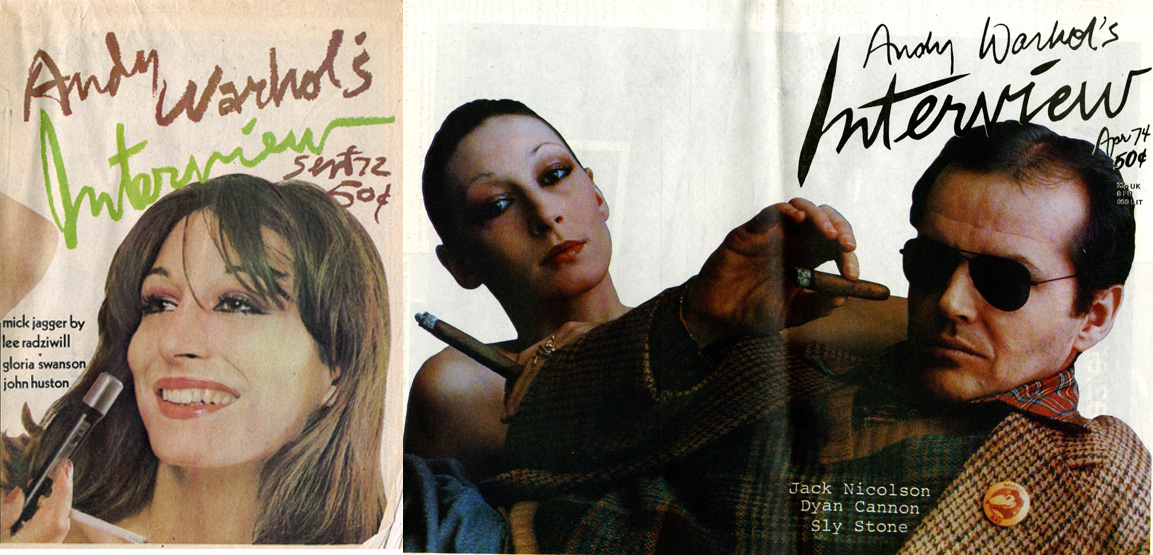
ANJELICA HUSTON: I think I was on one of the magazineâ??s first color covers. It was a photograph that I did with Berry Berenson. Iâ??m speaking into a red telephone.
BOLLEN: Actually, I think youâ??re posing with a hand that is coming out of the left corner of the cover and holding a microphone and, strangely, also a cigarette. I love that the designer didnâ??t find that too distracting to delete from the image. But I guess thatâ??s how it went back then: no separate photo shoot and interview. All the magic just happened at once.
HUSTON: Yes! As far as I can recall, it was just Berry and me in a room. I remember that interview in part because I basically said â??groovyâ? every other word.
BOLLEN: You canâ??t blame yourself for that. That was in the lexicon of the time. Or were you a woman particularly susceptible to groovy?
HUSTON: [laughs] Well, obviously, it held a lot of attraction for me. I used it on such a consistent basis.
BOLLEN: Berry Berenson was a regular contributor to the magazine. And you probably know this, butshe first got to know Anthony Perkins while doing a feature interview of himâ??and then they fell in love and got married. Were you friends with Berry, or was that interview the first time you two met?
HUSTON: Oh, we were very, very good friends. I first met Berry and [her sister] Marisa when we were all about five or six. Our parents used to go to Klosters in Switzerland for winter holidays, and Berry and Marisa were the stars of the skating rink. They were a little older than I was, but they were the Berenson sistersâ??very beautiful even at that young age.
BOLLEN: Your second Interview cover came two years later, in 1974â??which you shared with your thenboyfriend Jack Nicholson. I read the article they did on you. You two had just started dating, and I was struck by how honest and open you both were in the article. You donâ??t get that kind of candid look into celebritiesâ?? lives anymore. I guess there wasnâ??t the same need for protection in those days.
HUSTON: Well, I think the difference is due to the fact that, as Joni Mitchell so succinctly put it, thereâ??s â??the starmaker machinery.â? There are two levels of truth today. Thereâ??s the truth that goes on between people, and then thereâ??s the realitytelevision truth. In those days, there was only one kind of truthâ??what you were and what you were trying to do in the worldâ??as opposed to â??presented truth.â?
BOLLEN: It seems like celebrities canâ??t afford to put that truth out in the world now, so itâ??s all publicity smoke screen.
HUSTON: Well, you can, but itâ??s all extremes nowâ??extremes of inhibition or total lack of inhibition. So now people donâ??t just cry in public, they roar. Or they donâ??t cry at all. I think itâ??s come down to a choice of showing nothing or showing everything. There doesnâ??t seem to be much middle ground for who you really are anymore.
BOLLEN: Do you remember those early years in New York before you moved to Hollywood fondly?
HUSTON: I do. I was with the photographer Bob Richardson for at least four of the years I was living in New York. That was, at times, a very difficult relationship, so itâ??s not a period that I look back on through rose-colored glasses. But there was a tremendous energy in New York back then, and I met people who changed my life. I had the incredible good fortune to work with Richard Avedon and Irving Penn and Giorgio Santâ??Angelo and Halston and Guy Bourdin and Helmut Newtonâ??all the luminaries working in New York at the time. So I was in exalted company.
BOLLEN: Honestly, to me, that was the apogee of fashion photography.
HUSTON: Definitely! And there was Hiro, and Chris von Wangenheim, and Arthur Elgort, and Francesco Scavullo . . . That time was just brimming with talent. And then downtown there was The Factory, and every night people would go to Maxâ??s Kansas City and Andy would come in. And also at night youâ??d go to Elaineâ??s, practically as regularly as you would go to church, and there would always be amazing people around and great writers . . . It was a heady time.
Photo: Anjelica Huston in Los Angeles, August 2009. All clothing: Giorgio Armani. Hat: Makins. Pocket square: Tom Ford. Jewelry: Hustonâ??s own. Cuff links: Baade II. Shoes: Lanvin.
Itâ??s all extremes nowâ??extremes of inhibitions or total lack of inhibition. So now people donâ??t just cry in public, they roar.Anjelica Huston
BOLLEN: Were you submerged in this world straight off the plane in New York, or did you ease into modeling?
HUSTON: I went straight into that world, because I was understudying Marianne Faithfull in Hamlet at the time. I stayed in New York because my mother had just been killed in England. I didnâ??t want to be in England at that time. It was dreadful. And when I got to New York, I was immediately taken up by Dick Avedon, who had been a dear friend of my motherâ??s. He was incredibly sweet and protective toward me. And he photographed me. So I thought, Well, I might try my luck as a model.
BOLLEN: You didnâ??t want to go right into acting?
HUSTON: Well, I had done a film with my father when I was about 16 years old. I hadnâ??t wanted to do it in the first place. It was a difficult time for us.
BOLLEN: A Walk With Love and Death. I watched the trailer for it on YouTube. I couldnâ??t quite figure out what the film was about, but it looked interesting.
HUSTON: Itâ??s a romantic love story set in the 14th century about a young student whoâ??s looking for thesea. It was roundly criticized, and I was the center of the round criticism. So I thought modeling was a lovely way to work on something that was like acting, but whereone didnâ??t necessarily get so criticized for the job one did.
BOLLEN: Many years after you did Prizziâ??s Honor, you were quoted as saying that there had been someone involved in the movie who said that you only got the role because of who your father and your boyfriend were. Most people see those kind of connections as advantageous. Did you ever feel like they held you back?
HUSTON: It was a problem in that I was earning my own dues, so that I would be able to trust those dues, if you know what I mean. I didnâ??t want handouts, which in the end was a bit antithetical to what goes on in the business because, as anyone whoâ??s been in this business knows, itâ??s all about who you know and how you work it. So that point of view didnâ??t necessarily work for me, but I still understand where I was coming from, which was basically that I wanted to be known for what I had to offer rather than riding on the back of my family or my boyfriend.
BOLLEN: I have to ask you about working with Woody Allen because I love him and you were brilliant in both films youâ??ve done with himâ??Crimes andMisdemeanors [1989] and Manhattan Murder Mystery [1993].
HUSTON: Oh, he was an idol of mine from day one. I remember thinking Bananas [1971] was one of the greatest things Iâ??d ever seenâ??and of course Annie Hall [1977] and Manhattan [1979]. Heâ??s a fantastic director, so I was very excited and enjoyed it tremendously. It was a little panicking. He made my heart race.
BOLLEN: Well, he must have liked you if he asked you back. In the first film, your part is incredibly tragic. In the second, itâ??s comic. I believe youâ??re one of the few actresses to have had the pleasure of being murdered in a Woody Allen film.
HUSTON: No one in the world would ever conclude that I was the best person to play that part in Crimes and Misdemeanors, which was why I so appreciated it. Iâ??m seen as this threatening womanâ??or as some kind of cold mortician, or many other things. But Iâ??m not usually seen as this whining, grasping, weak, impossible flight attendant! It was such a great departure. I remember looking in the mirror as I was going on the set and seeing myself in the Farrah Fawcett bangs and argyle sweater and thinking, Oh my god, what am I doing to myself? [laughs]
BOLLEN: Are you offended by constantly being asked to play witches?
HUSTON: Well, no, not at all. I actually like it, because I think theyâ??re heightened, iconic female characters. Witches are witches for very distinct reasons. Theyâ??re witches because theyâ??re in hell; theyâ??re furious and angry, but theyâ??re almost like goddesses gone wrong. Thereâ??s a lot of depth there, and I enjoy it very much. But once in a while, itâ??s fun to play a flight attendant.
BOLLEN: Wes Anderson is a director whoâ??s included you in a number of his films.
HUSTON: Wes has a great imagination and a wonderful portfolio of ideas. His brain brims with colors and flavors. Heâ??s a fabulous person. I love him.
BOLLEN: How did you meet him?
HUSTON: He called my agency and asked if he could meet me. I was in New York, and we had eggs Benedict at the Carlyle. We hit it off pretty well. And then, I was doing The Royal Tenenbaums [2001].
BOLLEN: Have there been any parts over the course of your career thus far that you were offered and didnâ??t take but wish you had?
HUSTON: Well, thereâ??ve been a couple of roles. Jane Campion offered me The Piano [1993] early on. And, of course, my name came up for Misery [1990], but I was already doing The Grifters [1990]. Iâ??m glad I did The Grifters. Iâ??m very proud of that movie. And how do you get better than Holly Hunter in The Piano? She was better suited for that role. You know, it wouldnâ??t necessarily have been the same film. Good movies are kismet: Itâ??s people coming together and forming a kind of magic circle at the right time. This movie that Paul Mazursky made that I did, Enemies, A Love Story [1989], had the same kind of kismet to it. And in my fatherâ??s last film, The Dead [1987], everything just found its place. So, I donâ??t regret anything that I havenâ??t done, because maybe if Iâ??d done it, it wouldnâ??t have been as good. Maybe it just wasnâ??t meant to be.
BOLLEN: You live in a beautiful house by Venice Beach. How did you pick that neighborhood?
HUSTON: My husband [the late Robert Graham] was a sculptor, and he had lived here for many years when we met. We went around Los Angeles looking for our prospective home and couldnâ??t really settle on anything. His studio had always been in Venice, and Iâ??d been living in the Hills, and I was ready to leave the Hills. We lived in Malibu, and I said, â??Why donâ??t we just build another house where you have your place now?â? Because he was actually living in a converted bank. He agreed, and he architected a very beautiful house.BOLLEN: Was it nice to share a life with someone outside of the film business?
HUSTON: Yes, it was great. And he inspired me. He was a great artist and completely dedicated to his work. It was my privilege to share his life. He died seven months ago.
BOLLEN: I know. Iâ??m very sorry. He was a really powerful artist. Do you ever do any art yourself?
HUSTON: Yes, but not that Iâ??ve ever shown or really done a lot about. I like to do decoupage. Iâ??ve done quite a lot up at my ranch, but itâ??s sort of laborious work. Iâ??m thinking I should have, you know, 12 millers milling, 12 cutters cutting.
BOLLEN: Artists can do that. And, I suppose, so can directors. But actors canâ??t really throw off the grind of the profession to other craftsmen, can they?
HUSTON: The terrible thing about acting is the stops and starts. People say, â??Why is it that you love to act?â? And you want to say, â??Well, most of acting is sitting in your trailer, either bored or worried about the scene coming up.â? A lot of it is about things you donâ??t really like, so itâ??s a wonder why acting is such a huge draw, why everyone loves it so much. [laughs] It must be like childbirthâ??not that Iâ??ve had a child. But you moan and groan a lot in that trailer. Iâ??ve gotten better over the years. Now I have a good game of Scrabble, and my assistant, poor thing, is condemned to having to play it with me. Occasionally, I pick up needlepoint or something. But Iâ??m a better waiter than I used to be, even though, in actuality, waiting around makes me crazy. Thatâ??s why directing is, to a large degree, a lot easier than acting, because at no point are you unoccupied.
BOLLEN: Iâ??d like to ask you about one scene you did in The Grifters. Itâ??s the last scene of the film, where your son, played by John Cusack, is dying. Youâ??ve had a fight, and heâ??s mortally wounded. And what does your character do, while her own son bleeds to death in a motel room? You take the money and run, which is pretty devastating to watch. I canâ??t imagine reading that script and knowing the right way to play the scene.
HUSTON: That end scene was a very weird scene because, first of all, Johnny had to be hooked up to a lot of apparatuses. The director Stephen Frears had three cameras on it, but it was one of those things where we all knew it was a firstshot sort of take, so we were really working to get it right. So weâ??re in the scene, and I cut Johnnyâ??s throat, blood was spurting out extremely realistically, and in that moment I had a vision of having had him as a baby.
BOLLEN: Wow!
HUSTON: It was absolutely devastating. And as he lay dying, it was my idea that whatever his dying does to me, it has to resemble childbirth and fucking. So that was ultimately how that moment came about.
BOLLEN: Were you directed to imagine it that way?
HUSTON: No, it was just my feeling. None of us ever talked about it; that was the relationship. It was so evil, and the fact that Iâ??m over him like that was like looking at my own image. It was a completely sick and evil moment.
BOLLEN: Iâ??m sure that kind of visceral acting takes a lot out of you. Itâ??s probably hard to launch right into another character, even if it is a witch. Maybe those breaks you were talking about are psychically necessary.
HUSTON: For that film in particular, I remember dancing wildly at that wrap party. I got rid of that one fast.
Christopher Bollen is Interviewâ??s editor at large.
Photos: Interview cover from September 1972. Interview cover (with Jack Nicholson) from April 1974.