


Fantastic Man


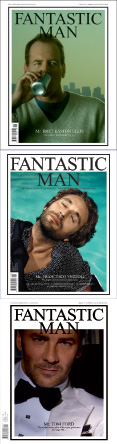
Gert Jonkers and Jop van Bennekom are the creators of Fantastic Man, one of the most remarkable magazines of this era. It is an avant-garde throwback—a remarkably formal and philosophical men’s fashion magazine that positions itself above the commercial fray with a singular tone and elegant design. Before launching this title in 2005, these two gentlemen published a very funny little magazine called Butt, which was printed on pink paper and brought a refreshingly candid and humorous perspective to gay magazines. Butt was sort of the very best out-of-the-closet magazine in the world. Fantastic Man is sort of the very best back-in-the-closet magazine in the world. And Gert and Jop are the best of both worlds. I interviewed them in Paris, where they were launching the Fantastic Man fragrance, over lunch at the Meurice Hotel, and at just the right moment, Mr. Jefferson Hack, publisher and editor of Dazed & Confused, Another Magazine, and Another Man, happened by.
GLENN O’BRIEN: Fantastic Man has such a distinctive style. How did it come about?
JOP VAN BENNEKOM: I think we’re very much defined by what we don’t like. There wasn’t a magazine out there—a men’s magazine—that felt contemporary and for us. We couldn’t identify with all the models being used in magazines, all the 12-year-olds . . . We thought, Let’s redefine a men’s magazine and make a contemporary magazine for us 30-plus guys who don’t want to wear sportswear anymore but also maybe don’t wanna wear suits yet—something in between. It’s also a magazine that’s kind of exclusive and chic again. It doesn’t talk to you as a consumer but as a reader. Also, we were making Butt magazine for four years and we were really ready to expand the adventure . . .
GERT JONKERS: And almost do the opposite. It was like we were about dressing up—not interested in nudity, not interested in flesh, but interested in clothes.
VAN BENNEKOM: Not that we got sick of nudity in Butt magazine, but, you know, they’re two sides of the same coin in a way.
JONKERS: We don’t need Fantastic Man as an outlet to do sexy things—we do that in another title already—so we have the whole magazine to be almost formal and dressed up and call people “mister” and not ask indecent questions, yet try to ask interesting questions.
VAN BENNEKOM: I think sex and fashion divorced a long time ago, and, especially for men, it’s not a good combination. Sexualizing male models . . . That’s not working for me.
JONKERS: We’re both convinced that men’s fashion is about character and that sense of personal power, and not so much about sexual deliverance.
VAN BENNEKOM: Also, it has to be an adventure because what did we know about menswear? It was nice to kind of grow up making the magazine and learning at the same time. The tone and the whole conceptualization of Fantastic Man was there in the first issue, because we had been thinking about it so much.
O’BRIEN: Was Fantastic Man the first title you thought of?
VAN BENNEKOM: No. [pauses] There was something in the beginning, something campy, but Fantastic Man sounds so ridiculous you can’t get it out of your head.
O’BRIEN: I always wonder about titles. Like with bands—what name did they reject before they became famous? Like The Who were The High Numbers, which is pretty good.
JONKERS: Not bad. But The Quarrymen . . .
O’BRIEN: Terrible.
JONKERS: What’s very special about Fantastic Man is that once it becomes an entity, there’s no question about it anymore. Whenever I hear The Police, I don’t think of [makes siren sound] ne-nu-ne-nu-ne-nu, the police . . . I think of the band.
O’BRIEN: I always hated the band because I did think of ne-nu-ne-nu. I didn’t like them.
JONKERS: Me neither.
VAN BENNEKOM: It is a bad name.
JONKERS: Sting is a bad name, too.
VAN BENNEKOM: Horrendous.
JONKERS: It’s not as bad as The Edge.
VAN BENNEKOM: Bono is terrible, too. Boner? Bono? With Fantastic Man, I thought it was a good title because when we ask people to be featured, it’s a great compliment. It celebrates people. We are very particular about the people we want to feature. We want to feature people we think are interesting ourselves. It’s not like, “Oh, let’s do Bono because the readers might want to read about him.” We would only want to do Bono if we felt that Bono was a fantastic man. I think people are expecting Fantastic Man to make a selection in our choice of subjects that is unexpected.
O’BRIEN: Do you have a big selection process?
VAN BENNEKOM: Oh, god, yesterday we spent the whole day talking about a new issue with the rest of the team here in Paris. How many people did we talk about—20?
JONKERS: There are names that make you immediately say, “Yeah,” and then a couple that make you think . . . Mmm . . . We’re stuck in Amsterdam, so it’s not always easy to contact people.
VAN BENNEKOM: It’s not like all the press people are calling us saying, “Oh, we got George Clooney for you, please!”
JONKERS: Thank god for Google. You can quite easily find somebody’s agent these days, but it took me years to get to Kofi Annan, and I’m still not there. You can track them down, but to find the right way for certain people . . . I would love to have a conversation with Steve Jobs, but it’s not a matter of simply calling Apple Holland.
VAN BENNEKOM: Apple Benelux!
JONKERS: Years ago we wanted to do this guy Barack Obama. We had just read one story about him, and we were talking about it with Bryan Adams, and Bryan said, “Let’s try.” I was like, “Can you get some guy named Barack Obama on the line?” Five minutes later, it’s, [mimics phone ringing] “Bryan, it’s Barack’s assistant.” Sometimes it’s not that hard, but then he was already planning to run for president and the press barriers were being pulled up. So that didn’t happen.
O’BRIEN: Do you think being in Fantastic Man would’ve stopped him from becoming president?
VAN BENNEKOM: Maybe. [laughs]
O’BRIEN: If he was in Butt . . .
VAN BENNEKOM: That would’ve finished him.
O’BRIEN: Well, it’s a good moment for Bret Easton Ellis, who’s on your most recent cover.
JONKERS: It is a good moment for him. I don’t know why, maybe because there are a lot of fashion references we’re finding. We’re finding a Bret Easton Ellis–ian mood. I’m wearing more suits now than I ever have . . .
O’BRIEN: When Bret first arrived, it was a lot more radical to wear a suit than it is now. He and Jay [McInerney] were all over New York in their suits and ties, and they really stood out.
JONKERS: But strangely enough, it almost feels radical again. In Amsterdam, if you wear a suit, people will say, “What’s up today?”
O’BRIEN: Jean-Baptiste Mondino told me the other day that in London, hooligans are beating up people if they look like bankers.
JONKERS: Because they hate their bankers?
O’BRIEN: No, just because they feel like they’ve ruined the economy. So how did you establish the tone of Fantastic Man? Was that just something that happened automatically—this sort of mock formality?
JONKERS: What is “mock”?
O’BRIEN: Like faux formality.
JONKERS: It just felt right. I mean, there are certain unwritten rules that we have, like we’re against using the word you in the magazine. Because I don’t think you should speak to the reader. I mean, you’re a magazine because you speak to the reader, but you don’t have to literally speak to the reader. If I say, “You’ll want a Dolce & Gabbana bag this season,” maybe you say, “Well, actually the only thing I’m not looking for right now is a bag, so why do you say that to me?” If you eliminate those choices, then you immediately fall into a certain formality. But also we wanted it to be a very language-driven magazine.
VAN BENNEKOM: We have to really think about how we want to address the reader. It’s very elaborate sometimes, maybe verging on crazy, and sometimes campy deadpan serious. I love it when, in a magazine, everything matters—when every detail and caption is thought about. That’s the way we approach the whole magazine.
JONKERS: We never want it to be that formal, but we absolutely don’t want it to be conservative or backward. Sometimes people should say, “Fuck you,” although we probably don’t use the word fuck in Fantastic Man, because it’s not decent to use it.
VAN BENNEKOM: We would say, “Blimey!” [laughs]
JONKERS: But, visually, people can say, “Fuck you.”
VAN BENNEKOM: I like it when the words in a magazine, the design, and the photography—the whole conception of the whole thing—all adds up to one language. Basically, I think it’s the secret of the magazine. [Jefferson Hack approaches] Hello. How are you?
JEFFERSON HACK: I’ve been smelling your fragrance. And I support your magazine. It’s the only one I’ve bought in years.
VAN BENNEKOM: [laughs] Aw . . .
HACK: Just one question then, from Jefferson for Glenn. Glenn, tell me what would your fragrance smell like? [laughs]
O’BRIEN: I don’t think I’d be allowed to have one. My wife is really anti-fragrance. She’d say, “What’s that smell? Wash that off.” She did smell the Fantastic Man scent, though, and she didn’t turn up her nose.
HACK: Well, that’s a good sign.
JONKERS: What would Another Fragrance smell like?
HACK: I’m working on it. You guys pioneer, and I just follow in your footsteps.
VAN BENNEKOM: Well, no, it was Tyler Brûlé who pioneered . . .
HACK: I think Playboy got there a bit ahead of Tyler as well. Magazines have been doing that for a while. I think Hugh Hefner was really the pioneer of brand-building magazines, taking that Playboy concept and turning it into a total anything-goes lifestyle possibility, from nightclubs to film production to clothes, cosmetics, playing cards . . . He was the Elvis of publishing.
JONKERS: The person from Playboy that I met said, “Make sure that everything that you publish, everything that you do for Butt magazine, make sure you have everybody’s signature, that you own all the rights, because you could put it on mugs and on calendars.”
HACK: I think everyone should have their own fragrance. What mine is gonna smell like will have to remain a secret.
JONKERS: When’s it scheduled? For Christmas?
HACK: [laughs] I’m just deciding.
O’BRIEN: Maybe we’ll do an Interview mouthwash. Stop bad breath! Stop bad quotes!
HACK: Send me a bottle of that when you do it.
O’BRIEN: You’ll have the test batch.
HACK: Take care, guys.
VAN BENNEKOM: So where were we?
O’BRIEN: Is it a coincidence that André [Balasz] had his finger in his mouth on your cover and then Bret’s got a can of Diet Coke in his mouth?
VAN BENNEKOM: No. Imagine you had so much control over photographers that you would say, “We’re thinking about André having a finger in his mouth.”
JONKERS: We’re not that formulaic.
O’BRIEN: Actually you’ve played with the format until it’s an art. I loved the table of contents where you listed every single page.
JONKERS: I saw a magazine copy that recently.
VAN BENNEKOM: We’re quite flexible since we’re both editors and we’re both sitting on each other’s chairs or laps or whatever. I’m designing, and I’m also editing the magazine, so I can change headlines to suit the way it looks.
O’BRIEN: Do you have more than one person writing the copy?
JONKERS: We work with Charlie Porter. He’s our deputy editor. It’s basically the three of us.
VAN BENNEKOM: And sometimes we are very preoccupied with certain words that we just keep on using. I personally find the word utterly so horrible, and it just pops up everywhere in the magazine. [laughs] I love utterly . . .
JONKERS: Audacious was a bit too much in this issue. I thought we were through using the word audacious. It’s a complex word, but at some point you’ve seen all sides of it.
O’BRIEN: You’re going with ballsy now?
VAN BENNEKOM and JONKERS: Ballsy . . . Mmm . . .
O’BRIEN: No, that’s more Butt magazine, right?
JONKERS: Yeah.
Photos: Fantastic Man editors Gert Jonkers, left, and Jop van Bennekom in Paris, March 2009. Fragrance: Fantastic Man eau de cologne. From top | Fantastic Man No. 9, Spring and Summer ’09; No. 8, Autumn and Winter ’08; No. 7, Spring and Summer ’08.
Glenn O’Brien is a New York City–based writer.