


Rachel Feinstein


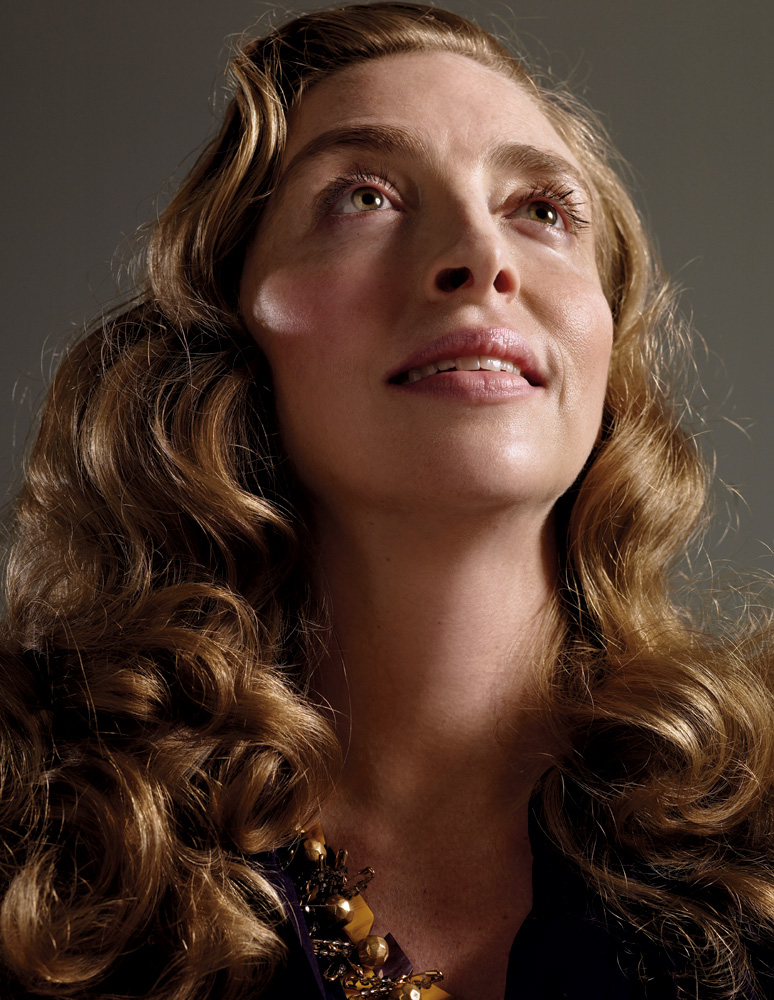
Rachel Feinstein is a renaissance woman.Literally. She looks like a musely princess from a 15th-century painting. (A good one.) And she’s a renaissance woman in that she’s a most accomplished artist in both two and three dimensions. She’s also the muse of her famous husband, John Currin, who is also interviewed in this issue. I’ve had such great conversations with Feinstein and Currin together that I originally thought of trying to interview them in their bed—me in the middle with the tape recorder. But with Rachel nine months pregnant, it seemed more prudent to have separate lunches. And this way they got twice as much space in the magazine—which they richly deserve—and I got two nice lunches at Il Buco. I talked to Rachel first because it seemed that she could go into labor at any moment.

GLENN O’BRIEN: I’m hungry.
RACHEL FEINSTEIN: Me too. Actually, being this pregnant, I have a small-stomach thing, so I have to take my time eating.
O’BRIEN: So you eat all day—you graze?
FEINSTEIN: Yes, I graze on little portions.
O’BRIEN: We always seem to wind up talking about beauty.
FEINSTEIN: We were talking about that in Miami. Beauty is something I like a lot in art. We were talking about ideas of the end of the world and how in crises—if there’s a crisis or world war—the things that people save and really care about are the beautiful things.
O’BRIEN: Yeah.
FEINSTEIN: That’s the whole question with the Duchamp urinal. I’m curious to see what people think about that. If the world is in flames, what do you rescue? Do you take the Duchamp urinal or the Jeff Koons glistening-gold Michael Jackson, or some painting?
O’BRIEN: Well, if the provenance of the urinal is lost, if the paperwork is lost, forget about it.
FEINSTEIN: Exactly—and it will be, of course. I have these weird, apocalyptic ideas of what people are going to carry away under their arms, and paintings are the number one thing because they’re easy. You take them off the stretcher, you roll them up, and you take them anywhere. So I think that’s why ultimately painting ends up being the most valuable thing in art, because it’s cash-and-carry.
O’BRIEN: It just gets an inch shorter all around every time somebody cuts it out of the frame.
FEINSTEIN: It’s so sad. We went to the National Gallery last weekend and saw the Ginevra de’ Benci painting—you know, that amazing da Vinci painting of the woman with the juniper bush behind her head. And it’s so beautiful. And supposedly it was a bigger painting with more of her body and now it’s only this big head. It’s so hard to imagine what it once was—maybe it would have been not as beautiful.
O’BRIEN: Yeah. Maybe Venus de Milo had ugly arms.
FEINSTEIN: It’s like our ideas of Greek sculptures. They used to be all painted, but now they’re all so beautiful because they’re white. They were garish before.
O’BRIEN: Our odd idea of the classical world, the white Washington, D.C., is based on buildings that were originally brightly painted.
FEINSTEIN: I know.
O’BRIEN: That was one of the interesting things about the HBO series Rome. They showed Rome in color—not like in the old Hollywood movies where the buildings looked like un-ruined ruins.
FEINSTEIN: I missed that series.
O’BRIEN: You should watch it. I think the idea of ruins and abandoned things is interesting now. There was a piece in The New York Times about people abandoning boats now because the upkeep is so high—sinking their boats or leaving them washed up—and it made me think about art that requires a lot of upkeep. There was an article about Damien Hirst a year or so ago, about how much it costs to maintain some of his pieces. Imagine torching your Hirst for the insurance.
FEINSTEIN: Oh, I can totally see that. Now he’s changing his whole approach. From what I’ve heard, he’s actually fired staff. I think at one point he had like 85 assistants. And I’ve heard that he’s making most of his paintings himself now. And that’s actually the biggest change that I’ve noticed among all my artist friends. Everybody is talking about the idea of, if you have an assistant, then fire the assistant or cut down their hours. It’s like rich people thinking it’s uncool to show their wealth right now. With artists, it’s uncool to show that you have assistants. Only a year ago you would show off all your assistants.
O’BRIEN: I’m trying to cut down myself.
FEINSTEIN: People are talking about it, but it hasn’t really happened yet. But the bad thing about sculpture—and Damien’s work is definitely to the nth degree in this aspect—is the maintenance. Most people actually don’t put their sculptures up in their houses, you know.
O’BRIEN: Really?
FEINSTEIN: Almost everybody who owns one of my pieces has it in storage. And that’s very depressing. No one has space for it. If it’s something that’s maybe 12 inches tall, then they’ll have it in the house, but if it’s over two feet, then they have it in storage. And I make these seven-foot-tall sculptures, you know . . .
O’BRIEN: That sort of thing happens to every artist, but I think for sculptors it’s especially a problem. I know a sculptor who’s getting on in years, and he was an important part of his generation but now he’s looking for homes for his work.
FEINSTEIN: Oh, man!
O’BRIEN: And it’s really serious stuff—but there’s no market at the moment, so it’s, “Do you have room for this in the country?” I’m thinking, like, “Well, it’s really great. I’d have to pour concrete, and my land is hilly . . . What about drainage? Do I put it in the woods?”
FEINSTEIN: It’s a huge commitment. That’s an aspect I hate about being a sculptor. But at the same time I really feel like you are born either a sculptor or a painter. There are exceptions, like Picasso, who was a mad genius and could do anything, but ultimately people are really one or the other. It’s like, I don’t believe in bisexuality either, for example. I think you’re kind of one or the other—it’s the same concept. I think that painters are really different from sculptors. Like Cecily Brown or Charline Von Heyl and
Jacqueline Humphries . . . all my friends. Or Lisa Yuskavage or Richard Phillips or John [Currin]—all these people who I know who are painters have a different way of doing things and organizing their time. They have a different way of seeing things compared to me. I think it’s natural. A lot of sculptors are like Richard Serra—kind of gruff men. It’s good to be a sculptor because it fits a particular physical persona. But if you’re a woman and you’re a sculptor, it’s almost like you have the wrong birth sign or something. People say that if you’re a Scorpio then it’s better to be a male Scorpio versus a female Scorpio.
O’BRIEN: Well, I definitely believe that about astrological signs. Gemini is better for men. I prefer Virgo women.
FEINSTEIN: I think that a woman’s demeanor actually doesn’t suit the whole thing of carrying gigantic things from studio to studio and the commitment of making somebody pour a concrete foundation. I actually think it’s like some kind of an asshole-ish man mentality to say, “I want you to do this for me.” It’s like you’re making this commitment for me, you know? It’s like this sculpture falling on someone and killing them. [laughs] That’s the ultimate ego.
O’BRIEN: Well, that’s Richard Serra.
FEINSTEIN: Yeah. [laughs] Exactly.
O’BRIEN: But some of the best sculptors in contemporary art have been women. Like Louise Nevelson . . .
FEINSTEIN: And Eva Hesse.
O’BRIEN: Or Marisol.
FEINSTEIN: I always think of Eva Hesse because her stuff is so tactile, and it’s so like women’s work. And then Niki De Saint Phalle’s work is borderline female but male because it’s these gigantic things. I think of it like Yves Tanguy or [Alexander] Calder. It’s male, but with a delicate quality.
O’BRIEN: I just saw a fashion show with Calder jewelry in it. He was definitely in touch with the goddess.
FEINSTEIN: His work has a nice touch to it, and it’s not the same brute thing, about forcing someone to build some foundation. That’s how I really think about the choices you make. There are many collectors who love that dominant aspect of it, that they are subjugated by this nasty artist who comes in and says, “You need to completely mow down your sunflowers and take down the trees and move that stream—I want to put my thing right there.” Some collectors like being told what to do. I’m definitely not like that. I feel very honored that people want my things to begin with . . . So I’m just like, “Oh, my god, that’s so great . . .” Marianne Boesky and I are going down this road for the first time. We’re having this big black carriage piece that I made for my show in May reproduced as an outdoor sculpture.
O’BRIEN: Puritan’s Delight?
FEINSTEIN: Yeah. It’s something that we hadn’t been able to do before because the cost of fabrication for large pieces is so high. It costs more than the original piece just to fabricate it . . . But that was such a beautiful piece, and we were both so in love with it. People would approach Marianne, saying, “I’d really love for that to be out in my garden with snow around it.” And I thought, “God, that’d be beautiful.” So we’re producing just one right now—it’s gonna be made out of -aluminum and have a carriage light outside. Some -collectors bought it, and it’s going to be in a garden in Greenwich, Connecticut. So that’s something I’d like to do more of in the future. It started when I did a piece in Korea for the Anyang Public Art Project. They asked Liam Gillick, Angela Bulloch, Dan -Graham, and a big list of people. You were given a budget to make a model, and the project made it into a gigantic outdoor sculpture. So I made a small wooden Don Quixote sculpture. I had this idea that it would be funny to have a gold, European-type equestrian sculpture in Korea in a square where cars drive around it, like they do in Europe. It became this huge thing, and it came out fantastic. So that’s something I’m thinking about for the future.
O’BRIEN: Semi-heroism? Mock heroism?
FEINSTEIN: Something like that. But it definitely involves that aspect of the male sculptor quandary, where you’re making big art that lasts for 300 years.
O’BRIEN: You have to have a little architect in you for that.
FEINSTEIN: And I don’t think I’m good at that.
O’BRIEN: Maybe that’s something you grow into.
FEINSTEIN: I’m not an architect. It’s been hard just doing our apartment. It’s very hard for me to imagine what something will look like. I need to actually physically see it. I’m not good at imagining, “Well, I need the refrigerator over here because of the traffic flow . . .” I have to be able to live in it and see. I don’t know why.
O’BRIEN: So when you’re making sculpture, you don’t start with a drawing?
FEINSTEIN: Basically, what’s happened in the last few years is that I’ll see an image that I like, and it’s usually something from, like, an old book, like a nice black-and-white . . . Did you see Rudy Stingel’s show at Paula Cooper?
O’BRIEN: No.
FEINSTEIN: It was medieval-like stone sculptures from an old 1930s-like book. A lot of times an old book with images will get the juices flowing. I could tell that he and I were kind of looking at the same sources, things that you would find at the Strand Bookstore for 50 cents. There’ll be something about the form, some aspect of the light, or the way an arm is too long or a piece of drapery is blowing a certain way . . . And then I’ll somehow take that one aspect of it and try to piece a whole thing together from it. I’ll do a drawing, and then drawings of the drawing, and keep getting away from the source as many times over as I can so I don’t just replicate. I’m not interested in trying to copy the object itself. And then sometimes I’ll cut up the drawing and hot-glue-gun the whole thing into a three-dimensional paper drawing, and either that will become a sculpture on its own—because that weird flattened, planed wood sculpture will be really beautiful—or I’ll use that as a skeleton, and then I’ll add stuff on top. Either they’re really round or they’re kind of these cubist-looking things, and it just kind of happens, like all of a sudden I’ll think, “God, that looks really good as is. I’m not gonna mess with it.” I’m not going to gild it, you know?
O’BRIEN: Your cubist-like things sort of look like they’re improvised on that scale.
FEINSTEIN: It’s true. It’s not that they have less freedom, but it’s strange that they are kind of more dictated by the model. And then the big round sculptural ones with the resin . . . There’s one I just had in the “the Glamour Project” show at Lehmann Maupin gallery. They take much longer because it’s about building it all up and making it really huge and then sawing pieces off. That’s much more physical—and it’s disgusting, sanding with big masks on. I stopped making those for a couple of years because it was just not very enjoyable to wear the whole sanding suit and deal with the venting system. But I like those pieces. They’re also just massive—they can weigh 500 pounds. There are many layers, a bit like that gigantic piece like a rose that was called The Stone Rose or something at the Whitney.
O’BRIEN: Oh, yeah—Jay DeFeo’s The Rose. It was in the “Beat Culture” show at the Whitney.
FEINSTEIN: She kept adding to it. The thing supposedly weighs like 2,000 pounds or something. That’s what these are about, these bizarre things where you could keep going and never let it end. You can literally keep shaving things off, adding things on.
O’BRIEN: It’s funny, though, that sometimes things that are monumental start out as small gestures.
FEINSTEIN: It’s true.
O’BRIEN: Maybe that’s how it works with -Richard Serra. I was in Beijing recently and I was taken to the CCTV Tower by Rem Koolhaas—this monumental building that’s like a cubist donut. It’s this amazing structure that kind of goes straight up and then, at about 40 stories, it makes a 90-degree turn and goes hundreds of feet without support, and then it goes down to the ground. It’s extraordinary. Somebody said he drew it on the back of an envelope—probably in about two minutes.
FEINSTEIN: It’s amazing that they can make it. The truth is that sculpture has probably a lot more in common with architecture than with painting, because when you’re building it, you have to think about gravity and if the thing’s gonna fall over. It’s very nerve-wracking in that way. But it’s also furniture.
O’BRIEN: You’re a secret engineer. When I was looking at this Rem Koolhaas building, somebody was saying, “Why would somebody do this?” And I said, “Well, obviously to show that they can.” Because it’s really about exploring the limits of the possibilities of engineering.
FEINSTEIN: Yeah, I can totally see that. The problem that I have with architecture is when architects are out to make their point, but they do it to the detriment of the art inside—or the people who live there. I’ve had my issues with MoMA. I think it is a little bit too much about the architecture, that you don’t look at the art like you used to. I could just be an old-fashioned person who got used to the old buildings . . . I think that one great thing about making a sculpture is that it’s a self-contained thing. All it’s about is how you walk around it and how it relates to your body. It’s not about you having to live inside of it. That seems pretty aggressive.
O’BRIEN: I have never really liked gigantic-scale painting. That’s something I like about John. His work is on a human scale. I think that so many artists are seduced by scale—“Well, if I make it that big then it has to go in a museum.”
FEINSTEIN: I agree.
O’BRIEN: But then it winds up in storage . . .
FEINSTEIN: That’s true. I keep wanting to make sculpture that’s smaller for that very reason, but it’s bizarre because I’ll start off with, like, something smaller but then it just gets bigger. It’s very strange. I think that John just made his biggest painting yet. It’s like seven feet tall. It’s enormous. He says it drives him crazy because he can’t move it around himself in his studio. And that’s exactly what I hate about making big sculptures. They’re overpowering. How do you drag them? But there’s this odd aspect, and I don’t understand why it happens, but you start making things bigger . . .
O’BRIEN: I think it’s the dealers whispering in your ear.
FEINSTEIN: I know. Now, of course, they’re saying, “Make ’em smaller.” [laughs]
O’BRIEN: John Chamberlain made these beautiful huge sculptures for years, but then he started making the same sort of things much smaller, and they don’t lose anything, really.
FEINSTEIN: You’re right. I think a lot of times there are people who make amazingly beautiful paintings on an apartment-size scale, and then they also make the big paintings, and there’s just no comparison. But then Julian Schnabel makes these enormous paintings like billboards, and it works for him. I don’t think I’ve ever seen a small painting by him. Does he make them?
O’BRIEN: I don’t know. But now that you mention Julian, I think he’s somebody who is known as a painter, but I much prefer his sculpture. I think he’s really gifted in that way.
FEINSTEIN: I’m the same way about Cy Twombly. I like his paintings, but I’m not an enormous fan of them. But with Julian’s personality—barely knowing him—he seems in a lot of ways like he’s a sculptor more than a painter . . . Painters are very meticulous, and they don’t actually like to get their clothes dirty. They like to be in a room sitting on a chair listening to some mellow kind of music. I used to make fun of the painters at Yale because they were all, like, born-again Christians, and they would play, like, Pachelbel, [laughs] and get up really early in the morning. John was making abstract paintings in those days—and he wanted to be Schnabel. He said he would wear clothes that had paint all over them, but secretly he wasn’t that person, and you ultimately have to own up to who you are and what your personality is. All the guys I knew in
college who were sculptors were more like Julian Schnabel—big guys who would just be loud and assertive. I kind of fit more into that type of personality myself, I think.
O’BRIEN: Did you start out trying to be something you weren’t, or did you come out fully formed?
FEINSTEIN: I think in some ways I’m trying to change now. In the beginning, I was more violently messy and spontaneous in terms of making my sculpture. But as I’ve gotten older, I’ve become obsessed with the longevity of pieces, and so I’ve gotten more into the craft of making them—which is not entirely true to my personality, but you do change as you get older. You start to think about death and life and history . . . Before, I would make something, and it would take, like, a day to make it. Then the work had this great energy that has become very popular in sculpture these days—kind of like the “Unmonumental” show at the New Museum. That was work that I made 15 years ago. And I got tired of having the male movers—like the shipping guys, who are all failed sculptors—coming over to my studio and picking up something that would fall apart and looking at me like, “Stupid girl.” I decided I was going to get my shit together and make these things really well. But when you do that, you lose the spontaneity. You become a slave to the stupid process of it. You lose an aspect of real freshness. But that’s also about getting older. I mean, every artist I know who’s approaching 40, or is past 40, thinks about their paint cracking…
O’BRIEN: Andy Warhol said, My work won’t last anyway. I use cheap paint. And now it’s turning out to be true.
FEINSTEIN: Eva Hesse . . . Supposedly, none of her sculptures are original. Someone who was dealing with her estate years ago told me . . . I don’t know if it’s true, but latex doesn’t last. It gets sticky and then completely falls apart. I don’t have that big of a problem with it. If you cast the original, then I’d imagine it’s pretty much the same as having the first thing.
O’BRIEN: It’s the same with photographers and C-prints. It won’t last. That’s why conceptual artists came up with the certificate as the work. The old ladies that you draw—are these a meditation on mortality?
FEINSTEIN: No. I think they came about naturally when I turned 30. When I first met John, I had just graduated from Columbia, and I was making this kind of fairy-tale based performance art–type sculpture. It was weird because I had never been in love with anybody before, and it was a huge change to be with an artist. He was almost 10 years older than me, and we would go to parties, and people would know who he was and then they’d be like, “Oh, well, what do you do?” I would be like, “I’m an artist, too.” [laughs] And so I stopped making sculpture for maybe a year or two—a pretty long time. And then I had to do something with myself to get that creativity bug out, so I started drawing little storyâ??boards for movies. I had this dream that I was an old woman in Maine. We’d go to Maine every summer, and we had gone to visit this island where this woman had lived for her entire life in this really tiny, completely fairyland-looking place in the middle of the ocean. She built her own little cottage in a grove with tons of moss and shaded trees and bugs flying around. It was so beautiful. It has a crazy name—Placenta Island or something like that. I had dreams about it for so long, and I had this idea that I became the old woman. I imagined wearing a big, black shawl and carrying wood in the forest. So I decided to make a Super-8 film with me as this old woman. My best friend was a video editor, and we spliced it together on weekends. That was a precursor to the old ladies. I must have always had a thing about imagining myself as an old lady. I had a very old grandmother who was an artist, and she was very eccentric. She had my mother when she was in her mid-forties, so she was quite old even when I was a little girl. She was almost 100 years old when she died. And I just saw the fabulousness of being a very primped-up old lady and having these insane wrinkles, but you’re wearing huge jewelry and wigs. And there’s something about old women whose husbands died when they were very young, and they have basically become like little children again . . . I think there’s an aspect of it that I see in myself. So when I turned 30, I started doing drawings of these women from these Strand books—big, full, life-size drawings with pencil and pastels. And then I had a mirror just lying around the studio, and I tried to put gesso on the mirror and do a drawing on top of that. John said, “Just make a painting.” And I said, “I don’t wanna make a painting. I’m not a painter.” It was a big thing for me because that’s his territory and because of my feelings about how you are one thing or the other.
O’BRIEN: Identity crisis!
FEINSTEIN: So I had all these sign paints for my sculpture just lying around, and I started messing around with them. It felt good in my mind to not use a small brush. I would use big brushes, and I would use a palette knife, so I would feel like I wasn’t making paintings. If you’re scraping a palette knife on a mirror, it doesn’t feel like you’re painting—it feels like you’re sculpting.
O’BRIEN: So maybe Cy Twombly really is a sculptor because he uses those sticks and twigs—anything but a brush.
FEINSTEIN: Exactly. Anyway, when I was doing my 2005 show with Marianne Boesky, I wanted to make a show about those mirror paintings and these old women, and I ran out of source material. It’s hard to find pictures of old women dressed up in costumes. So John said, “I get models. Why don’t you just get some models.” And it was like a revelation. I asked Cynthia Rowley and other people I know in the fashion world, “Can you cast old women? Are there agencies that specialize in really old women?” And Cynthia gave me the name of one or two, and I did a casting call at my house for women over 80. It was fantastic—like 10 of them came, and I chose six. It was hysterical. I got makeup, and I rented these incredible wigs. Another friend of mine is a Broadway star named Melissa Errico. She was in My Fair Lady. She helped me set up the wigs and costumes. And then another friend, a professional photographer named Alexis Rodriguez-Duarte, is really good at black-and-white Hollywood lighting, so he set up a whole professional studio, and we shot everyone in two days. I have an incredible stack of pictures that I can use now. The weird thing is that now I feel like I have to do something different. But I have all this incredible source material.
O’BRIEN: Well, you can always do a book of your old-lady photos.
FEINSTEIN: It was a funny time. I was also doing the Marc Jacobs campaign, and I had just had my first child, so I felt really strange in my own skin for lots of different reasons. I guess these women became almost like my doppelgangers. The hard thing is that it was very successful, and so it was like, “Oh, we want more of these paintings.” I’m thinking, I don’t know if I can make any more because it might have just been a specific period that’s over.
O’BRIEN: Is it true that John was painting somebody who looked like you before you met?
FEINSTEIN: Yeah. It’s really weird. I had just gotten out of college, and I got this apartment on the corner of West Broadway and Prince Street—it was a hole in the wall. And I worked at a bar, and I would walk around all the time in the neighborhood. Andrea Rosen Gallery was on the corner of Prince and Wooster streets, and John used to go there all the time, so he thinks that he saw me occasionally. He can’t completely be certain about it, but he started to kind of put me in his paintings. That was from ’93 to basically September ’94, but at that point, we had never met. And then I was in a group show that he was in at the Sonnabend Gallery—actually it was the first show that I was ever in. He had a drawing in it, and I had a sculpture, but he didn’t go to the opening, so we didn’t meet. Then in September of ’94 I was in another show at Exit Art—this group show where I built a big, Sleeping Beauty’s gingerbread house that I slept in. I would sleep there during the day, because I was working at night, and you could watch me getting humped by this motorized castle while I was sleeping. It was really crazy. I would wear a fresh cherry on my neck every night, and I had platinum hair, and I wore big glossy red lipstick, and I would wake up, and the lipstick would be smeared all over my face, and the cherry would be smashed up, and people would look in at me through this frosted glass window . . . The night of the opening, this man came up to me and said, “You look like a woman in John Currin’s paintings.” At this point, John wasn’t super-well-known, and I didn’t know who he was, so I said, “I don’t know who that is.” He said, “It’s so strange that you have to meet him.” I said, “I’m not interested.” And the guy was a little bit weird. He was wearing a leather vest, leather jacket, leather pants, leather boots—he was almost like my leather fairy or something. I thought he was trying to hit on me, but I couldn’t figure it out. And then he started to call me at the gallery all the time. He started really harassing me, and I just said, “Leave me alone.” So then he decided to call up John. He looked up John’s number and called and said, “I saw one of your paintings in some show in Boston a year or two ago, and you’ve got to see this girl.” And John, being a man, I guess, instead of telling this guy no, walked over that minute and into the gallery. I was standing there wearing this big kind of frilly pink underwear that Patricia Field used to sell and a shirt that said I’m a satisfier on it. I was just waking up, so I was all messy . . .
O’BRIEN: You’d just been humped by the castle?
FEINSTEIN: Yes, I’d just been humped by the castle. And he walked in, and it was crowded—there were probably 50 or so people there, and for whatever reason I walked straight up to him, and I kissed him on the lips. And he said, “Are you Rachel?” And I said, “Yeah.” And that was it.
O’BRIEN: Wow!
FEINSTEIN: [laughs] It was really strange. And we’ve been together for 15 years now. Yeah . . . [laughs] Really, really weird. The funny thing was, about two weeks later, he had a show in Paris, and neither of us had a pot to pee in, so he borrowed money to send me to Paris for the weekend. I got off from my bar job for two days and flew over, and he said, “Let’s get married.” We had known each other for 10 days or something . . . So I said, “I’m going to marry you. I just can’t do it unless you meet my parents first.” It was so unromantic that he got mad at me. And then he made me wait for, like, three and a half more years to get married. He made me pay the price. [laughs]
O’BRIEN: I proposed because we were having a fight, and Gina said, “You’ll never marry me.” And I said, “You wanna bet?” [laughs]
FEINSTEIN: That’s so awesome.
O’BRIEN: I think our son came about in a similar way . . . It’s funny how romance works.
FEINSTEIN: The strange thing for me and John was that neither of us really had anything at all before that. I never really had a boyfriend of any kind. I had friends who I would have relationships with, but they weren’t boyfriends. And John had weird relationships with various women that were, in his words, “terrible.” They were always about both people basically not liking each other. But he said that it was really good for his art. He had confrontational relationships with women, and you can kind of see it in a lot of his earlier work. The position of the women is very odd. I don’t know if you could make out what he thought about women . . . [laughs] Still, when he has to give a lecture, and he shows all of his early work, he’ll say, “This is my girlfriend who really wanted me to commit, but I didn’t want to,” and he’ll talk about this body of work in
relation to that girl, and this body of work in relation to this other girl, and then all of a sudden this one painting comes up, and it’s this woman with enormous breasts, feeding a little man that looks like him . . . And there’s another painting of this woman with enormous breasts and there’s a clown with black gloves touching her enormous breasts, and he’s closing his eyes. Whenever one of those paintings comes up on the screen, he’ll say, “And then I met my wife . . .” I think my whole thing with him and his whole thing with me is that we both have what the other one doesn’t have. I think that’s why it works so well. I’m a pretty positive person, and I kind of think that everything will work out in the end and that you kind of have to be free and just let go. And he’s the total opposite—he’s doom and gloom. He thinks the world is going to end at any moment, and you have to prepare for it. Taking things seriously is John’s aspect. Then, when he starts getting too finicky and he obsesses too long—maybe, like, painting a hand for a month—I’ll suggest that he move on. I think that’s why we’re a good combo artistically. But then we also primarily like the same things. You could actually put either of us into the same room separately in a museum we’ve never been to, and we’ll each probably choose the same thing that we like the best. It’s really weird.
O’BRIEN: I can relate to that. But if you critique one another, is there ever any, “What do you mean?”
FEINSTEIN: Oh, yeah, totally. There’s even anger at times. But the good thing is that we really do say what we feel, and if you really believe in your own opinion, then you’ll fight the other person on it, and they’ll come around. A lot of times I’ll throw something out there, and, if he’s wavering, he’ll say, “I’m going to try what you asked me to try.” And by using the other person as your sounding board, you’re making a point more clear. A lot of times, I’ll have had a fight with John about putting something in the work. He’s very clean and mean. He’s all about strict form and he thinks that a lot of the times people—including myself—gild the lily and add too many things that distract from the form. So sometimes I’ll want to put something in, and he’ll say, “You don’t need it. Don’t do it.” And if I’m certain about it and I do it, then he’ll say, “You shouldn’t have done it.” And then we’ll see the piece like a year later, and he’ll be like, “You were right.” It’s a strange thing, but by having that argument you’ll make yourself realize that you’re doing the right thing. The other thing is that when you start getting successful, you start to not believe what anybody says about you anymore.
O’BRIEN: Yeah, flattery is more available.
FEINSTEIN: Everybody just says, “Yes, yes, brilliant, great.” And then behind your back they’re saying, “That’s so stupid. I can’t believe she did that.” But that doesn’t happen in a relationship. It’s hard, because I’m so involved in it that I don’t have a very clear vision of his work anymore either. It’s not like I could go in and see a show without knowing everything about every aspect of where it comes from. But I think that a lot of times people really lose track of what their goal is because of success. And with artists, especially, you have to be so careful because there’s this fine line between continuing the same thing that you’re known for and what people love about your work, and reinventing yourself.
Glenn O’Brien is Interview’s editorial director.