


Olympia Scarry


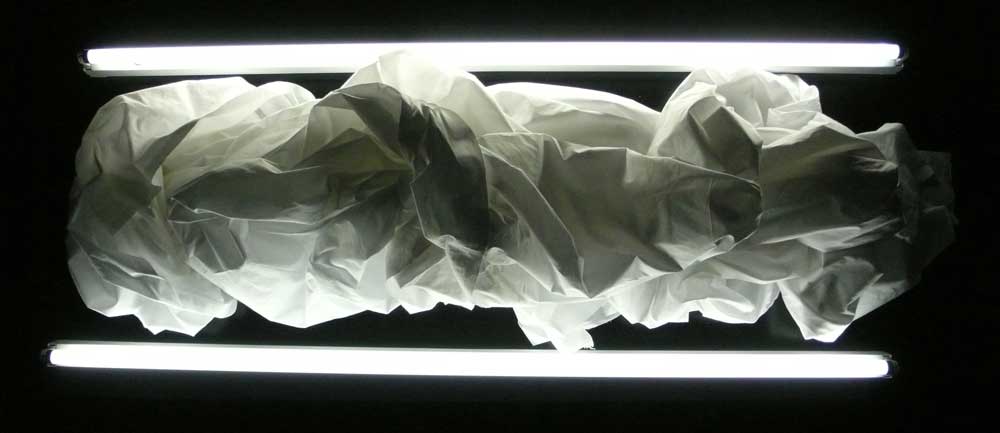
There are some rather flagrant contradictions and identity loopholes to Olympia Scarry. First, there’s her nationality: Although she’s a London-based artist, she’s not really British. Born in Geneva, she’s the second grand-daughter of famed children’s book author and illustrator Richard Scarry. Her father, who followed Scarry Sr. into the children’s book business, moved the girls to the French countryside when Olympia was four years old, then to a Venice palazzo for half a decade, and later, when she was a teenager, to New York City. This is only the beginning of Scarry’s nomadic existence, but we’ll get back to that. The second paradox is her artwork. It’s a bit of a shock to learn that her preferred artistic materials are mainly heavy industrial matter—cables, motors, mirrors, and fluorescent lights (the last of which she used to illuminate a human form under a white sheet for a piece entitled After-Math at last summer’s Venice Biennale). And, finally, another ambiguity: While Scarry is clearly a total catch, she admits that she has some major issues with love. Scarry’s transition into adulthood may explain some of her more psychologically beguiling activities. She began high school in Manhattan, at the Convent of the Sacred Heart, an uptown girls’ school known for graduating a full spectrum of boldfaced blondes, from the Hilton sisters to Lady Gaga. But midway through high school, Scarry’s family moved again, this time back to Switzerland, where she attended boarding school. Several friends from those years who remain close confidants tell me that even when she lived abroad, Scarry maintained her New York style—a Goth demeanor and, according to at least one friend, a spiked dog collar. After high school, she moved to Paris and later London to study psychology, incorporating art classes into her coursework. It was the mixture of those pursuits—the brain and the arts—that led to her recent breakthrough in the art world. Her first solo show was held at the Conduits Gallery in Milan earlier this year. She’s now at work on an ambitious show at London’s 20 Hoxton Square Project set for this winter. A reserved young woman, she told me during our chat last June—in Berkeley Square on a perfect London day—that her art is about peeling back her own layers as well as working out what she considers her biggest mental leap: falling in love.
DEREK BLASBERG: What was your first major artwork?
OLYMPIA SCARRY: About three years ago, I did a sculpture called Le Vanitaas: La Belle et L’Obsession. It was a structure of mirrors, and inside was a hardened bra and garter. As you looked at the piece from different angles, it looked like the undergarments were filled by a body; from other perspectives, it had an infinity effect.
BLASBERG: Why a bra and panties?
SCARRY: It was about the pressures inflicted on women. I’ve found that more and more, women have to be obsessed with their beauty, constantly looking at themselves in the mirror. So it’s about the pressures of beauty.
BLASBERG: I gather you find these pressures very oppressive. Is that why you use such industrial materials? Why do you think you’re drawn to metal and electric cords and glass?
SCARRY: Those materials make sense to me. To me, black rubber cables embody human veins, and glass cases are fragile, still bodies; steel represents harsh brutality and coldness, like a butcher’s cutting table, and neons represent life. Right now I’m interested in human bodies, soap, and air.
BLASBERG: Have you always been interested in harder, larger art?
SCARRY: The first larger-than-life “work of art” I remember is the moon. Its size, brightness, and motion drew me in. La lune were my first words as a child, and my parents tell me I was always pointing to the moon as if discovering it for the first time. My first painting was a replica of Magritte’s Le Seize Septembre, with the moon as the focal point. My art teacher bought it from me with a check for $200. I was 13—my first sale!
BLASBERG: I met your parents when I was in Venice for the Biennale. What do they make of their little girl being an artist who crystallizes women’s panties?
SCARRY: I think my father—he’s a very old-school painter and draftsman—for him, it’s . . . interesting. At first he didn’t know what I was about, but now he says he’s proud.
BLASBERG: I saw him at your opening in Venice, and he did seem proud. He’s the children’s-book illustrator?
SCARRY: Yes, his father was the first one—my grandfather—and then my father continued the family business. They write and illustrate books.
BLASBERG: What are the names of these books?
SCARRY: Busy, Busy World is probably the best-known one, though there’s an entire series. They’ve been translated into something like 54 languages and are sold all over the world.
BLASBERG: Why didn’t you become a children’s-book illustrator?
SCARRY: You never know, maybe I will. My father would love that.
BLASBERG: Were you aware as a child that not everyone’s father illustrated children’s books?
SCARRY: I grew up in the books. They were a reflection of our lives. My sister and I were characters in them, as was our house and car. We never owned a television. Well, there’s an exception: At Christmas-time at my grandparent’s chalet in Switzerland we watched Some Like It Hot, The Sound of Music, Luchino Visconti’s Death in Venice, and just about every Hitchcock film ever made on their blackandwhite ’60s television. We watched them over and over. When we lived in Venice, I learned to paint from my father and went sailing with him in the lagoon.
BLASBERG: I met your mother in Venice, too. We shared a water taxi. She’s fabulous. Did your mom work when you were growing up?
SCARRY: Before I was born, yes. She was a model. She was a Gucci girl for a time.
BLASBERG: Was she one of those wild ’70s supermodels?
SCARRY: I don’t think she was wild; she loved to travel, and she was very beautiful.
BLASBERG: You moved around a lot when you were a little girl. Was that difficult? Were you the type who was good at making friends?
SCARRY: I remember my first day of first grade in Venice: I was the only blond kid, and I didn’t speak a word of Italian. The little boys and girls all lined up to touch my hair . . . but a year later I was elected il presidente of the class, so I guess making friends wasn’t difficult.
BLASBERG: Tell me about the artwork I just saw in Venice, AfterMath.
SCARRY: I’m interested in the psychology between men and women, the struggle between them to connect. I find that they’re always out of sync. You don’t know why, it’s always in a moment, but you come to realize that we’re just wired differently. It’s so hard for us to understand this constant struggle and frustration in love.
BLASBERG: So much of your interest in psychology shows up in your work.
SCARRY: For a long time I think I’ve been quite numb, protecting myself. But now I feel I’m at a stage where I’m delving and exposing my fears and anxieties and emotions and feelings. Which is why one piece I’m working on now involves a human figure attached to a metal cage, under a large container of soap: It’s as if I’m putting this clean body that’s been so protected and numbed onto a stainless steel frame, like a butcher’s frame, to put myself out there.
BLASBERG: Is there ever a hesitation about putting so much of yourself in the public sphere?
SCARRY: Yes. I think I am—well, I’m told I am quite a reserved person emotionally. And then all of a sudden I’m putting so much out there. It’s kind of extreme. I’ve gone from being superclosed and protecting myself to wanting to express all this in the public. But it feels good; it feels like it needed to be done.
BLASBERG: Do you think that one day, after exposing so much of yourself, you will be—
SCARRY: Healed?
BLASBERG: Yeah, exactly. Just the way you look: I only see you in torn jeans, black lace and leather, and combat boots. After this journey, will I see you in something more ladylike? Pink satin high heels and sundresses, perhaps?
SCARRY: I don’t know about that. I don’t think the sundresses will happen, but you never know where life will take you. I’m not an angry person; that’s not where all of this comes from.
BLASBERG: Under all the chains and leather and metal is a really sweet girl?
SCARRY: Don’t make me sound like some sort of S&M dominatrix, but yes, I’m a nice girl.
BLASBERG: But you won’t be that bubbly girl bopping around in pearls until you figure out the centuriesold miscommunication between men and women.
SCARRY: Exactly. I’m working on a new piece where a man and a woman are each on a swing, positioned so that they are parallel and facing each other. They’ll both be naked, and they’ll swing back and forth, each looking in a singular direction but not toward each other. It will embody this notion of being together with someone sexually but never connecting emotionally. You’re always following your own path. And being on a swing, you’re throwing yourself into love, and then you retract from it. Then you thrust yourself again.
BLASBERG: And the rhythms of the partner are never the same?
SCARRY: Yeah, it’s different. You don’t pump your legs at the same time. It’s a constant backandforth.
BLASBERG: So, on the swing, who will the boy and girl be?
SCARRY: Performers.
BLASBERG: Wait, can I be one of the boys? Will you be one of the girls?
SCARRY: For sure.
BLASBERG: That way we won’t even be tempted to look at each other!
SCARRY: The swing is part of a bigger picture, too. No matter how mature you are or how old you are, you are still playing childish games.
BLASBERG: I agree with that. People will always be bullied at recess, or at least pushed to the ground.
SCARRY: We all still live on a playground.
DEREK BLASBERG is a New York–based fashion journalist. He is one of V magazine’s senior editors and a contributing editor at style.com.