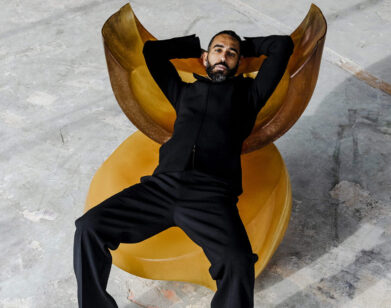



Albert Oehlen


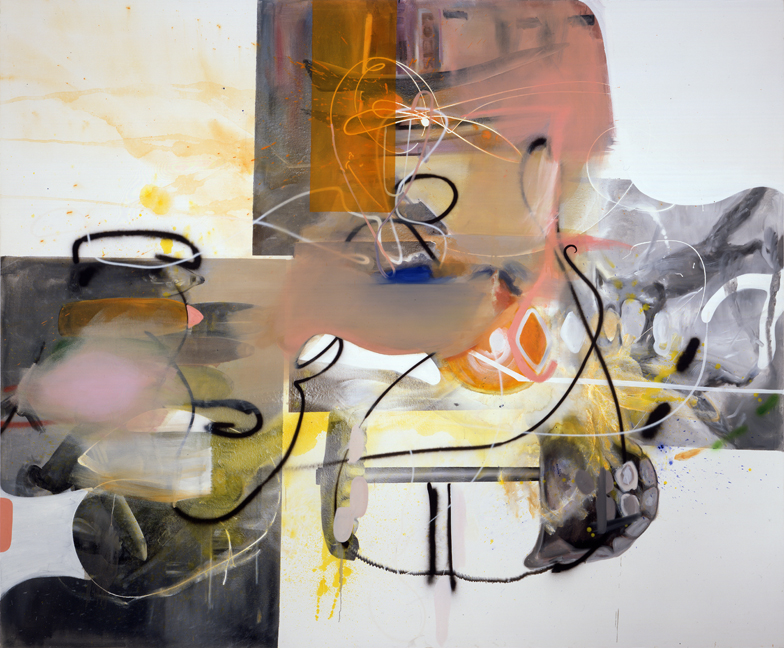
Albert Oehlen studied in Hamburg with Sigmar Polke, played a central role in a prodigious group of artists who came to the fore in the ’80s, and was associated with various movements and groups—some apt, some gratuitous. I would describe him with that popular health-food term free radical. Today, the German-born Oehlen lives and works in Berlin, Switzerland, and Spain. A retrospective of his work opened recently at Museo di Capodimonte in Naples, and he has a solo show running all this month at Luhring Augustine in New York. I interviewed him in New York when he came for the opening of a show featuring the work of his late friend Martin Kippenberger at the Museum of Modern Art. During the interview, we were joined by Oehlen’s friend and mine, the painter Christopher Wool.
GLENN O’BRIEN: Maybe this is a dumb question, but what made you want to be an artist in the first place?
ALBERT OEHLEN: Oh, I can’t remember the moment where I had this idea or made the decision, because I think I always had the feeling that I am an artist. My father was an artist, my brother’s an artist, so . . . [laughs]
O’BRIEN: Your brother is close to you in age, right?
OEHLEN: Yes, he’s two years younger and also a painter and a sculptor . . . He makes sculptures all the time. I think the moment where I would have made the decision—if I had made the decision—was in the late ’60s, early ’70s. Everything was still under the strong influence of the ’68 turbulences, and I was really shaken by that. One saw one’s role differently. It didn’t occur to me to make a kind of normal career, like learning to be an artist and becoming one. Because at that time, especially when you’re young and a bit naïve, a lot of things seem possible.
O’BRIEN: It seems like you were involved in a lot of groups, or certainly extended families of friends, who were doing things together.
OEHLEN: It was more extended families rather than groups.
O’BRIEN: I guess it was kind of like what was going on in New York around the same time. It was kind of a scene, and the same people were making paintings and making music and making films.
OEHLEN: Yeah, it was like that. It was friendships, and not much more. We were colleagues—I mean, fellow students.
O’BRIEN: Did you study alongside Martin Kippenberger?
OEHLEN: No, he was at the same school [Academy of Fine Arts Hamburg], but a couple of years before me. And our paths crossed at that moment. We moved in different directions. He, from Hamburg to Berlin, and I, from Berlin to Hamburg. But still we met . . . [laughs] maybe one day when we were both in the same city, and became friends.
O’BRIEN: You were in a band. Were you making music then, or did that come later?
OEHLEN: I never made music seriously. My brother was in a punk band at that time.
O’BRIEN: Which band?
OEHLEN: Mittagspause. I don’t know if you’ve heard of them. They were good.
O’BRIEN: That rings a bell. I tried to keep up with the Germans. I used to write for this German music paper—do you remember Spex?
OEHLEN: Yeah, of course.
O’BRIEN: I wrote for them, and I followed the German bands a little bit. I was a huge fan of Kraftwerk and Einstürzende Neubaten.
OEHLEN: Oh, yeah. [laughs] Well, that was a bit later. Markus’s band was very early. They tried to be the German Wire. I liked them. But I never played an instrument. Of course, I was part of some militant activities at that time and then later with Mayo Thompson, who was a friend.
O’BRIEN: You’re part of the history of Red Krayola, a band member, officially, even if you weren’t.
OEHLEN: It wasn’t really about music, but I was somehow involved—like talking, ideas . . .
O’BRIEN: There was a lot of funny stuff going on that was sort of the edge of music at that time.
OEHLEN: Absolutely.O’BRIEN: Remember the Art & Language records?
OEHLEN: Yeah, of course I do. I liked all this stuff. It was a big thing for me. There was a lot going on in Hamburg. So I knew a lot of these people. Some were friends, like Holger Hiller, who was a neighbor. [laughs] Chris Lunch—I don’t know if you know that guy, a funny experimenter of music . . . I was hanging out with these people.
O’BRIEN: And what other artists were you hanging out with?
OEHLEN: Georg Herold. I always spent a lot of time with him in school, and after school we did projects together. Then I was with Kippenberger a lot. We shared a house once for a year in Spain, which was a very good phase for both of us. We both wanted to do something new, and we started it together, working in the same place and criticizing each other—which was a perfect situation.
O’BRIEN: Did being in Spain push you in the surrealist direction?
OEHLEN: [laughs] No, no, no, no, no . . .
O’BRIEN: Or a sunnier direction?
OEHLEN: Yes, maybe in a sunnier direction, but the place where I live doesn’t have an influence in that way. The landscape or the culture of that place wouldn’t influence me, but if it gives me a good mood, then it’s very helpful. So it had some influence on me. I wanted to start something new that I was dreaming of for a long time, which was abstract painting, and I took the chance to start it there, which was very good because we were very isolated. It was Martin and I alone in that house, so you could do your failures and see how the other one reacts.
O’BRIEN: Were you pushing each other?
OEHLEN: Yes.
O’BRIEN: And was Martin trying to go in a new direction as well?
OEHLEN: Yeah, he did . . . He started the self-portraits there. He made some sculptures, but they were related to the “Peter” exhibition [“Peter. Die russische Stellung” (“Peter. The
Russian Position”), 1987], that he did before. But he did the self-portraits there and that was completely new. And, I did my thing.
O’BRIEN: What made you want to go into abstract painting?
OEHLEN: It was an old dream. I had this idea for years. I was carrying it with me. [laughs] In a way it was because I thought that art history went from figurative to abstract . . . And I should do the same. I should have the same development in my life as art history.
O’BRIEN: And then you end up as an installation artist? [laughs]
OEHLEN: No.
O’BRIEN: I was just kidding.
OEHLEN: Sorry.
O’BRIEN: So in the history of abstract painting, whose work inspired you?
OEHLEN: It’s mostly [Willem] de Kooning. I was fascinated by others, but the thing that lasts is de Kooning. I see a lot in him.
O’BRIEN: What do you think of Richard Prince’s de Koonings? You don’t have to say, but I was curious. [answers phone] Hey. Yeah, just come down the stairs, and we’re by the bar. [hangs up]
OEHLEN: I do like them. But they’re a little bit less mysterious than the other paintings he made. Which is kind of a weakness ’cause they’re a bit more obvious. But I like them.
O’BRIEN: I’ve read some interviews with you where you talk about making rules for how to work, to establish methods.
OEHLEN: Yeah.O’BRIEN: Is that something that you keep to yourself, or is it something that you can talk about?
OEHLEN: These rules could be so simple that they would sound very banal to say in an interview—but they mean a lot to me.
O’BRIEN: I read one which was “Work slower.”
OEHLEN: Yes, yes.
O’BRIEN: I thought that was interesting. It reminded me of . . . I don’t know if you remember Brian Eno’s Oblique Strategies. Eno invented this deck of cards, I think in collaboration with a visual artist. It was a set of completely random strategies that might lead to creative solutions. You would pick one from the deck if you were stuck in making a record or something.
OEHLEN: Yeah. It was things like that. I read about that, and it reminded me absolutely. He used those as a producer with other bands, right?
O’BRIEN: Yeah. It’s like, go backwards or subtract something.
OEHLEN: I have the same thing going on. And also I use that when I’m teaching, like saying, “Change the material.” Because a lot of decisions you’re not aware of. It starts when you’ll go shopping for art supplies. You make decisions, and they’re always the same, like the kind of brushes you buy. And if you’re forced to change something, it gives an insecurity to the work that is very helpful. It makes you find out what you really need.
O’BRIEN: When did you start that as a practice? When you were starting to work abstractly, or before?
OEHLEN: I started that even before, because in the beginning, I painted with acrylic paint, and the reason why I went to oil was mainly because I didn’t control it. I was looking for the insecurity of it. I mean, I might have found another reason later, but at that moment, the reason was I was looking for the insecurity.
O’BRIEN: Usually people look the other way around—for security.
OEHLEN: Yes, that’s very common.
O’BRIEN: It’s funny, I just started working with new designers on the magazine. When I first met them, I said, “So what do you think of the magazine?” And they said, “It needs turbulence.” I can relate to that. Is there generally one rule, one thing that you have in mind, or do you have a whole set of them in play, like the filmmakers, the Dogme 95 people, who have a whole set of rules?
OEHLEN: I have maybe two or three things on my mind, and some might be impossible. Some might be in contradiction to other orders, but I will still try them. [Christopher Wool enters.]
O’BRIEN: Did you ever propose these kinds of things to your colleagues?
OEHLEN: Yeah, with the people that I talked with, I tried to—to annoy them a bit with my orders. [laughs] Especially [Christopher] Wool.
O’BRIEN: I think there used to be more of that in the old days, maybe at the Cedar Tavern.
OEHLEN: Yeah.
O’BRIEN: There were people telling others what they should do, suggesting it, maybe challenging them, but I think it’s really good. What did you tell Wool?
OEHLEN: No, I, eh . . . [laughs]
O’BRIEN: How did you annoy him?
OEHLEN: [laughs] I don’t know when I did it last time, but I was planning to. I was very fascinated by what you said about Cedar Tavern. I’m interested in the relationship of John Graham and [Jackson] Pollock.
O’BRIEN: Few people know who Graham was—he’s so obscure. Was he Pollock’s teacher, or . . .
OEHLEN: No, they were friends. He had all of the ideas and tried to involve other people in his sometimes esoteric thoughts. He had a big knowledge, and to me it looks like he was almost the opposite of Pollock.
O’BRIEN: [to Wool] Okay, you can take over the interview now.
CHRISTOPHER WOOL: I’m just listening. O’BRIEN: We were talking about Graham and Pollock, right?
OEHLEN: I think what’s interesting is the difference of the one guy who knows so much and is full of ideas but can’t really make an interesting work—and the other one who is half stupid, and just does it.
O’BRIEN: Well, don’t you think that some artists are more, I wouldn’t say idiot savants, but, you know, more unconscious? So Pollock is in that category?
OEHLEN: It gets difficult. But I don’t know if unconscious is the right word.
O’BRIEN: Well, like an acrobat or a musician or something where it’s not sort of rationalized, it’s more instinctive.
OEHLEN: Whatever it is, I still believe in the unpredictable, in an artist who just has something and overwhelms you with something that you didn’t even ask for. I believe that in the sort of wrong moment there comes a time when someone who no one wanted, just does it . . .
O’BRIEN: Don’t you think there’s less and less of that quality? That it’s sort of been beaten out of people now? Whether by the market or . . .
OEHLEN: Oh, I think there are still those people. I mean, Chris . . . [laughs]
O’BRIEN: He’s very methodical in his madness.
OEHLEN: [still laughing] I think another example, even if you don’t like him, is Matthew Barney, who does something I didn’t ask for with that kind of art, and he’s just so strong. Or even Damien Hirst, whatever it is that he’s doing, it’s such a phenomenon, I don’t want to say it’s stupid . . . Because it’s a big show.
O’BRIEN: Yeah.
OEHLEN: Maybe it’s the wrong example, because it’s really a show. Matthew Barney is better. Because he did something that no one could have expected. That is already something.
O’BRIEN: So what advice would you give Matthew Barney? What rule would you give him?
OEHLEN: [laughs] I haven’t thought about it.
O’BRIEN: [to Oehlen and Wool] So how do you guys know each other?
WOOL: I think the first time that we met was when I was in Cologne, when you had the big bad-painting show at Max [Hetzler]’s new space. Max’s must have been ’88.
OEHLEN: Yeah, and then we were frequently in the same group shows. We did something in Chicago, too.
O’BRIEN: So when did the notion of bad painting come to your attention?
OEHLEN: Very early, when I was a student, it had to with this show that I think was in New York . . .
O’BRIEN: “‘Bad’ Painting,” at the New Museum.
OEHLEN: I just heard the name, and I had no idea who was in it at that time. I liked the name, and then, after years, I realized that no one was using that anymore, but it had a big impression on me. So then I rediscovered that work and thought, Yeah, if that fits . . .O’BRIEN: Well, it’s sort of kept going. It’s still a phenomenon.
OEHLEN: Yes, it still exists.
O’BRIEN: But can you be an abstract painter and a bad painter?
OEHLEN: Absolutely. [all laugh]
WOOL: The worst. I like a story you told once that I tell students sometimes. You said you were trying very hard to make seriously bad paintings, while the New Museum version of bad painting was really about something else—it was about outside ideas that were bad—but you were trying to make really bad paintings, and you realized that the worst ones you could make were exactly like the Neue Wilde painters in Berlin. And then you decided it really wasn’t worth it, and Dieter Roth said something similar. He was interested in making bad paintings, and he said he always failed, because with paintings it always looks good in some way. Just because of the material . . . But he could do it with music, he could do it when he was playing the piano by himself, but it was excruciating to listen to, and he would immediately have to stop. It kind of closes the loop.
OEHLEN: I mean, you have to do it seriously. You have to take responsibility. You cannot just do it as a side project and make an arrogant attitude, a gesture. I think Dieter Roth could not have done it because he was not a painter. You have to become a painter and hold your head out the window. You have to give it an importance, and I did that, so that’s why I could do it. [laughs]
O’BRIEN: I think bad painting in the sense of the original show was more faux-naïve, right?
WOOL: Yeah, it only challenged the most conventional ideas of what a good painting was, and these guys were talking about going much further with it.
O’BRIEN: Neil Jenney—who was part of that original show—he took the sort of childish or naïve art and made it internally abstract and pretty, in a context of the faux-primitive. When I wrote about your work in Parkett, I said that I thought of your idea of “bad” more like Thelonious Monk’s style and his title “Ugly Beauty.” It’s sort of finding the beautiful out of things that would ordinarily be a component of what’s regarded as ugly—like making something off-key. Does that make any sense?
OEHLEN: Yes. I don’t think you can really, seriously—or philosophically—try to find out what it is that a painting does to you. It’s contradictory. You can’t come to an end because, if it’s good, it’s beautiful—everything that’s good will be at the end called beautiful. But I like very much if you do things that seem to be forbidden and seem to be impossible, like a test of courage.
O’BRIEN: What’s considered forbidden now? I mean, it’s shrinking . . .
WOOL: What’s the most recent forbidden zone you’ve entered?
OEHLEN: Oh, what’s forbidden? I mean, at the moment, it looks like everything is done, but I don’t think that’s true, because 90 percent of the artists who are responsible for this or that invention, they just use it as an invention, as a method. They hide behind their invention. They’re not taking responsibility for it. They’re not doing it as painters. They’re doing it as inventors. A lot of people who are there as painters right now are not really painters, because they just have a process of doing it—they just have a way of making the painting, and that doesn’t hurt. It’s . . .
WOOL: A signature.
OEHLEN: Yeah.
O’BRIEN: What’s the old joke about conceptual artists and painting?
WOOL: [laughs] I don’t know, but it probably wasn’t very funny.
O’BRIEN: No, it’s not very funny. It’s a truism. Why are all the conceptual artists painting now? Because it’s a good idea.
OEHLEN: That’s good. [laughs] That’s mean.
O’BRIEN: But don’t you think that the recession, or depression, is changing the way that people look at art, or the way artists are approaching art? I was just walking around at Art Basel Miami, and all this doom was in the air, and I started looking at things and thinking, Well, that looks really too easy. That doesn’t look like art anymore. I think maybe just the pressure that has been added by economic adversity is going to make people want work that’s more labor-intensive or technically proficient.
OEHLEN: That is possible. Or at least that is what I hear from other people.
O’BRIEN: People want more for their money, not something just simply gestural.
WOOL: But I’ve noticed that for years.
OEHLEN: So what are you gonna do? [laughs]
WOOL: Was it you or Kippenberger who said, “When you run out of ideas, you make a diptych”?
OEHLEN: Well, it’s a saying. If you run out of ideas, you make a triptych.
WOOL: Have you made any triptychs recently?
OEHLEN: No.
WOOL: ’Cause that’s a terrible idea.
OEHLEN: I’m not running out of ideas. [laughs]
WOOL: No, but we’re talking about bad painting. Would you dare to make a triptych? ’Cause that’s a seriously terrible thing.
OEHLEN: It is bad, yeah—it’s a challenge.
O’BRIEN: I have a triptych that Jean-Michel Basquiat gave me for my birthday in 1980 or ’81. You’ve seen it hanging in my apartment probably. It’s on really fucked-up yellow wood. Then my friend [interior designer and artist] Ricky Clifton rehung everything in my apartment, and he rehung it vertically instead of horizontally, and my wife said, “You can’t do that.” And I said, “Well, it didn’t come with instructions.”
WOOL: Is it signed?
O’BRIEN: Yeah.
WOOL: Vertically or horizontally? [laughs]
O’BRIEN: My idea is that the one that’s chipping the most will go on the bottom.
WOOL: A German collector didn’t have tall enough ceilings, so he hung one of my paintings horizontally. I guess it didn’t look good because he sold it at auction.
WOOL: You don’t care how your paintings are hung? [Oehlen laughs] You used to not know which way they went.
OEHLEN: I still don’t know often, but when I know, then I care.
O’BRIEN: So what’s the new show at Luhring Augustine?
OEHLEN: I’m working with advertisement material—posters, big ones, just trashy stuff. And I’m trying to make these pictures have very trashy, cheap elements in them, things that will evoke feelings from the old left—left-wing protest feelings, anticommercial emotion.
WOOL: Are you using real posters, or are you reprinting them?
OEHLEN: Real stuff. And then I’m trying to forget all about that and make a nice painting.
O’BRIEN: Collages with painting on them?
OEHLEN: Yeah, it’s a very, very simple structure—it’s really noisy stuff that I’m smoothing down. [laughs]
O’BRIEN: Is it influenced by the current state of the world economy?
OEHLEN: No, they were done before.
O’BRIEN: Yeah?
OEHLEN: Yeah, the happy times.