



Moby


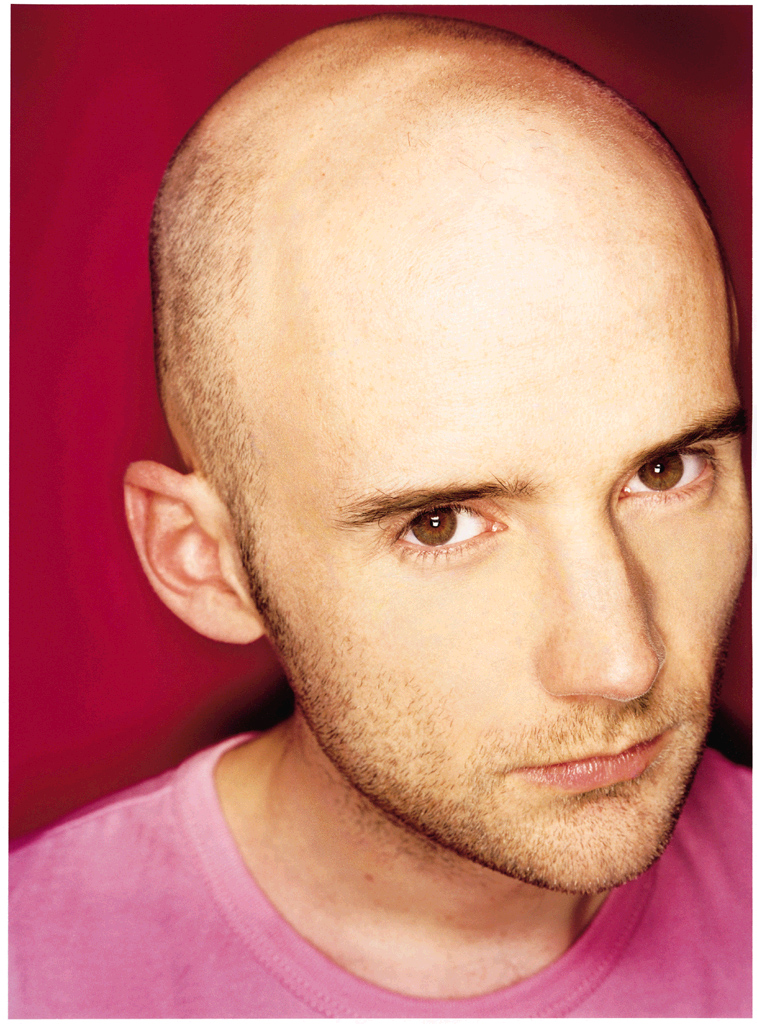
Hail pounds brutally on the skylight of Moby’s Nolita apartment, threatening to break the glass as we talk. His bookshelf, containing everything from Flannery O’Connor to Naguib Mahfouz to The MacHiavellian Guide to Womanizing, rattles from the storm. And Moby pauses every now and then to look worriedly around the room. His apartment is bare, wooden and sparsely furnished. It is the same place he lived when he recorded his first single, “Go,” in 1991. Though his material circumstances don’t seem to have changed, a lot has happened since then.
When he moved in, Moby, a veteran of punk bands in Connecticut, had reinvented himself as a local club disc jockey. The success of his first singles and albums catapulted him to the forefront of the first wave of next-big-thing techno in America, and he was heralded as the face of a so-called faceless movement. But Moby refused to stand as a symbol for something he didn’t belong to: He advertised his beliefs as a vegan, drug-free Christian and, in concert, was unafraid to strap on a guitar and return to his hardcore roots. Slowly, his star began to fade.
But then, out of the blue, came Play. Harnessing samples from old blues and gospel field recordings (particularly Alan Lomax’s Sounds of the South collection) to achingly melodic keyboards and a chugging beat, he once again transcended his genre. Play has sold over two million albums so far, hitting No. 1 in England and No. 54 in America at a time when preening teeny-boppers and rap/metal lunkheads are ruling the roost. It belongs to no specific genre other than that rare class of album that is simply agreed upon as good music by just about anyone who hears it. A year after the album’s release, Moby is still reeling from its unexpected reception and his trajectory into the realm of semicelebrity.
NEIL STRAUSS: Now that Play has been so successful, is it strange meeting people who you thought were untouchable stars?
MOBY: Yeah, it’s just so interesting to put things into perspective. I met Elton John at an Interview dinner, and we just sort of became friends. He’s got such a wicked sense of humor. He’s just very sharp. And it’s particularly interesting for me because the first song I ever learned to play on the guitar was “Crocodile Rock” when I was nine years old. I also met Steven Tyler from Aerosmith, and one of the first records I ever got was the first Aerosmith album. And the first time I ever went to second base with a girl was to that record. Do you remember how with a vinyl record, you could put this little thing down in the middle and when the needle got to the end of the record it would pick up and start from the beginning again? Well, I was thirteen or fourteen, and I was kissing a girl, and I was so nervous. We were making out in that bad junior high school way with neither of us enjoying it but couldn’t admit it. So I worked up my nerve and thought, When the needle picks up and goes back that’s when I’m going to go for second base. And I did, except she didn’t have breasts. I met Steven Tyler and told him this.
My goal with everything that I do is to present things in a way that I would want to see if I was in the audience or buying the record.Moby
NS: The first time I interviewed you when your first album came out, you were living in this same house. And it was just as empty. Has your life changed much?
M: I have been making records for ten years, and this record has been the most successful of my albums. But the only real difference in my life is I get to look at a picture of myself eighty feet tall every time I walk out of my house.
NS: What did you think when they put up that CK Jeans ad near your house in lower Manhattan?
M: I was so excited. I remembered that the first ad that went up in that space featured Foxy Brown, and I remember walking up Broadway and just being like, Oh fuck, that’s huge. At the time it was the biggest photo of a human being
I had ever seen. I remember just for a split second thinking, Wow, that would be so cool, and it happened. Maybe I shouldn’t say this, but I love it.
NS: Do people recognize you whenever you walk past it?
music can always serve a role in people’s lives when it’s emotional and warm and inviting and beautiful.Moby
M: I still never get recognized. Small, bald white guys like myself-we all kind of look the same.
I went out to dinner the other night and this woman asked me, “Have you ever met your doppelgänger?” And my answer was, “I see my doppelgänger twenty times a day!”
NS: Have you ever had one of those moments where you catch a glimpse of your own reflection in a mirror or see yourself on television, and for a moment you see yourself as a stranger might?
M: I have had that happen and I never, ever like what I see. My reaction is usually like, “Who’s that guy with the bad posture?” or “Who’s that inbred coal miner over there?”
NS: Play has been out now for over a year. Have you started working on your next album?
M: Yes. I’m like a bad musical cliché because I bring my guitar on the road and try to write songs in hotel rooms. I have a very strong idea of what I want the next record to be like, but I don’t know if it’s going to end up that way. My goal with everything that I do is to present things in a way that I would want to see if I was in the audience or buying the record. So I’ll go through my CD collection and think, “What do I want to listen to?” And I never have it. Right now, I really want to listen to something that has the romantic elements of Al Green and Bill Withers, the atmospheric elements of Brian Eno and David Byrne, the melodic elements of Maurice Ravel, and the overall sensitivity of Massive Attack. I don’t have a record like that, so my goal is to make one-not a hodgepodge, but just the sort of record that I would want to listen to.
NS: I know what you mean: You want to make a record that someone can put on in their house, and no matter who’s over and what kind of music they like, it’s going to be something that interests or appeals to them.
M: I love the idea of making records that people can use, records that have a sense of utility. One problem with a lot of musicians is that they remove themselves in a studio and make a record and assume people are going to pay attention to it just because they’ve made it. I really think that every musician who’s working on a record should be forced to go to a distribution warehouse and just see how many records come out every week. If a musician is making a mediocre, self-indulgent body of work, they have to know that, for the most part, people aren’t going to be interested.
NS: Did you have any idea your record would be as successful as it has been in the current pop climate?
M: I assumed it would be marginally successful at best because a lot of nice records come out and don’t do anything. I didn’t expect more because it’s not a pop record in the sense that Britney Spears and Christina Aguilera make pop records, it’s not a boy-band record, it’s not an R&B record, it’s not a hip-hop record, it’s not a white trash grunge record, it’s not country western, it’s not even dance music. It’s just this idiosyncratic body of work, and there isn’t a lot of precedent for idiosyncratic bodies of work being successful. But it is a very interesting phenomenon. In the U.K. it beat out Carlos Santana, it beat out Oasis, it beat out ‘N Sync and all the boy bands, and for the last five weeks, it’s been No. 1 in the U.K. without a single out.
NS: Do you think that’s because of what you said before, about music being more important when it has a use?
M: One thing that the success of the record has sort of taught me is that music can always serve a role in people’s lives when it’s emotional and warm and inviting and beautiful. It’s the same thing with the Air album Moon Safari. That record was successful because it’s a beautiful record. You have all these people at record companies trying to sign the next Creed and the next Kid Rock and the next Christina Aguilera. And it’s kind of like, why not encourage your artists to make heartfelt, beautiful music? I’ve been a little bit obsessed with “Rhapsody in Blue” by George Gershwin lately. And I was thinking to myself, What would George Gershwin do if he were twenty-six years old now? And I had this depressing thought: I imagined him being the guitar player in some generic modern rock band and having all these innate abilities that get squashed by some A&R person concerned about his job. I just envisioned him playing in Creed or something, and it was very depressing.
I hope that when I find myself no longer a public figure, which could be in six months or two weeks or ten years or whenever, I can give it up gracefully and not be bitter. But for now sometimes it’s fun indulging in the pitfalls a little bit. Moby
NS: It’s so interesting that your record has caught on now, because it’s the second time you’ve done that. With your first album, you transcended techno and everybody called you the face of the movement. And with Play, it’s a mostly electronic album that people who don’t know anything about the genre have in their collection. Why do you think that keeps happening to you?
M: Apart from the James Bond theme Iâ??did, whenever I’ve had success it has been completely accidental and completely surprising. I didn’t sit down and think to myself, I want to make a record that can reach as many people as possible. I just wanted to make a record that was beautiful and compelling and interesting.
NS: Does your phone ring a lot more? Are you meeting girls now who want to date you because of that album?
M: I certainly know what it’s like to be ignored by the opposite sex. I was never a pariah, but I know what it’s like to have just normal interaction with the opposite sex. For some reason women are attracted to public figures and quasi public figures. It’s not a flaw in their characters; it’s just a strange, interesting phenomenon, and as a result I get to meet more people.
But I don’t expect it to last too long. And I hope that when I find myself no longer a public figure, which could be in six months or two weeks or ten years or whenever, I can give it up gracefully and not be bitter. But for now sometimes it’s fun indulging in the pitfalls a little bit. Going out to a bar or a nightclub and indulging in success-meeting people and flirting with them and even occasionally on that rare, rare occasion allowing yourself to actually have a little bit of romantic exchange. It can be fun, but it’s not sustaining. By the way, I think your tape is about to run out.
NS: How do you know? You didn’t even look at it.
M: I know. It’s strange. But half the time when I’m doing an interview, all of a sudden I get this feeling that something’s weird, and then . . . [click]