



Jarvis Cocker


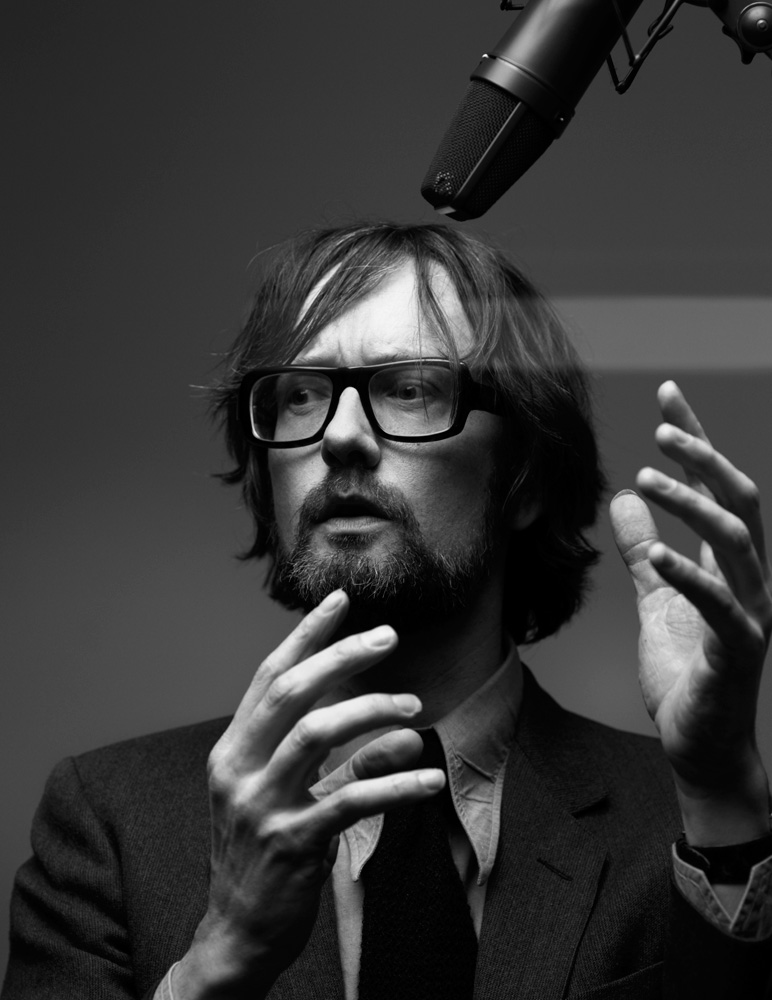
While it is widely accepted that rock stars are not like fine wines—they do not improve with age—Jarvis Cocker debunks that notion. Cocker first arrived on the music scene in 1978 as a dapper 15-year-old singer fronting a band from Sheffield, England, called Arabacus Pulp, which he named after a commodity he’d learned about in economics class. The name of the group was, of course, later shortened to Pulp, and they would go on to become a cornerstone of the ’90s Britpop movement with their seminal albums His ’N’ Hers (1994), Different Class (1995), and This Is Hardcore (1998)—threeswirling epics of romantic longing, outsiderinsecurity, and civil discontent.
The history of English music is populated by a parade of working-class heroes, but with Pulp, Cocker emerged as a new kind: part erudite dandy, part thrift-store lothario, and part Batman villain—a black comedian who, beneath the ornery veneer, is all heart. Since the band went on indefinite hiatus in 2002, he has quietly evolved into an introspective family man of sorts, moving to Paris, becoming a father, and enjoying a new kind of creative freedom. He has, by turns, served as a television host, a cultural critic, and an eco-explorer, and he has collaborated with the likes of Nancy Sinatra, Charlotte Gainsbourg, Beth Ditto, and Harry Potter (Cocker appeared in 2005’s The Goblet of Stone). He also released a well-received first solo album, Jarvis, in 2006, and now has followed it up with a second, Further Complications, which he unveils in June.
Recorded in Chicago with the notoriously Spartan production engineer Steve Albini (who previously oversaw the Pixies’ Surfer Rosa and Nirvana’s In Utero,among other significant albums), Further Complications is Cocker at his most raw and revealing, as he croons about impossible loves, tattered libidos, and the -foibles of getting older. Director Wes Anderson, who is working with Cocker on the music for an -animated film adaptation of the Roald Dahl children’s book Fantastic Mr. Fox, spoke with the 45-year-old singer—who at press time was sporting a Sgt. Pepper–style insurrectionist beard—as he put the finishing touches on the album.
WES ANDERSON: Are you in Chicago, Jarv?
JARVIS COCKER: Yes, I am. Have you ever been to Chicago?
ANDERSON: Yes, I’ve been there. I used to take the train from New York to Los Angeles, and I would stay for a night in Chicago on the way.
COCKER: How long does it take to go from New York to L.A. on a train?
ANDERSON: Well, it’s overnight from New York to Chicago, and then it’s two more nights from Chicago to Los Angeles. So I would break it up a bit because you can sometimes have, like, a five-hour layover in Chicago. And you don’t even want to get on the train after that. Have you been to the Art Institute of Chicago? In the basement, they have the Thorne collection of miniature rooms.
COCKER: I went to the Art Institute the last time I was here, but I didn’t go into the basement.
ANDERSON: Some woman, maybe around 75 years ago or so, subsidized the creation of these little rooms that are representative of different periods of architecture.
COCKER: How small are these rooms? Could a cat live in one?
ANDERSON: No, absolutely not.
COCKER: So they’re like the size of the rooms in a doll’s house really.
ANDERSON: I’d say that they’re about that size. A human would want to be about the height of an iPhone to really feel comfortable in them . . . a tall human.
COCKER: And these rooms are from different periods in history?
ANDERSON: They have rooms that represent different periods in America, but then they also have ones that represent the Louis XIV, Louis XV, Louis XVI periods . . . I’m not knowledgeable about what distinguishes one Louis from the next, but if you look at these rooms, you can make some guesses. They have an art deco one, and one that’s about Los Angeles, and different things like that. It’s worth visiting. So why are you in Chicago in the first place? It’s because of your producer, right?
COCKER: Well, you can’t call him a producer.
ANDERSON: We’ll call him a collaborator.
COCKER: An “engineer” is what he likes to be called.
ANDERSON: So he’s an engineer, but he’s a wonderfully talented engineer.
COCKER: Steve Albini is, yes. The way Steve and I came to work together was that when we played a concert in Chicago last July, we went to his studio and did some recording—and I enjoyed it, so we came back. But Steve is very precise about the fact that he doesn’t believe in the role of a producer. He thinks that, generally speaking, producers try to take all the credit for a record, when really it’s the band that should take the credit.
ANDERSON: That sounds reasonable.
COCKER: He and I have had many discussions about that because, while I think it’s an admirable position to take, there is the fact that just by being part of a process, you do alter it, don’t you? There isn’t really a way to be completely transparent. So it’s a nice thing to aspire to, but . . .
ANDERSON: Well, I would imagine that different producers have different goals. Somebody like Phil Spector is not necessarily looking to learn what an artist specifically has in mind and how he can help them achieve that—he has his own goal or result in mind. So maybe Steve Albini doesn’t fall into the Phil Spector category.
COCKER: No. Steve would be like the anti–Phil Spector . . .
ANDERSON: Is Phil Spector in jail now?
COCKER: I don’t know. I thought his murder case was going to be retried, and then I kind of lost contact with what was happening.
ANDERSON: Me too. I’ve completely lost contact with Phil Spector altogether at this point. [Editor’s note: In April, Spector was convicted of second-degree murder.]
COCKER: But what we’re talking about in terms of Steve’s approach to making records has to be somewhat similar to what you get with certain directors in the film world. I know that some filmmakers strive for a kind of naturalistic approach, but you’re never going to capture something that’s really natural—just the simple fact that you choose to put a frame around something means that you’ve already chosen one particular thing to put more attention on.ANDERSON: Yes, even in a documentary. But sometimes you can take something that’s a complete work of artifice and say, “Now I’m going to try to find the most spontaneous, natural version of this that we somehow make happen for real in front of the camera.” I have a question: Is the song “Further Complications” going to be the first single?
COCKER: Um . . .
ANDERSON: Do they even do singles now the way that they used to?
COCKER: Well, I don’t know. I mean, people do still release singles, but sometimes it’s more symbolic than anything else. There’s the famous thing that the A&R man from the record company is supposed to do: He’s supposed to come into the studio and listen to the songs you’ve been recording and then say, “Guys, I don’t hear any singles.” And then everybody falls into a terrible depression because you have to write one. [laughs]
ANDERSON: Well, I guess the thrust of what I was saying was that when I listened to “Further Complications,” I heard a single.
COCKER: You heard a single?
ANDERSON: Yeah. That song is a single to me.
COCKER: I was thinking that one could be a single, or that maybe that other one called “Angela.”
ANDERSON: “Angela” is great too. And then, what’s the one where the guy meets the girl at the Museum of Paleontology? What’s it called?
COCKER: It’s called “Leftovers.”
ANDERSON: “Leftovers.” In both “Angela” and “Leftovers,” a man is involved with a much younger person . . .
COCKER: Well, most people I meet nowadays are a lot younger than me, you see . . .
ANDERSON: Yes, I find that too.
COCKER: So that’s the thing I was kind of trying to address in “Leftovers.” It’s about someone looking at a dinosaur skeleton, and, you know, these creatures once ruled the earth . . . But then that person sees somebody that they’re sexually attracted to, and there’s something about looking at a skeleton while having erotic thoughts—not about the skeleton, but about the life of the person that runs the other skeleton within their body. That’s kind of where that song starts from, and I suppose there are intimations of mortality at work there . . . I don’t know. I always thought that I might retire from any form of sexuality by the age of 40 and just become a dignified older person. If you are able to still do it at least, then you find you still have wants and desires, and then you have to start dealing with that . . . [laughs]
ANDERSON: What’s the title of the song about the girl who there’s no possibility that any romance is going to happen with, so instead the singer will just do the song?
COCKER: Oh, that one is called “Fuckingsong.”
ANDERSON: Is it?
COCKER: Yeah.
ANDERSON: Are those songs about anybody in particular?
COCKER: Well, “Fuckingsong” is more about . . . You know, this will sound really stupid, but I’m going to say it anyway: If you perform on a stage or you sing a song, it’s like you sing your song, and then the words go into the air, and then they go into somebody’s body through their ears, so it’s kind of like penetrating somebody. It’s kind of like having sex with somebody—but, obviously, from a great distance. [laughs] And so the idea of that song is that that’s a better way to have a relationship with somebody—that somebody being me. It’s a better way to have a relationship with me than if you had the real thing. Because in a song you can kind of stage-manage everything so that it puts you in a good light. And once a song is recorded, it always performs well. That song won’t get drunk and then be unable to have sex with you—you can put that song on anytime, day or night, and it’ll perform its very best for you, which is far superior to anything that I could claim to do. So that’s what that song is trying to say—that this is as good as it gets, basically.
ANDERSON: That’s sad . . . but positive.
COCKER: Yeah. [laughs]ANDERSON: Where did you go in Texas recently?
COCKER: I went to that South by Southwest music festival in Austin.
ANDERSON: I lived in Austin years ago. They started that festival maybe the last year that I lived there, so that demonstrates my age . . . I was already finished with university—or college, as we call it in America—by the time they started that thing. And now South by Southwest is the venerated festival of everything.
COCKER: It’s huge. Did you go to it the first year?
ANDERSON: I think the entire festival might have been going a couple of years, actually, because there’s also a film festival and other things attached to it. But the music festival is what started when I was there. I think I saw a couple of bands—I can’t remember which ones. It was long, long ago.
COCKER: Maybe it’s the same where you grew up in Houston, but there seems to be a kind of rhythm to the weather there where you wake up in the morning and it’s quite cloudy and visibly cool, and then the heat kind of gradually builds up during the day. The clouds all disappear around half past 11, and then it’s really hot all day, and it’s very nice and warm at night. And then you just go through it again and again and again . . .
ANDERSON: Well, Houston is quite different. Austin is in a hilly area, and it’s dry. But Houston is on the coast and completely flat, so the weather is much more humid and muggy, and the air is filled with mosquitoes. Strictly from a weather point of view, I wouldn’t recommend it as much as Austin.
COCKER: Do you ever miss Texas? Do you ever feel like moving back there?
ANDERSON: Well, I have family there, and I do miss it a bit. But I don’t know if it’s where I would want to live.
COCKER: I recently spent quite a bit of time in Sheffield, England, which is where I’m from. I wouldn’t move back there, but it’s funny when you spend a bit of time in the place where you were brought up. You kind of realize how that place has had quite a big effect on you or made you a certain way.
ANDERSON: I always feel like there are specific things about Houston. There’s one museum in particular in Houston. So many of the things that I’m interested in now I can sort of trace back to that museum, which introduced me to them.
COCKER: What museum is that?
ANDERSON: It’s called The Menil Collection. There was this woman, Dominique de Menil—I think she was French, but she had one of the great Texas oil fortunes—and her art collection was vast. She collected lots of surrealist works—Salvador Dalí and René Magritte and Max Ernst and those Joseph Cornell boxes. She also collected abstract expressionist and pop art. So there were those John Chamberlain sculptures made from smashed-up cars and Dan Flavin fluorescent tubes and pieces by Donald Judd and Cy Twombly. There’s a building they call the Rothko Chapel that’s just these [Mark] Rothko pieces. I’d never heard of any of this before I walked through those doors. But there’s no place where I feel quite as much at home as I do in Houston. Even if Houston is not the place that I find the most exciting necessarily, it’s very peaceful for me to go there, I think, because I’m from there.
COCKER: It’s like you kind of fit there, isn’t it?
ANDERSON: Yeah.
COCKER: That’s what I thought when I was in Sheffield. You feel like you’re a proper part of the scenery or something.
ANDERSON: Do you still have friends in Sheffield?
COCKER: Yeah, a few.
ANDERSON: Yeah? Because I don’t really have that many friends in Houston. They all seem to have gone away. I mean, the one who was there the longest just moved to Austin, in fact.
COCKER: I was thinking when I came to Chicago yesterday that I must have followed a cattle trail. They would drive the cattle from Texas all the way up to Chicago, because this is around a place where they would slaughter them.
ANDERSON: Is that where they go? I don’t think they go that far up, actually. On foot, I mean.
COCKER: Don’t they?ANDERSON: I think they may only go to Oklahoma. There’s something called the Chisholm Trail, but I don’t know if that one goes up that way or has anything to do with cattle. That’s a good one for Wikipedia. In three minutes, we could have our biggest misunderstandings cleared up. Are you reading anything during your travels?
COCKER: I’m getting towards the end of The American Short Story: Volume 1. It takes me a long time to get through things. It’s a good collection—it starts just postwar and then keeps going after that. I think I’m at about 1985 now. I’ve only got a few stories left.
ANDERSON: I love reading short stories.
COCKER: Well, I’ve found it good because I’ve discovered a few writers I’d never heard of before. It’s like getting a compilation album, where you might find two or three artists you like, and then you go and investigate them a bit further.
ANDERSON: The Internet has accelerated that process. The thing I was saying about The Menil Collection—that’s something everyone goes through, where they learn about one thing or one artist, and it then connects you to three others, and that then connects you to three others. You follow this path like you might if you were spending time in a library. But now, while you’re reading about something, the other things that it refers to are highlighted, and you can just click on them, and that takes you instantly to the next thing. I do like Wikipedia.
COCKER: You’re saying that it’s a positive thing?
ANDERSON: Well, I would say that some of the things that I’ve learned a bit about recently, I wouldn’t have necessarily put the effort into learning about otherwise. And so I like libraries and the slower process as well, but I do enjoy this Wikipedia.
COCKER: It’s funny now how you can intensely investigate one very particular thing, and then it can lead you to other things through links and stuff like that. It’s like you’re going on this selective, very precise detour. But then it is strange because with it being so quick, there must be a difference. Like you said, before the Internet, you’d maybe get interested in something and then you’d have to go to a library in a different town to find out more, and then that would give you a lead. It was kind of like detective work,
and you would accumulate knowledge over a much longer period of time.
ANDERSON: Maybe you would retain more of it.
COCKER: But now it’s like you suddenly go into, like . . . What’s that drug that takes you on a very short but intense kind of psychedelic trip? I think it’s called DMT or something like that.
ANDERSON: Mescaline?
COCKER: It’s called . . . something. There’s one that I heard about where apparently it only lasts about 40 seconds, but while it’s happening, it’s very intense, and you sense that the time goes all weird so it seems like you’ve been tripping for four hours or something.
ANDERSON: That could be an analogy for the way we learn on the Internet.
COCKER: Well, in a way it is, isn’t it? Because you suddenly kind of binge on information about this one thing and you maybe learn a year’s worth of research in an hour.
ANDERSON: I will learn all about this drug right now just by typing “40-second hallucinatory trip” into Wikipedia.
COCKER: Right, and then you’ll probably find out where you can get it online.
ANDERSON: And there will be a direct link to a generic version. [both laugh] I had something else I meant to ask you. Did you enjoy your trip to the North Pole?
COCKER: Oh, yeah. I didn’t quite get to the North Pole, but I got to the west coast of Greenland. For the readers who don’t know why I went there, I suppose I should explain: I went on a trip organized by a group called Cape Farewell, and they take creative people on a boat to the North Pole. It’s kind of a climate-change-awareness thing. So I went for that reason, but I also went because Iwas curious to see what the Arctic looked like.I knew that I would probably never go there under my own steam.
ANDERSON: I followed your travels via the Cape Farewell website. Do you have to be English to go on that trip?
COCKER: No.
ANDERSON: Right, because Ryuichi Sakamoto went, and he’s not English.
COCKER: Laurie Anderson was there too.
ANDERSON: I want to go on this thing. Maybe the people running it, if they read this article . . .
COCKER: I could try to put in a good word for you if you want, Wes.
ANDERSON: That would be great.
COCKER: The trip I took was probably the most luxurious one—usually they go on a much smaller boat, like a wooden boat, with maybe only 20 people onboard. But the one we were on was a decommissioned Russian research vessel. Normally, the boat takes pensioners on a kind of eco-cruise.
ANDERSON: So it was quite comfortable.
COCKER: Yeah, and I much preferred the comfort version.ANDERSON: I’m not an expert by any means, but that vessel did look similar to the one that we filmed on when we made The Life Aquatic [2004]. There was the main boat that we were on, which was a much older one, but we shot for a day and a half on a NATO research vessel, and that was much fancier. I think it was similar to the type of boat that you were on. But yours was Russian, so maybe ours was like the M16 to your AK-47 . . .
COCKER: I actually wrote a song on the boat—a song that you haven’t heard—which is what I’m going to finish off today. It’s called “Slush.” It isn’t really a global-warming anthem, but it did kind of strike me that that would be the end result of global warming—that we would just have a lot of slush because the ice caps would go to that kind of horrible slushy snow you get in the center of town, so often brown and dirty . . .
ANDERSON: Maybe that image will get through to people.
COCKER: Wading through . . . So I’m looking forward to recording that today.
ANDERSON: You’re doing just the vocal today or you’re recording everything?
COCKER: We already recorded all the music, but now I’ve got this idea that I want to put a kind of ramshackle choir on it, so I’m going to get 20 people in the room who supposedly can sing to a certain extent, and I’m going to have cards with directions on them, so I’ll kind of direct it. I just want people to do kind of howling noises. I’m looking forward to that, actually—it’ll be good fun.
ANDERSON: I’m looking forward to hearing it.
COCKER: I wanted to ask you something, actually. It’s an obvious question, I suppose, but on your film that you’re making right now, Fantastic Mr. Fox, you’re using old puppets—well, do you call them puppets? What do you call them?
ANDERSON: I think puppets more or less covers it.
COCKER: So you’re used to working with live actors. How have you found the experience of working with things that will do exactly what you tell them to do?
ANDERSON: Well, as it happens, they won’t. As you know, the voices are recorded before it’s animated, and that process is more familiar to me—working with actors in that way. So when we’re recording the voices, there can be the same sort of excitement that working with actors normally has—there can be the same surprises and spontaneity. But then when it comes time to animate it, I’m working with people who each bring their own interpretations to it, even if we have very carefully determined what is going to happen in the scene. Sometimes I’ll do a video version of myself doing what I think the puppet ought to do, and then I’ll discuss it with the animator—and there are many different animators working on different stages all at once. But in the process of going one frame at a time to bring the puppet to life, the animator will sort of sculpt things out, and they have somehow trained their brains to sync in this ultra slow-motion way so there’s a performance that they’re giving. And so you can find in that process that you’re very slowly being pleasantly surprised over the course of several days or weeks and saying, “Oh, look at what’s happening here . . .” Or you can slowly see the shot falling apart right before your eyes and see that it’s not working. So there’s no real corollary in live-action movies, but it’s interesting anyway—and fun.
COCKER: So the animators are kind of the nearest thing you get to actors in that process, basically.
ANDERSON: They’re the nearest you get to working with actors, in a sense, yeah.
COCKER: Have you met the animators, the people who do the job?
ANDERSON: Yes, I work with them.
COCKER: Well, let me ask you this: Many of the characters in this story are animals—there are very few people. Do any of the animators resemble the creatures that they’re animating?
ANDERSON: Well, it doesn’t necessarily work that way because there are different animators with different levels of experience who will get different kinds of shots. And, you know, some of these animators can bring great subtlety into the expressions on the faces of these puppets, which are covered with fur but have little metal bones that move under their skin. There’s an animator named Kim, for example, and she has great talent with the most emotional moments and details of the performances. And then there’s another one named Jason, and he is particularly skilled with the main character—I think he understands what makes that character funny. That’s the role that George Clooney voices, and I feel like he might be the one who is most connected to George in the performance. And then there’s another animator named Brian, and it might just be partly the shots that he has ended up with, but his scenes have a bit more of a magical feeling. He brings something surreal to them. Now, I might be projecting some of these things onto these animators because of the material they’re working with, but that’s how I’ve started to see them. We have something like 29 units going at once, so we have a large number of animators working on all those sets, and they’re each bringing something different.COCKER: You wouldn’t get that with CGI, would you?
ANDERSON: No, you wouldn’t. But maybe you’d get some special computer programmers . . . I don’t know. I almost doubt it.
COCKER: I guess the way you’re doing that film with the stop-motion animation is kind of something that’s not done so much anymore.
ANDERSON: No, it’s not.
COCKER: I suppose the way that we recorded this album is somewhat similar to that. Generally speaking, when people make records now, they do it all on Pro Tools and then kind of pick the bit they want and then repeat it 25 times, or just pick 10 seconds from here and 10 seconds from there and put it together that way. And then I kind of thought that if you’re going to bother being in a band nowadays and making a record, then the only real reason to do it would be to capture what happens when five people all play together at the same time—and the kind of discrepancies and the different sort of a performance that you get when you do that.
ANDERSON: A bit of what happens live.
COCKER: Yeah. So, basically, we’re both working on outmoded, archaic forms.
ANDERSON: Yes, we’re leftovers. Dinosaurs—but youngish for dinosaurs.
COCKER: Happy dinosaurs. Very happy.
Wes Anderson is an Oscar-nominated filmmaker. His next film, Fantastic Mr. Fox, is due out in November.