



Wes Anderson


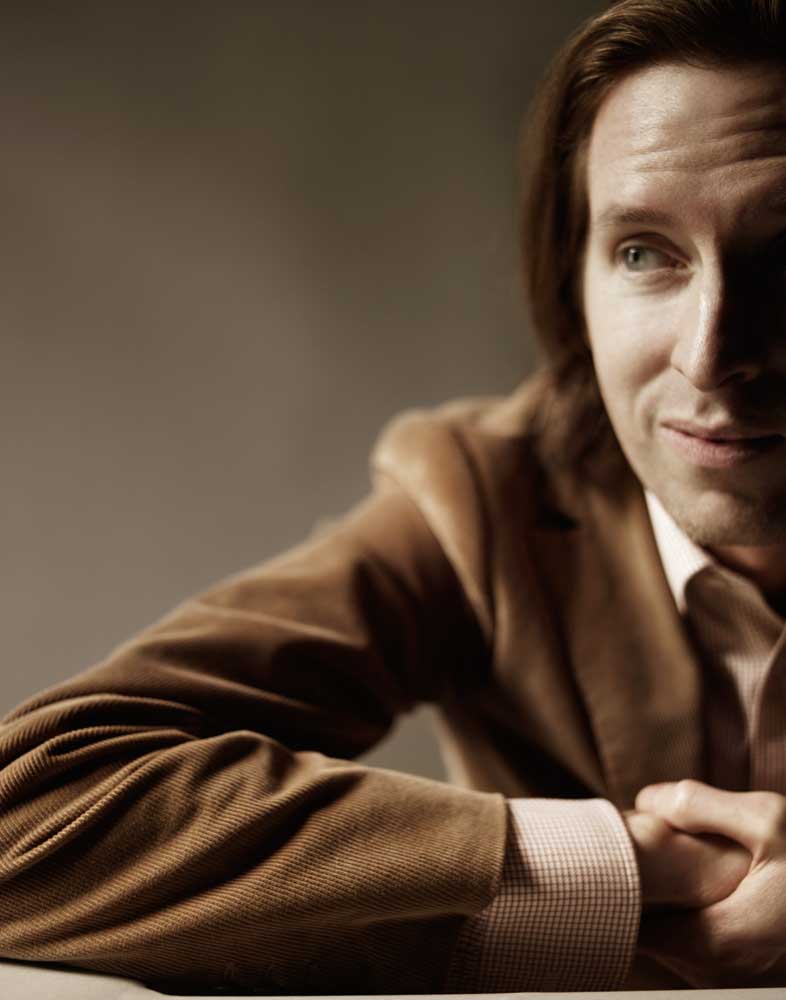
In the five films that Wes Anderson has directed, from his 1996 debut feature Bottle Rocket to 2007’s picaresque The Darjeeling Limited, he has managed to assemble a constellation of actors who might best be described as “Wes’s Gang.” This tragicomic fraternity includes Bill Murray, Jason Schwartzman, Anjelica Huston, Luke Wilson, and, of course, his college friend and longtime collaborator OwenWilson. Like Woody Allen before him, Anderson has constructed his own immediately identifiable cinematic landscape, one so distinct that certain clothes, music, expressions, and cleverly awkward situations in the real world can be dubbed as being “very Wes Anderson.”
This year, however, the 40-year-old Anderson seems to have given the slip to his frequent playmates—at least in bodily form—by swapping human actors for puppets and the concrete world for an imaginary one in his latest effort, Fantastic Mr. Fox. The film, due out in November, is a stop-motion animated adaptation of the Roald Dahl book about a family of foxes that is besieged by a group of angry farmers and forced to outmaneuver them in order to survive. Anderson tapped some of his usual collaborators—along with George Clooney, Meryl Streep, and Jarvis Cocker—to record the dialogue. He then used those vocal tracks to inspire a mesmeric fantasyland of puppet performances brought to life by a team of animators on an elaborate soundstage in London.
Watch Fantastic Mr. Fox trailer:
Fantastic Mr. Fox certainly marks a departure for Anderson. French filmmaker Arnaud Desplechin recently sat down with Anderson at the Cinéma du Panthéon in Paris—one of the city’s oldest movie theaters—to discuss the ever-evolving architecture of Anderson’s idiosyncratic universe.
ARNAUD DESPLECHIN: When do you finish shooting?
WES ANDERSON: We finish shooting tomorrow.
DESPLECHIN: Tomorrow? Are you depressed?
ANDERSON: We’ve been shooting for one year, so I’m not depressed yet.
DESPLECHIN: And you don’t have a wrap party?
ANDERSON: We had a wrap party.
DESPLECHIN: You already had it?
ANDERSON: Yeah. The wrap party had been scheduled in advance, and we went over schedule. It’s been a very long time shooting. The thing is, with the animation, you finish shooting, and then the whole thing is done. Everything else has already been put into place, so shooting is the last step, although we were mixing today on rue d’Enghien.
Photo credit: Wes Anderson in London, July 2009. Bespoke suit, shirt and pocket square: all Anderson’s own.
I do feel a bit like my characters from one movie could walk into another one of my movies and it would make sense.Wes Anderson
DESPLECHIN: The weather in Paris is terrible now, quite depressing. I was just wondering, while sitting at my desk depressed by the weather, what kind of weather you had growing up in Texas.
ANDERSON: Well, Texas is hot. I went to school in Austin, but I grew up in Houston, which is on the Gulf of Mexico. It’s hot, hot like India, and humid, and full of mosquitoes.
DESPLECHIN: And you don’t miss it? [Anderson laughs] I ask because I am looking out the window and this city is all gray, and I don’t understand how you could stay in such a city. It’s quite different from where you are from. So you went to school in Austin?
ANDERSON: College in Austin. Then I lived in California for a while. Then in New York.
DESPLECHIN: Where did you meet Owen Wilson?
ANDERSON: In Austin. We must have been 18.
DESPLECHIN: And you both wanted to work in cinema?
ANDERSON: I guess we did. I don’t know. I was studying philosophy, and he was studying English. But we met in a playwriting class. We first started talking about writers, but we also talked about movies right off the bat. I knew I wanted to do something with movies. I don’t know if he had realized yet that it was an option.
DESPLECHIN: I think I read somewhere that in college, you were working on Proust?
ANDERSON: No, I was never working on Proust, but I read Swann’s Way, which made a big impression on me . . . At that time, literature students in America didn’t seem to read Proust—at least not where I was going to school. It took me a long time to finish reading the first book, and I only read the one.
DESPLECHIN: I never read it at all.
ANDERSON: You didn’t? [laughs]
DESPLECHIN: Because in my family it was a snobbish thing—you know, to read Proust. I thought if I read this book, it would take something like one year. Instead, I could spend the year reading strange, odd books that my father or sisters wouldn’t read. Plus I wanted to work in cinema, so I didn’t feel that I should start with a serious thing. I was supposed to focus on futile things that belong to popular arts. It was really an impression that I imposed on myself. I will never read Proust as a commitment.
ANDERSON: You still hold to that?
DESPLECHIN: Yeah. I read 10 or 12 books about Proust to know the different books. I mean, it was a sort of stupid decision to make as an adolescent— against the teacher and for the cinema. But it has to do with the fact that I’m French. Proust was sacred, so I didn’t want to be a part of it.
ANDERSON: The opening of Swann’s Way is about being on the verge of falling asleep. The book is filled with images that have never left my mind.
DESPLECHIN: So when you started to write films, was that the moment you and Owen split parts, where one would be the director and the other would be the actor?
ANDERSON: Well, we started writing together. I was always going to be the director, but he didn’t really want to be an actor—or I don’t know if he knew he wanted to be an actor. As far as he was concerned, he was strictly a writer.
DESPLECHIN: Does he still consider himself strictly a writer now that he has become such a big movie star?
ANDERSON: Nope. [laughs] Now he considers himself an actor, too. But he’s a very good writer.
DESPLECHIN: You wrote Fantastic Mr. Fox with Noah Baumbach.
ANDERSON: Yes. We wrote most of it in New York, some of it in Los Angeles, some of it in England. Actually, we wrote for a little while at Roald Dahl’s house, in Buckinghamshire. And we wrote a little bit in Paris, too.
DESPLECHIN: I thought you were trapped here, that you couldn’t escape from this rain. But you still can escape to New York and places like that.
ANDERSON: I can go to different places, yes. I live in New York most of the time.
DESPLECHIN: Would you call what you are experiencing—jumping around from one city to another—nomadism? Or would you call it an exile? Either way, to me, it is a typical American thing, these ideas.
ANDERSON: The thing is, you’re French. You’re French for generations. You’re genuinely French.
DESPLECHIN: I’m not that French.
ANDERSON: Well, you’re quite French. But most Americans will say, “I’m Swedish.”
DESPLECHIN: Are you Swedish?
ANDERSON: Yes, I’m half Swedish, half Norwegian. If somebody asks you what your background is, you don’t have to go back very far before it’s outside of America—unless you’re part Cherokee or something. Anyway, I certainly don’t think I’ve chosen to be nomadic. I always wanted to live in New York, and it took me a long time before I got there. But once you start moving around a lot . . . I don’t know. The difference between exile and nomadism is probably just your mood.
DESPLECHIN: You’ve seen a lot of movies. I wonder if you learned to watch a lot of films from someone like Martin Scorsese. One could say that there are two kinds of directors: those who love to see films and those who actually don’t see that many.
ANDERSON: If you are going to pick directors that make you feel like you should watch old films, I think that would be Martin Scorsese and Peter Bogdanovich. There are so many films I was introduced to by them in one way or another. For example, on the laser-disc commentary of Raging Bull [1980],Scorsese mentions something about MichaelPowell, and I had never heard of the Powell and [Emeric] Pressburger films before. From Bogdanovich, I think I first learned about Howard Hawks and LeoMcCarey. Bogdanovich saw everything. He had this metal file cabinet with drawers filled with notes. Every time he saw a movie, he typed up a little card that would list the title, director, writer, description, the date he saw the movie, and what he thought. He’d give it a rating. Then if he saw it again, he’d take the card and add a note: “I saw it again, and actually I thought it was a little better this time.”
DESPLECHIN: Do you do that?
ANDERSON: No.
DESPLECHIN: I think it’s a critic thing.
ANDERSON: Bogdanovich started it when he was, like, 15 years old. But I think he stopped the week that he went to Texas to make The Last Picture Show [1971]. He stopped as soon as he really became successful as a filmmaker. I think the first director I was ever aware of was Alfred Hitchcock—before I even understood the idea of a director. I was aware of Hitchcock because of The Alfred Hitchcock Collection. That was the first time I was aware that there’s a guy who is not in the movie who’s on the front of the box. He’s responsible. I loved those movies.
DESPLECHIN: Those were the first films that mesmerized you as a kid?
ANDERSON: Well, they were the first films I took note of and thought, This is interesting, and it was directed by this particular man. Before that I was interested in Star Wars [1977] and The Pink Panther [1963]. Actually, the first movie I saw when I got to Paris was one of the Pink Panther movies. I remember because I remember having to figure out how to say “Un billet pour La Panthère Rose . . . ”
DESPLECHIN: I’m not able to name the moment I wanted to be a director because I also didn’t know the word for that. I couldn’t distinguish between producer, director, and author. I just wanted to be the guy in charge—the guilty one! [Anderson laughs] But, you know, as a kid I was not precocious at all. I had such bad taste. I loved Hitchcock but for the wrong reasons.
ANDERSON: What are the wrong reasons?
DESPLECHIN: I don’t know. Today I try to see some of his films and, you know, I’m failing him because I’m not moved. But other times I’m shivering and crying because what he tried to achieve is so amazing. It’s such dedication. I think he’s almost a saint. I can see all the unbelievable emotion in it. Before, I thought the big thing with him was that he was clever. Actually, I don’t know what I love about him. Is it that he accepts that he’s stupid? That he’s clever? That’s he’s vulnerable?
ANDERSON: He follows the thing that he’s drawn to over and over again. Sometimes, if I have to do a scene that involves suspense or drama or just some basic genre storytelling, I think, What’s the Hitchcock way to do it? There’s a Hitchcock solution that’s clear and simple and sort of professional and says, I want the audience to feel something specific. Usually when I’m doing a scene, I don’t want it to feel specific—I want to make something that different people will feel in different ways. But the greatest thing about Hitchcock is that his scenes do have very specifically intended effects—even while the overall film would still be interpreted wildly differently from person to person.
DESPLECHIN: Are there other directors who you think about like that?
ANDERSON: Yeah. I mean, it depends on the thing I’m working on. One other director I feel thatI always think about when I don’t know how to approach something is Steven Spielberg. He would know how to do it. But, ultimately, if you’re asking me which director I think about in terms of just living my life—maybe this is crazy, but I’m going to have to say Stanley Kubrick, which I think is a bad sign because that is someone whose whole thing was about controlling his life. I mean, he apparently had a great family life, and he had his work arranged in a way that fit into the way he wanted to live. And people went to see his movies. And he only did the movies he liked to do. He didn’t do one movie for the money, so he could do the next one because he liked it. He only did the ones he wanted to do. He had total, utter, complete creative control over not just the movies but also the life of making them. He had a system, which you need because there are too many things to keep track of.
DESPLECHIN: I have a friend who visited Hitchcock’s house when he was really old. My friend had written a famous book on Hitchcock and was so proud to visit. Hitchcock showed him his basement. At this time, he wasn’t allowed to eat anymore because he was too fat. But he was keeping food in a basement storage area. He had enough to feed, like, 100 people, just to be sure he wouldn’t ever lack any food, which was absurd because he wasn’t allowed to eat it. He was just visiting his food. That’s beautiful, no?
ANDERSON: That’s beautiful, yes.
DESPLECHIN: I wanted to talk to you about music in your movies. You have a very personal way of working with scores—such an exact taste and combination of songs.
ANDERSON: I like working on the music for my own movies—which is about the only music I’m interested in working on.
DESPLECHIN: Do you play an instrument?
ANDERSON: A little bit, but barely anything. For Fantastic Mr. Fox, we had Jarvis Cocker make a great song—he’s also the voice of one of the animated characters in the film. And, right now, we have Alexandre Desplat in the middle of doing the score. There’s much more music than I had any idea we were going to need. It’s like an hour or more of music that he’s written.
The first director I was ever aware of was Alfred Hitchcock—before I even understood the idea of a director. That was the first time I was aware that there’s a guy who is not in the movie who’s on the front of the box.Wes Anderson
DESPLECHIN: Were you with Jarvis Cocker when he recorded the music?
ANDERSON: Yes. We recorded it in Jean Touitou’s basement studio. We have a French banjo player who’s very good. I don’t think there are that many wellknown French banjo players, but we found the best one.
DESPLECHIN: I was surprised when you said you studied philosophy and read Proust, because it sounds so serious. But your films are also quite entertaining. The first time I had to introduce one of your films in Paris, it struck me that that you are to American cinema what J.D. Salinger is to American literature. You create a sort of pure cinematic world and the characters connect from one film to another and the films together are drawing a world that is constantly expanding. It seems so close in style to what Salinger did.
ANDERSON: I do feel a bit like my characters from one movie could walk into another one of my movies and it would make sense, whereas people from other peoples’ movies would probably feel a bit uncomfortable there. [both laugh]
DESPLECHIN: But it’s quite rare, no? To have created such a collant world. It reminds me of Francois Truffaut because you need to create life, jokes, cries . . .
ANDERSON: Your movies have the same thing, except they’re more realistic, so it becomes more subtle.
DESPLECHIN: I wouldn’t say that.
ANDERSON: Well, I suppose I mean the characters in A Christmas Tale [2008] and Rois et reine [2004]—I can’t really say the r’s right in Rois et reine—they are part of an imagined world, but those characters feel more like real life to me.
DESPLECHIN: You have all these guys who are really big fans of your movies because there is something so intimate about them. Even if we don’t know a thing about you, there is something so revealing in your films, something we see about your life there. If there is another director who gives me the same feeling, it’s Quentin Tarantino. To me, you and Tarantino are two brothers in the American cinema.
ANDERSON: I feel like with Tarantino, when he was doing Pulp Fiction [1994], there’s all this genre that he’s working with in this inventive way. But you also kind of get the feeling that he’s been traveling in Europe and he’s never been there before and he has just come back to town to report on some of the things that have happened in his life. Your film Ma Vie Sexuelle [1996] has the complete feeling of somebody reporting about their life, but it’s not like a documentary-style movie. Was your life at the time anything like that movie?
DESPLECHIN: Not at all. But there is a truth that when you learn a character or write a scene for a film, you can make it part of your life. I had an actor who didn’t smoke before he was cast as a chain-smoker in my film. Now he does. But even from a line in a film—writing it or acting it—you can think, “I could say this and also be funny. The girls might stop and laugh and I could get laid.” It’s true: You find a good line and after that you try to use it in real life. So, in a way, you are taught by your own films and the characters you impersonate. When people see the results of your work, they guess they can see something about your private life.
ANDERSON: But when your experience of making the movie turns into your life—what Kubrick called “pure cinema” then—that’s probably a bad sign.
DESPLECHIN: Well, thank you, Wes. On va manger?
ANDERSON: Oui.
Arnaud Desplechin is an award-winning French director, screenwriter, and cinematographer.