


Oliver Stone


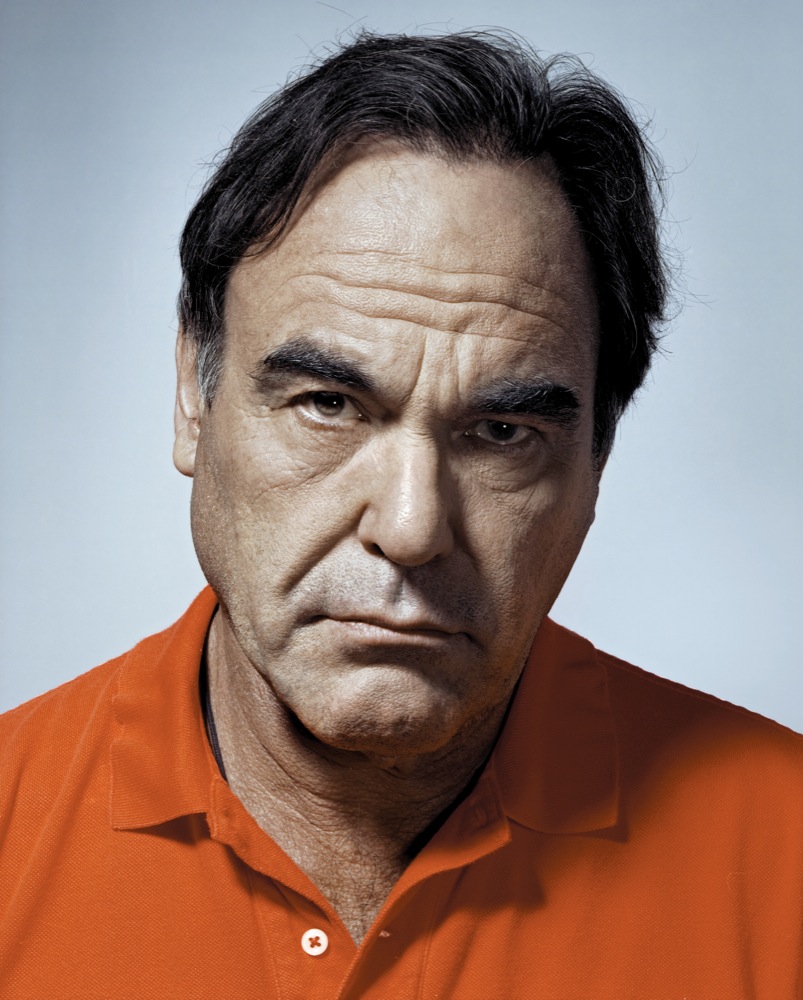
For many years, Oliver Stone tried to make a movie of The Fountainhead, Ayn Rand’s epic novel about the arrogant ur-capitalist and architect Howard Roark. Stone’s version would have reinvented Roark as a visionary designer of public buildings—maybe a guy like Fidel Castro or Hugo Chávez, two gifted egoists Stone has been known to pop a Fresca with. That’s interesting company for a born Republican and decorated Vietnam volunteer, though maybe not for the man who gave us Wall Street (1987) and Gordon Gekko, or who wrote Brian De Palma’s Scarface (1983).
Stone’s new film, W., is a biopic of George W. Bush that the director has scrambled to finance, shoot, edit, and release before the 2008 election. Surprising only to people unfamiliar with his work, Stone paints a politically excoriating but emotionally sympathetic portrait of our 43rd president. Josh Brolin stars in the title role, alongside Elizabeth Banks (Laura Bush), Jeffrey Wright (Colin Powell), Richard Dreyfuss (Dick Cheney), Thandie Newton (Condoleezza Rice), Scott Glenn (Donald Rumsfeld), and James Cromwell (George H. W. Bush). W. is Stone’s third crack at presidents or their legacies, following JFK (1991) and Nixon (1995). What could he possibly be thinking?
DAVITT SIGERSON: When I was first thinking about talking to you, lines from that Bob Dylan song “It’s Alright, Ma (I’m Only Bleeding)” came to mind: “If my thought-dreams could be seen/They’d probably put my head in a guillotine.” Do you ever feel like you’re running in a different time zone than the rest of the world?
OLIVER STONE: Why do you ask that question? Because I’m making a movie on George W. Bush?
DS: Well, no . . . We’ll get to that. But I have my own theories about why you freak people out so much.
OS: Oh, really? This is a great way to start. I like it. At least you’re honest. I would love to know your theory, if you can give me the short and sweet of it. It could help me frame my own life, I suppose.
DS: Well, I think this: You’re an impressive formalist, and you can be as grand or as vulgar as the material requires-for example, with the use of television and different film stocks in your movies. I also think that your films follow function because it seems you are, above all, a rabid moralist who is intent on saying what you’ve got to say. And I think that really freaks people out. People prefer a tasteful formalist to a rabid moralist. Even though you have elements of both in your work, I think that you . . . Well, I think you know what I think: that saying what you’ve got to say is the most important thing for you in your movies.
OS: Interesting. Very well said. I mean, I suppose in our culture—in our lifetime—we’ve always enjoyed people who tell it straight. We like our presidents, our comedians, and our actors to do that . . . It’s funny. You say that people prefer a tasteful formalism—as opposed to an oppressive formalism—but I do feel very strongly that form follows function. I really do. I’ve said repeatedly in many interviews over the years, “Look, the styles in my films have changed, and each film has a function at the time at which it was made.” But I don’t know that the point has really ever gotten across yet. I have skipped from style to style from film to film, and I love doing that because it’s given me the ability to free myself from the past. Perhaps one of the worst feelings that I can have is the feeling that I’m locked in, like a prisoner of myself, which is something we all feel at some point in our lives. So part of making those stylistic jumps is just to free myself up-to get away from the old or the old Oliver Stone. When I make a new movie, I always get stuck with, “That’s not an Oliver Stone film.” But I don’t know what to do about that except just move on. That’s why I was really happy to do W. It’s a chance to shrug it all off again. That’s the way I approached making the movie, and I know it’s one of the issues with its relationship to the other two presidential films I’ve made. But I’m leading you now-
DS: That’s all right. That’s good. I actually feel a lot of parallels between W. and Scarface.
OS: That’s interesting. Why is that?
DS: Well, let me disclose that I’ve seen a couple of versions of the script for W., and one of the things that struck me is that it seems you set off to make a film that is in many ways a very sympathetic understanding of George W. Bush. It’s certainly not a positive portrayal, but it definitely feels like you set out to get inside of him as a character and to understand him on his own terms—which is, I think, exactly what you did with Tony Montana in Scarface.
OS: That’s correct. It’s what I tried to do with Nixon, too.
DS: W. has that autumnal quality that Nixon had, but I also feel there are ways in which you and W. . . . For all the things that you and George W. Bush don’t have in common as people, there are some things that you do.
OS: Well, we both went to Yale, class of ’68. And although W. came from a much more powerful family, both of our families did have aspirations for us. I didn’t have the size of the family that he did-I don’t have brothers and sisters or a lot of cousins. We didn’t have boarders at our house or anything like that. But I did go to Yale and was raised Republican-Eisenhower Republican or Rockefeller Republican, I like saying. My dad was staunchly pro-Vietnam, and, you know, I believed everything I read in the media and saw on television in the ’50s and ’60s. I really did. And I watched the war in Vietnam unfold on that basis, without irony. I went as a volunteer.
DS: You requested combat duty.
OS: I requested infantry—I didn’t want to get fucked out of that. I didn’t want to end up in Germany or in South Korea or anything. And I got what I wanted. I got it in spades.
DS: Well, there’s a big difference between you and George W. Bush. You skipped out of Yale, and W. skipped out of Vietnam.
OS: I know. There are a lot of differences at that point—the fork in the road is huge. And I wish that George W. Bush had gone to Vietnam, because he would have seen history in a different light. He would’ve experienced it in a different light because I don’t think he understood the nature of war.
DS: But you do get us to like George W. Bush. There’s a scene, for example, where he drives up drunk after getting into Harvard Business School—
OS: Well, it goes beyond him being a kid. I, quite frankly, find him to be likable in the way that he’s a goofball president—it’s like having a bit of a goofball in the White House. I mean, people don’t like Richard Nixon. I found that out when Nixon came out—people just did not like the movie because they did not like the man. I think the movie is very well made, but there’s a thing about Nixon that turned people off: a dark side that Cheney also has. But in George W. Bush, there’s no evidence of a dark side that people see, and I think that’s fascinating about him. So people, of course, like him and trust him. As [Karl] Rove said, He’s a man you can have a beer with. And there’s an ineffable charm in that. Even my mother, who is a diehard-you know, she’s a Republican-and she’s seen what’s happened these last eight years, but she’s rigid about that. She said, “Don’t make a movie, Oliver, where you demean Bush or you hurt Bush.” And I was trying not to do that. I was trying to be, you know, fair is a tough word . . .
DS: Well, when it comes to hurting his cause, W. has already got the job covered, hasn’t he?
OS: Yes, George W. Bush speaks for himself. I mean, the fact that we haven’t had to make up words is the beauty of it. With Nixon, we had to reach inside and find some of that material-Nixon was very much a man behind closed doors. With Bush, you don’t have to reach very far. He’s put a lot of great, colorful stuff out there.
DS: I wanted to ask about that: One of the things about the movie that I found myself really enjoying is that the material is so familiar. I felt it was sort of like going to a Rolling Stones concert. They’re going to play “(I Can’t Get No) Satisfaction” and “Brown Sugar,” but you don’t know when. There is a reference that W. makes to his poppy, George H. W. Bush, throwing up in Japan . . .
OS: Yeah, there’s a lot of that going on, a lot of inside stuff.
DS: But the way you handled weaving in some element of the Rumsfeld “unknown unknowns” briefing from 2002 about evidence that Iraq was supplying terrorists with weapons of mass destruction . . . It makes up for the, perhaps, overfamiliarity of the story by providing all these little moments.
It’s possible that I was angrier when I was younger. I think a function of getting older is that you become more compassionate toward everybody, even people who dislike you.Oliver Stone
OS: One of the dangers about making a movie about a current president is that everyone thinks they know him. I think that people think they know a lot about George W. Bush—I mean, wherever I go, everyone has an opinion. But people don’t really know everything they need to know about him. They don’t know the history. They know how it all plays into the present, but they don’t think about it in terms of the whole span of his life and how his past contributed to what his thinking was at various points and how he allowed these certain things to happen. So by putting his life into a two-hour framework and dealing with some of the complexities of his time growing up and his youth-the first act-and then the second act, where he really had his greatness, I suppose, in the ’90s with the baseball team [Bush was part owner of the Texas Rangers from 1989 to 1998] and the Texas governorship, where he reached his level, so to speak . . . And then the third act becomes very interesting because this is the payoff: the seeds of the man now and the growth and the strength. This is the man who became stronger than his father and became president. So the movie really takes place at that point. The fulcrum is in 2001, after 9/11, and the movie is climactically about that 2001-to-2003 period. We didn’t go beyond the beginning of ’04—once he goes into Iraq, we know what happens. We didn’t want to go into the crumbling apart because we sort of know what’s happening now.
DS: You’re right. Especially around W.’s campaigns for the governorship of Texas, there are some key moments, like where he stands up to his poppy about the fact that he’s going to run. There’s also the conversation with Rove, where Rove says, “I’ll tell you what to say.” And W. says, “You’re the wordsmith, you give me the words, but I’ll tell you what we’re saying.”
OS: There’s also one of those defining moments when he tells Laura that his father lacks the decisive spirit of a decision maker. Stuff like that. We took dialogue from everywhere. We did sometimes put it into another context, but we tried to stay true to the feeling of it. In other words, like Rumsfeld’s line—”I know what I know and I know what I don’t know . . . ” He’s a great press conference guy, Rumsfeld, but we’re not showing him in a press conference, so our difficulty as dramatists is to get that stuff contextually into dialogue so that it makes sense. You have to do that as a dramatist-you have to have the people in front of you. I reread all the same research books—I think the book about Paul O’Neill by Ron Suskind [The Price of Loyalty: George W. Bush, the White House, and the Education of Paul O’Neill] was the first to break in 2004, and then Richard Clarke’s [Against All Enemies: Inside America’s War on Terror]. We read all those books, and they really started to change the picture of what was going on in the Bush administration. I really could not have made the movie in 2004, because we didn’t have the information. I mean, Bob Woodward penetrated a lot with his books, and there was also the other Suskind book, The One Percent Doctrine: Deep Inside America’s Pursuit of Its Enemies Since 9/11. We got a lot of that stuff into the movie, which was really tough to do. We put in a lot of rancorous disputes with Powell fighting with Cheney and Rumsfeld-there was sort of a triangle, and we went out on a limb in presenting that. Now I’ve been reading more and more that there were some big arguments behind the scenes, but that hasn’t really come out yet because Powell won’t write anything about it. Rumsfeld’s memoirs are coming, though I don’t think they’re going to be different than you’d expect—they’re going to be above it all, so to speak. But Powell did have some arguments. He did fight on behalf of his beliefs. All of these actors are great, by the way—Jeffrey Wright, who plays Powell, and Scott Glenn, who plays Rumsfeld. I can’t believe the humanity they brought to it.
DS: How did you handle presenting W.’s relationship with Laura? I really felt the truth of that couple. What did you do to get inside of that?
OS: There’s so little written on Laura-we read everything that we could, but then we had to go into the dialogue.
DS: That line, though, that’s in the film, “I read, I smoke, and I admire”-Laura Bush actually said that, didn’t she?
OS: I believe she said that in another context. Again, we have to deal with lines. If they said it to the press and we’re trying to fit it into a one-on-one situation, they won’t talk as they do sometimes to the public.
DS: There’s a moment of tremendous beauty in the script when W. and Laura are in London and Laura says, “Why don’t you go buy a suit?” And W. says, “The shoulders never fit.” That’s almost Death of a Salesman-like.
OS: “The shoulders never fit . . . ” I remember that line. It’s unfortunate that we didn’t shoot it.
DS: No?
OS: Yeah, I wrote the line. I don’t know if W. ever said that, though.
DS: Who cares?
OS: You liked that line?
DS: Oh, you’re fucking killing me.
OS: You have to recognize that this film was made -under Spartan conditions. Nobody in America wanted to make it, basically, except for one small company. And if it wasn’t for China and Australia and Germany, we wouldn’t even be talking about it right now. So thank God there’s a little diversity of thought in the world. But, you know, we made the film for $25 million, which is about 60 percent of what Nixon was made for, and we made W. in 46 days, which is amazing considering the amount of footage we got in that amount of time. Normally it would have been a 60- or a 70-day shoot, so I’m just saying that you have to let things go. You can’t fight for everything. So London is not in the film. I loved that scene, though, because I was in London when W. went through there [in 2003]. It was this remarkable moment in history, to just see an entire city closed down. They had to close down all of central London and keep everybody away from him. There were demonstrations. And the American media, again, did not really report it correctly.
DS: Well, obviously there was a hand behind that.
OS: Oh, yes. But that’s another movie, I suppose. In fact, I’m working on a documentary with Mark Weisbrot [the American economist and co-director of the Center for Economic and Policy Research in Washington, D.C.]. He’s very good with media subjects and the dirty tricks that go on.
DS: When I look at your three presidential pictures, it does feel that, as different as they are, you could almost weave them together into a sort of John Dos Passos-like triptych on American disappointment.
OS: Wow. I wrote a long essay on Dos Passos in high school.
DS: Did you really?
OS: Yes, I was a big fan of his. I was a Republican in school, and I remember liking Midcentury. I was very impressed with that. The style was unbelievable. He hasn’t been appreciated. He really got the workers, you know? When I was a young man, I thought, Wow, I’ve never read something like this. I really -understood what the Wobblies were about, the socialists . . . And I didn’t realize it at the time, but I identified with them. I had my own political framework, but the humanity of it got through to me. I remember the sex in those books-as a young man, reading those things under lightbulbs in dingy rooms. Farm girls and stuff.
DS: Let’s talk about Natural Born Killers [1994] for a minute.
OS: Sure.
DS: I understood that maybe Quentin Tarantino, who wrote the script, didn’t like what you did with it. I don’t know if that’s something you can talk about . . .
OS: Quentin never saw the film at that time, frankly—he admitted. Quentin and I have since spoken many times. You know, he was a young filmmaker. He was coming up, and there was a big dispute with him and two producers, Don Murphy and Jane Hamsher, who had he thought undermined him and gotten the rights. It’s a complicated story, but basically everything was done legally. And then I announced I was going to make the movie, and he was upset because it was his movie. But he had never expressed a desire to do it.
DS: So it was a business fight rather than one about interpretation.
OS: According to some, he never saw the movie-or he walked out of it 10 minutes in or whatever. But he just didn’t like the fact that I had changed his screenplay. Quite considerably-that was his issue.
DS: What’s funny about Natural Born Killers, having seen the film when it came out, was that there were things about it, like certain aspects of W., that seemed very familiar—the predatory newsmen characters, for example. Yet over time, between YouTube and Abu Ghraib, it has shown itself to be an unbelievably prescient movie. The main characters, Mickey and Mallory, have these roles as the self-cast stars in their own drama. That’s become the story of our world today.
OS: You know, I felt at the time that those characters in Natural Born Killers were archetypes that we should do big and broad and that we should make it a cartoon . . . This was the way the world was going. I put my feelings at the end of the movie very clearly. There was a run of things happening at the time making front-page news. It started roughly around the time of Tonya Harding and John Wayne Bobbitt’s penis being cut off and terminated with O.J. Simpson. It was just these three years in the media where all of this stuff was seeping onto the front page of The New York Times. It was ridiculous. It’s when the news became entertainment, I guess. Wasn’t it Laurence Tisch who started that up 10 years before, at CBS, when he said that the news -division was going to have to make money on its own? It was around ’86 when Tisch got a hold of CBS-and I say that because I remember it very clearly. It was a shock at the time. CBS never recovered.
DS: And now you get the pictures from Abu Ghraib, and it does look like a cartoon. I mean, it’s an indecent cartoon . . .
OS: Well, it’s been written about like a cartoon because it never went further than that. The media never invested in really following up. The hard news takes time—it’s not one-day stuff. It took years to bring that to the surface, you know? It took so much time. It took a lot of work. And even now more details are coming out. So hard news takes time. It takes a nonprofit sensibility.
DS: I was reading something, I think around the time all of these Abu Ghraib pictures first came to light, about why the people were smiling in the pictures. There’s an amazing Weegee [Arthur Fellig] photograph called Their First Murder. It was taken on a street in New York City. It’s of all these people standing around [an out-of-frame] dead body, and there is one kid looking up and smiling straight into the camera-because that’s what you do when there’s a camera, right?
OS: Well, we have pictures like that from Vietnam, snapshots of people standing over bodies. It’s that white-hunter thing. It’s part of the human instinct, the death ray that we all have—that dark side in every single person. Even Mr. Bush. If anybody is a walking optimist, it’s George W. Bush, but even he must have a dark side. I think we took a few shots at exploring this idea of who he is toward the end of the film. It does come out—Josh Brolin did an extraordinary job of bringing that to the surface.
DS: Back to Scarface: Tony Montana is an ultimate example of a character who you’re totally blatant about as a writer in terms of your moral judgment of him. And yet you show him so purely that he has become a kind of ultimate folk hero. Did that surprise you? Or was that part of your goal?
OS: There was an impulse in that direction. I think Mickey and Mallory in Natural Born Killers are the same thing. I remember what happened in Scarface vividly because I did most of the research in Miami and in Fort Lauderdale and the Caribbean-there were just guys like that around. They were obviously not as big as Tony was, but there had been some chain saw murders, as you know, and the AK-47 had been introduced into the streets of Miami for the first time in around 1981. As a dramatist, you could imagine where things were going to go because the DEA [Drug Enforcement Administration] was getting into the war on drugs down there big time-but they had no idea of the amount of money that was involved. They had no idea. I remember that the first estimates were in the $100 million range. It’s that big, you know? But little did we know that really, if you go back now and check Pablo Escobar and all that, the take was even bigger. It was probably in the billions.
DS: But what happened with the Tony Montana character afterward was like how Macbeth became a hero for Scotsmen.
OS: Yeah, well, I could say I was amazed. It did take off right away on the street. The black and Spanish communities really took to the picture, and they made a hero of the guy. I don’t think he was one. I think Al [Pacino] played him as an antihero, as a Brechtian character. Arturo Ui was really my influence in that, but it’s amazing . . . The same thing happened in Wall Street. Gordon Gekko was the antihero of the picture.
DS: You told me about the documentary that you’re doing with Mark Weisbrot, but what is the subject of the other one you are currently working on?
OS: It’s a secret. I’ve been working on it for a year. I’ve self-financed it up to today. It’s another one of those tough ones to get made.
DS: And then what’s next after that? Do you know?
OS: No, I really don’t. I wrote an original, which is a smaller film, but it’s really important to me and hopefully-maybe-I’ll get a chance to make it. The market has changed so much, and the business in the last 10 years—it’s gone, the way I know it. I’ve been operating on the edges since Nixon. I’ve been independent, except a couple of times when I went back and worked for studios under completely different circumstances than I had before. It’s just that the risk factor in making a film has become so enormous. The corporations have become bigger. The accounting mentality is completely dominating the business. So people like me-and directors in general-are kind of like a thing of the past.
DS: This can be a function of aging, but do you think you’re less angry than you once were? Because I think it would have been pretty fair to characterize you as an angry guy. Whenever I see pictures of you, you have these puffy eyes, and I always think, Oh, he’s been crying tears of rage his whole life.
OS: [laughs] Oh, really? It’s possible that I was angrier when I was younger. I think a function of getting older is that you figure out more and you become more compassionate toward everybody, even people who dislike you. I don’t think it’s an issue of what’s fair—I think that compassion is the key because in a movie, you have to relate to the person you’re telling the story about. Even if it’s Richard III or Henry VIII or Macbeth, you have to relate to that person. And that’s been part of my learning curve, too.